






Weekly Editors' Picks Weekly Editors' Picks (0506-0512)


"Weekly Editor's Picks" is a "functional" column of Odaily. On the basis of covering a large amount of real-time information every week, a lot of high-quality in-depth analysis content will also be released, but they may be hidden in the information flow and hot news, and pass you by.
Therefore, every Saturday, our editorial department will select some high-quality articles that are worth spending time reading and collecting from the content published in the past 7 days. You bring new inspiration.
secondary title
invest
LSDfi - Protocol layer on top of LSD (unshETH, Stader Labs, StaFi Protocol, Pendle), DEXs wars (Chronos, Trader Joe, Curve, Camelot), RWA (Polytrade, Centrifuge), decentralized stablecoins (Curve, Frax) , yield wars (Pendle, IPOR, Flashstake), decentralized leveraged exchanges (GMX, MUX Protocol, Level Finance).
30 Trading Tips From Crypto Short Selling Master GCR
secondary title
start a business
To quote some words from UniSat founder Lorenzo:
We have been working in full swing, delivering a series of products non-stop, and we have never felt this "low tide" at all. On the contrary, when there is not much attention from the outside world, there are still many new ideas emerging in the community. BRC-20 is just one of them, and some innovations have not come out. This is also very reasonable for a rapidly developing community.
The most difficult part of developing the BRC-20 transaction process is the design trade-off.
The starting point for the design of the deployment royalties is very simple. It hopes to motivate the Deployer to participate in the operation and become an active and effective network node. The benefit to the deployer is indeed to stimulate everyone's enthusiasm for participation. However, recently we have also continued to hear users objecting to the design of the royalty, saying that the deployer is just preoccupied with a good name. Such an opinion is not unreasonable.
The analysis of the index is a very important part of the whole ecology. If we open it in time, all developers can have a default reference, which can save everyone's time and eliminate potential differences to the greatest extent.
secondary title
Meme
Meme players must see: four steps to help you quickly find the next PEPE
Investing in meme coins must be viewed as a gamble.
Steps to find a meme and increase your edge: monitor coins, verify meme culture of coins, research fundamentals, follow smart money.
In addition, remember not to allocate too much funds, use a separate wallet, use technical analysis, pay out the principal after doubling, and use the indicator combination to find the top in advance.
PEPE skyrockets, who will be the next meme king?
A combing introduction.
The typical gameplay of meme coin/Dogcoin includes well-known meme derivative coins (PEPE, WOJAK, CHAD, POGAI), airdrop hype (AIDOGE, MONG) and social experiment/CX (CLIPS, RG).
Recreating the rich myth, this article reveals the NFT forces behind PEPE
For MEME to be successful, it must not only have a story, but also have a big brother. What can be confirmed at present is that the NFT community and the Chinese power in Dubai bought PEPE together in the early stage, which became the key driving force for the early growth of PEPE. By analyzing the holding addresses of a large number of PEPE in the head, it is found that a large number of early buyers hold a kind of NFT - Milady.
secondary title
Bitcoin ecology
A basic introduction to BRC 20.
The Ordinals protocol assigns a unique number and note to each Satoshi, realizing the uniqueness, irreplaceability and on-chain records of Satoshi.
BRC-NFT refers to non-fungible tokens stored on the Bitcoin blockchain, which can store some small, immutable data, and the stored data will be permanently stored on the chain.
The BRC-20 token standard allows users to implement the deployment and management of token contracts in the form of inscriptions on the Bitcoin network, and then realize the minting and transfer of tokens.
Controversy creates consensus, and serious prejudice leaves behind information cocoons. BRC-20 has a strong story, and the narrative is not single, which brings new opportunities for miners, exchanges and project parties. BRC-20 has a new narrative of returning to the original intention, differentiated competition with ETH, and low education costs.
The essence and original intention of the blockchain are only two points, low-cost trust + the freest freedom. Meme is an experiment, and cryptocurrency is also an experiment. The strong consensus is always criticized, and it is only by trying new opportunities that unexpected gains can be made.
DeFi
Foresight Ventures: Changes and Development of the DEX Paradigm
AMM and RFQ (request for quotation) realize the efficient use of funds from two perspectives, the former through combination, and the latter through high turnover. At present, the reuse of funds through composability seems to have reached the end of leverage, and AMM DEX has begun to make a fuss from the perspective of improving capital turnover. At this time, the RFQ model representing high capital utilization is put on the table again , The focus of the narrative is still the issue of capital utilization.
Core Pools has changed Balancer's income structure, adding income from external interest-earning assets as a source of Balancer system income. Compared with other veToken-based DEXs, it is more conducive to reducing the debt of the entire system.
At present, there are two forms of liquidity incentives and bribery on the chain, one is incentives about the depth of LP liquidity, and the other is price-related, liquidity incentives about a specific price range.
DEX also has some interesting small innovations, such as Crocswap’s mechanism for automatically adjusting swap rates based on transaction volume, Cowswap’s anti-MEV Batch Auction, Cow Protocol’s Coincidence of Wants protocol, and the anti-MEV rabbit hole function launched by 1inch and Metamask. These small innovations of DEX are tools that users can choose to use when executing swap.
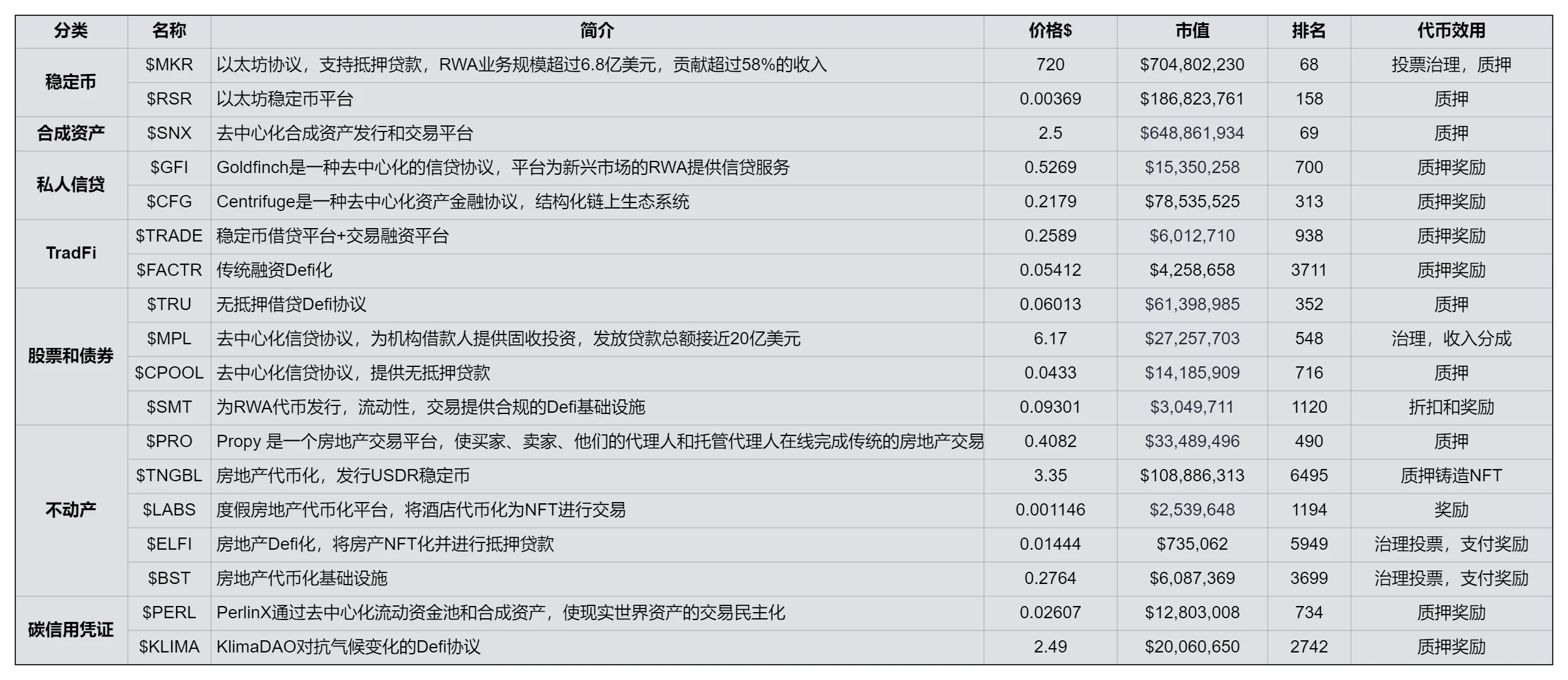
RWA Track Project
The article introduces Ondo Finance, Matrixdock, TProtocol, OpenEden, Ribbon Finance in detail.
NFT, GameFi and Metaverse
In-depth interpretation of NFT MEV: new opportunities in NFT transactions
NFT MEV is an emerging way. Although there are some risks in making money, its greatest value lies in the fact that searchers (that is, arbitrage robots) run algorithms on blockchain data to detect MEVs with profitable opportunities and automatically Extract to the web) provides more opportunities.
The NFT market is capitalized due to frequent mint events, the secondary trading volume is low, bidding liquidity is challenging, and there is a large off-exchange order book. The shape of the NFT MEV market is also different, with fewer arbitrage opportunities, but more MEV can be withdrawn during mint. In addition, there are some unique forms of MEV in the NFT market, such as clearing the bidding wall and re-listing (artificially creating trading volume leads to arbitrage space), Trait Sniping, and withdrawal from idle pending orders.
As a more mature market, the DeFi market offers some useful implications, such as the need for MEV-aware minting solutions, more open pricing data, dynamic on-chain order books, experimenting with new auction formats, and providing traders with additional communication channel.
With NFTs as a vehicle to represent everything from on-chain art to tickets, affiliate links, IP licenses, property ownership, we think we'll see more MEVs emerge. NFTs have many possibilities, are a great way to bring outside capital into the crypto ecosystem, and the design space is open. However, in the early stages of any market, there will always be inefficiencies.
Ethereum and scaling
Cancun upgrade will be a turning point for Ethereum L2
In the upcoming Cancun upgrade, Ethereum will usher in major changes, which will increase the speed of Ethereum Layer 2 by 10x, and even have the opportunity to increase by 100 times with lower costs. L2 projects that may benefit are Arbitrum and Optimism, Boba and Metis, Loopring, Immutable, dYdX, Polygon, SHIB and CULT.
MEV-Burn is just one part of the Ethereum roadmap that directly addresses MEV issues. The solution returns MEV to ETH holders by burning the value currently being extracted by MEV participants. This amounts to an indirect redistribution of value to ETH holders, making the asset more scarce and reducing selling pressure on block validators. A secondary goal of MEV-Burn is to reduce chain instability by equalizing MEV profits for block builders.
After completing the PBS, block proposers will no longer be able to determine which transactions are more valuable. Proposers have no choice but to submit “neutral” fee bids for block builders for the blocks they assemble. This market process will exist entirely on-chain, rather than the off-chain market powered by Flashbot's third-party MEV-Boost software today.
Steady MEV profits also mean getting block validators to redirect capital to staking, especially as issuance rewards increase in a bull market. This expands the economic bandwidth of ETH and preserves capital for dapp collateral such as decentralized stablecoin collateral, lending, other forms of collateral, etc.
Like many Ethereum proposals, MEV-Burn will not be ready anytime soon, but is looking at a 3-5 year timeframe.
Although MEV brings huge profits, these benefits mainly flow to MEV searchers and block builders, while Ethereum users, wallets and DApps cannot share these benefits.
In order to solve this problem, the Ethereum infrastructure service Flashbots recently launched a beta version of the MEV-Share protocol, which aims to distribute a part of the MEV revenue to users of the Ethereum ecosystem to achieve an open and fair distribution of revenue. The MEV-Share win-win model solves the problem of traders being "caught".
The introduction of the MEV-Share protocol will have the following major impacts on the Ethereum ecosystem: improving the efficiency and fairness of transactions, reducing the impact of MEV, enhancing the benefits and participation of ordinary users, and promoting innovation in the Ethereum ecosystem. Improve the overall competitiveness of the Ethereum network.
The Complete Guide to Rollup Sorters: Concepts, Status, and Shared Sorting
The sequencer is to set the Rollup history and then watch it go to the destined state.
There isn't much difference between Optimism and Arbitrum, but there are security differences between the two.
secondary title
hot spots of the week
In the past week,Total BRC-20 Token Market Cap Exceeds $1 Billion,BTC miner fee income increased by 24.5 times compared with 2 months ago,Voyager Digital plans to liquidate assets and gradually close operations, with creditors expecting to recover only 36% of its assets,DEI, a stablecoin launched by DEUS, was hacked,ParaSpace "infighting";
In addition, in terms of policies and macro markets, informed sources:U.S. Democrats support SEC's crypto regulation, arguing that almost all cryptocurrencies are securities,SEC Issues New Subpoena to Bitcoin Miner Marathon, is being investigated for violations of securities laws,Biden Calls for End to Tax Loophole Favoring "High Net Worth Crypto Investors", the Fed reports:There are a lot of liquidity risks in the financial market, and stablecoins are still vulnerable to runs;
In terms of opinions and voices, Arkham:The U.S. government now has more than $6 billion worth of bitcoin in custody on-chain;
Institutions, large companies and top projects,Digital Asset will launch global blockchain network Canton Network with Goldman Sachs, Deloitte and others,Circle Rebalances USDC Reserve Portfolio to Avoid Risk of U.S. Debt Default, the latest ACDE conference on Ethereum: focus on discussing EIP-4844,The next meeting or two is expected to determine the scope of the Cancun upgrade...well, another week of ups and downs.
With "Editor's Picks of the Week" seriesPortal。
See you next time~





