OpenAI 與 Anthropic 的 IPO 對決:兆元估值、價格戰與中國開源轉向


- 核心觀點:AI 行業正面臨關鍵轉折點:前沿模型 IPO 估值超高但 ROI 存疑,token 成本激增而生產力提升有限;中國 AI 策略由開源轉向閉源,而美國政策一致強調對華技術領先;同時,一種創新的全民投資計劃 Trump Accounts 上線,重塑個人財富積累模式。
- 關鍵要素:
- Anthropic 與 OpenAI 正衝刺 IPO,前者傳聞年營收或超 1000 億美元,估值可達 3 兆美元,但投資人 Chamath 警告 token 成本每 45 天翻倍,下游生產力提升僅 5%。
- Chamath 分析標普 493 公司(剔除七大科技巨頭)的 EPS 增長僅為 9%,其中大部分由定價權和回購驅動,真正可歸因於 AI 的 ROI 介於 0% 到 2% 之間。
- 儘管企業希望轉向低成本開源模型以控制成本,但多數缺乏技術能力,導致閉源模型在企業支出份額從 19% 上升至 11%。
- 中國正考慮限制海外存取其頂級 AI 模型,策略與 OpenAI 類似:追趕上之前開源,追趕上之後閉源,以捕獲全部價值。
- 美國華盛頓在 AI 監管上達成絕對共識:不惜一切代價在 AI 領域領先中國,並將打擊模型蒸餾行為,因中國模型 GLM-5.2 被發現含有美國前沿模型的水印。
- Trump Accounts 計劃已上線,為每個美國新生兒提供 1000 美元標普 500 投資帳戶,24 小時內開設 150 萬個帳戶,吸納超 10 億美元存款。
- 該計劃允許每年存入 5000 美元並享受 18 年免稅複利,Sacks 測算若存滿,孩子到 28 歲可成為百萬富翁,長期有望替代社會保障體系。
Organized & Compiled: Odaily TechFlow
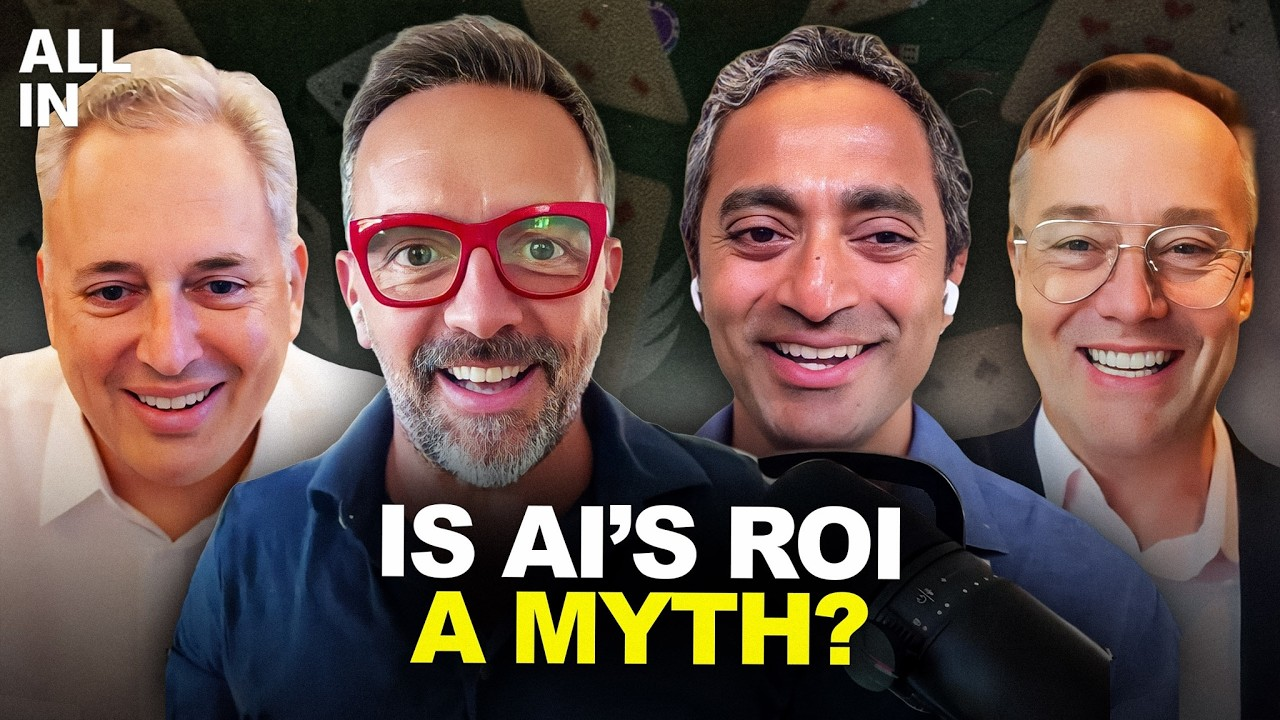
Guests: Chamath Palihapitiya (Founder of Social Capital), Brad Gerstner (Founder & CEO of Altimeter Capital), David Sacks (Partner at Craft Ventures)
Host: Jason Calacanis, All-In Podcast
Podcast Source: All-In Podcast
Original Title: OpenAI vs Anthropic IPOs, Anthropic $3T, Zuck's Price War, China Ends Open Source?, Trump Accounts
Air Date: July 11, 2026
Key Takeaways
This episode of All-In, #280, saw Friedberg on vacation with Brad Gerstner filling in. The show kicked off with a trillion-dollar IPO race: SpaceX had already gone public successfully at a $1.75 trillion valuation, Anthropic had filed confidentially on June 1st, with OpenAI following closely. Gavin Baker predicted Anthropic's annual revenue could exceed $100 billion this year, with a potential IPO valuation of $3 trillion. Brad didn't hesitate, saying Altimeter would be a major buyer in the IPOs of both companies.
But Chamath poured cold water on the enthusiasm. He found his company's token costs were doubling every 45 days, while downstream productivity gains were at most 5%. He asked Claude 5 a question: How much EPS growth has AI contributed to the S&P 500? The answer was 50%. But stripping out Nvidia selling chips to Amazon, the actual EPS growth for the S&P 493 was only 9%, mostly driven by pricing power above inflation and buybacks. The real AI ROI was between 0% and 2%. Chamath's judgment: if you can go public now, do it now, before these numbers seep into the market's consciousness.
The second half turned to China. Reuters reported that the CCP is considering restricting overseas access to China's top AI models, classifying AI research leaks as a national security crime. Sacks discussed this in Washington with the White House and Treasury. His assessment: China's strategy is the same as Sam Altman's years ago – open-source while catching up, then close-source once you've caught up. He also revealed that GLM-5.2 contains distillation watermarks from US frontier models, and the US government will likely act against distillation. The show concluded with Brad spending nearly an hour discussing Trump Accounts, a plan giving $1,000 to every newborn American, invested in the S&P 500. The app saw 1.5 million accounts opened in its first 24 hours, attracting over $1 billion in deposits.
Highlights of Key Insights
On IPO Timing
- Chamath: "If you can go public now, go now, before these numbers seep into the market's waterline. Because I think that's your window to get a high price and raise a huge amount of money."
- Brad: "Today, Altimeter would buy both these IPOs at scale and size."
- Brad: "Anthropic's annualized revenue could exceed $100 billion, while SpaceX's forward revenue is $35 billion. Based on SpaceX's success, this will be a phenomenal IPO."
On AI ROI
- Chamath: "My token costs double every 45 days, and downstream productivity gains are at most 5%. My costs are doubling, but benefits are essentially flat."
- Chamath: "EPS growth for the S&P 493 is 9%, with the vast majority coming from pricing power above inflation, and another 3% from buybacks. The real AI ROI is between 0% and 2%."
- Brad: "We've never seen revenue growth like this because we've never seen a TAM this large. Intelligence is the largest addressable market in human history."
On Open Source vs. Closed Source
- Sacks: "The spirit of enterprises is willing, but the flesh is weak. They want to move away from closed-source models but can't."
- Sacks: "Open source's share of enterprise spending is actually declining, from 19% last year down to 11% this year."
- Brad: "Whether you use a $3 cheap model or a $15 frontier model to replace a $200-per-hour consultant, that cost difference is irrelevant."
On China's Open Source Pivot
- Sacks: "China's strategy is clear: open-source when you're catching up, then close-source once you've caught up. Sam Altman did the exact same thing three years ago."
- Sacks: "GLM-5.2 contains distillation watermarks from Mythos. The US government will act against distillation, and rightfully so."
- Chamath: "The best thing for the US would be for an 'doomer' community to emerge in China too."
On Trump Accounts
- Brad: "If you get $1,000 at birth, someone matches some, and you save $10 a week, by age 18 you have $50,000. All invested in the S&P 500."
- Sacks: "If a Trump Account is maxed out from the start, based on the market returns of the past 30 years, that child would be a millionaire by age 28."
- Jason: "This could replace Social Security. It replaces the Giving Pledge."
Body
Chapter 1: The Trillion-Dollar IPO Race: SpaceX Sets the Stage, OpenAI and Anthropic Ready to Take the Floor
Jason: Let's start with the IPO update. A trillion-dollar IPO sprint is underway. SpaceX has gone public and is trading around its offering price. The pricing was perfect. Theoretically, two more are coming: OpenAI and Anthropic. SpaceX's stock once hit $200, now back to $150, right at the offer price. Current market cap is $2 trillion, the seventh-largest company globally. Anthropic filed confidentially on June 1st, Polymarket gives it a 65% chance of IPOing this year. Gavin Baker said two weeks ago he believes Anthropic's revenue will exceed $100 billion by year-end and be profitable, implying a $3 trillion valuation if it listed now. Chamath, you said earlier that Elon going public first was a good move. What's the probability these two come out this year or Q1 next year?
Chamath believes both are fantastic businesses, but the core question is where the market clearing price is. It depends more on the market's appetite for new issuance and at what price it can be absorbed.
OpenAI and Anthropic are at different stages. OpenAI's last disclosed information showed high cash burn due to its diverse business and reliance on consumer spending. Brad mentioned earlier that Anthropic might have unexpectedly become profitable. Chamath shared a detail: he asked his CTO about token spending, who said "currently doubling every 45 days." When asked about downstream productivity gains, the CTO said "at most 5%." Costs are doubling, benefits are flat. The CTO explained that achieving the next iteration improvement requires exponentially more tokens due to diminishing returns.
Chamath's judgment: if you can go public now, do it now, before these numbers seep into market perception. This is likely the window to raise huge money at a high price.
Brad, an investor in both companies, offered a more optimistic view. SpaceX's IPO was textbook: raising $75 billion at a $1.75 trillion valuation, forward revenue around $35 billion, stock already up 25%. Anthropic's revenue is rumored to potentially exceed $100 billion this year. If true, next year's GAAP revenue could be much higher. Based on SpaceX's successful precedent, Brad believes this will be a phenomenal IPO. SpaceX set a precedent in total IPO size, pricing, liquidity, index inclusion, and lock-up arrangements, which both Anthropic and OpenAI are learning from.
Regarding the controversy over index inclusion, Brad explained existing rules existed for a reason (newer companies, less revenue, weaker profitability). But SpaceX is too big and important not to be included. Exchanges and index companies adjusted, avoiding stuffing it in at the peak, preventing the common 30% post-IPO drawdown from hurting passive investors.
Brad also shared the latest on OpenAI: revenue has recovered to about $70 billion this year, with GPT-6 potentially launching within 30 days. While only twice SpaceX's revenue and less than Anthropic's rumored $100 billion, as one of the two leading labs, growing at this pace makes a trillion-dollar valuation reasonable. He doesn't see a race between them; both will act when the time is right. OpenAI's corporate structure restructuring is more complex, so it might go after Anthropic.
Chapter 2: Token Costs Doubling Every 45 Days, AI ROI Near Zero?
Jason: We've been discussing the ROI of token spending for weeks. CTOs and CEOs in the industry are starting to respond publicly on X. Uber's CTO Pinen shared their approach: 99% of engineers use AI tools, over 70% of pull requests come from local or cloud agents, and engineers have built 200 agentic skills. They deploy engineers to various departments as "forward-deployed engineers" to map processes with department heads. Brad, what do you think of Uber's approach?
Brad agreed with Chamath's point, noting it's just a matter of time frame. Currently, a lot of money is spent in experimental buckets, possibly without direct ROI. But enterprise AI adoption is still too early. The addressable market is every company on earth, larger than ever. Revenue distribution isn't concentrated either; millions of customers make independent rational decisions daily.
Brad made a bold prediction: if Anthropic's revenue exceeds $100 billion by year-end, they could multiply revenue 3-5 times next year. Going from $100 billion to $300 billion in incremental revenue is unimaginable in Silicon Valley history.
Chamath's skepticism centered on the sustainability of ROI. He asked Claude 5 two questions. First: How much EPS growth has AI contributed to the S&P 500? The answer was 50%. But he found this included Nvidia selling chips to Amazon. So he asked a second question: What's the EPS growth for the S&P 493 (excluding the Magnificent 7)? The answer was 9%. Breaking it down, the vast majority came from pricing power above inflation, with another 3% from buybacks. The truly attributable AI ROI was between 0% and 2%.
Chamath argued the enterprise side looks glamorous, but the problem is that smart investors like Brad and Gavin will eventually ask companies: What's your ROI? Where's the actual EPS improvement? If the answer is "I'm not sure," and you lack sustained pricing power, the enterprise side becomes fragile. The consumer side, conversely, acts as a safe haven because with tens of millions of buyers at much smaller price points, the two orders of magnitude difference in buyer count shields you from ROI scrutiny.
Jason added a perspective: this technology's uniqueness is its pervasiveness across every person in an organization. When Excel came out, the accounting department was excited, but HR and marketing barely noticed. AI is different – in a thousand-person organization, everyone uses it. Each person spends $200/month, doubling to $400, which is only a 3-4% increase relative to a $150k salary. The key question: does it make this person 3-5 times more efficient? If so, that explains why token spending is booming.
Chapter 3: Open Source vs. Closed Source: Revenue Concentrates on Frontier, But Enterprises Want Out
Jason: Sacks, CTOs are starting to discuss intelligent routing on X: first send tasks to open-source models, fallback to Claude if they can't handle it. How do you see this trend? As an investor, when the CFO of a frontier model starts asking "can we get a cheaper price?", how do you view frontier model growth?
Sacks believes enterprise CTOs indeed want to shift token consumption to cheaper models. They watch token costs skyrocket and are looking for ways to brake or at least control spending. Add to that last week's discussion on AI sovereignty – enterprises fear giving core alpha to a frontier lab that might become a competitor.
Sacks's core judgment: enterprises want to move away from closed-source models, but most lack the technical capability. The spirit is willing, but the flesh is weak.
Coinbase and DoorDash succeeded by building token routing middleware, sending frontier tasks to frontier models and non-frontier tasks to cheaper ones. But typical enterprises lack this capability. That's why closed-source wallet share is actually increasing. Open source's share of enterprise spending dropped from 19% last year to 11% this year. Of course, this doesn't mean usage is declining – open source users only pay hosting fees, not to labs, making tracking difficult.
Sacks also cited Decagon's founder: when you know exactly what to do, small, cheap open-source models are fine, but you need data and post-training. If you don't know what to do yet, you want the most powerful general intelligence. Mature use cases use open source; immature ones use frontier models.
Jason brought up Databricks founder Ali's finding: using a different harness (task orchestration framework) with the same model can halve costs. GLM-5.2 paired with a specific harness performs excellently, halving task volume. Jason himself experienced: running a trend-spotting agent hourly, optimization reduced token consumption by 80%. With cheaper tokens, he switched from daily to hourly runs and split the single agent into three parallel tasks. Waking up to find 14 tasks completed felt entirely different.
Brad's take: the core debate is whether intelligence will converge. 18 months ago, during the DeepSeek moment, the market dropped 40%. Many thought frontier models were finished, that open source would kill them. But 18 months later, the opposite is true. Jesse Zang's tweet pointed out that frontier lab wallet share is actually rising, even as token usage grows on both sides.
Brad proposed a counterintuitive hypothesis: maybe intelligence won't converge. If superintelligence becomes self-recursive – smarter models make more money, buy more compute, build better models – the gap might not be shrinking but widening over the next 2-3 years.
Jason also mentioned interviewing Lovable's CEO Anton: the product launched ~30 months ago, revenue went from zero to $600 million. He also asked 11Labs CEO Matti: you're a frontier model's big client spending tens of millions annually, aren't you worried about data leakage and competition? Both said they're developing their own models. These are eight- and nine-figure clients. If they start building vertical models, frontier labs will feel pressure. But Chamath countered: 11Labs wants the best voice agent. If the best voice capability comes from a frontier lab, can they afford using a suboptimal in-house model in a competitive market?
Chapter 4: Zuck Launches a Price War: Same Quality, One-Hundredth the Cost
Jason: Meta released Spark 1.1 this week, a strong agentic encoding model at a very low price