MiCA過渡期結束,牌照短缺,歐洲迎來最大規模交易所清退


- 核心觀點:歐盟《加密資產市場法規》(MiCA)過渡寬限期於2026年7月1日結束,導致約75%的舊有加密服務商失去合法營運資格,幣安、MEXC等頭部交易所被迫撤出或暫停服務,穩定幣市場完成洗牌,USDT退出,USDC成為主流。
- 關鍵要素:
- 截至2026年5月,僅約194家加密企業獲得正式MiCA授權,而此前歐盟境內註冊或營運的加密服務商估計在1,100至3,000家以上。
- Coinbase、Kraken、OKX、Bybit等頭部交易所已提前獲得MiCA牌照,可透過「護照通行」機制服務全歐盟市場。
- 幣安因監管機構對其治理架構存有顧慮而撤回申請,暫時退出歐洲市場,預計未來數月內重新提交。
- Tether的USDT因不符合MiCA儲備要求被主要平台下架,Circle的USDC和EURC獲授權,市值升至約750億美元。
- 約60%的歐洲加密用戶仍在未授權平台交易,歐洲證券和市場管理局(ESMA)要求未授權平台執行「有序關停」。
Original|Odaily(@OdailyChina)
Author|jk
On July 1, 2026, the transitional grace period for the EU's Markets in Crypto-Assets Regulation (MiCA) officially ended.
From this day forward, any institution providing crypto asset services to users within the EU must, without exception, hold a formal MiCA license. Unlicensed operators are prohibited from accepting new deposits or conducting new business. The French regulator AMF explicitly warned that illegal operations could result in up to two years imprisonment and a fine of €30,000. Regulators also retain the enforcement power to publish blacklists and apply for website blocking.
As of May 2026, approximately 194 crypto firms had obtained formal MiCA authorization within the EU. In contrast, the number of crypto service providers previously registered or operating under various European national regimes was estimated to be between 1,100 and over 3,000. Law firm Hogan Lovells estimates that about 75% of the old platforms will lose their legal qualification to operate after the grace period ends. Exchanges that cannot be used without authorization include Binance, MEXC, among others.
What kind of regulatory test will this be for exchanges? What do the details in MiCA say? Which exchanges will no longer be accessible? What actions do users need to take? Odaily will provide a detailed interpretation.
What is MiCA?
MiCA is the first comprehensive regulatory framework for the crypto asset market in EU history. It officially came into effect in 2023, covering all 27 EU member states plus three EEA member states: Norway, Iceland, and Liechtenstein.
Before the implementation of MiCA, the regulation of crypto firms across Europe was highly fragmented. The same exchange needed to register with financial regulators in Germany, obtained France's PSAN license, etc. The thresholds and enforcement levels varied significantly between countries. MiCA's goal is precisely to replace this fragmentation with a unified set of rules, a typical policy-making approach for the EU.
As a comprehensive regulatory framework, MiCA covers a wide range. Any institution providing crypto asset-related services to clients within the EU, collectively referred to as "Crypto Asset Service Providers" (CASPs), must apply for authorization from national regulators and clearly specify the categories of services they offer.
MiCA divides CASP services into ten major categories, including: operating a trading platform (order matching), custody and administration of crypto assets, exchange of crypto assets, execution of orders on behalf of clients, portfolio management, advisory services, etc. A single MiCA license only covers the categories specified in the application. If an exchange wants to offer matching, custody, and transfer services simultaneously, it needs authorization covering multiple service categories.
MiCA also establishes a specific sub-framework for stablecoins. Stablecoins pegged to fiat currency and those pegged to a basket of assets must meet separate issuance authorization and reserve requirements. Issuers exceeding a certain scale threshold face stricter regulatory constraints.
Furthermore, MiCA introduces a "Passporting" mechanism: similar to how an EU passport holder can live and work in any member state, a firm obtaining a MiCA license in any EU member state can extend its services to other member states through a notification process, without needing to re-apply in each country.
Different Transition Periods?
MiCA's stablecoin rules took effect first in June 2024, while the CASP provisions officially came into effect at the end of December 2024. To accommodate crypto firms already registered or operating in individual member states, MiCA set a transitional grace period. Each member state could decide its own grace period length, with a maximum of 18 months, meaning the final deadline was July 1, 2026.
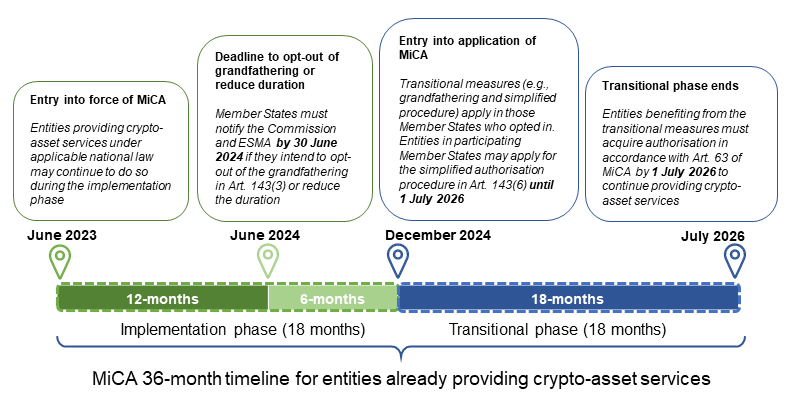
The core logic of the grace period was to give platforms operating under national regimes time to complete the MiCA application and approval process while continuing operations.
The handling of the grace period varied by country. The Netherlands terminated its grace period early on July 1, 2025, forcing some local exchanges to complete licensing ahead of time. Germany shortened its grace period to the end of December 2025, using this to pressure applicants and speed up approval. When Lithuania's transition period ended, over 240 crypto firms registered locally closed down. By June 2026, 20 out of the 27 EU member states had ended their national transition periods before the final July 1 deadline.
On April 17, 2026, the European Securities and Markets Authority (ESMA) issued a formal statement confirming July 1 as the final deadline, with no further extensions. For CASPs not yet authorized by the deadline, ESMA requires an "orderly wind-down": stop accepting new deposits, stop initiating new business, transfer existing user assets to licensed platforms, or assist users in moving assets to self-custodial wallets.
According to a report from Crypto News citing institutional data, as of May 2026, only about 194 crypto firms had received formal MiCA authorization within the EU. Previously, the estimated number of crypto service providers registered or operating under various national regimes in Europe ranged from 1,100 to over 3,000. Hogan Lovells estimates that about 75% of platforms operating under the old registration systems will lose their legal operational status after the grace period.
How Did Major Exchanges Respond?
Platforms that Completed Licensing Early
- Coinbase x Luxembourg: In June 2025, the Luxembourg Financial Supervisory Authority (CSSF) granted a MiCA license to Coinbase's European subsidiary, consolidating several local licenses previously held in Ireland, Germany, France, Italy, Netherlands, Spain, etc. Luxembourg now serves as the single EU licensed hub, serving the whole EU via the passporting mechanism.
- Kraken x Ireland: Kraken obtained CASP authorization from the Central Bank of Ireland, while also holding a Luxembourg entity and a MiFID derivatives license.
- OKX x Malta: OKX was the first major exchange globally to receive MiCA authorization, licensed by the Malta Financial Services Authority (MFSA), operating across the EU from Malta.
- Bybit x Austria: Received authorization from the Austrian Financial Market Authority (FMA) on May 28, 2025, with its EU headquarters in Vienna, serving 29 EEA member states.
- Crypto.com obtained a full license in Malta on January 27, 2025, and Gemini followed suit in Malta in August of the same year. Bitstamp also chose Luxembourg, completing CSSF authorization in May 2025 (now under Robinhood). eToro holds the CySEC license in Cyprus, while Robinhood registered in Lithuania.
Platforms with Pending Applications
Bitget is a notable case currently under attention. As of June 17, 2026, Bitget's application submitted to the Austrian FMA is still under review. Its EU headquarters is in Vienna, led by Oliver Stauber, formerly of KuCoin and Bitpanda. Pending approval, Bitget has suspended services for EEA users.
KuCoin's situation is more complex. It received authorization from the Austrian FMA in November 2025. However, due to vacancies in key anti-money laundering and sanctions compliance positions, the FMA prohibited it from formally commencing business. KuCoin has appealed this decision and is still unable to accept new EU users.
Stablecoins: Mixed Fortunes
If the shakeout among exchanges is ongoing, the shakeout in the stablecoin space is complete. Tether's USDT, the world's largest stablecoin, never obtained MiCA authorization. CEO Paolo Ardoino publicly stated that MiCA requires a significant portion of EMT reserves to be held in accounts with regulated EU banks, incompatible with Tether's existing reserve model. The result: Coinbase delisted USDT in December 2024, Crypto.com followed on January 31, 2025, and Binance and Kraken delisted it in March 2025. USDT has completely exited major compliant platforms in the EU.
Circle's USDC and EURC have both received EMT authorization. As of June 2026, USDC's market cap is approximately $75 billion, making it the dominant stablecoin option in EU compliant scenarios. The Asset-Referenced Token (ART) framework represents MiCA's highest hurdle, with no issuer having obtained authorization to date.
Most Affected Platforms
Binance
Binance is the most watched name in this shakeout. By scale, Binance has over 300 million registered users globally. As the undisputed leader in the exchange space, it would naturally be expected to qualify for a MiCA license.
In January 2026, Binance submitted its MiCA application through the Hellenic Capital Market Commission (HCMC) in Greece, positioning Greece as the core base for its European expansion. However, on June 16, Reuters reported, citing two sources, that the HCMC was planning to reject Binance's application. Regulators from Greece, Ireland, and Latvia reviewed the application jointly, expressing concerns about Binance's past legal record and corporate governance structure.
On June 24, Binance officially announced the withdrawal of its application, stating it would resubmit in another EU member state, expecting approval "within the coming months," but without disclosing the target country. Before obtaining a license, we may see Binance temporarily exit the European market, potentially ceding some market share.
In its official statement, Binance said: "Regarding user impact, Binance states that some users may be affected. The specific situation depends on the user's country and account status. The company is directly sending account-specific notifications to all EU users. These notifications will explain whether the user needs to take any action, available options, relevant timelines, and support channels."
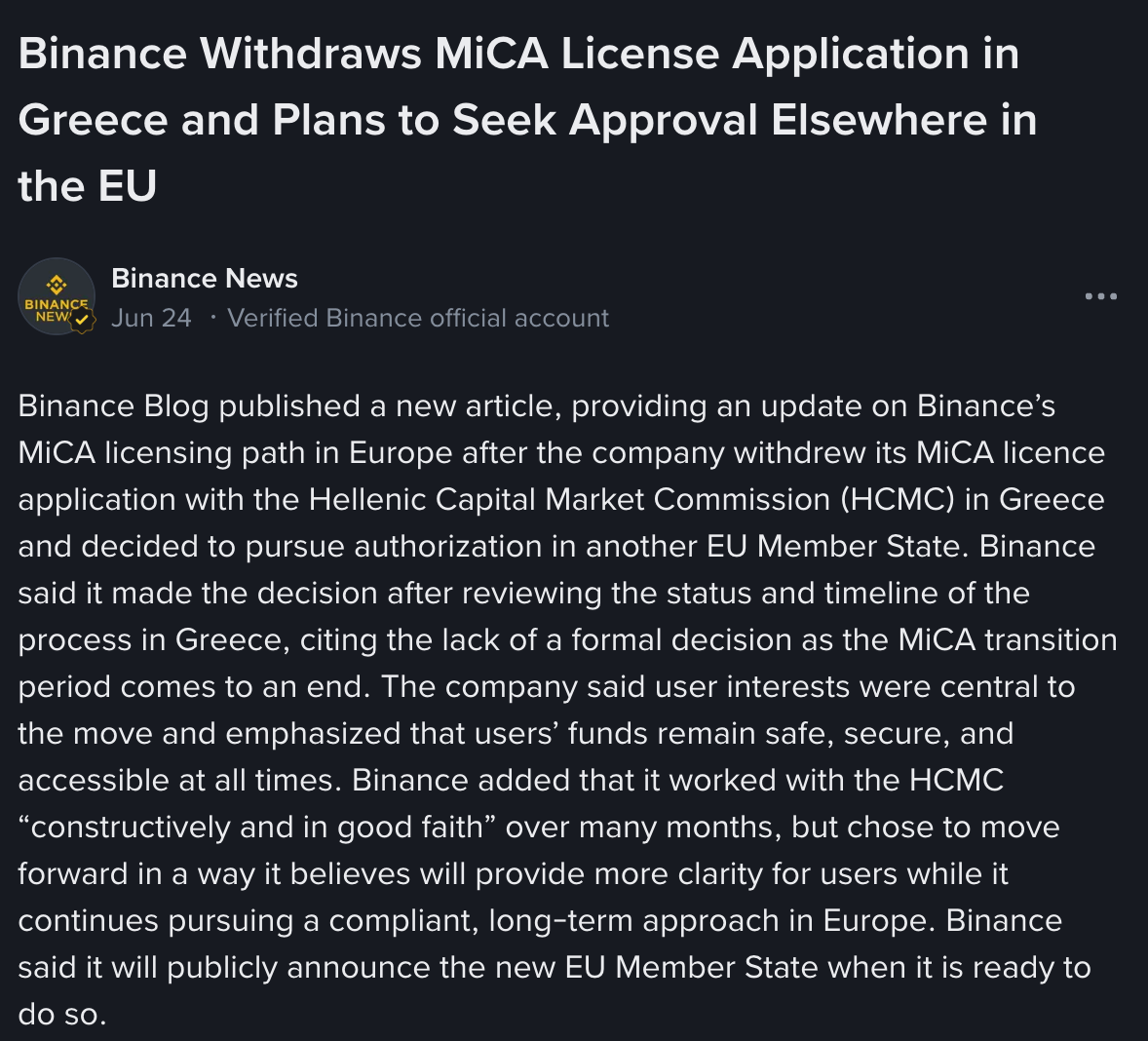
Binance official statement, Source: Binance Square
MEXC and HTX
Compared to the high-profile Binance incident, the situation with MEXC and HTX (formerly Huobi) is quieter. Neither platform holds a MiCA license nor has any public record of an application.
What Should Users Do?
For EU users, after July 1, using unlicensed platforms presents several practical risks: the platform may stop accepting new deposits, may require withdrawals to be completed within a set timeframe, or may restrict account operations without prior notice. OKX Europe analysis found that between May 2025 and May 2026, approximately 41% of European crypto app downloads came from exchanges without MiCA authorization, and it's estimated that about 60% of European crypto users are currently using unauthorized platforms.
If a platform has already notified users about account migration, as experienced by some EU users of Bybit, Bitvavo, Kraken, Coinbase, and Crypto.com, this typically involves re-completing KYC identity verification and accepting updated terms of service. This is a normal process under MiCA's anti-money laundering requirements.
Next Steps for Industry Regulation
MiCA is not the end point. On May 20, 2026, the European Commission launched a formal review and consultation procedure for the MiCA regulation, inviting comments until August 31. A final report must be submitted to the European Parliament by June 30, 2027. The 86 questions in this consultation cover stablecoin competitiveness (especially the weak position of euro stablecoins against dollar stablecoins), DeFi, staking and lending, RWA tokenization, and whether ESMA should gain direct supervisory authority over major CASPs.
France, alongside Austria and Italy, explicitly supports ESMA directly supervising major CASPs to narrow regulatory gaps between member states. Meanwhile, the Qivalis consortium, jointly initiated by 37 banks including BNP Paribas, ING, and UniCredit, is developing a compliant stablecoin pegged to the euro, aiming to carve out a space for euro digital currencies in the dollar stablecoin-dominated market.
The industry shakeout continues. Odaily will keep tracking and reporting on these developments.