伯恩斯坦上調高通目標價至235美元,為何評級仍按兵不動?


- 核心觀點:伯恩斯坦將高通目標價從140美元上調至235美元,但維持「市場表現」評級,核心在於認可其AI資料中心等遠期成長目標(FY2029非手機收入約400億美元),但短期手機業務下滑、營運支出上升及資料中心毛利率不確定性構成約束,風險回報未明顯偏向買入。
- 關鍵要素:
- 目標價上調源於估值模型納入更大資料中心收入(FY2029超150億美元)和多元化結構,本益比從14倍升至20倍,而非短期獲利大幅上修。
- 資料中心路線包括客製化ASIC和Dragonfly C1000 CPU,有兩個未具名雲端客戶預計FY2027各自貢獻超10億美元客製化晶片收入,Meta合作確認非獨家的多代CPU合作。
- 汽車和IoT構成第二成長曲線,汽車設計管道從450億美元增至650億美元,FY2029目標分別達100億和140億美元以上。
- 手機業務面臨壓力:FY2027安卓收入預計持平或略降,蘋果收入退出使手持裝置收入可能減少50-60億美元,安卓手持收入FY2026-2029年複合成長率僅約5%。
- 費用端提前承壓:FY2027營運支出將雙位數成長,資料中心收入確認落後於投入,可能導致FY2027前後每股盈餘面臨下修風險。
- 資料中心毛利率約40%低於公司平均水準,整體毛利率可能從FY2026的55.2%降至FY2029的51.6%,影響獲利品質。
- 下行情景中即使資料中心收入顯著低於150億美元目標,FY2029每股盈餘仍約15美元,顯示基本盤穩健,但18美元以上目標的實現需依賴客戶放量、毛利率穩定及手機業務平穩過渡。
TL;DR
- Bernstein raised Qualcomm's target price from $140 to $235, but maintained a Market Perform rating.
- Qualcomm's FY2029 targets are focused on data centers, automotive, and IoT, with non-handset revenue aiming for approximately $40 billion.
- A declining handset business, rising OPEX, and uncertainty over data center gross margins remain the core constraints on the rating upgrade.
Target Price Soars, But Rating Doesn't Follow
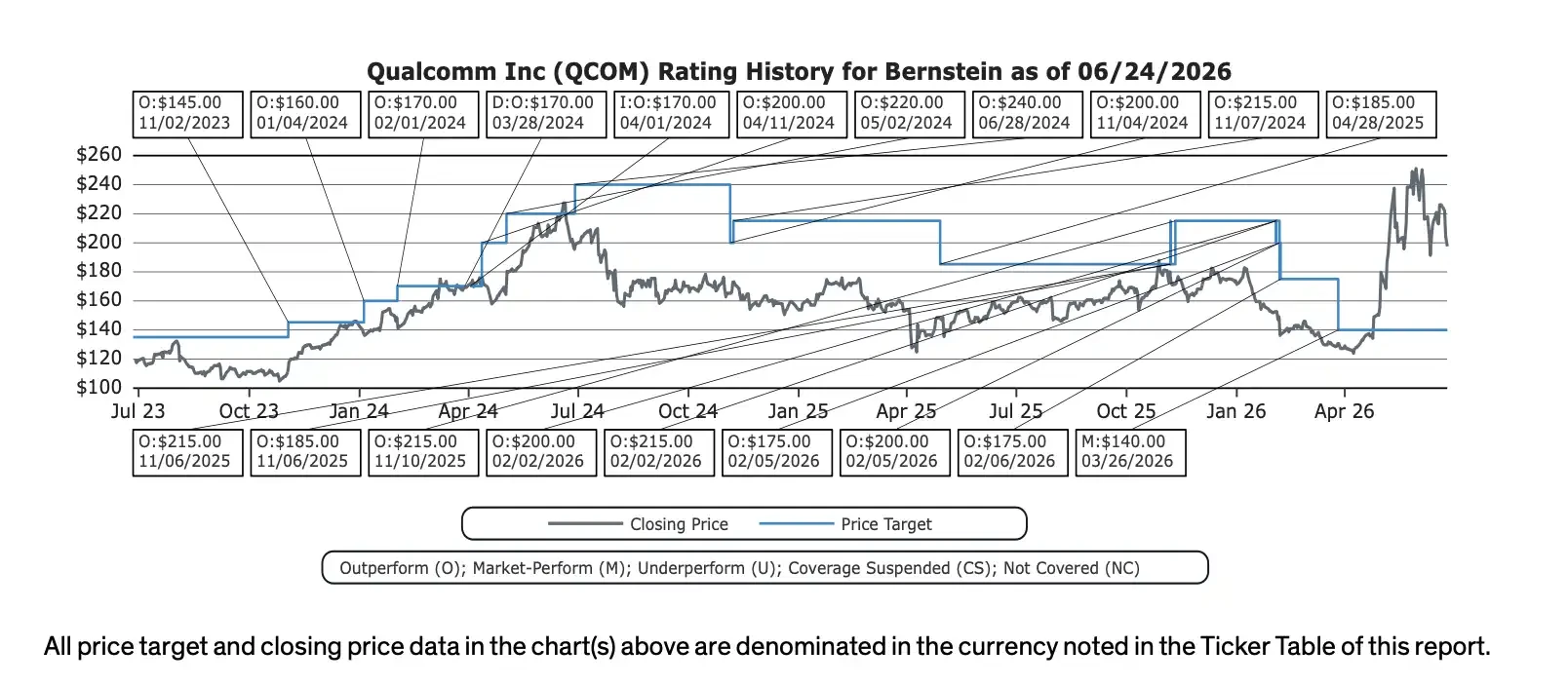
Following Qualcomm's Investor Day in New York, the company presented a larger set of long-term growth targets to the market. Bernstein subsequently raised Qualcomm's target price from $140 to $235, but maintained a Market Perform rating.
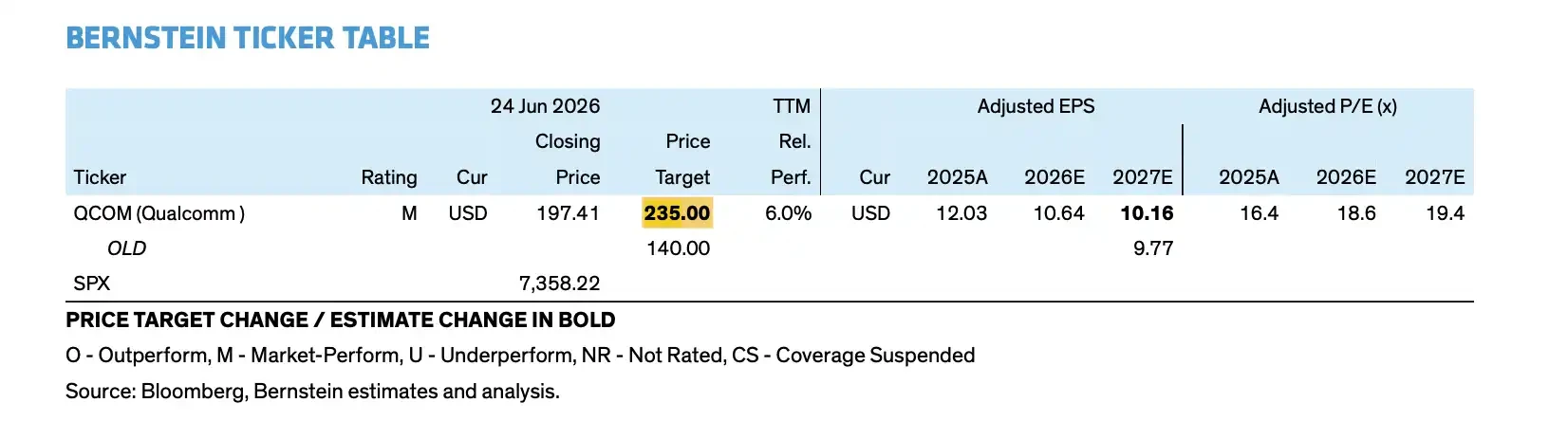
The target price increase indicates that Bernstein acknowledges Qualcomm's long-term story is expanding. The company is no longer positioning itself solely as a mobile chip supplier but is attempting to enter broader computing markets such as AI data centers, automotive, IoT, and personal AI devices. According to Qualcomm's official targets, by FY2029, the company's non-handset revenue will reach approximately $40 billion, data center revenue exceeding $15 billion, and Non-GAAP EPS over $18.
However, the unchanged rating suggests that the sell-side does not believe this story is sufficiently certain yet. The real constraint lies in the timing mismatch: the realization of data center and automotive revenue is further out, while the decline in the handset business, loss of Apple revenue, increased OPEX, and margin pressure will impact financial results sooner.
This explains why the $235 target price does not equate to a "buy" signal. Bernstein acknowledges that Qualcomm's long-term valuation ceiling has been raised, but with current stock prices already reflecting some optimistic expectations, the risk-reward ratio has not yet clearly tilted towards buying.
The New Story: Shifting from Handset Cycles to AI Data Centers
Qualcomm's most important new story this time is its data center push.
The company's official targets indicate that FY2029 data center revenue will exceed $15 billion. Compared to the current data center revenue base of approximately $30 million, this means Qualcomm must genuinely penetrate the AI infrastructure budgets of cloud vendors in the coming years, rather than just staying in the mobile chip and edge computing markets.
Qualcomm's disclosed data center roadmap includes custom ASICs, AI inference accelerators, the Dragonfly C1000 CPU, connectivity products, and related software layers. The company also mentioned two unnamed Hyperscaler customers, each expected to contribute over $1 billion in custom silicon revenue by FY2027.
The partnership with Meta is another important validation point. Qualcomm and Meta announced a multi-generational collaboration on data center CPUs, with the Dragonfly C1000 CPU planned to start production in the second half of 2028. However, caution is warranted here: the official statement is that Qualcomm will be one of the suppliers, with details on volume, capacity, and exclusivity undisclosed.
Automotive and IoT form the second growth curve. Qualcomm's official targets show FY2029 automotive revenue reaching $10 billion and IoT revenue exceeding $14 billion. The automotive design-win pipeline has grown from $45 billion 18 months ago to $65 billion, as the company continues to bet on digital cockpits, driver assistance, and in-vehicle connectivity.
The $235 Target Price Bets on 2029, Not Next Year
The core reason for Bernstein's target price increase is not a sudden improvement in Qualcomm's short-term performance, but the valuation model beginning to incorporate larger data center revenue and a more balanced business structure.
Based on Bernstein's model, Qualcomm's FY2029 revenue is approximately $64.8 billion, with EPS around $18.12, closely aligning with the company's long-term target of "Non-GAAP EPS over $18". Compared to the past, when the market primarily priced Qualcomm based on handset cycles, data centers, automotive, and IoT give the company an opportunity to achieve higher valuation multiples.
The $235 target price corresponds to a higher valuation framework. Bernstein uses an average FY2027/FY2028 EPS of approximately $11.75 with a 20x P/E multiple; the previous $140 target price implied a multiple of about 14x. In other words, the key to the target price increase is not a major upward revision in next year's earnings, but the market's willingness to pay a higher multiple for Qualcomm's AI data center and diversified revenue story.
However, this also harbors disagreement. Bernstein's model assumes a data center business gross margin of approximately 40%, lower than Qualcomm's current corporate average. Even with revenue scaling, the early stages may not improve overall profit quality. The report estimates that due to the changing business mix, Qualcomm's overall gross margin could decline from 55.2% in FY2026 to 51.6% in FY2029.
Handset Pressure Arrives First, Data Center Realization Awaits
Qualcomm aims to prove its revenue structure is changing through data centers, automotive, and IoT, but the pressure on the handset business has not disappeared.
Sell-side reports and management Q&A indicate that Android handset revenue is expected to be flat or slightly down in FY2027. Combined with the loss of Apple revenue, total handset revenue could decrease by $5 billion to $6 billion year-over-year. The handset business remains Qualcomm's largest current revenue source, and this decline will directly impact the profit base over the next two years.
The company's long-term assumptions for Android phones are also more cautious. From FY2026 to FY2029, Android handset revenue is expected to grow at a CAGR of approximately 5%, significantly lower than the high-growth phases of previous cycles. Qualcomm may still maintain advantages in high-end Android, AI phones, and RF front-end, but this can hardly fully offset the pressure from losing Apple's business and the slowdown in the smartphone industry.
Cost side pressures will also emerge earlier. Qualcomm has explicitly stated that FY2027 OPEX will see double-digit growth. To advance data center CPUs, AI accelerators, custom silicon, and the software ecosystem, the company needs to invest ahead of time in R&D, sales, and customer support. Revenue recognition typically lags behind investment, meaning there is a potential downside risk to EPS forecasts around FY2027.
This is the key reason for the target price increase but unchanged rating: Qualcomm's long-term story is bigger, but the profit curve over the next two to three years is not necessarily smoother. Investors need to accept both propositions: FY2029 EPS could be boosted by AI data centers, but earnings pressure around FY2027 could also be more pronounced.
The Disagreement Lies in Whether $15 Billion in Data Center Revenue Can Translate into Real Profit
Bernstein's report is not simply bearish on Qualcomm; rather, while repricing Qualcomm, it warns the market not to treat long-term targets as already realized performance.
In a downside scenario, if data center revenue falls significantly short of the $15 billion target and personal AI and computing business growth is limited, Qualcomm's FY2029 EPS could still reach around $15. This suggests Qualcomm's fundamental base is not fragile; automotive, IoT, licensing business, and cost control can still support a certain level of profitability.
However, the gap between $15 EPS and over $18 EPS has a significant impact on valuation. If the market has already priced Qualcomm based on more optimistic data center revenue and higher valuation multiples, the company must prove three things: cloud customer volume can scale as planned; data center gross margins won't persistently drag down overall profitability; and the handset business decline won't excessively depress EPS before new businesses materialize.
Therefore, the $235 target price is not a conclusion that "Qualcomm's AI transformation has succeeded," but rather a new price after incorporating long-term diversification prospects into the valuation. Qualcomm's story is indeed bigger than before, and it increasingly resembles a chip platform company spanning handsets, automotive, IoT, and AI data centers.
But the Market Perform rating reminds us that until the headwinds in handsets ease, data center revenue scales, and gross margins are tested, there is still reason for the market not to rush into viewing Qualcomm as a definitive AI winner. What truly needs validation next is not whether Qualcomm can articulate a $15 billion data center target, but whether this target can translate into revenue on time and ultimately into sufficiently good profits.