铠侠年报里的「存储超级周期」:苹果订单暴增、原料库存激增,整条产业链都在抢先布局


- 核心观点:摩根士丹利研报指出,存储行业正进入「超级周期」,以苹果为代表的消费电子巨头因预期价格上涨而恐慌性扫货,上游厂商也积极囤积原料,产业链已全面进入涨价备货模式。
- 关键要素:
- 苹果贡献营收同比暴增58%至4760亿日元,远超铠侠整体增速(+37%),显示消费端存储价格已实质上涨。
- 苹果营收占比从约18%升至约20%,且存在提前拉货(pull-in procurement)行为,以锁定成本并确保供应。
- 截至2026年3月末,铠侠原材料库存显著增加,主因是提前采购SSD用DRAM,反映上游供应紧缺预期。
- 铠侠资本开支结构从厂房建设(建筑转入骤降至62亿日元)全面转向BiCS-8等前道设备投资(机械转入升至2598亿日元)。
- 摩根士丹利维持对铠侠「增持」评级,目标价11万日元,基于约10%的自由现金流收益率和11倍隐含市盈率。
Original Author: Dong Jing
Original Source: Wall Street News
Morgan Stanley's latest analysis of Kioxia's annual report reveals a "super cycle" brewing in the semiconductor storage industry.
On June 25, according to information from the Zhuifeng Trading Desk, the core conclusion of Morgan Stanley's latest research report points to one signal: The storage industry's super cycle is accelerating, consumer electronics giants are panic-buying, and upstream manufacturers are frantically stockpiling raw materials. Kioxia's annual report data provides the clearest footnote for this cycle.
The report states that revenue contributed by Apple surged 58% year-over-year to 476 billion yen, far exceeding Kioxia's overall growth rate. This not only suggests a significant price increase in storage for the consumer end but, more importantly, indicates that major clients are "stocking up in advance" in anticipation of price hikes.
Meanwhile, Kioxia's raw material inventory surged as of the end of March 2026, primarily used for the early procurement of DRAM needed for SSDs, confirming the expectation of tight supply upstream in the industry chain. Additionally, the company's capital expenditure is shifting entirely from building construction to front-end equipment investment for BiCS-8 and other technologies.
Morgan Stanley maintains an "Overweight" rating on Kioxia with a target price of 110,000 yen, stating that AI-driven demand and strong free cash flow will provide solid support for the stock price.
Apple Orders Surge 58%, Consumer Giant Adopts "Advance Stockpiling" Mode
The biggest highlight of the annual report data is the sharp divergence in orders from major clients.
In the fiscal year ending March 2026, Apple's annual revenue reached 476 billion yen, a 58% increase year-over-year. This growth rate not only significantly outperforms the company's overall revenue growth (+37%) but also exceeds the growth rate of its SSD and storage business segment (+40%).
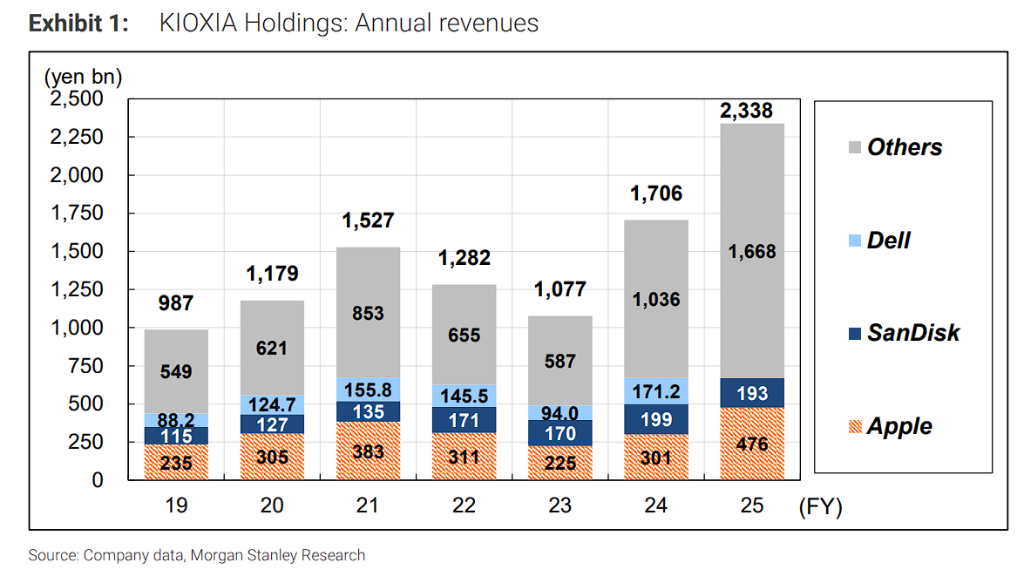
Morgan Stanley believes this data supports two important judgments:
- First, the storage price increases in the quarter ending March 2026 have already spread to the consumer market. Previously, the market's focus was on storage demand driven by data center clients. However, the rapid growth in Apple orders indicates that the consumer electronics sector has also experienced substantial price increases. Kioxia significantly raised prices for its consumer-facing clients as well.
- Second, Apple engaged in pull-in procurement. Against the backdrop of continuously strengthening expectations for sustained storage price increases, Apple likely conducted pull-in procurement of components to lock in lower costs or ensure supply security. This behavior itself is a direct reflection of the "advance deployment" logic across the entire supply chain.
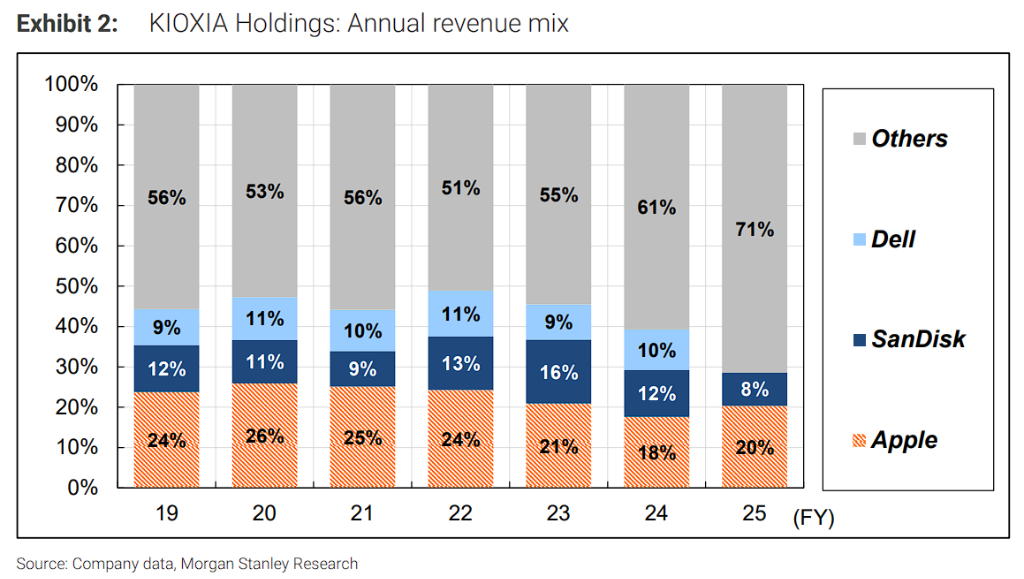
Looking at historical data, Apple's share of Kioxia's revenue has jumped from about 18% in the fiscal year ending March 2024 to approximately 20% in the current fiscal year. The absolute amount has risen sharply from about 301 billion yen to 476 billion yen.
It is worth noting that two major clients disclosed in last year's annual report for the fiscal year ending March 2025—SanDisk and Dell—are no longer listed separately in this report as their revenue share has fallen below the 10% threshold. SanDisk's revenue was reported in the quarterly report as 193.4 billion yen (-3% year-over-year).
Surge in Raw Material Inventory: The Entire Industry Chain Preps for the Next Round of Price Hikes
Morgan Stanley believes that Kioxia's annual report inventory data reveals another key signal.
As of the end of March 2026, Kioxia's finished goods inventory and work-in-process inventory remained roughly flat year-over-year, but raw material inventory saw a significant increase.
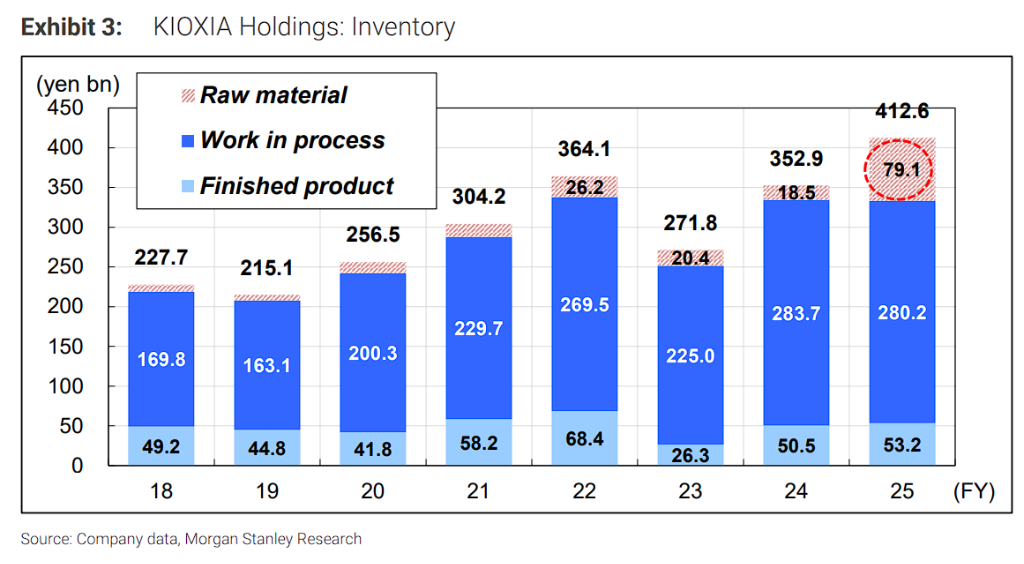
Morgan Stanley judges this change is likely due to advance procurement of DRAM for SSDs. DRAM is a crucial raw material for SSD production. Locking in raw material supply early is a rational choice for manufacturers during an upward storage price cycle.
This change in inventory structure echoes Apple's pull-in procurement behavior—from terminal brand owners to storage manufacturers, the entire industry chain is deploying in advance in their own ways, betting on the continued rise of storage prices.
In terms of total inventory, Kioxia's total inventory at the end of the fiscal year ending March 2026 reached 412.6 billion yen, an increase from 352.9 billion yen at the end of the fiscal year ending March 2025, with the increase in raw material inventory being the most prominent.
Shift in Capital Expenditure Structure: From "Building Factories" to "Installing Equipment," Accelerating BiCS-8 Mass Production
The report points out that Kioxia's capital expenditure structure has undergone a significant transformation in the current fiscal year. This change directly reflects the company's transition from the capacity construction phase to the equipment investment and mass production ramp-up phase.
FY3/25 (Previous Fiscal Year): In tangible fixed assets, the transfer-in amount for buildings and structures was 109.9 billion yen, while the transfer-in amount for machinery and equipment was 192.7 billion yen. This indicates large-scale investment in factory buildings and infrastructure for projects like the Kitatani factory.
FY3/26 (Current Fiscal Year): The transfer-in amount for buildings and structures plummeted to 6.2 billion yen, while the transfer-in amount for machinery and equipment rose to 259.8 billion yen. Morgan Stanley believes this clearly shows the center of gravity for capital expenditure has shifted to BiCS-8 front-end wafer fabrication equipment at the Yokkaichi and Kitatani factories.
Looking ahead to FY3/27 (Next Fiscal Year), Kioxia plans capital expenditure of 450 billion yen, an increase of 166 billion yen year-over-year. Morgan Stanley judges that while there may be cleanroom construction investments in existing factories, the main direction will still be front-end equipment investment for BiCS-8 and BiCS-10.
This capital expenditure path clearly demonstrates that Kioxia is fully committed to building the mass production capacity for next-generation NAND flash memory technology, preparing the supply side for the upcoming peak in demand.
Morgan Stanley maintains an "Overweight" rating on Kioxia with a target price of 110,000 yen, representing approximately 19% upside from the current stock price (closing price of approximately 92,290 yen on June 23, 2026). Morgan Stanley also designates Kioxia as a Top Pick in the Japanese semiconductor sector.
Morgan Stanley anchors its valuation on an expected free cash flow (FCF) yield of approximately 10% for FY3/28, believing this level provides ample support for the stock price. The implied price-to-earnings ratio based on FY3/28 EPS estimates is 11 times.