






特朗普言行反轉:所謂「協議將至」,只是戰爭煙霧彈


- 核心觀點:文章批判特朗普政府在伊朗問題上政策反覆,以「協議即將達成」的輿論煙霧掩蓋軍事升級,導致美軍空襲伊朗引發報復,荷姆茲海峽持續關閉,外交談判實為服務於新聞週期的政治表演。
- 關鍵要素:
- 美軍AH-64直升機在荷姆茲海峽墜毀,原因存在爭議(可能與伊朗無人機相撞),特朗普態度從「沒什麼大不了」急劇轉變為「伊朗擊落」,並發動空襲。
- 美軍對伊朗沿海20個目標實施「自衛性打擊」,導致當地2萬人飲用水供應中斷;伊朗隨即發動21次反擊,打擊美軍在巴林、科威特和約旦的基地。
- 特朗普自衝突爆發以來已三十多次承諾協議「即將達成」(如「兩三天內」),但每次承諾後均被軍事行動或事實戳穿,撕毀協議本質是政治表演。
- 所謂「最成功的封鎖」未實現重新開放荷姆茲海峽的核心目標,油價上漲、市場承壓,外交姿態在情緒驅動下反覆無常。
- 作者建議讀者對「非常接近」等言論保持記錄並預設相反結果,因其已演變為體制化的空頭承諾。
Original Title: "Trust Me, Bro" Is Not A Middle East Policy: Trump Just Bombed Iran Again Over A Helicopter That May Have Flown Into A Drone
Original Author: Dean Blundell
Compiled by: Peggy, BlockBeats
Editor's Note: This article focuses on the US military airstrike on targets near the Strait of Hormuz in Iran in the early morning of June 10, Beijing time. Dean Blundell, with strong sarcasm, criticizes the Trump administration's policy flip-flops on the Iranian issue: a US Army AH-64 "Apache" helicopter crashed near the Strait of Hormuz, with both pilots rescued. The cause of the incident remains disputed; Trump initially called it "no big deal," but later on Truth Social labeled it as Iran "shooting down" a US helicopter and used it as a pretext to strike Iranian coastal air defense, radar, and ground control facilities.
The article's real critique is not just about this military response, but the Trump administration's repeated strategy of creating a smokescreen that a "deal is about to be reached." While claiming negotiations are in the "final stage" and a deal could be signed "within two or three days," they simultaneously escalate military actions and publicly humiliate Iran. The so-called diplomatic negotiations resemble more of a political performance serving the news cycle. Meanwhile, the US military's so-called "proportional response" further provokes Iranian retaliatory strikes on US regional bases. The Strait of Hormuz remains unnavigable, and oil prices and market pressures persist. The author reminds readers that when "very close" repeatedly replaces real progress, the most rational reaction might not be to believe it, but to document it and assume the reality is likely the exact opposite.
The following is the original text:
Let's start with the timeline, because the timeline itself is the core of the entire deception.
Monday night, a US Army AH-64 Apache attack helicopter crashed in the Strait of Hormuz off the coast of Oman. Both pilots survived and were unharmed—they were rescued by an unmanned vessel within two hours. Admittedly, that is a pretty cool piece of military equipment and the only truly functional part of the whole story.
But here's the part Trump won't include in his all-caps social media posts: A US official told the Associated Press that the Apache crashed after colliding with an Iranian drone, and it is unclear if the collision was intentional. Trump himself told the Wall Street Journal the whole thing was "no big deal" and that "the pilots are fine."
So, remember this first: No big deal. Pilots are fine. Cause is under investigation. Maybe an accident.
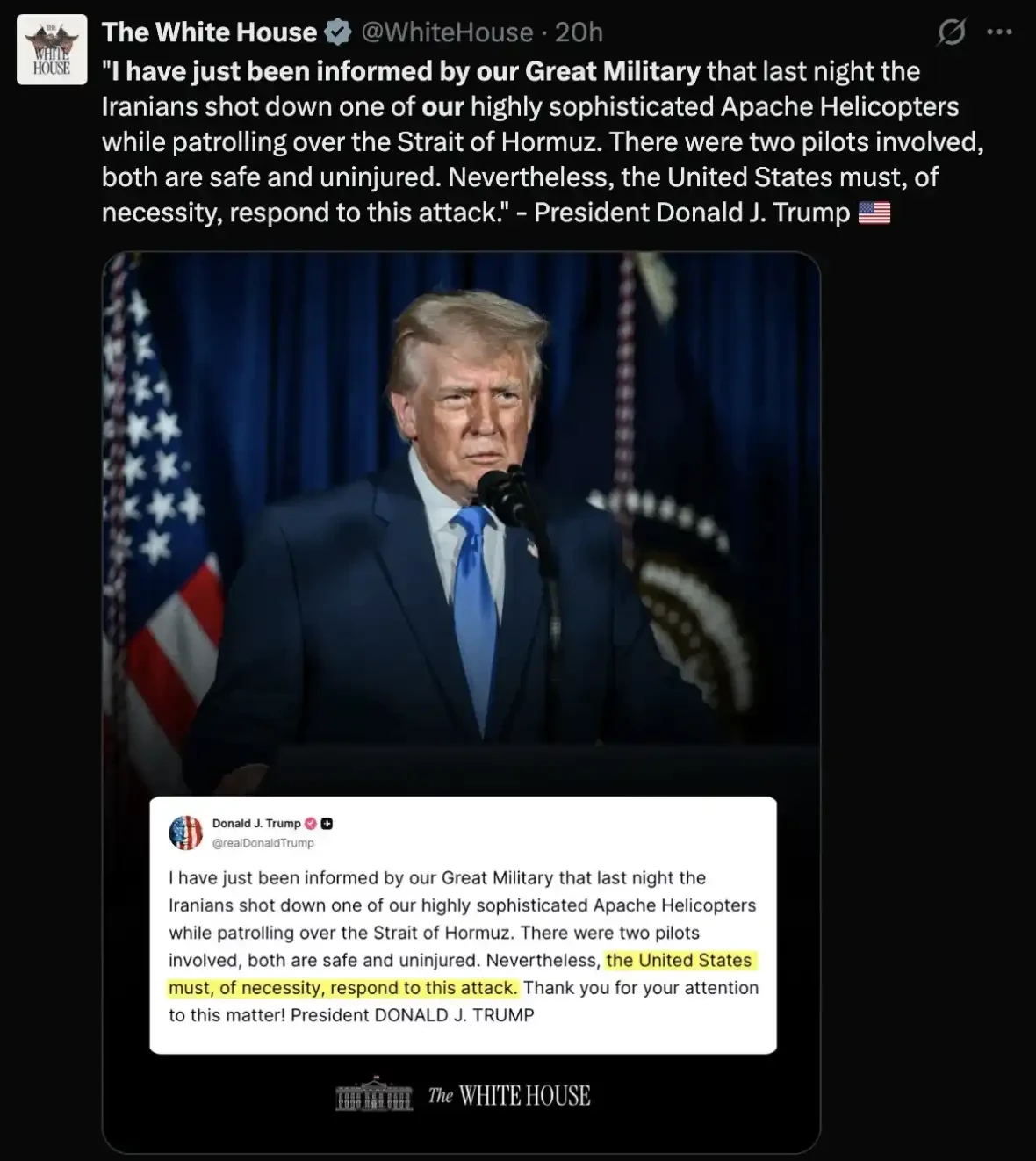
Tuesday morning, the same person, but a different mood. He went back on Truth Social and wrote: "I just received notification from our great military that last night, Iran shot down one of our highly advanced Apache helicopters while it was patrolling over the Strait of Hormuz... It is necessary for the United States to respond to this attack. Thank you for your attention to this matter!"
From "no big deal" to "necessary to respond" – just one news cycle apart. This person contradicted himself in less than 24 hours, and we seem expected to nod our heads as if witnessing some kind of national governance art.
Late Tuesday night into early Wednesday, US Central Command began striking targets along the Iranian coast. The operation lasted from 22:00 GMT Tuesday to nearly 01:00 Wednesday, hitting about 20 targets, including air defense systems, ground control stations, and surveillance radar sites across Qeshm Island, Goruk, Bandar Abbas, Jask, Sirik, and Minab, stretching along and into the Strait of Hormuz. The Pentagon's stated reason: "self-defense strikes," a "proportional response" to Iran's "unprovoked aggression."
However, according to Iranian state media, the "proportional response" on the ground resulted in: two water reservoirs near Sirik being struck, cutting off drinking water supplies for about 20,000 people in the Bamani area. Next time you hear the term "surgical strike," remember this scene.
That same night, Iran retaliated. Iran's Revolutionary Guard stated they launched 21 strikes against US targets in the region—drones attacked the US Fifth Fleet in Bahrain and Al Salem Air Base in Kuwait, while long-range missiles struck Azraq Air Base in Jordan; they claim they destroyed an F-35 hangar there. Jordan said it shot down 5 missiles. Iranian Foreign Minister Araghchi, using a threatening tone Trump thinks he owns, said, "Want safety? Leave our region." Iranian Parliament Speaker Ghalibaf stated, "We prefer to use the language of diplomacy, but we are more fluent in other languages."
Wednesday morning. And then—right here—the truly key moment appears. Trump returned to Truth Social, the "master dealmaker" dropping the mask completely:
"The Iranian military is in complete disarray. Most of their forces, like the navy and air force, don't even exist anymore—they have been utterly defeated. Iran is all talk, no action. The Middle East bully is dead!!! They took too long to negotiate a deal that was extremely favorable to them, and now they must pay the price!!!"
"They took too long to negotiate."
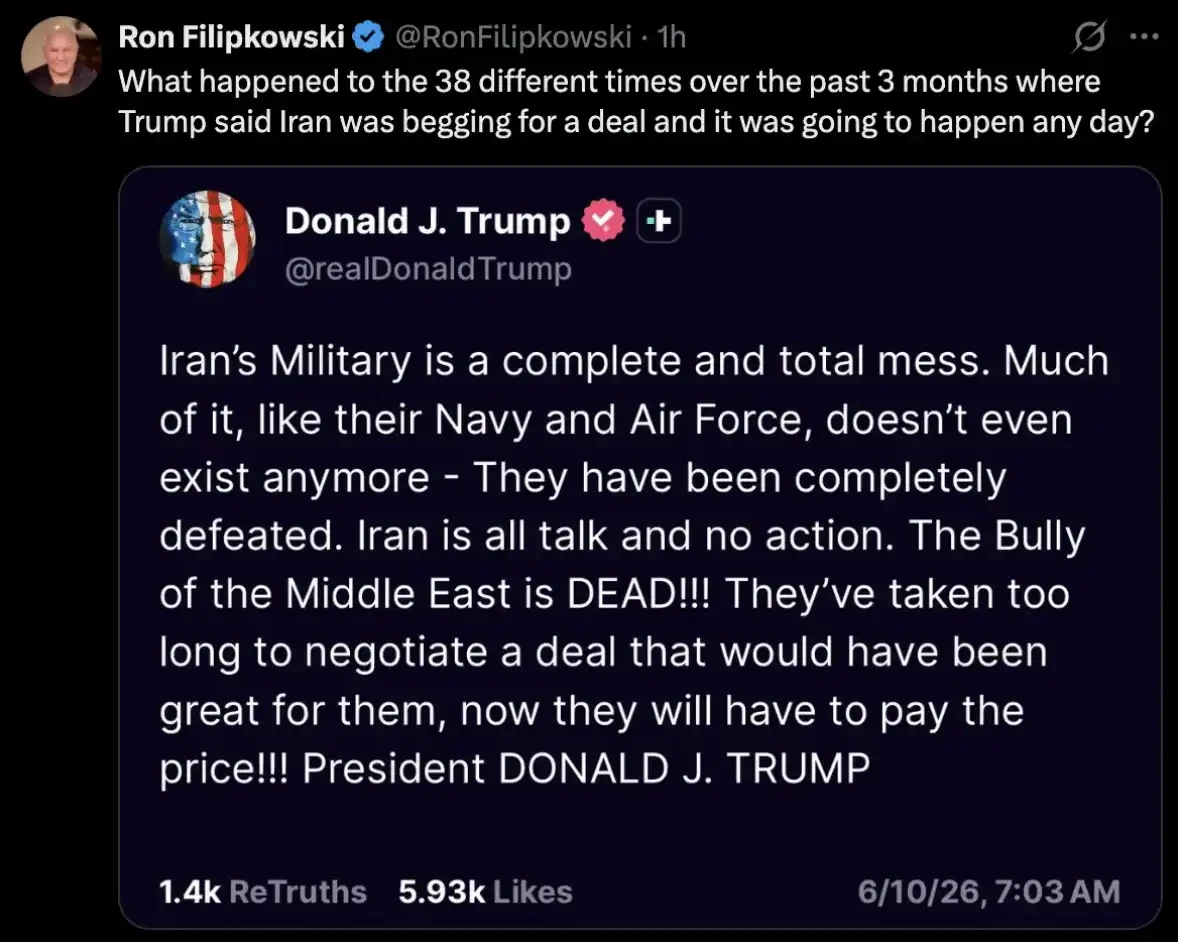
Too long. This comes from the same person who, just the previous morning, claimed the deal was in its "final stage" and could be signed within "two or three days." The same person who, after leaving the NBA Finals Monday night, said both sides were in the final stages of a "very, very good deal" that, once signed, would "immediately" reopen the Strait of Hormuz.
The "Two or Three Days" Industry Complex
There's something I want you to seriously consider. Throughout this entire conflict, Trump has been telling us a deal is just around the corner. By Sunday, this conflict had exceeded 100 days. By my count—and yes, I recorded every instance because someone has to do it—since the conflict erupted in late February, Trump has promised an imminent, shiny, right-around-the-corner deal over thirty times.
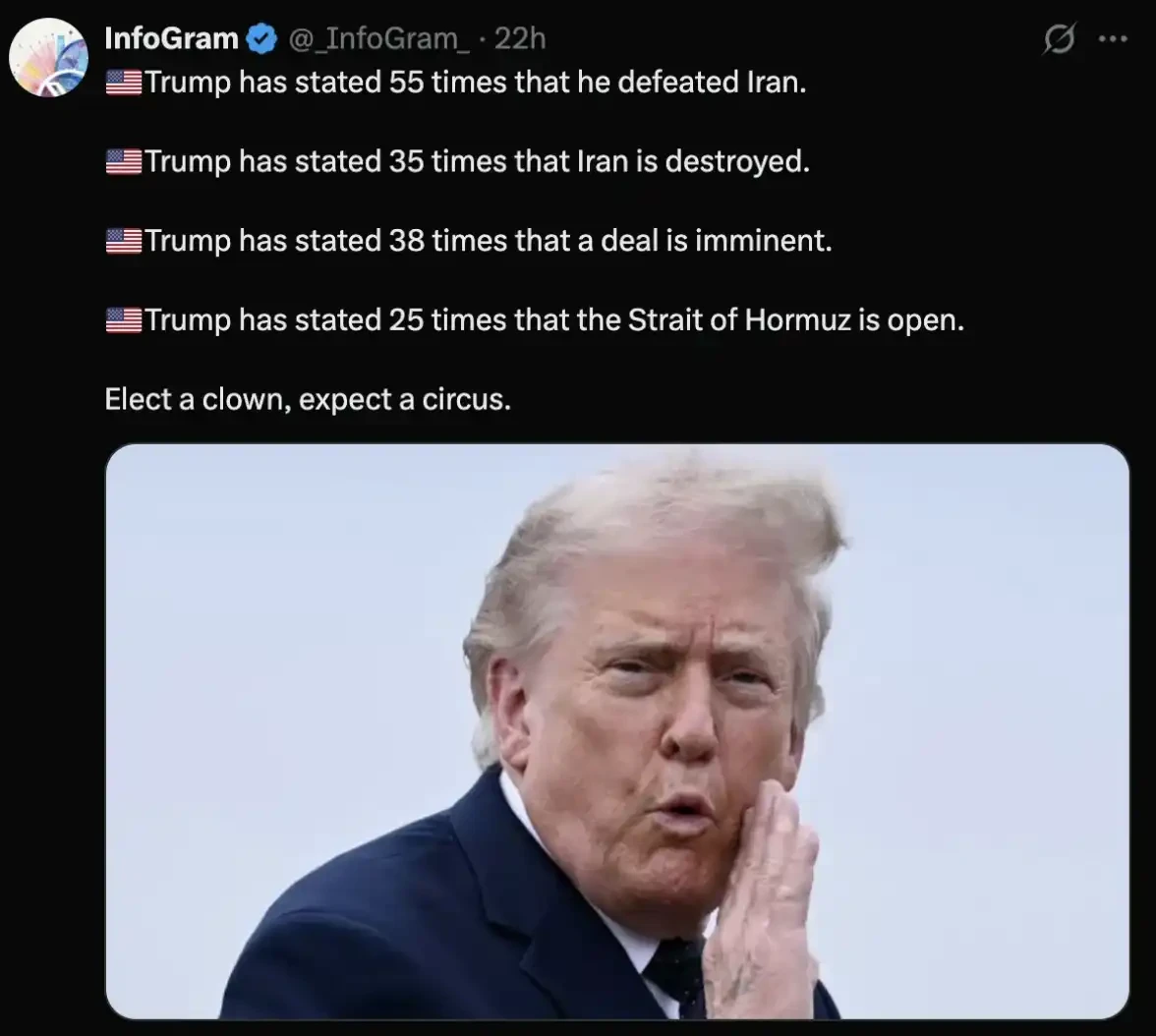
Let's pull a few receipts from the drawer:
March 23: Announced "very good and productive" talks and delayed a previously threatened strike on power plants by five days. Iran's response? They directly denied any talks had taken place. Oil prices fell, then bounced back after Tehran debunked his claim.
Late March: Threatened to "destroy" Iran's power plants within 48 hours if they didn't open the strait. They didn't open it. He didn't strike.
April: Announced a "10-day pause on energy facility destruction." A ceasefire was declared. Then came talks in Pakistan, mainly brokered by Islamabad, which ended inconclusively.
This week: "Final stage." "Two or three days." "Open immediately upon signing."
Wednesday: "They took too long. Must pay the price."
This isn't negotiation. It's a slot machine that only dispenses media exposure. Every time the lever is pulled, the screen shows the same three cherries: Deal is almost done, the other side is weak, trust me.
And every time, JD Vance is there to back him up—Sunday, he told CBS the administration was "very close" to a deal. Very close. Those two words might be the most abused in this administration, second only to "perfect phone call."
Let's Pull the Mask Off
Behind the "Trust Me, Bro" facade lies this.
If you were truly in control of the negotiations, you wouldn't need to blow up water reservoirs to prove you're winning. If you were truly in control, the other side wouldn't launch 21 missiles at three of your bases the same night. If you were truly in control, your diplomatic demeanor wouldn't shift like a mood ring from "very, very good deal" to "the Middle East bully is dead" within 18 hours, based seemingly on nothing more than how you feel about the cable news coverage.
The blockade he constantly boasts about—in his own words, "the most successful blockade in naval warfare history"—hasn't stopped Iran from launching attacks across the region, hasn't reopened the Strait of Hormuz, and hasn't produced any deal. A shopkeeper in Tehran even told CBS this week that his shelves remain full. But of course, it can still be called the "most successful." He even wrote a "Praise be to God"—I have many questions about that, but that's for another article.
The real giveaway is here: The strait remains closed. The one tangible goal this war was supposedly about—reopening the passage for one-fifth of the global oil supply—remains unachieved after over 100 days. In that time, there have been dozens of "imminent" deals, a naval blockade, and now a new round of strikes. Oil prices rose nearly 2%. Markets fell. And the person at the center of it all is posting in all caps, declaring a "bully" dead.
This isn't leverage. This is a man who started losing control of the car around March, driving it off course, and has spent three months insisting he meant to drift it into the guardrail.
The Bottom Line
It's good the two pilots are safe—the only clean result in this whole affair. But tonight, 20,000 people in southern Iran have no drinking water, three US allies have been hit by missiles, a possible F-35 hangar in Jordan is smoldering wreckage, and the person responsible is handling it all like a professional wrestling promo.
Every "two or three days" is either a lie or a delusion. By now, the distinction between the two is irrelevant. You can't say the deal is in its "final stage" on Tuesday, say "they took too long" on Wednesday, and expect anyone with a functioning memory to still trust your judgment about Thursday's situation.
So, the next time you hear "we are very close," whether it's from Trump, Vance, or anyone in their circle, do the only sensible thing.
Count it. Write it down. And assume the truth is exactly the opposite.
Because "Trust Me, Bro" stopped being foreign policy around the twelfth promised deal. We are now well past thirty.
This is clearly something worth remembering.


