PoW 神礦?a16z 150萬美元掃貨,Pearl讓礦圈再度沸騰(附挖礦實操)


- 核心觀點:新興礦幣 Pearl 透過「實用工作量證明」(PoUW)機制,將 GPU 挖礦與 AI 推理任務相結合,試圖打破傳統 PoW 的算力浪費弊端,成為一個兼具挖礦與 AI 服務價值的 DePIN 項目;但其是否能避免礦幣的「死亡螺旋」,仍需依賴技術突破與實質性機構支持。
- 關鍵要素:
- PRL 代幣因傳聞「a16z 關聯錢包囤貨」兩天暴漲超 150%(從 0.6 美元至 1.5 美元以上),但該消息真實性存疑。
- Pearl 的 PoUW 機制用矩陣乘法(MatMul/GEMM)替代 SHA-256,使 GPU 算力同時用於網路保護與 AI 訓練/推理,已與 Together AI 合作推出模型端點。
- PRL 總供應量 21 億枚,無減半機制,出塊時間約 194 秒,由發行曲線決定區塊獎勵;當前逾 8.8% 代幣被挖出,流通市值超 3 億美元(按 1.65 美元計)。
- 挖礦成本較高,官方雲端套餐成本約 1.33-1.77 美元/PRL;社群推薦透過 runpod、vastAI 等平台租用廉價 GPU(如 4090/5090 顯卡)降低開支。
- 生態較完整:已有礦池(pearlhash 等)、跨鏈橋 PearlBridge(鎖定超 32 萬 PRL)、OTC 平台及小型交易所 SafeTrade 上線 PRL。
- 技術侷限:當前 PoUW 僅支援整數矩陣乘法,難以適配現代 AI 訓練所需的低精度浮點運算,實際應用價值仍偏向「噱頭」。
Original | Odaily Planet Daily (@OdailyChina)
Author|Golem (@web3_golem)
Every year, one or two mining coins emerge in the crypto market, reigniting the sentiment within the mining community. This year's project is called Pearl.
On April 27, the Pearl mainnet quietly went live, but it didn't attract attention until this week, a month later. The catalyst was a post on X by Pearl community member @optimist on May 27, claiming that a wallet potentially linked to a16z had quietly accumulated over $1.5 million worth of Pearl's native token, PRL. After the news spread, the PRL token price surged from around $0.6 to over $1.5, a gain of more than 150% in two days.
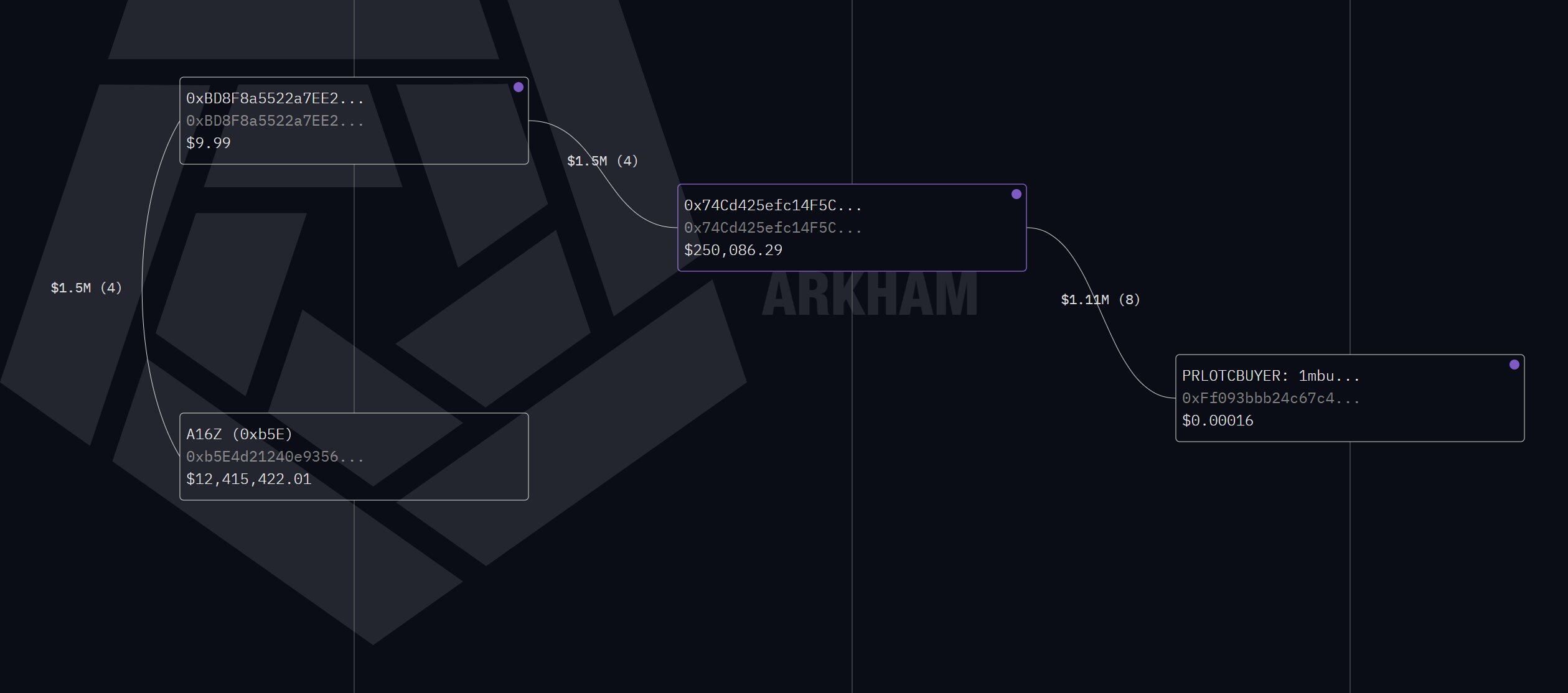
Rumor of a16z-linked wallet accumulating PRL
However, it remains uncertain whether this wallet truly belongs to a16z. It's highly possible that the community deliberately spread this rumor to boost attention on Pearl. What is certain, though, is that a16z has indeed had some connection with the project: On January 26, 2026, a16z crypto research published an article introducing the PoUW algorithm proposed by Pearl's founder, Omri Weinstein, which is the core of the Pearl network (Odaily note: the article has since been deleted).
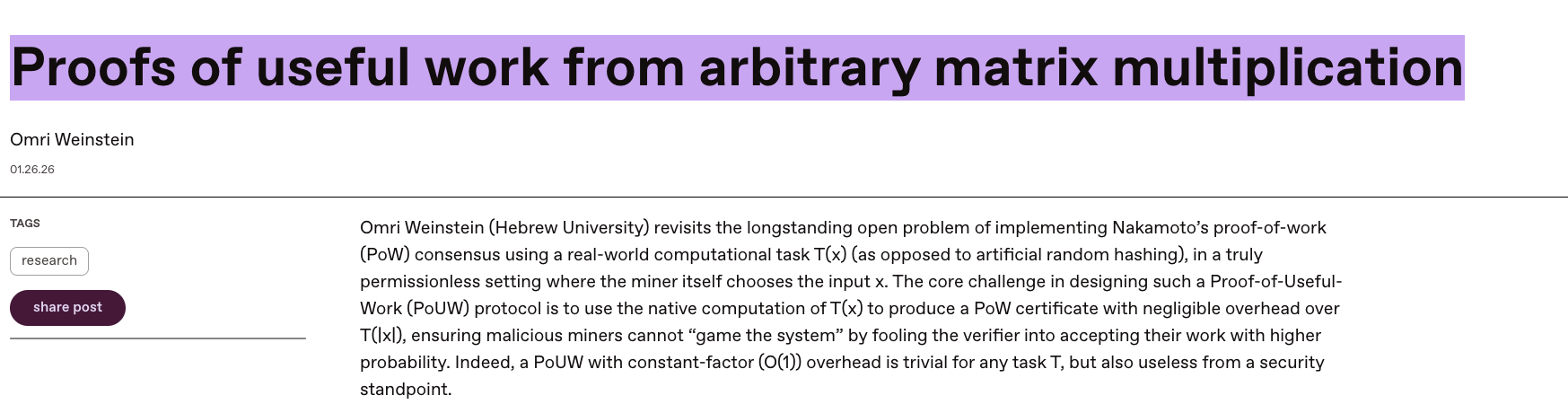
Proof of Useful Work (PoUW): Combining AI Inference Tasks with Mining
The core model of Pearl remains users mining coins with mining machines (GPUs), and its network design is similar to Bitcoin's blockchain. However, its uniqueness lies in proposing a new proof-of-work mechanism built upon PoW: Proof of Useful Work (PoUW).
In traditional PoW blockchains, miners primarily solve cryptographic puzzles using computers to secure the network. This computation is often criticized as meaningless—serving no purpose other than securing the blockchain, especially wasting valuable computational resources in the current AI boom.
To prevent wasted computational power, Pearl's PoUW discards the SHA-256 algorithm and instead adopts matrix multiplication (MatMul / GEMM) used in AI computations. The computing resources contributed by users' GPUs to the Pearl mainnet are used not only to secure the Pearl network but also to execute AI workloads, providing AI training and inference services to large model companies, thereby generating real value. From this perspective, mining tokens is essentially a reward for users providing computing power to participate in AI computations.
Pearl's PoUW is called "useful" precisely because it allows GPUs to achieve blockchain proof-of-work and generate tokens while simultaneously performing AI training and inference workloads. Currently, Pearl has partnered with the large model training platform Together AI to launch the Gemma-4-31B-it-Pearl endpoint (based on Google's Gemma 4 31B model), and developers using this endpoint receive a 25% discount, subsidized by the mined PRL tokens.
The token produced by the Pearl network is PRL, with a total supply of 2.1 billion. The network's average block time is set at 194 seconds, but the number of tokens generated per block is not fixed and has no halving mechanism. Instead, it is determined by an issuance curve. One of the core formulas of this curve is A(t)=t / (t + H), where A(t) is the cumulative token allocation ratio, t is the current block height, and H is a fixed value of 650,226 (the block height corresponding to four years).
Based on the PRL cumulative allocation ratio, one can estimate the number of tokens produced per block. Of course, as a regular user, you can directly visit the Pearl block explorer to view the current total token supply, block reward amount, block height, and average block time, without needing to calculate it yourself.
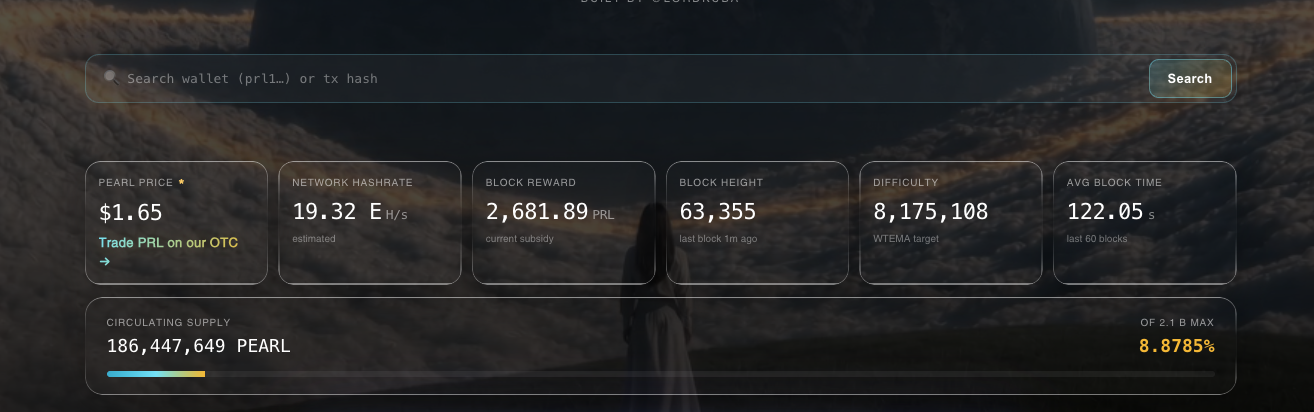
As shown above, over 8.8% of PRL tokens have already been mined. Meanwhile, at a price of $1.65, PRL's circulating market cap exceeds $300 million.
Complete Overview of Mining and Ecosystem
In the current crypto market environment, PRL's market cap might seem overvalued, but this is also due to increased mining costs. Pearl supports users mining with their own GPUs and also allows users to rent cloud GPUs directly on the platform for mining. As shown below, Pearl launched three packages, all of which sold out quickly due to the project's high popularity.
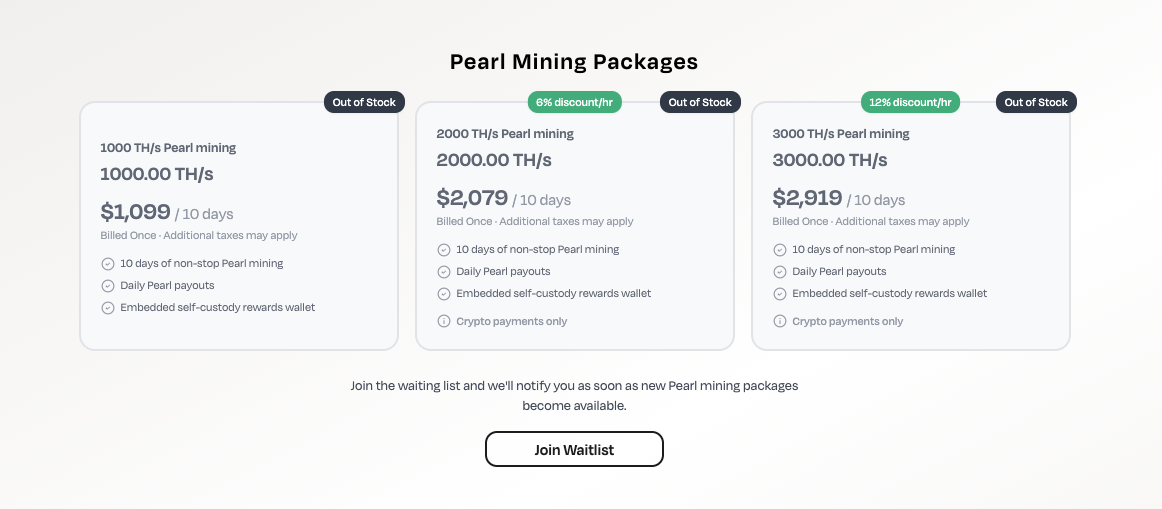
The mining costs for these three packages are not cheap. Taking Package 1 as an example, renting 1000 TH/s for 10 consecutive days costs $1,099, meaning the hourly cost for 1000 TH/s is approximately $4.57. Community member @AKAKAY04 created a simple PRL mining cost calculator. Plugging in the hourly cost and hashrate of Pearl's Package 1 yields an average cost per mined PRL of $1.51-$1.77, which is close to PRL's market price. Even with Package 3, the cost per PRL only drops to $1.33-$1.56.

Therefore, to profit from Pearl network mining, one must rent sufficiently cheap GPU computing power. Currently, the community-recommended GPU rental platforms are runpod and Vast.ai, with 4090 and 5090 graphics cards priced between $0.5 and $2 per hour.
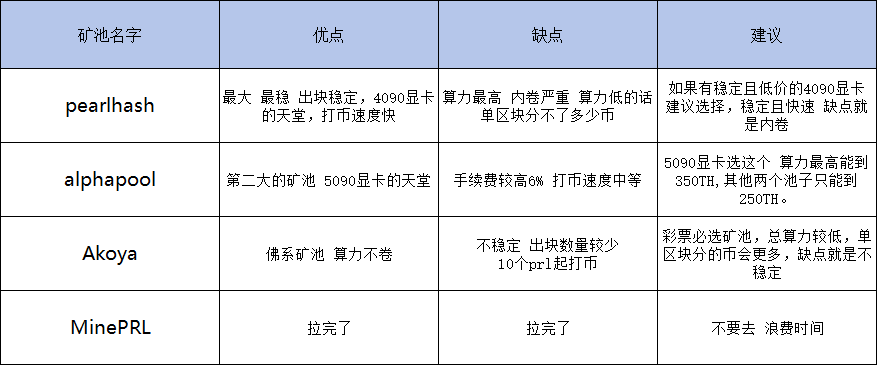
After successfully renting a card, users can choose to join a Pearl mining pool. Currently, the Pearl ecosystem mainly has four mining pools: pearlhash, alphapool, Akoya, and mineprl. Community member @peterdai111 has summarized the characteristics of these four pools, which users can refer to when evaluating their choice. (Odaily note: For specific steps, ask AI or refer to the tutorial written by community member @0xtonixie).
It has only been a month since the Pearl mainnet launch. For a new project, its ecosystem development is already quite mature. In addition to community-initiated mining pools and block explorers, there are also cross-chain bridges, OTC platforms, NFTs, and other features.
PearlBridge is the first cross-chain bridge project for the Pearl network. It allows users to lock native PRL tokens and mint WPRL on Ethereum on a 1:1 basis. The project charges a 1.5% deposit fee (minimum 4 PRL), and redemption has no fee. Currently, the project has locked over 320,000 PRL. Users holding WPRL on EVM chains can trade it freely on the OKX Web3 wallet or other DEXs.
Users can also buy and sell native PRL tokens directly on the pearl-otc platform. This is a non-custodial trading platform: USDC is transferred directly between buyer and seller wallets, while PRL is held in a "2-of-2" multi-signature escrow account co-signed by the seller, preventing the platform from unilaterally transferring funds. This platform is currently the main reference for PRL pricing, offers strong liquidity, and also displays PRL's price fluctuation curve.
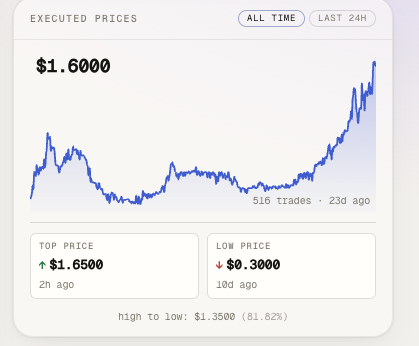
PRL price fluctuation curve
On May 23, the crypto exchange SafeTrade also listed PRL, but the platform is relatively small and not well-known. Users trading PRL on this platform should be cautious about fund security.
The No-Longer-Hidden Flywheel of Mining Coins
An unwritten rule in the mining community is that no matter how innovative a mining coin model is, the core logic always revolves around "mine and dump." PoW mining is essentially a mathematical game, filled with cold machines, precise input-output calculations, and the greed to squeeze out the last bit of profit before a crash. It is not like a regular project token because it lacks fundamental value, nor is it a Meme token because it lacks attention and cultural consensus.
Therefore, the flywheel effect of mining coins is no longer hidden: "Miners mine tokens → create buying pressure → token price rises → generates wealth effect → attracts more people to mine." The core support for this model always requires the existence of buying pressure, but there is no perpetual motion machine in this world, and the market cannot have unlimited buy orders. It can be said that a mining coin is like a train heading straight for a cliff from the moment it departs. Everyone can see this, and everyone believes they will get off before the last moment.
In the past, some mining coin projects used a method of "self-mining and self-pumping" to create fake market demand. Their primary profit came not from selling coins but from users buying mining machines. However, when the market-making cost exceeded the mining machine profit, this model also collapsed.
Now, for Pearl, some believe it is more than just a mining coin and has the potential to grow into the next Bittensor (TAO). This is because Pearl's biggest difference from past mining projects is that the computing resources it consumes are not just used to price PRL but are genuinely used to provide AI training and inference services for real-world large model companies. This is the value of Pearl's useful PoW, making Pearl more akin to a DePIN project.
However, given the current progress of the project, this value is more of a gimmick. This is because Pearl's current core implementation is based on precise integer matrix multiplication, whereas modern AI workloads (especially large model training) do not operate in an INT (integer) environment but rely on low-precision floating-point formats. Extending the current PoUW mechanism to floating-point data types presents significant technical challenges.
Therefore, whether Pearl can break the death spiral curse of mining coins in the future depends on genuine technical strength, real support and endorsement from capital and institutions, rather than relying solely on today's "unlimited imagination" regarding a16z.