






BTC跌破7.5萬美元,將迎來最後一跌?


- 核心觀點:加密市場近期出現顯著回調,比特幣跌破7.5萬美元,市場恐慌情緒蔓延,這主要由中東地緣政治風險升溫以及機構投資者透過比特幣現貨ETF大量獲利了結所致,短期內市場可能繼續面臨震盪整理。
- 關鍵要素:
- 市場恐慌指數降至34,過去24小時全網爆倉4.7億美元,多單爆倉4.2億美元,顯示市場情緒極度悲觀。
- 美伊緊張局勢升級,川普威脅控制伊朗資產,美軍對伊朗軍事基地進行打擊,地緣風險推升避險情緒,導致資金從加密等風險資產流出。
- 5月5日至26日,美國比特幣現貨ETF錄得連續淨流出,單日最高流出達6億美元,以太坊ETF同樣遭大幅淨流出,反映機構獲利了結。
- 分析師指出,短期資金鏈上活躍度權重已降至歷史極低水平,類似以往熊市底部,表明短期換手大幅降溫,市場可能處於底部或蓄勢階段。
- 機構Wintermute認為,AI(如輝達)勢頭消退後,宏觀因素(通膨、消費者信心)將獲得更大權重,加密市場難以獨善其身。
- 分析師認為比特幣7.5萬至7.6萬美元是關鍵支撐位,守住則有望重拾漲勢,跌破則可能快速滑向7萬至7.2萬美元。
Original Author: Ma He, Foresight News
On May 28, after repeatedly struggling at $75,000, the price of Bitcoin ultimately failed to hold and has now slipped to around $74,000. ETH continues to fluctuate around the $2,000 mark. Previously surging tokens like NEAR, WLD, and ONDO have all experienced corrections.
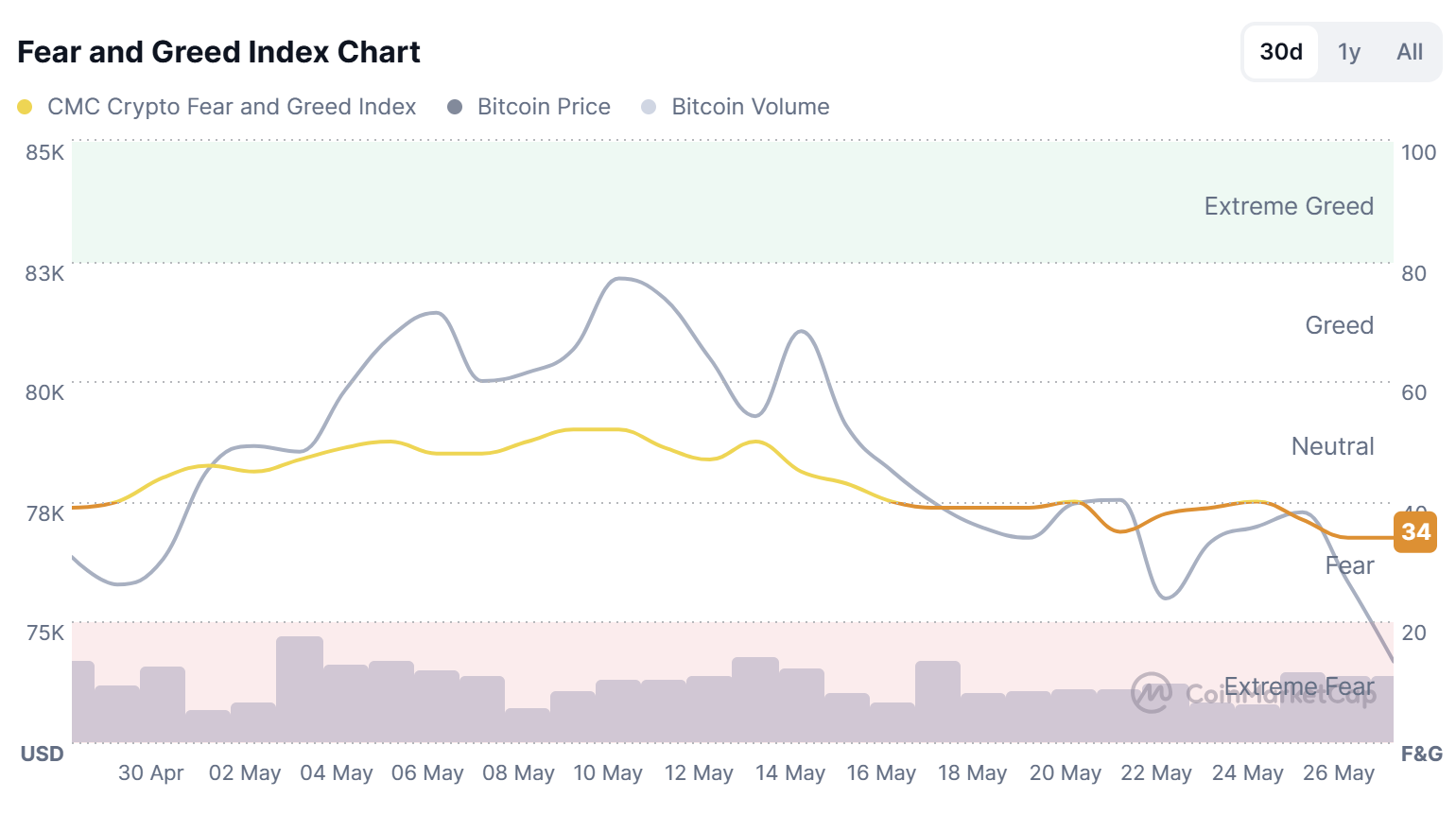
The current market Fear and Greed Index has fallen back to 34, indicating a state of panic.
Data from Coinglass shows that total liquidations across open contracts on all networks reached $470 million in the past 24 hours, with long positions accounting for $420 million in liquidations.
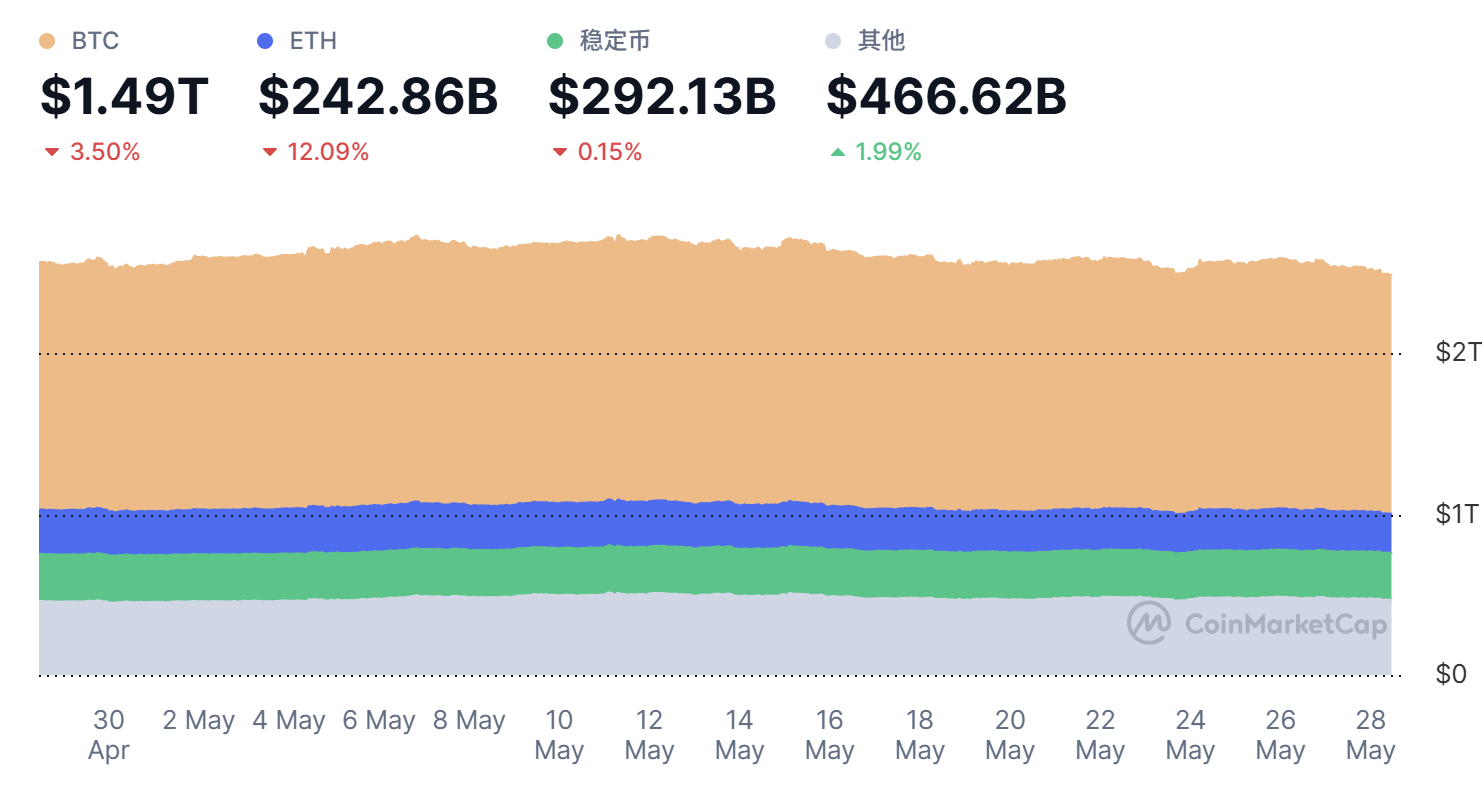
Over the past few weeks, Bitcoin has been oscillating within the $75,000 to $80,000 range, briefly attempting to break above $78,000 but failing to establish a foothold. In the crypto market over the last 30 days, BTC has dropped 3.5%, ETH has fallen approximately 12%, and stablecoins have also declined by 0.15%.
On the macro data front, Brent crude oil edged up to $97/barrel, silver dipped slightly to $73, and the Dow Jones Industrial Average rose 182.60 points (+0.36%), hitting a record high. The S&P 500 index gained 1.24 points (+0.02%). The Nasdaq Composite Index stood at 26,674.73, up 18.55 points (+0.07%). Spot gold lost the $4,400/ounce level for the first time since March 27, falling over $50 intraday, a decline of 1.25%.
US-Iran Conflict "Reignites"
Geopolitical risks in the Middle East have emerged as another significant external variable. Since 2026, tensions between the US, Iran, and related parties over issues like Iran's nuclear facilities and the safety of navigation in the Strait of Hormuz have alternated between escalation and de-escalation. In recent months, the US has adopted a strategy combining military action and diplomatic pressure, accompanied by airstrikes, rumors of port blockades, and repeated ceasefire negotiations.
Even during windows of ceasefire or diplomatic progress, the market's pricing of the risk of "reignition" has not completely dissipated.
In the early hours of May 28, US President Donald Trump stated that the US would continue to control Iran's assets. Iran has started providing us with what we want. If things don't go well, Secretary of Defense Pete Hegseth will get the job done. We could end the war with Iran very quickly, and we might have to. But I don't think we need to.
Around 5:00 AM Beijing time, according to Iranian media outlet Fars News, local residents reported hearing explosions near the port of Bandar Abbas in southern Iran.
A US official told Reuters that the US military had conducted new strikes on an Iranian military base that posed a threat to US forces and commercial shipping in the Strait of Hormuz. US forces also intercepted and shot down multiple Iranian drones that threatened US forces and commercial maritime traffic.
Renewed tensions surrounding the Strait of Hormuz have once again become a focal point, exacerbating oil price volatility and putting pressure on global risk assets. In this environment, Bitcoin has exhibited more characteristics of a risk asset rather than the safe-haven function of a traditional "digital gold" – geopolitical uncertainty boosts demand for the US dollar and Treasuries while suppressing risk appetite, leading to capital outflows from the crypto market.
ETF Net Outflows Reveal Institutional Profit-Taking
Since their launch in early 2024, US Bitcoin spot ETFs have attracted cumulative net inflows exceeding $57 billion, becoming a primary channel for institutional Bitcoin allocation. However, entering May 2026, the flow pattern has clearly reversed.
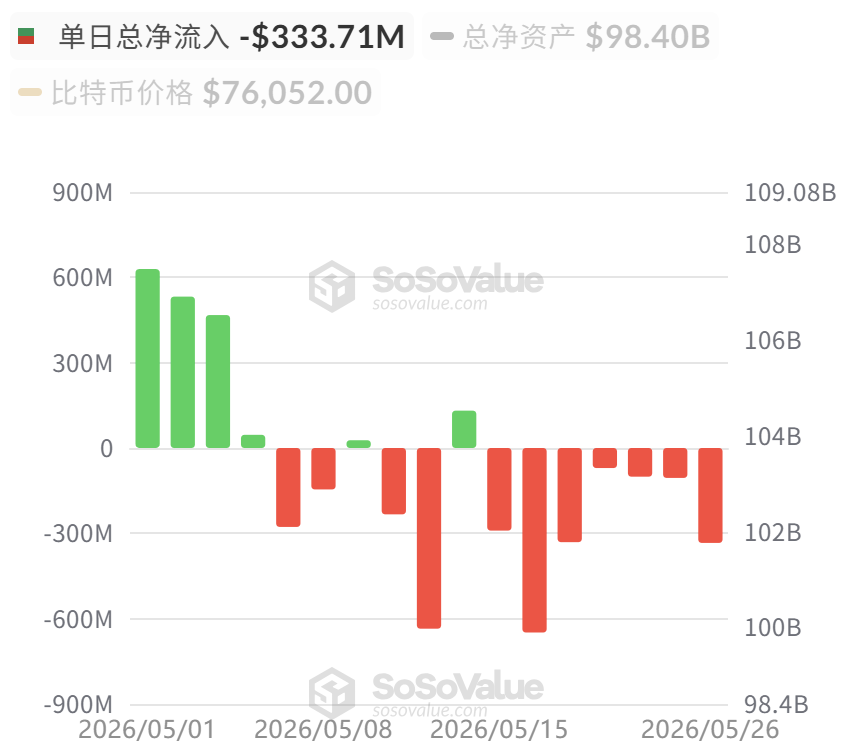
According to tracking data from SoSoValue, between May 5 and May 26, US Bitcoin ETFs recorded consecutive net outflows. The scale of daily outflows expanded from tens of millions of dollars to a maximum of $600 million, with this peak occurring twice.
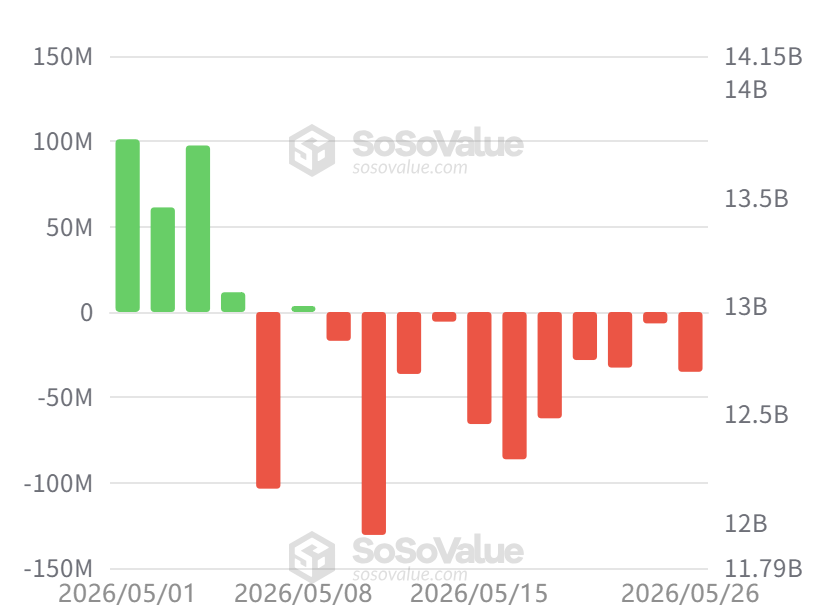
The situation for Ethereum spot ETFs is similarly concerning. Mirroring Bitcoin, they have also experienced significant net outflows since the beginning of May.
This may not be a simple case of "panic selling," but rather represents systematic profit-taking by early investors. ETF holders include traditional asset managers, family offices, and hedge funds. After Bitcoin recovered from its lows to the $75,000-$80,000 range, many chose to lock in profits through the redemption mechanism. Some funds may have rotated into stronger-performing AI-related tech stocks – the S&P 500 and Nasdaq indexes hit new highs during the same period, while the crypto market underperformed overall, highlighting capital reallocation within the risk asset class.
Future Outlook
Wintermute posted that BTC has seen over $1 billion in ETF outflows for two consecutive weeks (after six weeks of inflows), indicating that institutions are taking advantage of the strength to cash in on some recent positive returns. More noteworthy is AI. Nvidia delivered textbook-beating results, but saw almost no movement in after-hours trading. Incremental beats no longer move the needle. If AI momentum fades, the macro picture (record-low consumer confidence, sticky inflation, a hawkish Fed under Trump's influence) will gain more weight, and cryptocurrencies will not be immune.
BTC's long-term structure remains intact (reserves at multi-year lows, long-term holders continuing to accumulate, CLARITY progressing, HYPE doing what major early-stage tokens should do). However, short-term fund flows are driving the price, and they are currently negative. The $75,000 to $76,000 range is a critical line for BTC. Holding here would allow BTC to retest $80,000; breaking below this zone could lead to a rapid slide towards $70,000 to $72,000.
glassnode tweeted that at a price of $76,000, approximately 7.75 million BTC are in a loss position. This supply overhang is a structural characteristic of bear markets and typically only resolves when weak hands capitulate.
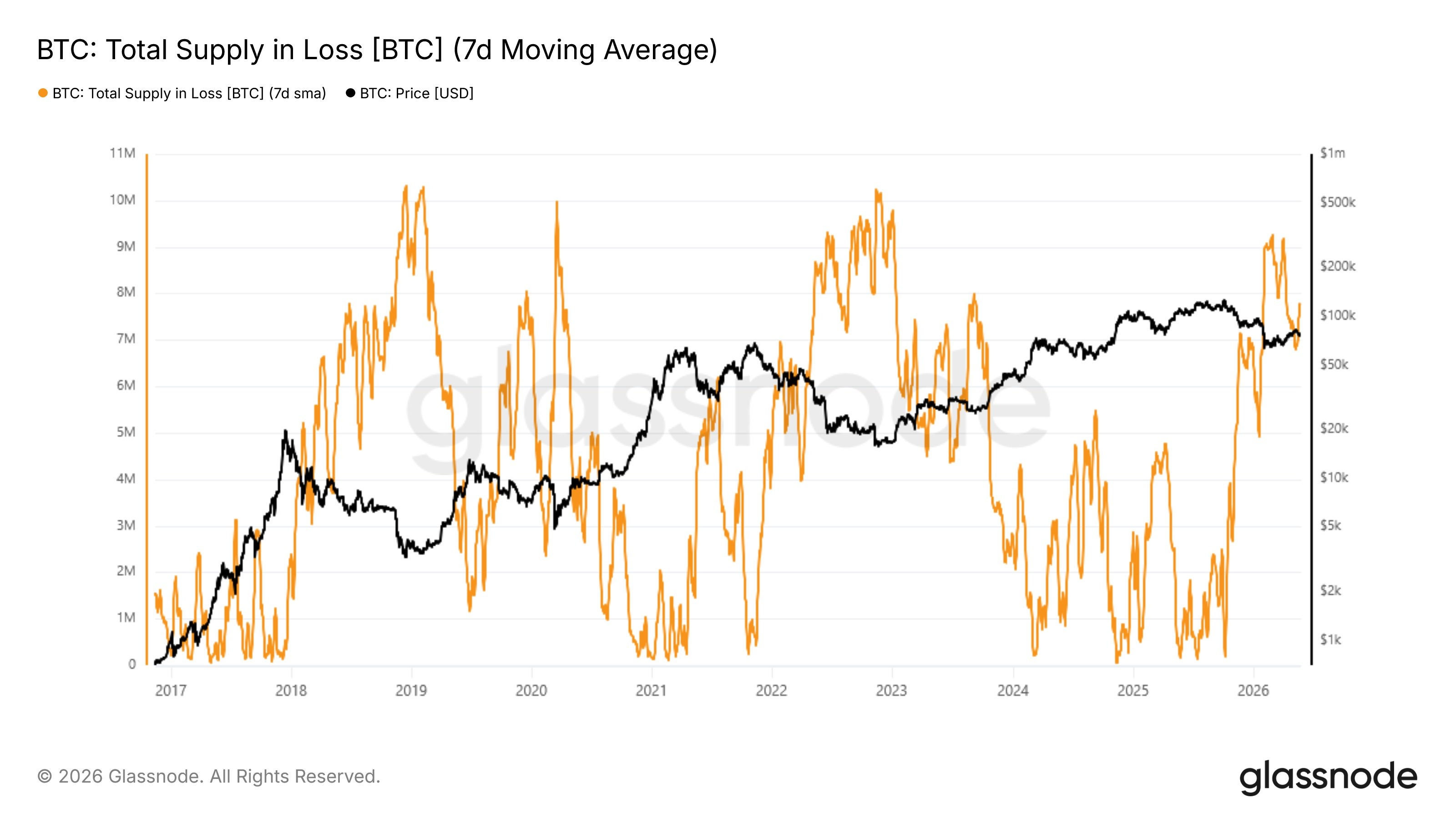
BIT tweeted that regarding Bitcoin, the sustained rally over the past period has largely depended on the tug-of-war between institutional demand and marketable supply. Over the past year, Bitcoin spot ETFs and Strategy have been significant sources of this demand. When ETF inflows accelerate and Strategy continues to increase its Bitcoin holdings, Bitcoin's price typically trends higher.
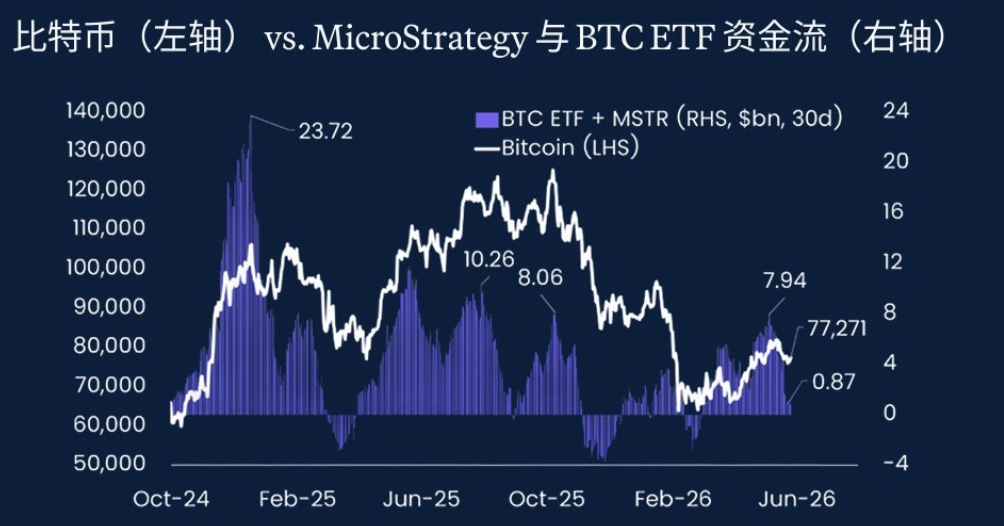
BIT stated that the combined net purchases of ETFs and Strategy have now fallen to just $870 million, primarily due to significant ETF outflows shifting from net buying to net selling. Until ETF inflows stabilize and rebound, Bitcoin's price action is likely to remain characterized by consolidation in the short term.
Analyst Murphy said that by observing the "on-chain activity weight of short-term capital" – the proportion of dollar value represented by the turnover of short-term chips – one can assess the current state of the BTC market. This indicator reflects recent speculative, arbitrage, profit-taking, or panic selling activities. Currently, this weight has dropped to historically extremely low levels, levels seen only during the deepest bear market bottoms over the past 15 years. This implies a significant cooldown in short-term turnover, with economic value shifting towards long-term holdings, indicating a market phase characterized by low volatility, accumulation, or clear bottoming features.
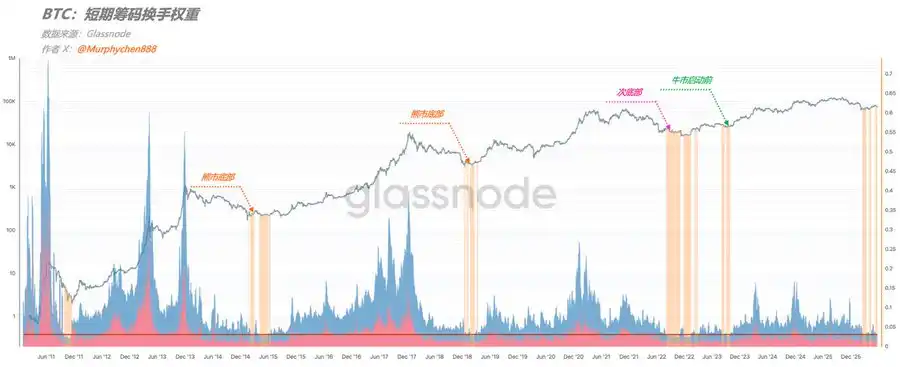
Murphy judges that based on this, the current market is likely in one of three phases: a bear market bottom; a secondary bottom, potentially with one final dip; or accumulation before a bull run. However, rational analysis temporarily rules out pre-bull run accumulation. It is currently not advisable to bet fully on a single scenario. A diversified position strategy is recommended to cope with different outcomes. The relative position on the long-term horizon indicates that Bitcoin is near its bottom.


