






From "Hantavirus" to "Sudan Ebolavirus": If Global Public Health Risks Escalate, Which US Stocks May Be Repriced?


- Core Viewpoint: Although the recent Hantavirus and the Democratic Republic of Congo (DRC) Ebola outbreaks are not a repeat of COVID-19, financial markets, based on historical memory, have begun to reassess the risks of travel-related assets and re-evaluate the value of defensive assets such as vaccines and remote work.
- Key Elements:
- The transmission mechanisms of the two public health events (Hantavirus and Ebola) differ from COVID-19. Currently, there are no signs of a global pandemic, and the WHO has not classified them as pandemics.
- Market reaction is driven by keywords such as "cruise ships," "cross-border travel," and "quarantine" that trigger memories, prioritizing a sell-off in assets tied to high human-traffic scenarios like airlines (DAL.M), online travel (ABNB.M), and offline entertainment (DIS.M).
- In the Ebola outbreak, while the historical case fatality rate (25%-50%) of the Bundibugyo strain is lower than that of the Zaire strain, its risk of stealth transmission poses a more severe challenge to the efficiency of public health response.
- The focus on defensive assets is not based on direct benefit, but on capacity reserve: vaccine platforms (MRK.M, PFE.M) reflect R&D response capability, while antiviral treatments (GILD.M) are viewed as potential solutions.
- Remote work (ZM.M, MSFT.M) is currently more of a "tail option." Its logic would only be significantly strengthened if the risk escalates from a regional level to widespread office restrictions.
- Healthcare defensive spending (UNH.M, WMT.M, COST.M), due to its inelastic demand, becomes a more stable safe haven for capital when risk appetite declines.
Recently, two public health incidents have sequentially entered the global spotlight.
First, there is the Hantavirus incident, which has been unfolding for over a month and a half. Among those affected, 18 passengers repatriated from the M/V Hondius cruise ship to the United States have been asked to remain in quarantine monitoring until May 31. Meanwhile, after some passengers disembarked, new cases were also reported in France, Spain, and Canada respectively.
Then, as one wave subsides, another rises. The Democratic Republic of the Congo (DRC) and Uganda have experienced an outbreak of Bundibugyo ebolavirus. As of this writing, the WHO has classified this outbreak as a Public Health Emergency of International Concern (PHEIC) but has clearly stated it does not meet the criteria for a pandemic emergency.
Objectively speaking, neither of these outbreaks currently shows signs of becoming a global pandemic, nor is it appropriate to simply compare them to COVID-19. However, for the markets, the impact of public health risks often begins to manifest before situations spiral truly out of control.
Historically, when public health risks intensify, the first assets to be re-evaluated are often high-liquidity ones like airlines, cruise lines, hotels, tourism, and offline consumption. Conversely, vaccines, antivirals, testing, medical equipment, PPE, remote work tools, health insurance, and essential consumer goods may re-enter the market's hedging list.
In trading, one must prepare for rain before the storm. This article attempts to draw a map of US stocks to watch under public health risks, from an asset perspective.
1. From Hantavirus to 'Subtype' Ebola: Are Global Public Health Risks Rising?
Let's first look at Hantavirus.
It is not a new virus, nor is it a highly efficient respiratory transmission virus like SARS-CoV-2. It is primarily transmitted through rodents. Humans usually become infected after contact with air, dust, or environments contaminated by rodent urine, feces, or saliva. The CDC also notes that the Andes virus is the only type of Hantavirus currently known to spread between humans, and this transmission typically occurs among those in close contact with a patient.
This is precisely why Hantavirus itself should not be simply modeled after COVID-19.
The reason the M/V Hondius cruise ship incident has garnered attention is not necessarily due to the scale of global transmission it has caused, but rather because it combines several elements that easily trigger market memory: cruise ships, enclosed spaces, international passengers, quarantine monitoring, multi-national cases, and public health department notifications.
In other words, while Hantavirus itself may not share the transmission dynamics of COVID-19, the combination of keywords 'cruise ship + international travelers + quarantine + multi-national response' naturally reminds the market of the impact path early public health incidents had on airlines, cruises, tourism, and offline consumption back in 2020.
Next, consider the Bundibugyo ebolavirus.
As is well known, Ebola is a disease with an extremely high fatality rate. WHO data shows that the case fatality rate in historic Ebola outbreaks has ranged from 25% to 90%, with the Bundibugyo virus, Sudan virus, and Zaire virus all being types known to cause major Ebola outbreaks.
However, Bundibugyo ebolavirus is not a new virus either. It was first discovered in Uganda in 2007, reporting 131 cases and 42 deaths, with a case fatality rate of about 32%. Recent CDC FAQs also mention that the historical case fatality rate for Bundibugyo virus disease is roughly between 25% and 50%.
This means that, compared to the more common and deadly Zaire ebolavirus, the historical fatality rate of Bundibugyo virus is relatively lower. But the problem is that 'lower' does not equal 'low risk.' A historical case fatality rate of 25% to 50% is already enough to put any public health system on high alert. Here's a little-known fact about public health that is often overlooked:
For a virus, being 'more lethal' does not necessarily equate to 'easier spread.' If a virus quickly makes patients severely ill, dead, or incapacitated, it might be detected earlier by the healthcare system. Conversely, a virus with a relatively lower fatality rate and early symptoms resembling common fever or muscle aches, coupled with delays in testing, community mobility, and cross-border travel, might actually have a longer window for stealthy transmission.
This is precisely the risk of the Bundibugyo ebolavirus. Although its historical fatality rate is lower than that of the Zaire type, 25% to 50% is still an extremely high level. Furthermore, it currently faces challenges like insufficient specific vaccines and therapies, difficulty in early identification, an increase in suspected cases, and the risk of cross-border transmission. Therefore, it may not be a 'more ferocious' Ebola, but it could be the type that truly tests the efficiency of public health response.
This is one of the reasons why this outbreak has garnered more attention than many past Ebola incidents.
Overall, while there is currently no clear evidence that we are facing another global systemic pandemic shock, under the shadow of latent public health risks, the US stock market may have reached a point where it needs to re-evaluate risk premiums.
2. Travel Chain Under Pressure: Highly Sensitive Consumption Scenarios Priced First
Once public health risks enter the market's field of vision, the first assets to be scrutinized are often not pharmaceutical companies, but assets highly correlated with 'people flow / travel / gathering.'
The reason is simple. These companies may not face an immediate earnings hit, but they are most sensitive to risk expectations. As soon as the market begins to discuss cross-border monitoring, travel advisories, and a decline in offline foot traffic, related assets are easily treated as risk exposures first.
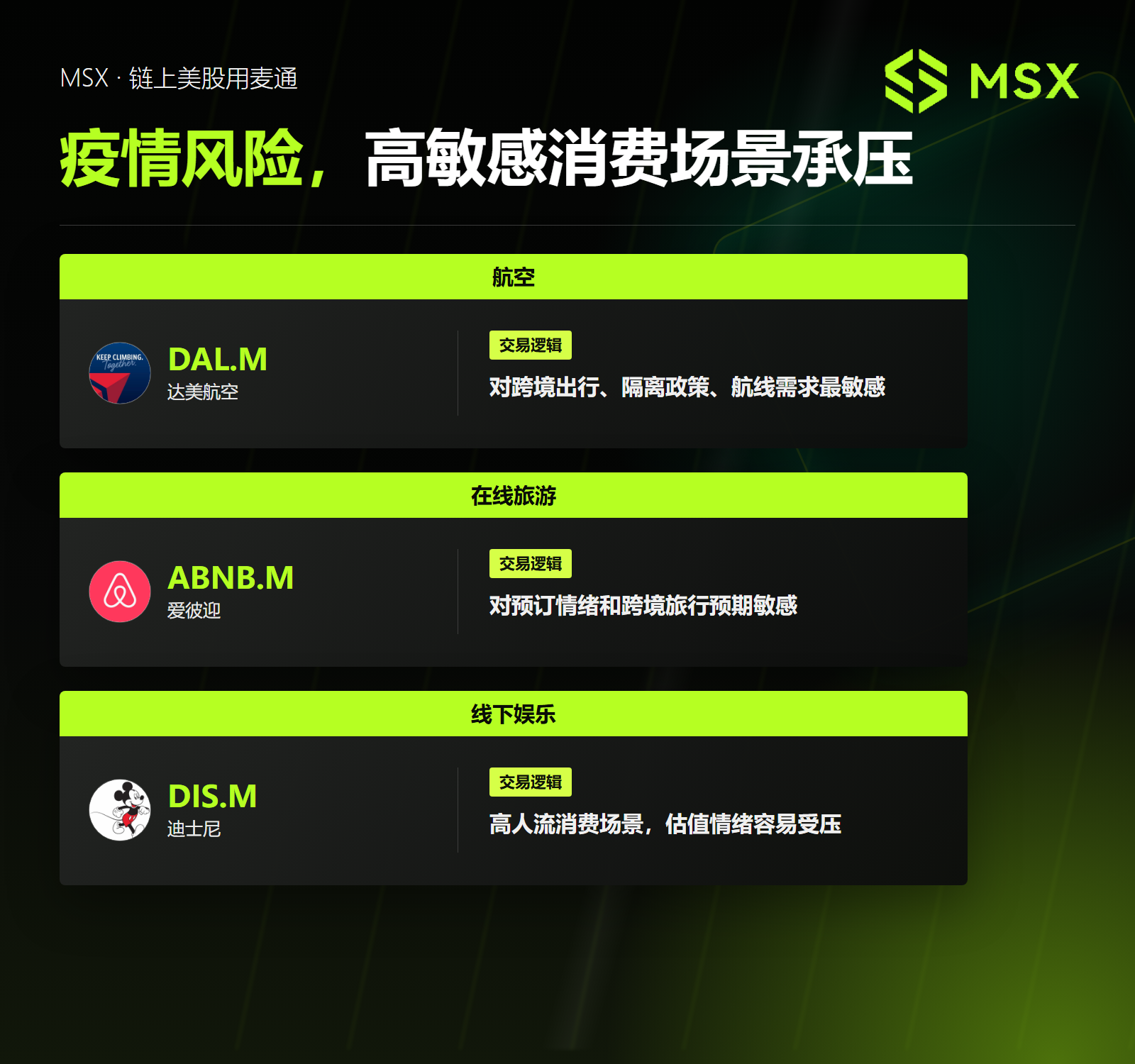
First are airlines.
Airlines, represented by DAL.M, are highly sensitive to cross-border travel, quarantine policies, route demand, and business travel expectations. After all, an airline's business model heavily relies on passenger load factors and aircraft utilization (fuel costs were already in a fragile state due to high oil prices). Once the market starts worrying about escalating public health risks, capital may apply a discount to airline valuations immediately, even without large-scale flight suspensions or travel bans.
This is not to say that airline fundamentals will deteriorate immediately, but rather that airlines are naturally at the forefront of the public health risk transmission chain. Especially in the current macro environment, airline stocks are already affected by both oil prices and consumer resilience. If a public health event is added on top, the market is more likely to interpret them as 'highly sensitive assets.'
Secondly, online travel.
ABNB.M represents another type of asset more tied to consumer expectations. Compared to traditional airlines and hotels, Airbnb's business model is more decentralized and not exactly analogous to a single hotel chain. However, it is highly correlated with leisure travel and longer-term stays. Of course, the impact of public health risk on ABNB.M may not manifest as an immediate ban on stays in a certain country, but rather through changes in travel planning cycles and consumer risk appetite.
If users start worrying about cross-border travel or flight uncertainty, the first thing to change is often not the consumption that has already occurred, but the bookings that haven't happened yet. In other words, online travel platforms essentially trade on 'future travel intentions.' Once public health risks rise, these assets are easily used by the market to price in expectations of a tourism consumption cooldown.
Third is offline entertainment.
DIS.M is one of the most typical representatives in this category. Disney, of course, is not purely an offline consumption company; it also has streaming, content, IP, and film businesses. But from a public health risk perspective, the most sensitive part for the market remains its theme parks, resorts, offline entertainment, and family travel scenarios.
The common characteristic of these businesses is high foot traffic, long dwell times, and strong family consumption attributes. When public health risks heat up, the market naturally thinks about changes in family travel plans and offline entertainment spending.
Similarly, this is not to say that DIS.M will suffer an immediate material impact from a single regional outbreak, but rather that it is easily placed by the market into the 'high-traffic consumption scenario' basket for re-evaluation. Especially when overall market risk appetite declines, the valuation sentiment for offline entertainment often reacts earlier than actual operating data.
However, it must be reiterated that, at least as of this writing, the current public health risk has not yet evolved into global travel lockdowns. For example, the WHO does not recommend simply treating this Ebola outbreak as a reason for comprehensive border closures or flight suspensions. The core response measures remain risk communication, travel health notices, border surveillance, case identification, laboratory testing, and preparation of isolation facilities.
Therefore, for airlines, online travel, and offline entertainment, the current situation is more about an adjustment in risk premiums at the sentiment level, rather than a confirmed fundamental collapse. The real variables to watch are threefold:
- Whether more cross-border imported cases will appear;
- Whether any major countries will raise travel advisories or strengthen entry screening;
- Whether airports, seaports, hotels, and high-traffic consumption venues begin implementing stricter prevention and control measures;
If these variables continue to escalate, travel chain assets could be among the first batch of targets to be re-priced in the US stock market, and their impact may gradually transmit to other asset classes easily framed as 'risk exposures' by pandemic narratives.
3. Defense Chain Heats Up: Capital Seeks Public Health 'Insurance Assets'
Corresponding to the pressure on the travel chain is the heating up of the defense chain.
After public health risks emerge, the market often looks for the most familiar 'insurance hedging directions' amidst uncertainty. These can be mainly divided into four categories: vaccine platforms, antiviral/candidate therapies, remote work tools, and healthcare & defensive consumer goods.
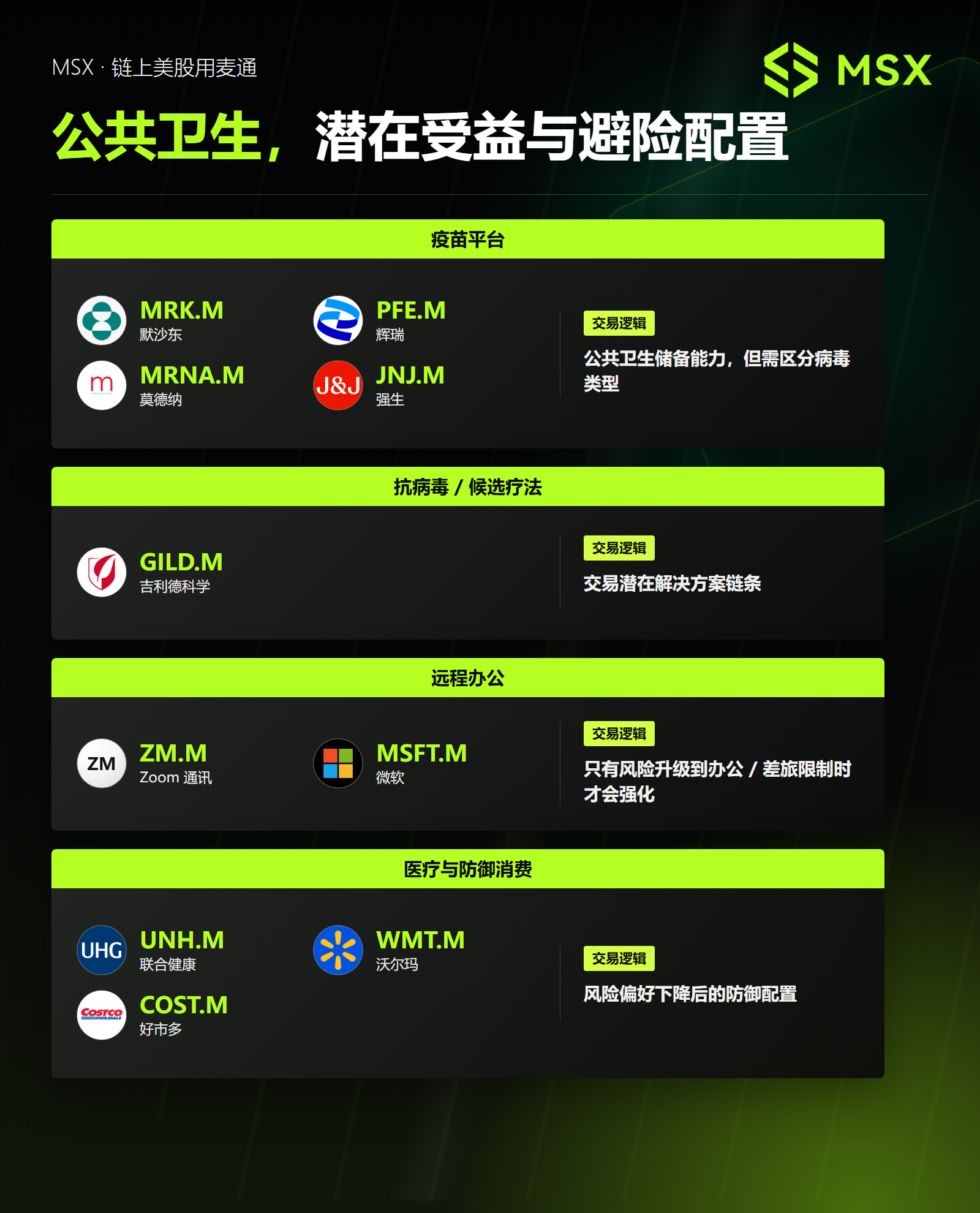
First, vaccine platforms. MRK.M, PFE.M, MRNA.M, JNJ.M are the most easily recalled group of targets for the market. They collectively represent large pharmaceutical companies, vaccine research and development, production platforms, and public health stockpile capabilities.
However, it is worth noting that the current attention is on the Bundibugyo ebolavirus, not the more common Zaire ebolavirus. Taking MRK.M as an example, Merck's ERVEBO is an approved Ebola vaccine but is primarily targeted at the Zaire ebolavirus, which does not mean it directly covers all types of Ebola viruses.
Therefore, MRK.M is better understood as a representative of 'Ebola vaccine stockpile capability' and 'public health asset,' rather than being a direct solution to this particular Bundibugyo outbreak. PFE.M, MRNA.M, and JNJ.M follow a similar logic. They are not in the spotlight because they have a definitive solution for this specific event, but because large pharmaceutical companies and vaccine platforms naturally enter the market's purview during public health incidents.
In other words, the trading logic here isn't about single-drug revenue, but rather the R&D, production, and stockpile response capabilities under public health risks.
Secondly, antiviral drugs and candidate therapies.
In the final list of targets, GILD.M can serve as a representative. Gilead has a strong antiviral R&D reputation, and the market tends to place it under the 'potential solution' chain for observation during public health events. However, the trading logic for this type of asset is also more about potential solutions than imminent short-term profits.
Especially for diseases like Bundibugyo ebolavirus, which currently lack approved specific vaccines and therapies, the market will focus more on candidate drugs, trial progress, potential emergency use authorizations, and procurement expectations from public health agencies. In other words, the value proposition for GILD.M isn't about how much revenue a single outbreak can generate immediately, but rather that when public health risks escalate, capital will re-evaluate the strategic value of antiviral R&D capabilities themselves.
Third is remote work.
ZM.M and MSFT.M represent a very familiar memory line from 2020 for the market. If offline office work, business travel, cross-border meetings, and business trips are restricted, companies would rely again on video conferencing, online collaboration, cloud office, and digital work tools. However, this time around, remote work seems more like a tail risk option rather than a core asset. The reason is that the current public health events have not yet evolved into widespread office restrictions or a stage forcing a global restructuring of corporate operations.
If the risk remains confined to local areas, specific travel scenarios, and regional outbreaks, remote work assets are unlikely to replicate the extreme market movements of 2020. Therefore, for ZM.M and MSFT.M, the remote work logic will only significantly strengthen if the public health risk escalates from a regional event to one causing office restrictions and corporate operational adjustments. Until then, it remains a backup hedge in market memory, not the primary theme.
Fourth is healthcare and defensive consumer goods.
UNH.M, WMT.M, COST.M represent another type of asset that comes into play when risk appetite declines: those with more stable cash flows, more inelastic demand, and stronger defensive characteristics.
UNH.M corresponds to health insurance and the medical payment system. It is not simply a 'pandemic beneficiary stock' in the traditional sense, as public health events can also lead to changes in healthcare utilization, claim costs, and operational pressures. However, when risk appetite falls, assets related to medical payments, health security, and healthcare services are generally viewed by the market as a more stable direction compared to discretionary consumption.
WMT.M and COST.M correspond to essential consumer goods and the logic of household restocking. When public health risks escalate, consumers may reduce non-essential outings and high-risk consumption, but demand for daily necessities, food, medicine, household supplies, and membership-based retail often proves more resilient.
Overall, 'insurance assets' under public health risks are not limited to pharmaceutical stocks. Instead, they form a more complete defense chain: the front end being vaccines and antivirals, the middle being operational substitutes like remote work tools, and the back end being medical payments and essential consumption.
Final Thoughts
Objectively speaking, the transmission logic of Hantavirus and Bundibugyo ebolavirus is completely different from that of COVID-19.
Hantavirus is more related to rodent exposure, while Bundibugyo ebolavirus primarily spreads through bodily fluids and close contact. Neither should be simply modeled after the COVID-19 pandemic of 2020.
But financial markets never wait for all the facts to be completely confirmed before reacting.
Once the wind shifts, they often conduct a rapid rehearsal of the transmission chain based on historical memory. For example: airlines, cruises, hotels, and tourism consumption get suppressed first; vaccines, antivirals, testing, PPE, medical equipment, and remote work regain imagination; health insurance, pharmacies, essential consumer goods, and defensive assets are re-evaluated as risk appetite declines.
It is precisely for this reason that public health events may not become long-term themes, but they are sufficient to change capital's risk appetite during period-specific trading.
So, against the backdrop of intertwined themes like AI, interest rates, and geopolitical conflicts, whether global public health risks are re-entering the pricing framework might just be becoming a dark horse that the US stock market hasn't actively traded in a long time.


