






Kelp DAO’s $400 million Bad Debt was Covered, but Aave Paid a $12 Billion Price


- Core Insight:Although Aave managed to backfill assets after the rsETH incident, it now faces a triple challenge: a loss of over $12 billion in TVL, pending legal disputes in a New York court, and internal governance friction. Its future growth depends on V4’s openness to heterogeneous scenarios and Horizon’s institutional RWA roadmap. However, both paths are constrained by external pacing and internal politics, making it difficult to restore market confidence in the short term.
- Key Factors:
- After the rsETH incident, Aave’s TVL dropped from $26.396 billion on April 18 to $14.181 billion on May 25, a loss of over $12 billion.
- The U.S. District Court for the Southern District of New York is scheduled to hold a hearing on June 5 regarding the ownership of the 30,766 ETH frozen by the Arbitrum Security Council, exposing Aave to legal and reputational costs.
- DeFi United rallied multiple parties to provide financial support to Aave, but the community has exhausted its emergency response capacity and cannot replicate a bailout of the same scale.
- Whale users like Justin Sun have withdrawn approximately $174 million from Aave to Spark, indicating a clear capital migration trend and a loss of trust from major clients.
- Deposit growth has been slow since the launch of V4 (reaching $86.13 million on May 26), and internal governance friction due to bundled voting proposals has hindered the speed of openness.
- Horizon, a permissioned V3 instance focused on institutional RWA, had accumulated over $500 million in net deposits by May 26, with partners including BlackRock, but its growth is constrained by the pace of traditional finance integration.
- Competitors Morpho and Spark regained TVL after the rsETH incident, capturing the lending demand lost by Aave and forming a long-term competitive dynamic.
原文作者:Sanqing,Foresight News
On May 26, Kelp DAO transferred the final batch of 20,373.72 rsETH to the LayerZero OFT Adapter, and Aave simultaneously announced that rsETH and all affected markets had returned to normal. In 37 days, all 116,500 rsETH were fully replenished.
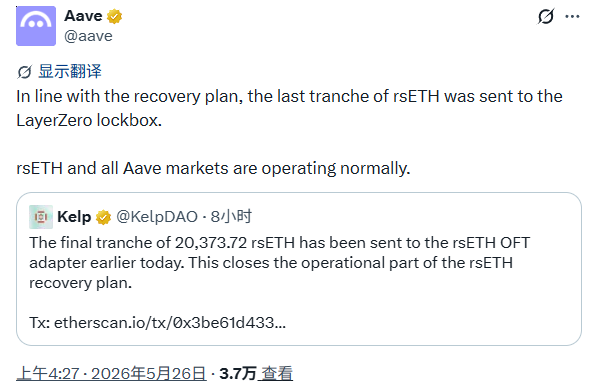
However, this only means rsETH has regained its 1:1 backing; it does not mean Aave's balance sheet is entirely cleared. The 30,766 ETH frozen by the Arbitrum Security Council remain tied up in the U.S. District Court for the Southern District of New York, with ownership still undetermined. Aave's lost TVL cannot simply return along with the rsETH.
The Bill Goes Beyond the TVL Column
According to DefiLlama data, on April 18, the day of the incident, Aave's TVL stood at $26.396 billion. By May 25, it had dropped to $14.181 billion. Over a month later, more than $12 billion in value had not returned.

The more difficult challenges lie ahead. The U.S. District Court for the Southern District of New York will hold a hearing on June 5 regarding the ownership of the 30,766 ETH frozen by the Arbitrum Security Council. Both Aave LLC and Gerstein Harrow submitted supplementary briefs before May 22. While the judge modified a restraining notice on May 8 to allow fund transfers, the substantive ruling will not be determined until June 5.
Gerstein Harrow represents the families of North Korean terrorism victims and holds an unsatisfied judgment of $877 million. Regardless of the outcome of this lawsuit, it represents a drain on the Aave brand.
The formation of DeFi United this time was possible because multiple parties were willing to backstop it: Stani Kulechov contributed 5,000 ETH personally, Consensys and Joseph Lubin pledged up to 30,000 ETH, the Aave treasury allocated up to 25,000 ETH, plus a credit line of up to 30,000 ETH from Mantle, and support from Lido, Ether.fi, and others.
The scale of community mobilization was unprecedented, but Aave has expended this one-time card. If another upstream contamination event occurs next time, the same roster of rescuers may not be assembled.
For example, after the incident, Justin Sun withdrew approximately $174 million (including 65,854 ETH and various stablecoins) from Aave to Spark, accumulating over $1.3 billion in total deposits on Spark. Whales are voting with their feet, and capital has already migrated.
V4's Openness is Being Slowed by Governance
Aave has more than just V4 as a counterpunch, but V4 is the most critical one.
V4 went live on the Ethereum mainnet on March 30, featuring a Hub-and-Spoke architecture with three initial Liquidity Hubs. Aave Labs has committed to a "security-first growth" strategy, gradually increasing deposit caps. The protocol surpassed $10 million in deposits on April 8, crossed $50 million on May 9, and as of May 26, total deposits stood at $86.13 million, with active lending positions at $27.77 million.
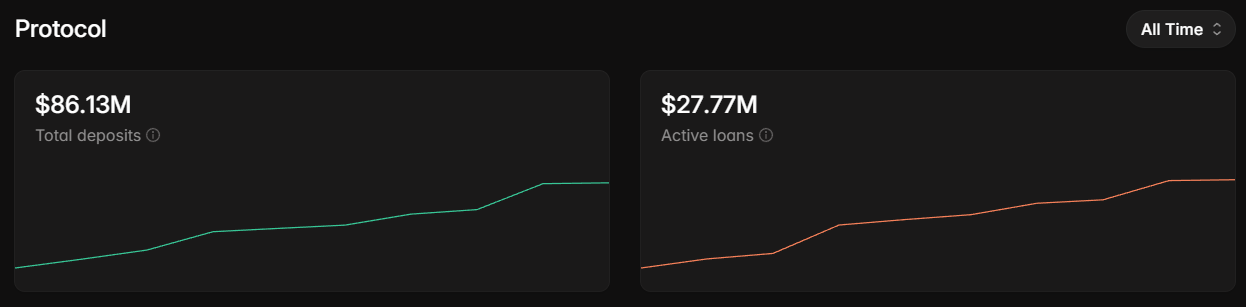
This measured pace was a responsible design choice before the rsETH incident, but afterward, it turned into a stress test. Aave is grappling with $200 million in bad debt on V3 while cautiously expanding caps on V4.
More critically, V4 also faces internal friction within its own governance layer. In February 2026, Aave Labs submitted a strategic proposal bundling together product revenue, service provider incentives, the V4 growth engine, and brand legal custody, requiring delegates to vote on four distinct risk dimensions at once.
Marc Zeller, founder of the Aave Chan Initiative, publicly questioned the appropriateness of bundling massive funding requests with strategic approvals. This governance dispute has continued to simmer around the V4 launch, with each delay allowing competitors to eat further into Aave's market share.
V4's strength lies in the openness of its Spoke design: anyone can build a Spoke, and if it meets the conditions, it can connect to the Liquidity Hub as a credit line. This is why Babylon Labs chose to integrate its Trustless Bitcoin Vaults into V4 instead of another platform. However, the speed at which this openness translates into substance depends on governance keeping pace.
Beyond V4, Aave is Fighting Three Battles
Aave V3 remains the cash cow, generating over $100 million in annualized revenue and housing $14.1 billion of the total TVL. The "Aave will win" proposal positions V3 in a "stable maintenance" phase, and Stani has publicly committed to no forced migration and no deadline.
V4 and V3 will run in parallel for at least 24 to 36 months. V4 acts as an additive supplemental layer, handling heterogeneous use cases that V3 cannot accommodate. Horizon is a separate permissioned fork of V3, specifically designed to serve institutional RWA.
Each of the three layers targets different incremental growth. V4 aims to capture new scenarios that V3's risk architecture cannot handle, and after the rsETH incident, it has an added task: giving capital that migrated to Morpho and Spark a reason to return to Aave. Horizon targets RWA flows from traditional finance, operating in a completely separate pool from V3 and V4.
The Horizon Market officially launched in August 2025 as a permissioned instance of V3 deployed by Aave. It allows institutions to use tokenized treasuries, corporate bonds, and money market funds as collateral to borrow stablecoins like USDC, GHO, and RLUSD.
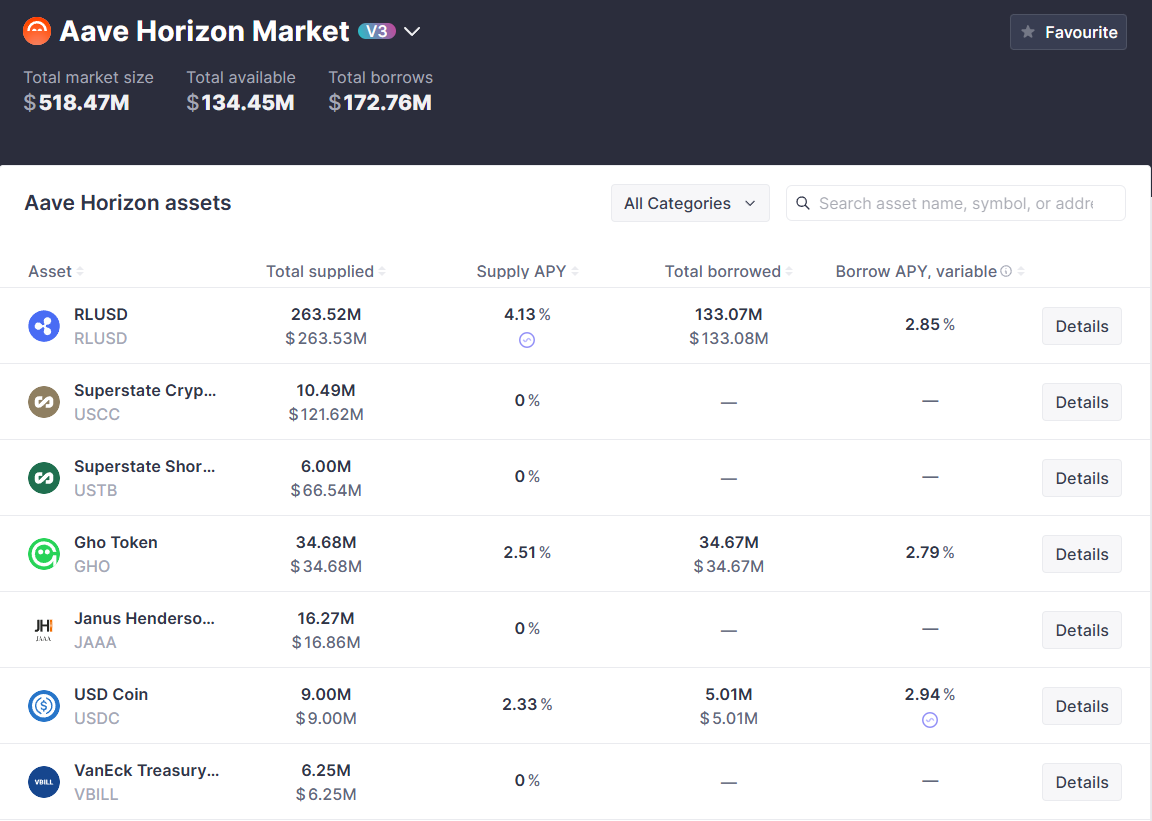
As of May 26, Horizon has accumulated over $500 million in net deposits, targeting a milestone of $1 billion by the end of 2026. Partners include BlackRock, Franklin Templeton, Circle, Ripple, and VanEck.
This approach diverges from Morpho's vault management model. Morpho uses third-party curators like Steakhouse and Gauntlet to curate vaults that capture lending flows from retail institutions like Coinbase. Aave, through Horizon, directly connects with asset managers in traditional finance to onboard RWA.
These two paths target different institutional client profiles. Morpho serves fintech companies that use on-chain lending as a tool. Aave serves asset managers that view the blockchain as an issuance venue.
The capital migration following the rsETH event primarily affected the first type of client. The second type faces higher migration costs and reacts more slowly. The compliance framework, KYC processes, and asset onboarding audits that Aave has accumulated on Horizon are things Morpho cannot replicate in the short term after the event.
This is Aave's only growth line not directly impacted by the rsETH incident, but its growth depends on the pace at which traditional finance integrates with DeFi.
There is No Second DeFi United
Aave remains the largest protocol in the lending market. Its $14.1 billion in TVL is still nearly double that of Morpho, and the deep deployment footprint accumulated over years is unmatched by competitors in the short term.
However, the bill from the rsETH incident isn't on the balance sheet; it's in the column of institutional default preferences for lending protocols. Spark's TVL rose from $3.727 billion to $5.3 billion in one month, and Morpho slowly climbed back to pre-incident levels after bottoming out on April 21. These numbers will not automatically flow back just because Aave's markets have recovered.
The speed at which V4 delivers on heterogeneous use cases, combined with the progress of Horizon in institutional RWA, will determine whether Aave can win back lost market share. However, the former is bottlenecked by governance infighting, and the latter by the internal integration pace of traditional finance. For both, Aave can only wait.
DeFi United was not a permanent institution; it was a one-time mobilization.


