美股喊單王Serenity:領先機構低位建倉,年回報3840%


- 核心觀點:本文介紹了匿名交易者Serenity透過其獨創的「供應鏈瓶頸(Chokepoint)投資法」,在美股AI半導體領域取得超常收益(年內報酬率3840%),並引發市場對其真實性及動機的廣泛討論。
- 關鍵要素:
- Serenity自稱前WSB交易者與AI專家,2024年5月粉絲達35.8萬,其公開收益率(年內3840%、兩年2256%)遠超市場平均水準。
- 其核心策略「瓶頸點投資法」聚焦於AI產業鏈中具有不可替代性、未被充分定價的上游「隱形冠軍」企業,如光模組、矽光、儲存等賽道的21檔持股均獲利超過100%。
- Serenity公開拒絕付費社群和實盤展示,僅以收益率驗證其論點,引發市場對其「拉高出貨」操縱小市值股票的質疑,但其解釋稱旨在對抗機構、提前分享資訊。
Original | Odaily Planet Daily (@OdailyChina)
Author|Golem (@web3_golem)
As an investor focused on US AI and semiconductor stocks, if you haven't heard of Serenity yet, chances are your research is still lagging behind.
Why is that? Because Serenity is currently the hottest US stock picker on the internet, from retail investors to Wall Street — almost everyone reads his reports and follows his trades. Some have even packaged his free public opinions into paid courses sold within communities.
On May 24, Serenity disclosed his investment performance for this year on platform X: a year-to-date return of 3840.39%. Just the day before, he had also shared his return over the past two years, which stood at an astonishing 2256.99%.
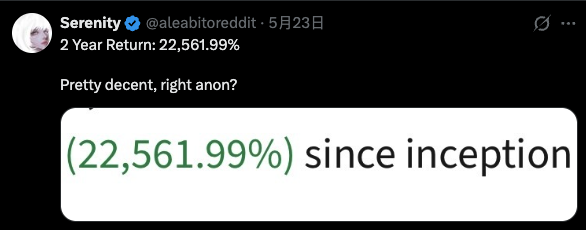
Serenity: "Leagues Ahead"
Serenity joined X in July 2025, and by May of this year, his followers had surged to 358,000, with over 32,000 subscribers — just shy of 15,000 fewer subscribers than Elon Musk. Yet, no one knows Serenity's true identity. All insights into his background come from his own bio:
- A former Reddit WSB trader who moved to X (Editor's Note: Wall Street Bets is the largest retail trading community in the US. Serenity was banned for recommending a stock called AXTI in 2022, which has since gained over 700% year-to-date);
- AI and semiconductor supply chain analyst, former RISC-V Foundation member, former AI research scientist;
- Now primarily trades "overlooked bottlenecks";
From his bio, it's clear that Serenity positions himself as an AI expert. He once claimed to have turned down a job offer from NVIDIA's AI team in 2018. In one post, he stated that his investment decisions are based on a thorough understanding and research of the AI and semiconductor industries. His typical research process: start with initial paper research, translate those ideas into practical plans and trades, follow up with due diligence on the alpha, and finally, celebrate when the stock rises.
As shown below, community user @kaikaibtc compiled Serenity's main holdings, primarily focused on sectors like optical modules, silicon photonics, storage, CPO, and substrates within the AI supply chain. None of these 21 stocks have yielded a profit lower than 100%. His most frequently mentioned and longest-held stock, AXTI (called out for over 2 years), has even yielded over 10,000%. He has publicly stated that AXTI is his most legendary trade.
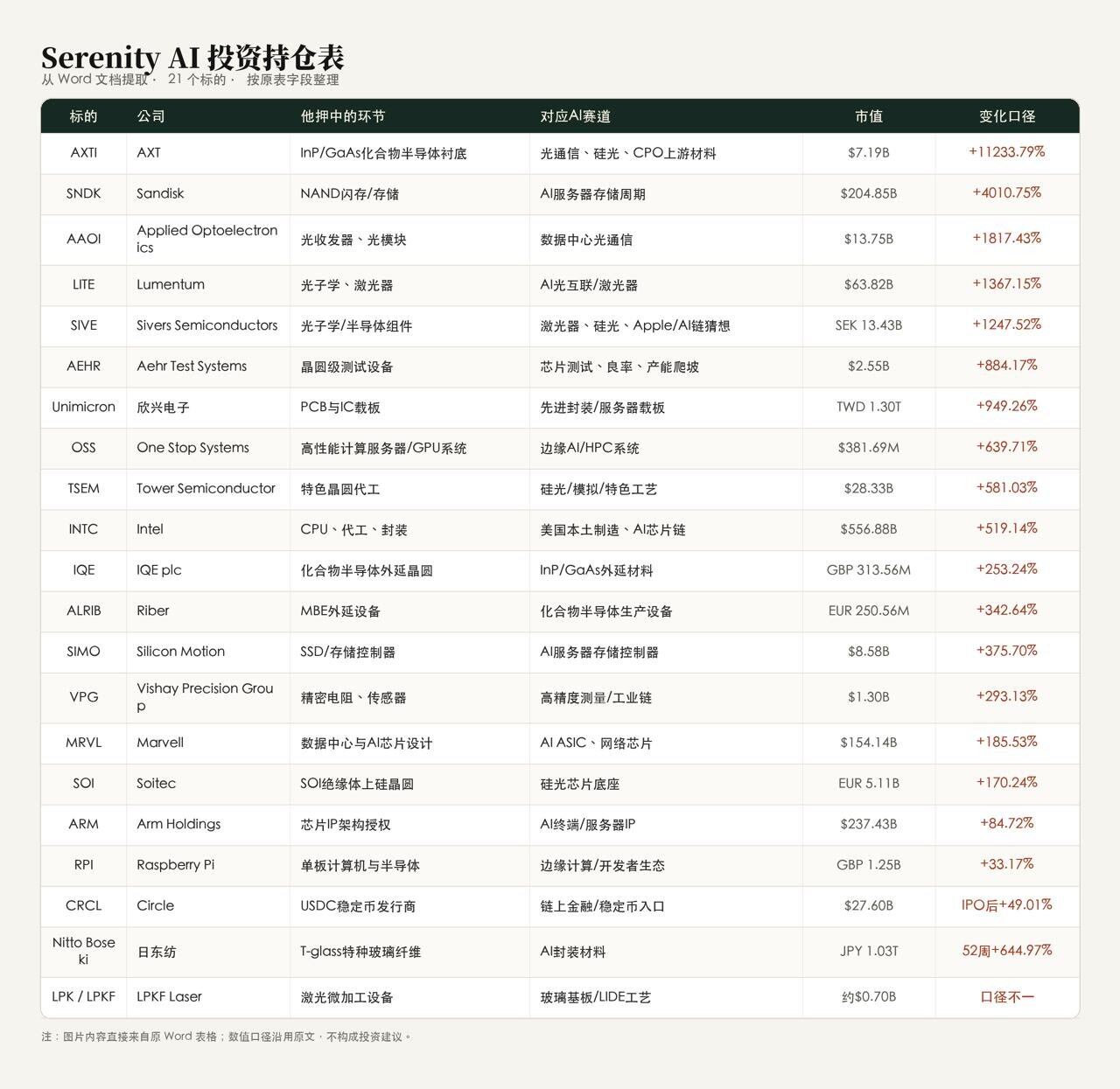
However, what's even more remarkable than these extreme profits is the fact that before Serenity uncovered these targets, not only were retail investors unaware, but institutions hadn't entered either.
When Serenity initially posted calls for certain stocks, he was often met with skepticism. It was only months or even a year later, when investors saw the stocks' phenomenal performance, that they belatedly realized he was right. RPI, AXTI, SIVE are all vivid examples. After such cases repeated, Serenity's account naturally became essential daily reading for retail investors, Wall Street, and even Silicon Valley investors.
How does Serenity consistently stay ahead of the market and uncover undervalued stocks? His secret lies in his self-built Chokepoint investment theory.
The Chokepoint Investment Method
Chokepoint is the most frequent word in Serenity's posts and his core investment logic.
AI is undoubtedly the world's dominant narrative today, but the AI industry suffers from a clear supply-demand imbalance. On one hand, internet giants are pouring money into AI infrastructure in an "arms race." On the other hand, supply is noticeably insufficient, with NVIDIA's orders even entering a "rationing system." Capital has realized that at this stage, AI development hinges not on the downstream, but on the upstream supply chain. Companies that hold critical, irreplaceable positions in the AI supply chain are most deserving of revaluation.
Consequently, over the past few months, market hype around the AI industry has moved from initial GPU computing power down the chain layer by layer: first to storage, data centers, and optical modules, then further down to power, materials, and network equipment. This approach of deconstructing the AI supply chain and identifying key "bottleneck" companies at each link is essentially Serenity's Chokepoint investment method, only he acts much earlier than most retail investors and institutions.
On March 31, Serenity used an analogy to vividly explain what a chokepoint is while calling out AXTI. He compared it to the Strait of Hormuz, through which over 20% of the world's crude oil supply passes. The Strait is a critical chokepoint in global energy trade. Similarly, AXTI's role for AI optical module companies is analogous to the Strait of Hormuz's role for global energy trade.
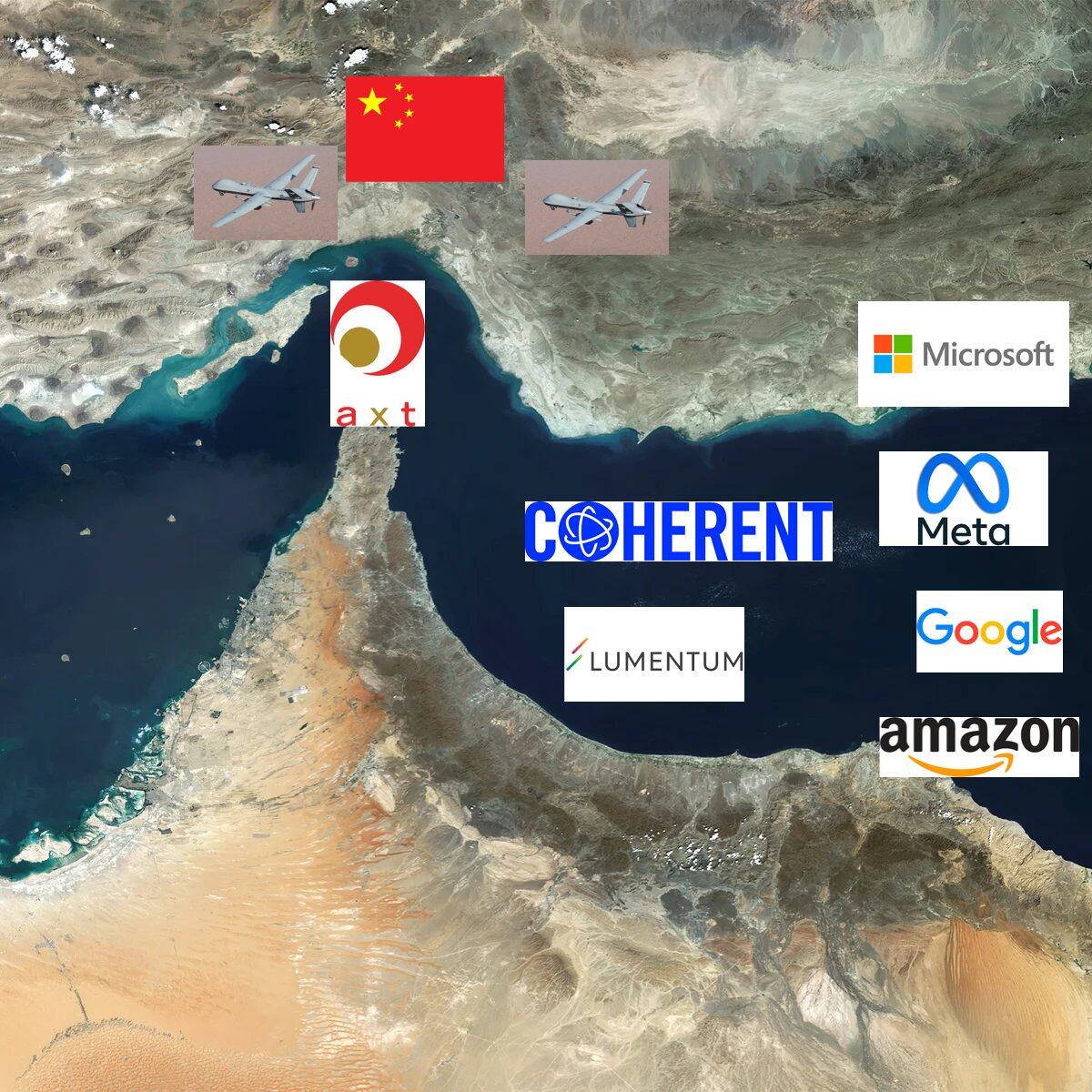
The essence of Serenity's ability to achieve excess returns still stems from market information asymmetry. He uses sharp thinking and foresight to seek out "hidden champions" along the AI supply chain that are not yet fully priced in. These companies may not be as dazzling as giants like NVIDIA, Micron, or SK Hynix, but they are small monopolies whose shortage or shutdown would cause seismic shocks to the trillion-dollar downstream AI industry.
For example, when Serenity called out IQE in February-March this year, he repeatedly stated that both IQE and Landmark are major photonic chip epitaxial wafer foundries, but IQE's overall capacity is much larger than Landmark's. At that time, Landmark's market cap was around $3.8 billion, while IQE's was only $135 million.
It's worth noting that Serenity is not a superhuman who knows every link in the AI supply chain intimately. He often mentions using AI to assist in his AI supply chain research, including deconstructing the industry chain, uncovering suppliers, and debating viewpoints with AI.
True Legend or "Photoshop Master"?
In the investment world, over-mythologizing anyone is extremely dangerous. Serenity's win rate is not 100%. Stocks he recommended early this year, like CPSH and INFQ, experienced significant drawdowns in February and March. Rather than blindly copying his holdings, retail investors and traders should learn from his research framework and mindset, develop their own system, and ultimately find their own Alpha.
Serenity is also a highly idealistic and enigmatic figure. None of his public personal information has been verified by a third party; no one even knows if he's male or female. The only personal details he has shared are that he lives an international digital nomad lifestyle, currently studying Japanese in Japan. He also lived briefly in mainland China and knows some Chinese, and frequently travels to South Korea, the UK, Singapore, and Canada, claiming to have visited at least 28 countries.
Because Serenity only shows returns without real-time portfolio proof, some question whether his returns are fabricated. Serenity's response is that "the reason for not disclosing the specific amount is that the amount itself is not important." He merely wants to prove that users can find genuinely valuable information from his free posts. He argues that market returns expressed in percentages are the best way to validate an argument. He also stated that he despises traditional KOLs who flaunt money, luxury watches, cars, and private jets.
Opposing paywalls or paid communities is another defining characteristic of Serenity. The vast majority of his core market research is published on X for anyone to read for free, with no barriers and no paid community. His subscription costs only $1 per month for an Excel sheet, and not subscribing does not hinder understanding of his core viewpoints.
In a world that often seems driven by profit, Serenity's seemingly altruistic and generous sharing of his views appears almost unnaturally selfless. Therefore, some speculate that he is merely using his influence to manipulate the prices of these low-market-cap stocks — buying low, promoting, and then selling high, leaving behind insignificant positions to mislead followers. After all, he only ever announces percentage returns, never actual profits.
This line of thinking could be seen as "measuring a gentleman's heart with one's own mean measure." Of course, Serenity has his own gentlemanly explanation.
He believes the stock market is a positive-sum game. His goal is to share critical information before institutions "buy-in," enabling retail investors to also find the right path and capture gains. He takes pride especially when they find the "wealth code" without paying over $2000 to join any paid community. He claims to be changing the old model, citing the example of IQE: if he hadn't told its story, an institution like AVGO might have quietly acquired IQE, leaving retail investors with no gains at all.
Which version is the truth? Is Serenity truly someone who sees through the AI supply chain, or is he a top-tier player using the "bottleneck narrative" to harvest traders? For now, we don't know. Whether Serenity will eventually become a legend or a bubble is something only time can answer.