






Six Gods at War: A Panorama of 13F U.S. Stock Holdings, Are Top Institutions Turning Against Each Other?


- Core Viewpoint: The Q1 2026 13F filings from top U.S. stock institutions reveal that Wall Street's consensus on AI investment has fractured, shifting from collective buying to intense internal divergence. Institutions are no longer investing broadly in "AI" but are instead pricing the platform, application, and hardware layers separately based on different assumptions, forming a clear pattern of opposing positions.
- Key Elements:
- Google (Alphabet) has become the biggest sample of divergence: Berkshire Hathaway significantly increased its position, betting on cash flow and low-valuation correction; Bill Ackman's Pershing Square nearly liquidated its position, worried that generative AI would disrupt the search business model.
- The AI trade has shifted from "generalization" to "stratification": Institutional holdings have diverged into three main tracks—the platform layer (Microsoft, Google), the application layer (Salesforce being sold off), and the hardware & infrastructure layer (NVIDIA, TSMC being heavily bought).
- Traditional SaaS (e.g., Salesforce) saw significant liquidation by Bridgewater Associates, while AI hardware (NVIDIA, TSMC) saw increased holdings, reflecting a structural shift by institutions from "software middlemen" towards "AI hard currency."
- Microsoft also shows clear divergence: Ackman built a new position, bullish on Azure and enterprise AI; Egerton Capital liquidated its Microsoft position, believing its AI premium is already overvalued.
- Berkshire Hathaway liquidated its holdings in Amazon and Visa while increasing its position in Google, reflecting a trend under a high market to streamline portfolios and strictly adhere to valuation discipline, rather than holding the same assets long-term.
The results of the Q1 2026 portfolio adjustments by six major fund managers are now in.
As everyone knows, mid-May each year is one of the most important observation windows for the global stock market. Around this time, major institutions must submit their 13F filings to the SEC, disclosing their holdings as of the end of the previous quarter. While 13F filings have a lag, typically submitted within 45 days after the quarter ends, making them unsuitable for "real-time copy trading," they are excellent for observing how institutional funds understood and repositioned around the market's main themes in the previous quarter.
For the Q1 2026 13F filings, the most significant change isn't which stock someone bought or which big-name investor sold off something. It's that the consensus among Wall Street's top capital is beginning to fracture.
In the past few years, the US stock market had a very clear shared narrative: buy the Magnificent Seven, buy AI, buy leading platform companies, buy high-quality tech. While the timing varied, capital generally flowed in the same direction. But not this time. Look at Google: some are frantically adding to their positions, while others are nearly clearing them out. Look at Amazon: some have completely sold out, while others continue to hold heavily. And Microsoft: some built new core positions, while others completely liquidated. Traditional SaaS is being heavily liquidated by Bridgewater, while AI hardware and computing infrastructure are being heavily bought by another wave of capital.
This signals a clear divergence in their assessment of "which layer of the AI value chain will ultimately capture the profits," "which company's moat will be re-evaluated by AI," and "which valuations have already priced in too much future growth."
Therefore, this 13F season is not just a simple list of holdings; it's more like a map of Wall Street's counterparty risks.
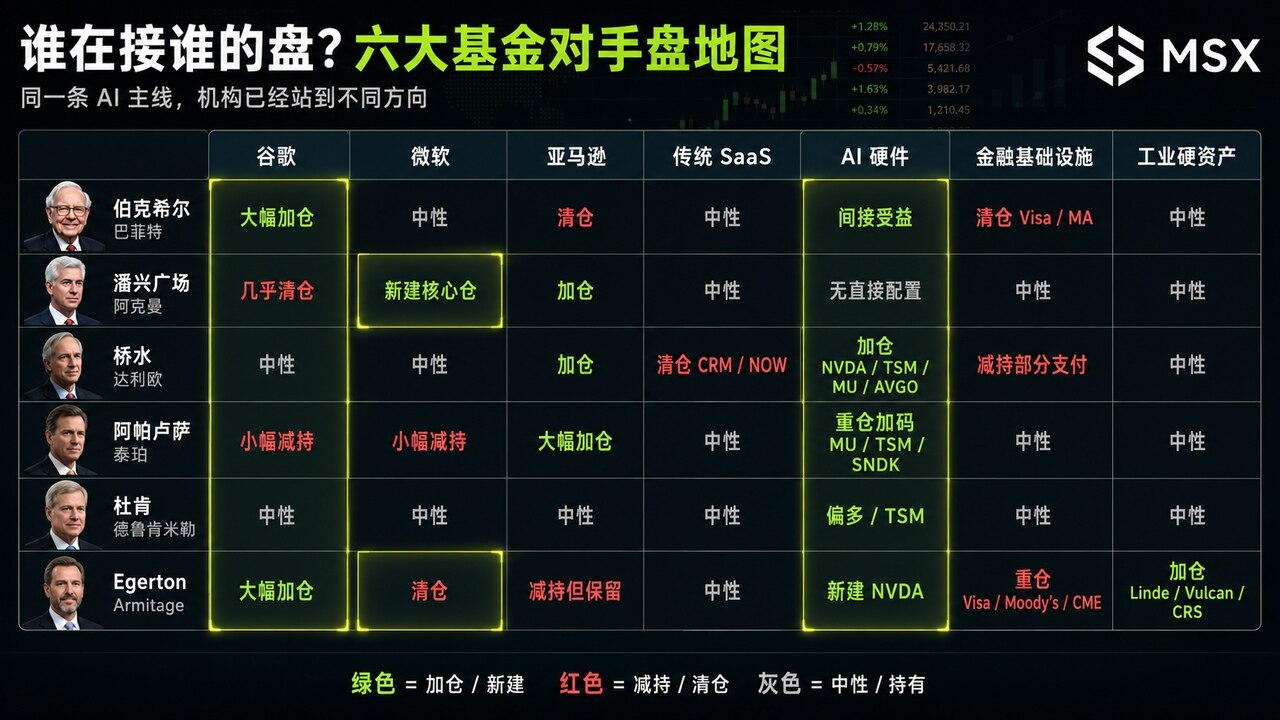
1. Core Change: The Consensus Shifts from 'What to Buy' to 'Who is Taking the Other Side'
A prominent trend in this 13F season is that institutions have begun to act as counterparties to each other within AI stocks themselves.
In the past, institutional trading in US stocks was like a large river – everyone was going in a similar direction, differing only in position size and timing. Now, it's more like a fork in the road. Everyone knows AI is the main theme, but no one is willing to pay the same valuation for the same story:
- Some buy Google because it's cheap, has strong cash flow, and YouTube and Search still have moats; others sell Google because AI search could potentially undermine its core business model.
- Some buy Microsoft because of the higher certainty with Azure and its enterprise AI entry point; others sell Microsoft because the market has already given it an excessive AI premium.
- Some buy Amazon because AWS remains a core platform for AI cloud capital expenditure; others sell Amazon because their portfolio no longer needs to bear the risk of such high-valuation platforms.
- Some flee from Salesforce and ServiceNow because the middleman value of traditional SaaS is being compressed by AI; others buy NVIDIA, TSMC, Micron, and SanDisk because, regardless of which AI application wins, the underlying hardware needs to be purchased first.
So, the core of this 13F filing isn't simply "buying AI."
It's that AI as a unified concept is disintegrating. Institutions are starting to break it down into platform layer, application layer, hardware layer, industrial capex layer, and financial tollbooth layer, and repricing each accordingly.
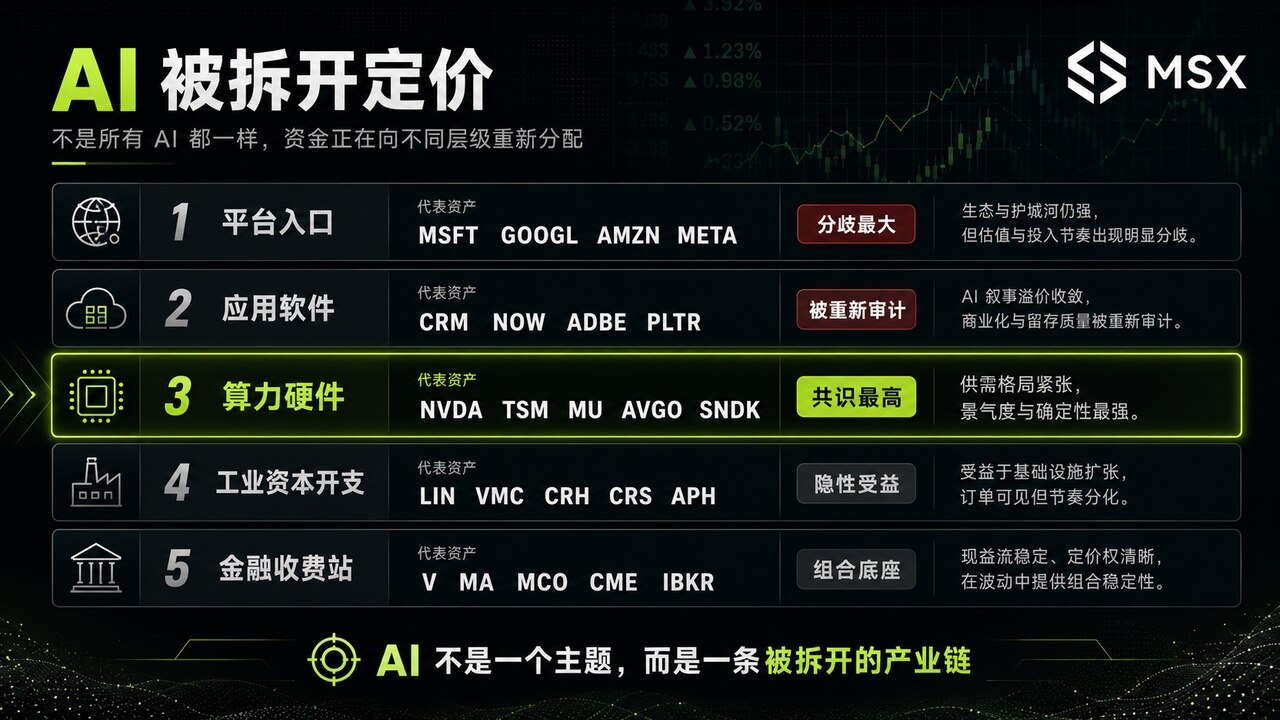
Let's break down each major player in detail.
1. Berkshire Hathaway: Redrawing the Lines in the Post-Buffett Era
Objectively speaking, Q1 2026 is the first complete observation window for Berkshire Hathaway entering the post-Buffett era.
The most interesting aspect of this 13F filing is that it did two seemingly contradictory things simultaneously: significantly pared down its portfolio while heavily increasing its stake in Google.
According to public reports, Berkshire significantly increased its Alphabet holdings in Q1, while building new positions in Delta Air Lines, Macy's, and others, and clearing its holdings of Amazon, Visa, Mastercard, UnitedHealth, and several others.
- Clearing Amazon, Visa, and Mastercard suggests it doesn't want to hold all past high-quality business models.
- Increasing its stake in Google indicates it hasn't moved away from tech, but is searching for assets within tech that align more closely with Berkshire's traditional aesthetic: strong cash flow, reasonable valuation, significant debate, but core business not yet fully disproven.
This is why Google became the biggest point of division this 13F season. Berkshire isn't buying an "AI story"; it's buying a cash flow giant that has fallen under market suspicion. It's betting on the side that "Google's moat is still valuable."
2. Pershing Square: Ackman Takes the Opposite Side of Buffett
If Berkshire is one of the largest buyers of Google this quarter, then Ackman represents the most typical counterparty.
Pershing Square's most striking Q1 move was nearly clearing its Alphabet stake and building a new position in Microsoft. In public explanations, Ackman emphasized that Microsoft's valuation became more attractive after the stock price correction, and that the long-term growth potential of Azure, Microsoft 365, and enterprise AI remains strong. In other words, he rotated his tech exposure from Google to Microsoft.
This presents a stark contrast to Berkshire. Fundamentally, Berkshire sees the resilience of Google's cash flows from Search, YouTube, Cloud, and advertising, while Ackman sees the risk of generative AI disrupting the search entry point.
One believes Google is undervalued; the other believes Google's moat is being re-priced. To put it bluntly, Ackman hasn't given up on AI; he simply believes Google isn't the highest-probability bet in this AI trade.
3. Bridgewater Associates: Dalio Sells Software, Buys Hardware
Bridgewater Associates' 13F filing is always complex as it focuses on macro allocation, not single-company bets.
But this time, Bridgewater's direction is very clear: sell traditional software, buy AI hardware.
Public 13F tracking shows Bridgewater exited Salesforce in Q1 and shifted significantly towards AI hardware and infrastructure like NVIDIA, TSMC, and Amazon. Some market reports mention TSMC became one of Bridgewater's top new positions this quarter, while Salesforce was a major exit. This trend is very important.
It shows Bridgewater isn't simply bullish on tech; it's executing a supply chain rotation within tech. Over the past decade, traditional SaaS was one of the most comfortable business models: subscription revenue, customer stickiness, high margins, excellent cash flow. But after the emergence of AI, the valuation logic for traditional SaaS is being re-evaluated.
If large language models can automatically generate code, automate processes, and replace some enterprise software functions, the middle-layer value of traditional SaaS gets compressed. So, Bridgewater's move isn't a retreat from tech stocks; rather, it's shifting from "software middlemen" to "AI hard currency."
Assets like NVIDIA, TSMC, Micron, Broadcom, Oracle, and Amazon represent computing power, wafer foundries, memory, networking, cloud, and infrastructure. Their commonality is that regardless of which AI application ultimately wins, the underlying capital expenditure likely needs to pass through these links first.
To summarize: Bridgewater isn't buying the AI concept; it's buying the money that must be spent on AI.
4. Appaloosa Management: Tepper Bets on 'Hardware No One Can Avoid'
David Tepper's Appaloosa Management also gave a very strong signal in Q1.
Public reports show Appaloosa significantly increased its stakes in Amazon and Uber in Q1, exited airline stocks, built a new position in SanDisk, and continued to increase exposure to semiconductors and the AI hardware chain like Micron and TSMC.
Tepper's logic is similar to Bridgewater's and quite direct: It doesn't matter who ultimately wins in AI; first, buy everything that all winners must procure:
- Micron represents HBM and memory;
- TSMC represents advanced process nodes and foundry capacity;
- SanDisk represents the storage chain;
- Amazon represents the AWS cloud infrastructure;
These aren't pure AI application stories; they are the hardware, cloud, and infrastructure in the AI arms race. Looking closer, while there's overlap with Bridgewater's thinking, Tepper is more concentrated and aggressive.
You could say Bridgewater is executing a macro allocation-style "increase hardware, decrease software," while Tepper is more directly betting that the AI computing power cycle isn't over, and the ones who will truly capture orders and cash flow are those in the hardware and infrastructure chain.
To summarize: Tepper is buying the pickaxe sellers, specifically those closest to the computing power bottleneck.
5. Duquesne Family Office: Druckenmiller's Signal is 'Don't Chase the Hottest Areas'
Stanley Druckenmiller's Duquesne Family Office is a bit different from the previous ones.
It isn't the most typical buyer of AI hardware this time, but its significance lies in representing another institutional philosophy: don't stay too long in the most crowded trades.
Druckenmiller has previously reduced or exited popular AI concepts like NVIDIA and Palantir while consistently focusing on upstream parts of the supply chain like TSMC. Public reports also show that macro-trading oriented funds like Duquesne are characterized by rapid adjustments, not long-term holding of a single story.
This is highly consistent with the theme of this 13F season: When the market has crowded into AI application stocks, truly sensitive macro capital has already started moving to more upstream, more fundamental, and cheaper links.
To summarize: he doesn't stand where the crowd is thickest; instead, he pre-emptively moves to areas the market hasn't fully priced yet.
6. Egerton Capital: Sells Microsoft, Buys Google, NVIDIA, and Industrial Hard Assets
Egerton Capital didn't just buy AI; it also bought financial infrastructure and industrial hard assets. More importantly, it liquidated its Microsoft position, placing itself opposite to Ackman.
Public 13F tracking shows Egerton Capital's Q1 13F portfolio is approximately $9 billion. Its top five holdings include Visa, Alphabet, Moody’s, Linde, and Carpenter Technology. It also built or increased positions in NVIDIA, Linde, Devon Energy, Canadian Natural Resources, and others.
This group of holdings is fascinating. It's not a simple "buy the Magnificent Seven" strategy. Instead, it divides the portfolio into several lines:
- Line 1: Financial infrastructure: Visa, Moody’s, CME, Interactive Brokers, Mastercard;
- Line 2: AI platforms and computing power: Alphabet, NVIDIA;
- Line 3: Industrial hard assets and capital expenditure: Linde, Vulcan Materials, Carpenter Technology, Amphenol;
- Line 4: Energy and resources: Devon Energy, Canadian Natural Resources;
This suggests Egerton isn't buying a single "AI story," but rather the intersection of the AI cycle, industrial capex, and financial tollbooths.
Most crucially, it liquidated Microsoft, creating a clear counterparty position against Ackman.
Ackman sees Microsoft as having a higher probability of winning in enterprise AI and Azure, hence he built his Microsoft position. Egerton chose to sell Microsoft, putting more tech exposure into Google and NVIDIA.
Same AI, same quality growth, completely opposite conclusions from different institutions.
2. Cross-Comparison: Who Exactly are the Counterparties?
1. Google: The Ultimate Example of Divergence This 13F Season
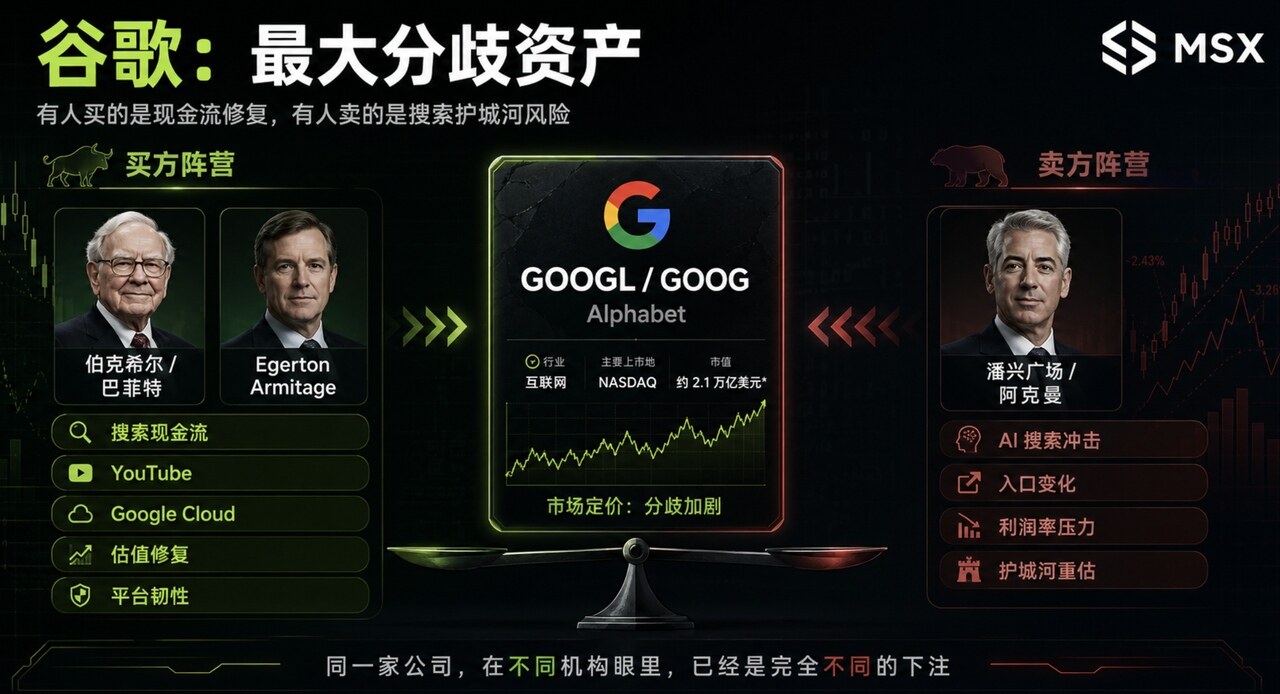
It's safe to say that Google is the most noteworthy single asset this season: Berkshire Hathaway heavily increased its stake, Egerton also added to Alphabet, but Ackman nearly liquidated his position.
This shows Google has transitioned from a consensus tech leader to a divergent asset. The bulls argue Google Search, YouTube, Cloud, and advertising cash flow remain strong; the valuation is relatively cheaper; and the disruption from AI is being overplayed by the market. The bears argue generative AI could change the search entry point; the advertising business model faces repricing; Google Cloud and Gemini need to prove monetization efficiency; and capital expenditure could pressure margins.
Google isn't simply "institutions buying" or "institutions selling." It's more like a moat stress test.
Whoever buys Google is buying its cash flow and valuation reversion. Whoever sells Google is selling the risk of AI search disrupting the old entry point.
2. Microsoft: Some See Enterprise AI Gateway, Others Believe it's Overpriced
Microsoft is another major point of divergence this season.
Ackman built a position in Microsoft, seeing long-term certainty in Azure, Microsoft 365, and enterprise AI. However, Egerton liquidated Microsoft, indicating another class of institutions is unwilling to pay the high AI platform premium for Microsoft.
This divergence is critical. Microsoft isn't abandoned by the market, but it's no longer an uncontested consensus asset.
Its problem is a classic one for high-flying tech stocks: has a good company's future potential already been priced in? The business can continue to perform well, but the stock price may have already discounted years of future growth.
3. Amazon: Berkshire Sells, Ackman and Tepper Buy
Amazon also lacks consensus.
Berkshire liquidated Amazon, but Ackman and Tepper still value it highly. Bridgewater also kept it in an important position, and Egerton maintained a stake even after reducing it.
The divergence here revolves around whether Amazon is a high-valuation platform risk or a core infrastructure play within the AI cloud capex cycle.
Bulls see AWS, its e-commerce moat, advertising business, and AI cloud demand. Bears point to portfolio simplification, valuation discipline, and rebalancing of platform assets.
So, Amazon's divergence isn't about its "moat" like Google's; it's more about its "portfolio position." Institutions are asking whether they need such a large exposure to Amazon at the current price and portfolio structure.
4. Traditional SaaS: From Safe Haven to Assets Under Audit
Bridgewater's liquidation of Salesforce and ServiceNow is one of the most structurally significant moves this season.
It isn't just selling two stocks; it represents the market beginning to re-evaluate the traditional SaaS business model. SaaS used to be a high-quality asset that thrived on subscriptions, stickiness, data, and process optimization. But with the generalization of large AI models, the middle-layer value of enterprise software is being challenged.
If many processes can be automated by AI, much code generated by AI, and many software functions invoked directly by LLMs, then the high valuations of traditional SaaS need new justification.
This is why traditional software and AI hardware form a clear counterparty trade this season: selling the software middle layer, buying the computing power, memory, foundry, cloud, and hardware infrastructure.
5. Financial Infrastructure: Berkshire Sells, Egerton Buys
Visa and Mastercard also showed interesting divergences.
Berkshire liquidated Visa and Mastercard, but Egerton's top holding is Visa, alongside other financial infrastructure assets like Moody’s, CME, and Interactive Brokers. This suggests financial tollbooths haven't lost their value.
The difference is simply their perceived role in a portfolio. Berkshire might be cleaning up old holdings and simplifying its portfolio. Egerton views assets like Visa and Moody’s as long-term cash flow anchors.
Therefore, it's not a simple case of "payment stocks are failing." Instead, financial infrastructure is no longer an unquestioned consensus, but it remains a high-quality core holding for some institutions.
3. How Should We Understand This 13F Season?
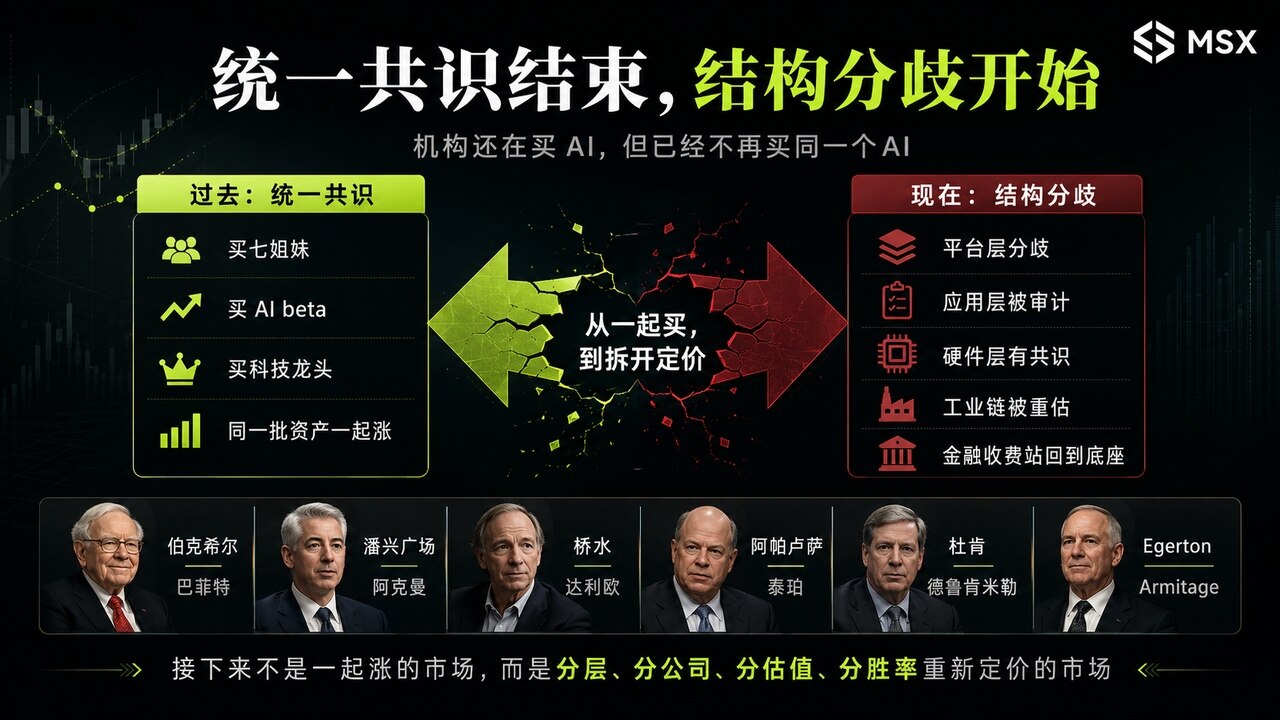
Many might say: this 13F season still looks like everyone is buying AI. How can you say consensus is gone?
The key point is: Directional consensus for AI remains, but the beta consensus for AI is gone.
In the past, buying AI meant buying the Magnificent Seven, tech leaders, or semiconductor ETFs, and you'd likely capture the main trend. But now it's different.
AI is being deconstructed into platform layer, application layer, hardware layer, cloud layer, industrial capex layer, and financial tollbooth layer, each pricing independently. This means the market will no longer broadly lift all "AI stocks." Instead, it will ask increasingly specific questions.
In short, the real signal from this 13F season is that the AI trade is moving from generalization to layer-by-layer differentiation.
Meanwhile, the divergence on Google is another classic new signal: no


