






韩国金融大乱局:三星罢工、AI共产主义与币圈大失血


- 核心观点:韩国金融市场在AI红利驱动下出现繁荣与混乱并存的局面,三星电子罢工和“AI公民红利”政策讨论引发股市剧烈波动,而加密市场则因流动性流失和监管收紧持续低迷,形成显著的分化格局。
- 关键要素:
- 三星电子罢工可能造成巨大经济损失,仅一天停工损失或达1万亿韩元(约6.68亿美元),法院部分批准罢工禁令,但工会仍计划如期行动。
- 韩国总统府政策负责人提出“AI公民红利”构想,引发市场对超额税收担忧,导致KOSPI指数一度大跌5%,后官方澄清来源为“超额税收”而非企业利润。
- 韩国股市上周外资出逃规模达132亿美元,创历史第二大单周流出纪录,受三星罢工和获利了结等因素影响。
- 韩国加密市场持续萎缩,Upbit母公司Dunamu一季度净利润暴跌78.3%,Bithumb则由盈利转为亏损,规模达869亿韩元。
- 韩国监管收紧加密市场,包括反洗钱规则、22%加密收益税(2027年生效),以及韩亚银行收购Dunamu股权面临审查。
- 截至5月4日,韩国已停运的15家虚拟资产服务商涉及约194.9万用户,冻结资产规模达221亿韩元(1487万美元)。
- 韩国金融部门计划收紧证券公司流动性监管标准,包括优化流动性比率核算、调高地产风险权重等,以提升危机应对能力。
Original|Odaily Planet Daily (@OdailyChina)
Author|Wenser (@wenser 2010)
Just after the "sky-high bonus of 6.1 million won" craze at SK Hynix, the South Korean financial sector took a sharp downturn:
On May 18, the South Korean stock market triggered a circuit breaker as the KOSPI 200 futures fell by 5%, causing program trading to be suspended for 5 minutes; Samsung Electronics found itself in a dilemma due to a "major union strike." This came on top of a previous stock market crash triggered by Kim Yong-beom, the head of policy at the South Korean presidential office, who proposed an "AI tax for universal dividends." Meanwhile, the crypto market, a key financial sector in South Korea, continued to bleed, with Dunamu, the parent company behind Upbit, seeing its first-quarter net profit plummet by 78%.
South Korea's financial market, a place where bubbles and dividends coexist, and speculation and hype dance together, has enjoyed the dividends of the AI era but has also entered a new era of chaos.
The Samsung Strike Turmoil: From an Injunction to Ongoing Negotiations; Strikes May Still Occur
Let's start with Samsung Electronics, often considered the "barometer of the South Korean stock market."
Previously, Odaily Planet Daily discussed the root of this major strike in an article "The AI Bull Market Reprices Everything, Including the 'Male Valuation System' in the Marriage Market": the union wanted the company to increase the bonus ratio and remove the bonus cap. At the time, JPMorgan estimated that the planned 18-day strike could cause losses of 4 trillion won and reduce the production of DRAM and NAND chips.
But the negative impact of this strike goes far beyond that.
According to South Korean Prime Minister Kim Min-seok: "A single day's shutdown of Samsung Electronics' semiconductor factory is expected to cause direct losses of up to 1 trillion won (approximately $668 million). More worryingly, a temporary halt in semiconductor production lines could take months to resume. If materials must be discarded due to the strike, the market fears economic losses could expand to as much as 100 trillion won." In other words, this is a strike whose losses are unacceptable for Samsung Electronics and the entire South Korean financial market.
In light of this, South Korean Prime Minister Kim Min-seok first stated that they would seek all possible means to avoid a strike at Samsung Electronics; subsequently, this morning, a South Korean court partially approved Samsung Electronics' injunction request against the union's planned strike. Following this news, the KOSPI index turned positive; after Samsung Electronics restarted high-stakes wage negotiations with its largest union, its stock price briefly rose by 6.7%.
Just as the market thought the "Samsung major strike" event was about to take a turn, news from the union side once again put South Korean stock investors on edge: around noon, the Samsung Electronics union declared that, despite the local court partially approving the company's injunction request, they would still hold the strike as planned on May 21. The gist of their statement was: "They respect the court's injunction, which requires the union to ensure that any strike action does not disrupt production."
Last Sunday, the South Korean government announced it would invest 170 billion won (about $113.3 million) to support small and medium-sized enterprises involved in cutting-edge semiconductors and related industries. This also hints at the South Korean government's new plans and development intentions for the financial market and economic industries. While Samsung Electronics has seen development opportunities thanks to the AI dividend, it also means a restructuring of profit distribution, accompanied by increased volatility and risk in financial markets like the KOSPI index.
Behind the "AI Communism" Discussion: The South Korean Government's Push to "Maximize AI Dividends"
Last Friday, May 15, the KOSPI index touched the 8000-point mark for the first time, hitting an all-time high.
At the same time, last week also saw a historic "foreign capital exodus" from the South Korean stock market.
On May 15, influenced by the Samsung strike and profit-taking, foreign investors sold off 1.6 trillion won worth of KOSPI stocks in early trading. According to Goldman Sachs statistics, overseas investors withdrew approximately $17 billion from Asian emerging markets excluding China last week, the second-largest single-week outflow on record. Of this, the South Korean market accounted for the vast majority, with outflows reaching $13.2 billion.
The "AI citizen dividend" previously proposed by Kim Yong-beom, head of policy at the South Korean presidential office, was a major contributing factor behind this.
On May 11, Kim Yong-beom posted on Facebook: "Excess profits generated in the era of AI infrastructure should be structurally returned to all citizens through institutional design." He tentatively named this concept the "citizen (national) dividend."
He also emphasized that excess profits in the AI era naturally concentrate among a minority. Without institutional intervention, domestic wealth disparity will further worsen. Shareholders of memory chip companies, core engineers, and various asset holders are highly likely to reap substantial rewards, while the broad middle class may only feel indirect effects.
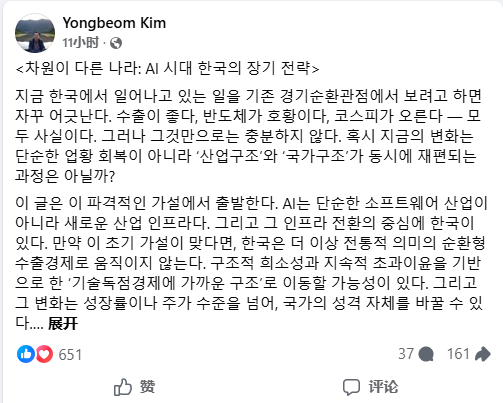
Although I don't understand why a government department spokesperson would post opinionated statements on Facebook?
The news caused an uproar: many interpreted his remarks as the South Korean government planning to levy additional taxes on high-profit AI companies like Samsung Electronics and SK Hynix; the KOSPI index subsequently plunged over 5% at one point.
Kim Yong-beom later clarified to the media, stating, "The 'citizen dividend' from the AI industry would be sourced from excess tax revenue, not directly from the profits of AI companies." South Korean President Lee Jae-myung also posted on X platform, stating that Kim's related remarks were discussing "the possibility of distributing national excess tax revenue generated from AI excess profits in the form of a citizen dividend," and did not imply directly using corporate profits to distribute subsidies. Lee Jae-myung used strong language, labeling the external interpretation as "fake news attempting to manipulate public opinion."
As one of the world's major economies, South Korea's industrial and social structure is highly distinctive: constrained by the limited size of the domestic market and the accumulation of past technological advantages, the South Korean economy and industry exhibit the following characteristics: high dependence on exports, high dependence on the chip industry, and high concentration among a few conglomerates. In terms of social structure, South Korea has a powerful union culture and a high degree of social sensitivity. Therefore, when the AI industry became a "profit machine," South Korea became the financial market with the most intense "excess profit distribution conflicts."
Only a few companies, such as Samsung Electronics, SK Hynix, and Micron, have the mass production capability for HBM (High Bandwidth Memory), holding the "key to AI storage." This is a significant reason why numerous securities companies and institutions are flocking to stocks like SK Hynix and Samsung. Today, Nomura published a report stating that AI-driven demand is growing exponentially while memory supply is limited, likely leading to a re-rating of memory stocks. The firm significantly raised its target prices for Samsung Electronics and SK Hynix, lifting Samsung's target from the previous 340,000 won to 590,000 won, and SK Hynix's target from 2.34 million won to 4 million won, with a "buy" rating for both.
"The Crypto Market Abandoned by South Korean Finance": Plummeting Exchange Revenue, Regulatory Scrutiny, and Asset Freezes
According to estimates from the renowned investment bank Goldman Sachs, South Korean retail investors bought $14.1 billion worth of stocks last week. In contrast, the South Korean crypto market began bleeding persistently as early as last year.
Statistics show that the value of holdings by South Korean crypto investors nearly halved within a year: in January 2025, the size of the South Korean crypto market was about 121.8 trillion won ($83.3 billion); by the end of February 2026, this figure plummeted to 60.6 trillion won ($41.4 billion). The average daily trading volume of the top five South Korean crypto exchanges (Upbit, Bithumb, etc.) also collapsed from $11.6 billion in December 2024 to $3 billion in February 2026, a drop of 74%.
The main reasons for the sustained loss of liquidity are the continued decline of the overall crypto market and the persistent siphoning effect of the stock market. In a nutshell, external stock markets kept hitting new highs, while the crypto market itself failed to perform.
Revenue Plummets at Two Major Exchanges: Upbit Parent Company Net Profit -78%, Bithumb Revenue and Profit -95%
According to The Asia Business Daily, Dunamu, the parent company behind Upbit, reported first-quarter operating revenue of 234.6 billion won, down 54.6% year-on-year from 516.2 billion won; operating profit was 88 billion won, down 77.8% year-on-year from 396.3 billion won; net profit also fell to 69.5 billion won, down 78.3% year-on-year from 320.5 billion won.
Bithumb's first-quarter revenue was 82.5 billion won, down 57.6% year-on-year from 194.7 billion won; operating profit was 2.9 billion won, plummeting 95.8% year-on-year from 67.8 billion won; net profit turned from a profit of 33 billion won in the same period last year to a loss of 86.9 billion won.
Anti-Money Laundering Rules, Crypto Taxation, and Acquisition Scrutiny
In August last year, the South Korean Financial Supervisory Service officially implemented revised anti-money laundering rules, where single transactions exceeding 10 million won to overseas exchanges or private wallets are flagged as suspicious addresses.
Additionally, the South Korean Ministry of Economy and Finance has confirmed that the 22% tax on crypto gains will take effect on January 1, 2027, as scheduled.
Moreover, the recent acquisition of Dunamu, Upbit's parent company, has also come under review by the South Korean Financial Services Commission – Hana Bank previously announced plans to acquire approximately 6.55% of Dunamu's shares without consulting regulators; this transaction potentially violates the "separation of finance and virtual assets" regulatory rule.
According to the Virtual Asset Department of the South Korean Financial Services Commission, Hana Bank's indirect holding of Dunamu equity through the acquisition of Kakao Investment shares is essentially an investment in a virtual asset trading platform and will therefore be reviewed under the same regulatory standards. It's worth noting that since 2017, the South Korean government has used administrative guidance to restrict financial institutions from holding, purchasing virtual assets, or making equity investments in related companies. If ultimately deemed a violation, the related Hana Bank transaction may not be completed.
Assets of South Korean Crypto Investors Frozen Exceed 22.1 Billion Won
As early as 2024, a joint study by the FSS and the FIU found that up to 70% of closed cryptocurrency exchanges failed to return customer investment funds.
Now, more detailed data has emerged – according to Yonhap News, data obtained by lawmaker Kang Min-guk of the People Power Party from the Financial Supervisory Service shows that as of May 4, a total of 15 virtual asset service providers in South Korea have ceased operations, involving approximately 1.949 million users and frozen assets amounting to 22.1 billion won ($14.87 million).
It must be said that such a polarized regulatory environment doesn't exactly attract new retail investors to the crypto space.
The "Leveraged Nation" Drinking Deeply from the Bubble
Today, South Korean finance has found a "second spring" through the "AI bubble." Although institutions like Goldman Sachs and Citibank have stated they have taken some profits, they remain highly optimistic about the future trajectory of the South Korean stock market.
Having learned lessons from the Asian financial crisis and the 2022 Lotte debt crisis, the South Korean financial regulatory authorities have their own plans for risk management.
Recently, the South Korean Financial Services Commission and the Financial Supervisory Service issued a notice stating plans to tighten liquidity regulatory standards for domestic securities firms, aiming to fully extend liquidity ratio regulatory rules to all local brokerages. They also intend to optimize the calculation method of liquidity ratios, apply discount coefficients to assets, and include contingent liabilities such as debt guarantees to enhance crisis response capabilities. Additionally, they plan to raise the risk weight of net capital ratios related to real estate exposure and set overall investment limits. Special capital supervision rules will be introduced for securities firms with higher systemic importance.
With aggressive investors favoring "leveraged trading" on one side, and the heavy hand of strict regulation on the other, a new era of chaos in South Korean finance has begun.





