






何一最新訪談:我的野心,是有一個配得上我的世界


- 核心觀點:何一分享其從農村女孩到幣安聯席CEO的成長歷程,強調主體性、野心與執行力的重要性,認為認知、執行力、勇氣和野心是成長四大支柱,並解釋比特幣如何重塑了她對金錢和金融未來的認知。
- 關鍵要素:
- 何一的早期經歷(如4歲主動要求上學、輸錢後堅持還賭債)塑造了其強烈的主體性和主動爭取意識。
- 她將成長動力歸納為「認知、執行力、勇氣、野心」四支柱,認為它們相互推動,並強調「敢想」與「從結果倒推過程」的方法論。
- 2013年研究比特幣後,她認知被重塑,將其視為基於全球共識的信任網路,而非國家信用背書的貨幣,從而決定all in區塊鏈行業。
- 在主持事業上升期辭職加入幣圈,何一認為其核心能力是「把已有東西優化迭代到最大」,而非從0到1創新。
- 針對女性成長,她建議「先去試,清楚代價」,並否定「雌競」標籤,強調在競爭中靠實力(「雄競」)取勝。
Original Source: Money-Making Girls (搞钱女孩)
Edited by: TechFlow (深潮 TechFlow)
Key Takeaways
In this episode of "Money-Making Girls," the host had an in-depth conversation with Yi He, Co-founder and Co-CEO of BINANCE, covering everything from her childhood, upbringing, and career choices to ambition, cognition, execution, and how women can uplift themselves.
Yi He recalled how, as the second child in her family, she learned to proactively fight for what she wanted – pestering to attend school at age 4, reading Wuxia novels and Yi Shu in her youth, and being unwilling to return to her hometown as a teacher after attending a normal school. These experiences collectively shaped her strong sense of agency.
She also discussed why she went "all in" on Bitcoin during the peak of her hosting career: Bitcoin made her rethink "what money really is" and showed her a financial future built on global consensus and trust networks. For ordinary people, her answer is straightforward: first understand the cost, then bravely try; iterate your cognition through execution. In life, you either gain or learn.
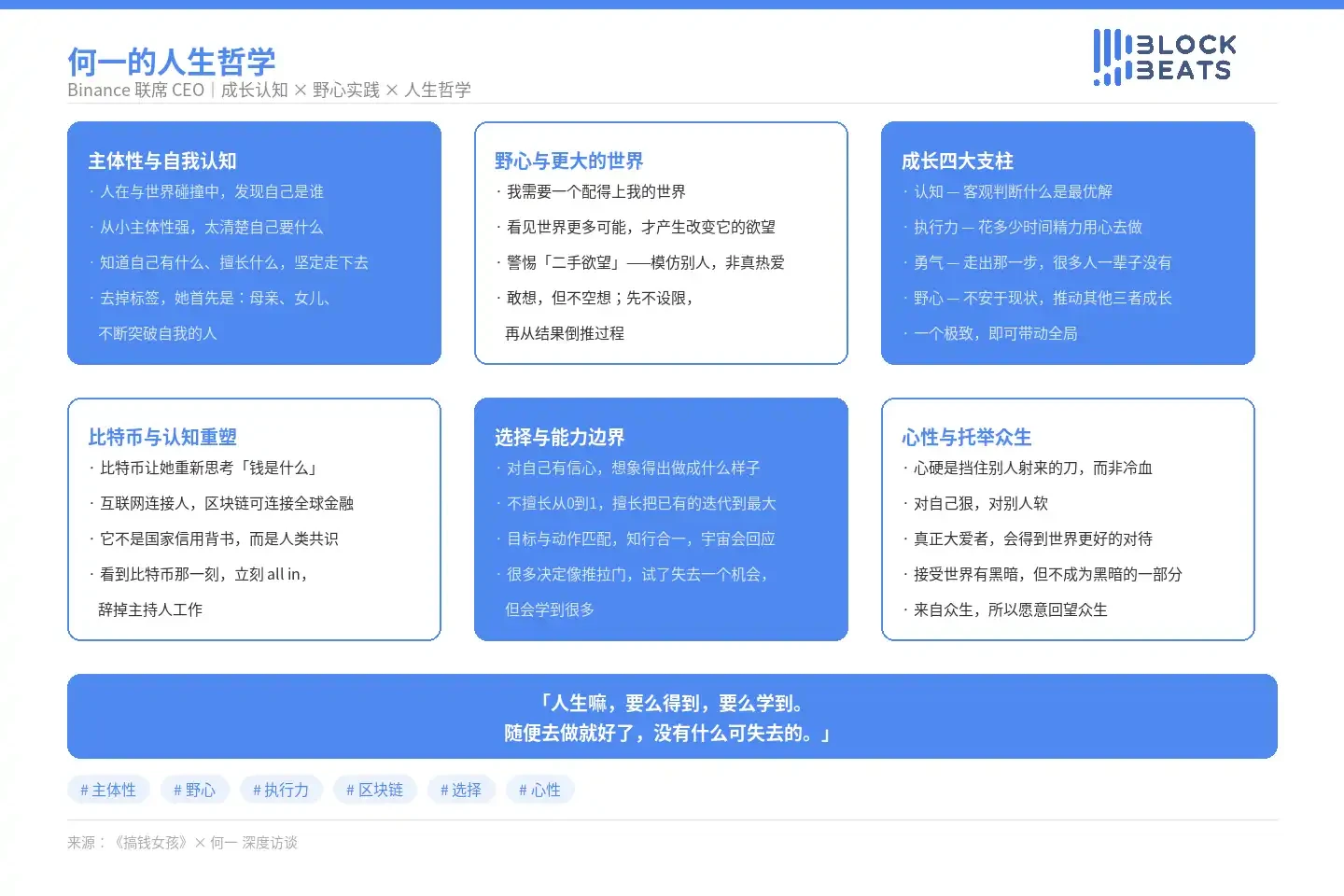
Highlights from the Conversation
On Agency and Self-Awareness
· "People don't exist in isolation. You discover who you are through every collision with the world. Through every interaction, by how you face and handle things, you come to understand yourself more and more."
· "Looking back, I think I had a strong sense of agency since childhood. I knew too clearly what I wanted."
· "Why can only city kids like beautiful things like flowers and plants? Why can't I?"
· "Do you truly know what you have and don't have, what you're good and not good at? And can you firmly walk that path, enduring even if knives fall from the sky?"
On Ambition and a Bigger World
· "I've always been a bit ambitious. I've always felt I needed a world worthy of me."
· "When you see parts of the world you want to try changing, you hope for a bigger world to try it out in."
· "Many times, our desires are secondhand desires. We just see others doing it and mimic them."
· "You have to dare to think, but not just daydream. First, don't set limits, then work backwards from the goal."
On Cognition, Execution, Courage, and Ambition
· "The so-called four pillars are cognition, execution, courage, and ambition. If one of these corners is extremely strong, it will drive the growth of another. If two grow, it can push you further forward."
· "Knowing yourself means being able to objectively judge if something is your best option and if you truly love it, willing to keep doing it even if it doesn't pay."
· "Execution isn't just about doing it. It's about how much time and energy you invest. Are you truly dedicated? Can you endure the long, painful process of self-iteration before success?"
· "Many people think they know a lot and are just unlucky, but they might not even have the courage to take the first step."
· "If you truly love something, doing it feels effortless."
On Bitcoin and Reshaping Financial Understanding
· "Bitcoin made me rethink what money really is. That's what touched me the most."
· "If the internet can connect everyone globally, then there could also be a globally trusted network connecting the world's finances."
· "It's not a currency printed by a country or government based on credit. It's a human consensus."
· "The moment I saw Bitcoin, I felt it was the right direction. I wanted into this space and wanted to do this."
On Choices, Mission, and Boundaries of Ability
· "I have confidence in myself. If I joined BINANCE, I could envision what I could do and turn it into a top global platform. It's just a matter of time."
· "I'm not necessarily best at creating something new from 0 to 1. But I'm very good at continuously optimizing and scaling up something that already exists."
· "Everyone wants to be someone and go somewhere. In the end, the universe will respond to you. You just need to align your thoughts and actions, matching goals with execution."
· "Many decisions are like sliding doors. You can regret them later. Trying doesn't hurt. You might lose an opportunity, but you'll learn a lot."
On Success, Mentality, and Uplifting Ordinary People
· "Being tough doesn't mean being cold to others. It means being able to withstand opposing views and attacks directed at you."
· "I'm tough on myself but soft on others."
· "If there's a true 'hand of God' in this world, it would favor those who genuinely love the world."
· "The world has black and white, light and dark. You must accept it as part of the world, but that doesn't mean you choose to become part of the darkness."
· "Life, you either get something or learn something. Just go do it. There's nothing to lose."
Removing All Social Labels, Who Are You?
Jiu Shi Xiaohui: Today, Xiaohui is in Hong Kong, interviewing a truly legendary woman. Born in a rural village in Yibin, Sichuan, she stumbled into becoming an outdoor reporter for Travel Channel, and later became known as "Customer Service Xiao He" among blockchain users. Her latest title is Co-CEO of BINANCE, the world's largest blockchain trading platform and ecosystem.
How can someone achieve such a turnaround? I'm very curious about her upbringing. Today, we welcome Yi He, Co-CEO of BINANCE.
Yi He: Hello everyone, I'm Yi He from BINANCE, also known as everyone's customer service, Xiao He.
Jiu Shi Xiaohui: Most people imagine CEOs or female presidents to be domineering and imposing, but you exude a gentle and approachable aura. So today, I'm also curious to trace back how 'Xiao He' gradually became the Yi He of today.
There's a popular self-introduction game recently: If you removed all your social labels, how would you introduce yourself?
Yi He: First and foremost, a mother, a daughter, a person who constantly breaks boundaries.
Jiu Shi Xiaohui: That's a humble expression. As for me, I seem to rely heavily on external judgment. If I can't define myself, I wonder how others would define me. For example, I've received feedback that I'm approachable, probably because of my job as an interviewer, saying I'm good at making people open up.
But that's how others see me. I seem to need others' validation to confirm who I am.
Yi He: That might mean you're still exploring life. People don't exist in isolation. You discover who you are through every collision with the world. Through every interaction, by how you face and handle things, you come to understand yourself more and more. It means you are still young.
"The Middle Child Law" Taught Yi He to Proactively Fight for Things from a Young Age
Jiu Shi Xiaohui: Before coming here, I did my homework and found a similarity between us: you are the second of three kids, while I'm the third. There's a psychological concept called the "Middle Child Law," which reminds me of my second sister.
My second sister has a contrasting personality – bossy, loud, and mischievous, which gave our parents headaches. I was the well-behaved one, more of the typical 'daughter.' I'm curious, looking back, did being the second child leave a mark on your personality?
Yi He: Quite apparently, yes. I have three kids myself. Usually, parents pour a lot of attention into the firstborn. The second child is often raised more loosely. The third is usually the spoiled darling. So the eldest has assured love, the third has assured love, but the second needs to proactively fight for it, otherwise, they might feel forgotten.
Sometimes, what we call a child's rebellion is actually a cry for help. Relatively speaking, they might become more independent and self-centered.
Earliest Awakening of Agency: Pestered to Start Primary School at Age 4, Admitted as an Exception
Jiu Shi Xiaohui: When did you first realize that you had to fight for things yourself?
Yi He: My earliest memory might be from when I was 4 and wanted to go to school. My sister was 6 years older and already in primary school. I wondered, 'Why can she go, but not me?' So, I pestered the adults daily until they finally sent me to school.
My homeroom teacher was a family friend. He asked my parents how old I was. They lied and said 6. IDs weren't checked back then, so they said we'd see about it later. If I did poorly, I could repeat. I never had to repeat and actually did quite well.
Jiu Shi Xiaohui: Because it was something you wanted to do, you could do it well. This might be the core of your personality: you are very brave in expressing what you want. If the current environment isn't what you want, you actively seek a suitable one.
Yi He: I have another vivid childhood memory. Living in a rural Sichuan village filled with wildflowers, I would pick them every day on my way to school. My mother would laugh at me, asking why a country kid liked flowers. For them, wildflowers were too common to be special. They thought it was a privilege for city kids.
But I clearly remember disagreeing. Why can only city kids like beautiful things? Why can't I?
I think this reflects my proactive nature, my insistence on self-direction. In today's lingo, I had a strong sense of agency and early self-awareness. I was probably born a bit rebellious.
Jiu Shi Xiaohui: I had a similar experience. I'm left-handed and write with my left hand. My parents briefly tried to switch me, but my kindergarten teacher was open-minded and let me be. She said my writing was fine. There's also a superstition that left-handed people are smarter, so my teacher protected my preference, and my parents accepted it.
But I was also very stubborn. When they pushed, I refused. They didn't force it. How about your parents? Were they lenient, or did you face environmental pressure?
Yi He: My mother was very strict. But I think I've had a strong sense of agency since childhood. I knew myself too well.
Here's a crazy thing: I gambled before I was 10. Small stakes with older kids. I lost 5 yuan, had no allowance, and got a severe beating from my mom. She asked if I'd stop. I said yes.
But later, I thought about the debt I owed. You have to be a person of your word. So I found new people to play with to win back the money. Got caught again, another beating. I eventually paid off the debt and then never gambled again.
Before age 10, I understood gambling: you lose and want to win back, you win and want to win more – it's a bottomless pit. So I have zero interest in it now. I was inoculated before 10.
Jiu Shi Xiaohui: You endured beatings from your strict mother while figuring out how to repay your debt. How many beatings did you endure in total?
Yi He: Not that many. Besides gambling, I also got beaten for reading novels. There was a scrap collector in our village with lots of books. I'd borrow from him and later rent novels. In middle school, around 10, my mom found out again.
Jiu Shi Xiaohui: What were you reading? Qiong Yao?
Yi He: I didn't read much Qiong Yao. I read a lot of Wuxia, some semi-classical stuff like *Strange Tales from a Chinese Studio*. Options were limited – you read whatever the scrap collector had. Later, I rented novels, reading a lot of Li Bihua and Yi Shu. These two Hong Kong writers influenced me significantly.
Li Bihua is a quirky genius. She had a saying I still remember: "The 16-character creed for navigating the world: Murder must be avenged, debts must be repaid, you win or lose by the game, you take responsibility for your own gains and losses." I used it as my QQ status.
Yi Shu's novels can be sentimental, but their core theme is women buying their own flowers – independent female protagonists. This seemed to become part of my character.
Jiu Shi Xiaohui: Let's move to your career. Your path seems very unconventional. You seize opportunities and act without much planning. I'm curious: before becoming a host, your dream was to be a model. I remember you mentioned in an interview that before 16, you wanted to be a model.
Yi He: Yes. I was in a normal school (teachers' college) because my parents were teachers. Your expected path was to become a teacher. In class, a teacher once said it would be a shame if I didn't become a teacher. I told the whole class I thought it would be a shame if I *did* become one.
Ambition Awakens During Normal School: "I thought becoming a teacher would be a shame."
Jiu Shi Xiaohui: You were truly rebellious. Despite being a top student, why were you so sure you weren't suited to be a teacher?
Yi He: It wasn't about being unsuited. I was probably unwilling to be *just* a teacher.
Jiu Shi Xiaohui: Why? It was a good job back then.
Yi He: Probably because I read a lot and saw a much bigger world beyond my immediate one. I attended Yibin College. Going back, I'd likely return to the village to teach. I wasn't content with that.
Reading Li Bihua, Yi Shu, and other depictions of the world, I felt there must be a more expansive world out there. I wanted to see it.
"Secondhand Desires": Many of our desires are just mimicking others.
Jiu Shi Xiaohui: So you didn't want to be a teacher. How did you end up wanting to be a model?
Yi He: It's a bit embarrassing. I read a book called *The Desire Map*. Like, seeing someone with a Hermès bag makes you want one. Is that your true desire?
Often, it's a secondhand desire. You just see someone else doing it and mimic them.
Back then, I didn't really know myself or my potential. I tried a speech contest and won first place. Another classmate dreamed of being a model. Seeing her try, I thought, 'I can probably do this too.' So, at under 1.6m tall, I signed up for a modeling competition in Sichuan. I'm sure they just wanted my registration fee. They had a print category, which was my entry into television.
"Ambition" Isn't a Bad Word; I Wanted a World Worthy of Me
Jiu Shi Xiaohui: During adolescence, that mimicking is natural. Seeing peers succeed makes you think, 'If they can, why can't I?'
Yi He: I think that's a primal desire and ambition, and there's nothing wrong with it. Chinese people, especially women, often shy away from the word "ambition." But I've always been a bit ambitious. I always felt I needed a world worthy of me.
Jiu Shi Xiaohui: I still can't say that. I often feel undeserving of good things. I try to become worthy. But it's rare for someone to say the world should be worthy of them. It implies discontent with reality.
Yi He: Yes. I hate attributing my success to my background. I feel incredibly blessed. But during this journey, when you see parts of the world you want to try changing, you hope for a bigger world to try it out in.
I think that's my primal ambition: being discontent with the status quo.
Jiu Shi Xiaohui: Your career involved many leaps outside your comfort zone. How did you become an outdoor host for Travel Channel?
Yi He: It wasn't entirely random. Many can't leave their comfort zone because they only think but never execute properly.
Like your podcast. Originally named "Voluntary Confession," it had a


