Q1財報、CLARITY法案、沃什換屆……Circle本週連迎三場大考


- 核心觀點:Circle(CRCL)將在本週迎來2026年Q1財報發布、CLARITY法案參議院闖關及聯準會換屆三大關鍵事件,這些事件將直接影響CRCL短期價格走勢,並可能重新定義其長期估值邏輯。
- 關鍵要素:
- Q1財報市場預期營收7.15億美元,EPS 0.178美元,重點關注分銷成本佔比及非利息收入增長趨勢。
- 與Coinbase的分銷合約將於8月到期,雙方續約條款談判結果對Circle盈利能力至關重要。
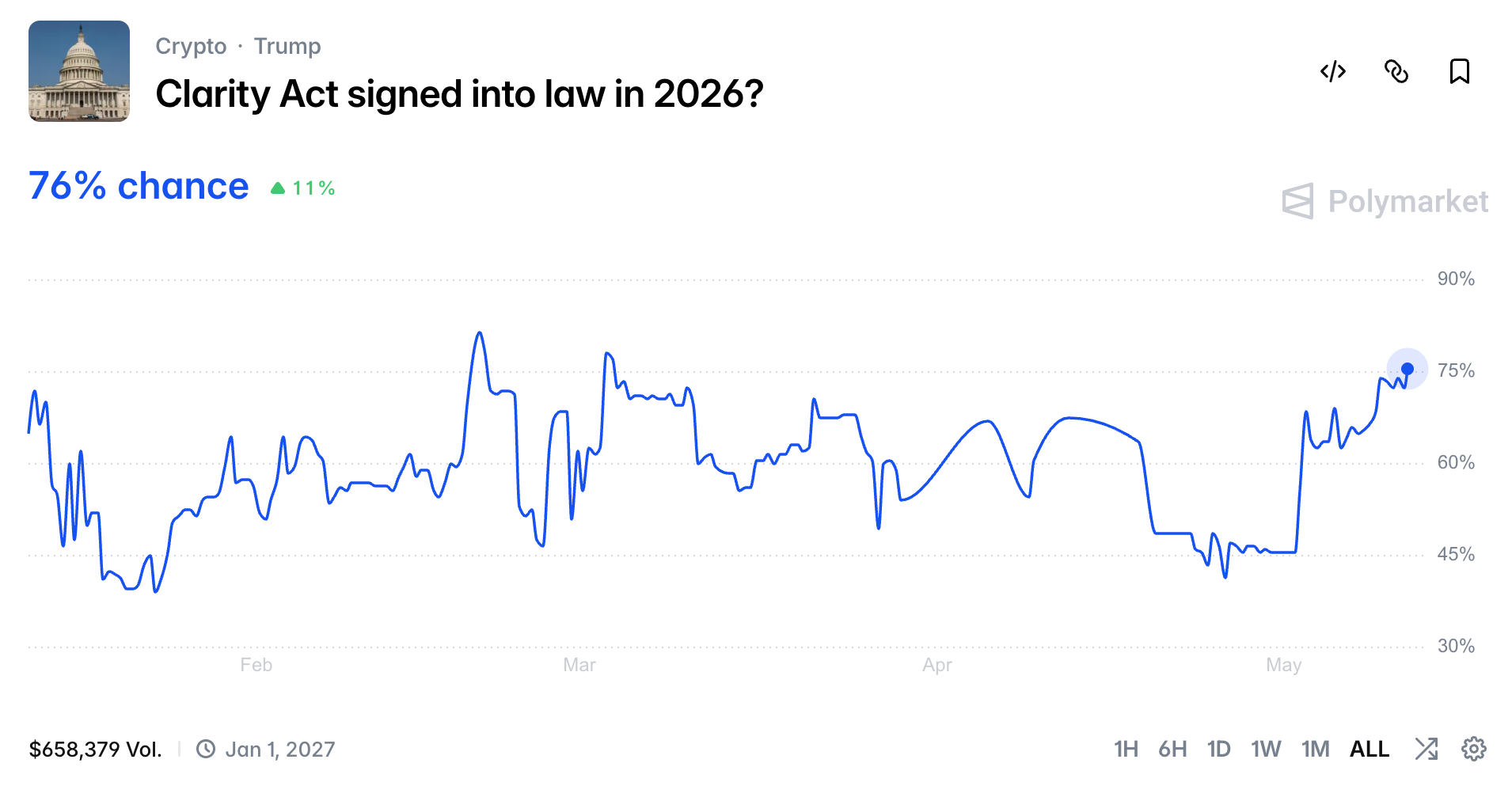
- CLARITY法案旨在建立數位資產聯邦監管框架,市場在Polymarket上預測今年通過機率為76%。
- 法案爭議焦點包括穩定幣收益分配,最新折衷方案擬禁止靜態儲備收益但允許活躍獎勵。
- 聯準會換屆後,新任主席沃什主張「縮表+降息」組合,短期可能因降息預期利空依賴美債收入的Circle。
- 沃什本人為加密貨幣持有者,反對CBDC但支持將USDC等納入監管,長期有望為Circle提供政策順風。
Original | Odaily Planet Daily (@OdailyChina)
Author|Azuma (@azuma_eth)

The Q1 earnings report on May 11, the CLARITY Act's Senate vote on May 14, and the Federal Reserve leadership change on May 15... Circle (CRCL) faces three major tests this week, each of which will directly impact CRCL's price trend and could even redefine its valuation logic.
Below, Odaily Planet Daily will analyze the progress and expectations for these three events and predict their potential impact on CRCL (Note: The following content does not constitute investment advice).
Event 1: Q1 2026 Earnings Report
Tonight at 20:00, Circle will release its Q1 2026 earnings report before the US stock market opens, followed by an earnings conference call.
There are three key points to watch in this earnings report:
- First, Circle's comprehensive Q1 revenue and profit data. Market expectations for Circle's Q1 revenue stand at $715 million, with an earnings per share (EPS) expectation of $0.178.
- Second, the proportion of Circle's distribution costs (primarily paid to Coinbase) relative to total revenue. This indicates Circle's dependence on distribution platforms like Coinbase. This ratio has shown a slight downward trend in recent quarters, and Q1 is expected to continue this trend.
- Third, the growth of non-interest income, i.e., revenue from payments, enterprise, and on-chain businesses. This is Circle's most important long-term metric, indicating whether it can establish a second revenue stream beyond Treasury yields.
Regarding the distribution agreement with Coinbase, analysts will surely ask about it during the earnings call, and Circle's response will be critical. In August 2023, Circle signed a three-year contract with Coinbase, stipulating that Coinbase would receive all interest income generated by USDC on its platform, while interest from USDC held off-platform would be split 50/50 between Coinbase and Circle.
This contract expires this August. However, last week, Coinbase's CFO emphasized that the contract "renews every three years, forever." If renewed under the same terms, it would certainly be unfavorable for Circle. That said, given Coinbase's significant financial pressure and strong dependence on Circle—contracts are negotiated, and this could become a favorable factor for Circle to negotiate revised revenue-sharing terms.
I am cautiously optimistic about tonight's earnings report, expecting solid performance, but the focus will be on Circle's stance regarding the August renewal.
Event 2: CLARITY Act's Senate Vote
On May 14, US time, the Senate Banking Committee will hold a vote and hearing on the "Digital Asset Market Transparency Act" (CLARITY Act). This is a crucial step for the CLARITY Act to pass the Senate and become law.
The CLARITY Act aims to establish a regulatory framework for digital assets, clearly define their classifications, and delineate the regulatory responsibilities of the Securities and Exchange Commission (SEC) and the Commodity Futures Trading Commission (CFTC).
On July 17 last year, the CLARITY Act passed the House of Representatives with an overwhelming majority (vote count approximately 294–134), but subsequently faced resistance in the Senate due to disagreements among various stakeholders.
Disputes centered around stablecoin yields, regulatory approaches to DeFi, and ethical standards related to the Trump family. In particular, the issue of stablecoin yields led to intense clashes between the banking and crypto industries, with Coinbase even briefly leaving the negotiating table, causing the bill to stall (recommended reading: Why Must Banks Block Stablecoin Yields?).
A key turning point has recently emerged: Senators Thom Tillis and Angela Alsobrooks have reached a compromise, proposing to ban yields on static stablecoin reserves but allow rewards for actively circulating stablecoins.
On the prediction market Polymarket, the probability of CLARITY becoming law this year is as high as 76%, indicating market optimism about the bill's subsequent progress.
If CLARITY becomes law, it will establish a clear, functional federal regulatory framework for the US digital asset market, resolving long-standing issues of regulatory ambiguity and inconsistent enforcement. This would be a significant positive for all industry participants, including Circle. My prediction on this is relatively optimistic.
Event 3: Federal Reserve Leadership Change
On May 15, Powell's term as Chairman of the Federal Reserve will officially end (he will remain as a Governor until 2028), with Kevin Warsh set to succeed him.
On April 29, the Senate Banking Committee voted in favor of Warsh's nomination. Although it has yet to be confirmed by a full Senate vote, this is expected to happen within the next couple of days.
Unlike Powell, Warsh advocates for an unconventional combination of "balance sheet reduction + rate cuts." He supports using quantitative tightening (QT) to control inflation while cutting rates to provide liquidity to the real economy, arguing that QT targets the financial sector while rate cuts benefit the industrial sector.
For Circle, which still relies on Treasury yields as its primary revenue source, a shift towards a rate-cutting cycle would be a direct negative for CRCL. At the same time, QT could tighten short-term financial market liquidity, weighing on the stock market.
However, Warsh himself is a cryptocurrency holder. He is the first Fed Chair in history to have directly invested in the crypto space and places great importance on the "digital upgrade of America's financial competitiveness." Warsh has also explicitly opposed the Fed issuing an official CBDC, arguing that its credit is deeply tied to national sovereignty. If US dollar credit is damaged, the CBDC would also collapse. Instead, he hopes to bring private stablecoins like USDC under the Fed's regulatory framework, making them "shadow dollars."
Therefore, in the long run, Warsh taking office could provide some policy tailwinds for Circle's business, thereby supporting its expansion.
So, regarding expectations: in the short term, the outlook may lean pessimistic, but it could turn neutral or optimistic in the long term.