《CLARITY法案》出爐:以太坊成最大贏家?


- 核心觀點:美國《數位資產市場清晰度法案》(CLARITY Act) 透過確立嚴格去中心化測試,將使以太坊成為美國法律體系下唯一兼具可程式性與監管明確性的數位商品,從而終結長期壓制 ETH 的兩大看空邏輯(監管風險與競爭威脅),並推動其進入基於貨幣溢價而非現金流的估值體系,開啟潛在數兆美元的重估。
- 關鍵要素:
- 法案中關於「協調控制」的五項測試(如去中心化、開源、權限等)中,49% 的代幣或投票權集中度門檻是關鍵分界線。比特幣和以太坊輕鬆通過,而 Solana、BNB Chain、Sui 等主流智慧合約平台因結構性原因未能通過,被劃為「附屬資產」。
- 「附屬資產」分類會引發半年度揭露義務和基於現金流估值的框架,這將使代幣喪失貨幣溢價。而通過測試的資產(如 ETH 和 BTC)則可基於稀缺性、網路效應等非基本面因素定價,估值上限被徹底打開。
- ETH 通過全部五項測試,直接消除了其作為「證券」的監管風險。同時,未能通過測試的直接競爭對手(如 Solana)將被迫進入現金流估值體系,無法在貨幣溢價的估值框架上與 ETH 競爭,終結了「以太坊殺手」的敘事。
- 與比特幣相比,以太坊的原生質押收益提供了正的淨持有成本,且避免了工作量證明帶來的結構性拋壓和長期安全補貼風險,使其成為更具經濟優勢的 Tier 1 貨幣資產。
- 全球貨幣溢價資金池(約 50 兆美元資產)正從房地產、黃金等傳統載體向數位資產遷移,以應對機構信任度下降和地緣政治風險。ETH 成為首個兼具負持有成本、全球流動性、密碼學安全和機構獨立性的候選資產。
- 即便 Solana 或 Aptos 等在未來四年過渡期內通過測試,僅獲得法律認證不足以使其自動獲得 Tier 1 估值,還需網路自身、生態系統及市場對其「貨幣溢價」屬性的共識,這對於目前以效能和應用為導向的網路而言是巨大挑戰。
Original Author: Adriano Feria
Original Compilation: Jiahuan, ChainCatcher
On May 12, the Senate Banking Committee released the full 309-page revised text of the Digital Asset Market Clarity Act.
Most reports will focus on which tokens fail the new decentralization test, which issuers face new disclosure burdens, and which projects need to restructure within the four-year transitional certification window. These reports are not wrong, but they are incomplete.
The more important story lies in the bill's impact on the sole asset that passes every criterion of the test and happens to be the only one with a programmable smart contract platform.
Once this framework becomes law, Ethereum will occupy a regulatory category in the U.S. legal system with only itself as a member. The two dominant bearish theses on ETH over the past five years will simultaneously collapse, and the market has yet to price this in.
Two Bills, One Framework
Before delving into the substance, it is necessary to briefly review the broader regulatory architecture, as public discussion often conflates two distinct pieces of legislation.
The GENIUS Act (Guiding and Establishing National Innovation for U.S. Stablecoins Act) was signed into law by the President on July 18, 2025.
It establishes the first federal regulatory framework for payment stablecoins: requiring 1:1 reserves with liquid assets, monthly reserve disclosures, federal or state licensing for issuers, a prohibition on algorithmic stablecoins, and a key restriction stating that stablecoin issuers cannot pay interest or returns directly to holders.
The GENIUS Act covers USDC, USDT, and bank-issued stablecoins. It includes nothing else.
The CLARITY Act covers everything else. It addresses the jurisdictional division between the SEC and CFTC, the decentralization test for non-stablecoin tokens, exchange registration, DeFi rules, custody rules, and the ancillary asset framework.
These two acts are complementary components of a broader regulatory architecture.
Most financial media coverage of the CLARITY Act has focused on the stablecoin yield issue, because Title IV on "Preservation of Stablecoin Holder Rewards" was the political flashpoint that nearly killed the bill.
Banks pushed to prohibit indirect yield generation through exchanges and DeFi protocols, as yield-bearing stablecoins compete with bank deposits. Crypto exchanges strongly advocated for retaining this feature. The bipartisan compromise reached on May 1, 2026, cleared the bill's path, but after several delays in deliberation, the bill still remains in a precarious state.
This debate is important, but it is just one part of a nine-title bill. For anyone holding and trading non-stablecoin tokens, the more far-reaching provisions are hidden in Section 104, and almost no one is discussing their second-order effects on asset valuation.
The Five Tests
Section 104(b)(2) of the bill instructs the SEC to weigh five criteria when determining whether a network and its token are under coordinated control:
Open digital system. Is the protocol publicly available open-source code?
Permissionless and credibly neutral. Does any coordinating group have the ability to censor users or grant itself hardcoded priority access?
Distributed digital network. Does any coordinating group beneficially own 49% or more of the circulating tokens or voting power?
Autonomous distributed ledger system. Has the network reached a state of autonomy, or does someone retain unilateral upgrade power?
Economic independence. Is the primary value capture mechanism actually functioning?
A network failing this test will produce a "network token" presumed to be an "ancillary asset," meaning its value depends on the entrepreneurial or managerial efforts of a specific sponsor.
This classification triggers semi-annual disclosure obligations, Rule 144-style insider resale restrictions, and initial issuance registration requirements. Secondary market trading on exchanges can proceed without disruption.
The 49% threshold is the core data point, and it is more lenient than the 20% red line in the House version of the CLARITY Act. Networks failing under the 49% threshold do so for genuine structural reasons, not technicalities.
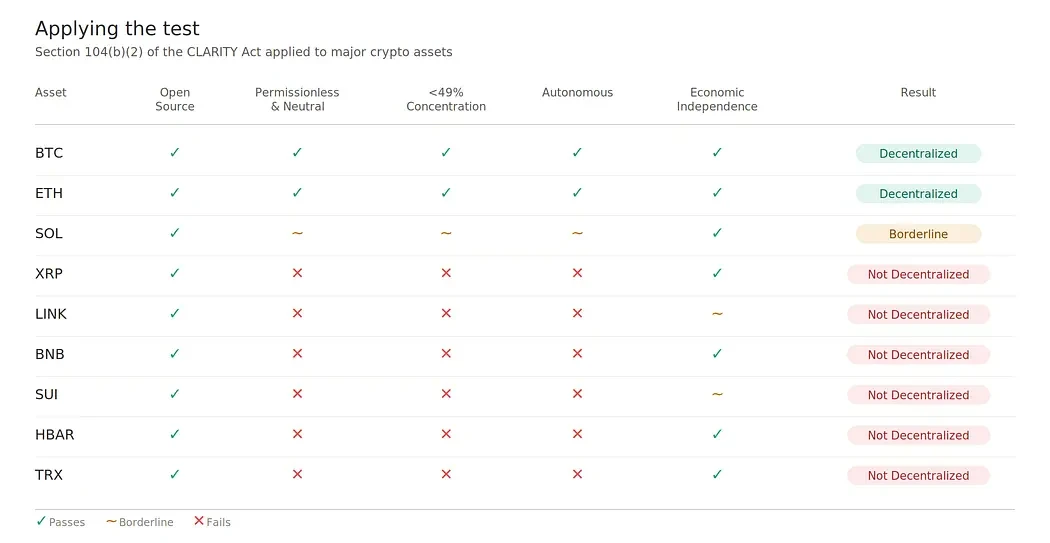
Bitcoin and Ethereum pass all criteria without controversy. Solana hovers on the edge, with the Foundation's influence on upgrades, heavy allocation to early insiders, and a history of coordinated network halts working against autonomy and credible neutrality.
All other major smart contract platforms fail due to structural reasons that cannot be easily remedied. This list includes XRP, BNB Chain, Sui, Hedera, and Tron, extending to most L1 competitors.
Among the assets that pass the test, exactly one has a functioning native smart contract economy.
The Shift in Valuation Framework
Tokens trade on two fundamentally different valuation frameworks.
The first is the commodity/monetary premium framework, where value derives from scarcity, network effects, store of value properties, and reflexivity, with no fundamentals-based valuation ceiling.
The second is the cash flow/equity framework, where value derives from revenue capitalized through standard multiples and is bound by strict ceilings imposed by real revenue projections.
Most non-Bitcoin tokens have occupied a strategic gray area between these two frameworks, marketing themselves whichever yields a higher valuation. The CLARITY Act ends this ambiguity through three mechanisms.
First, disclosure requirements impose a cognitive framework. Section 4B(d) requires semi-annual disclosures including audited financial statements (for those over $25 million), a CFO's going concern statement, related-party transaction summaries, and forward-looking development costs.
Once a token has SEC filings akin to Form 10-Q, institutional analysts will evaluate it as they would any entity filing a 10-Q. The document format dictates the valuation framework.
Second, the statutory definition is itself a qualification. An ancillary asset is defined as a token "whose value depends on the entrepreneurial or managerial efforts of the ancillary asset promoter." This definition is conceptually incompatible with a monetary premium, which requires value independent of any issuer's efforts.
A token cannot plausibly claim a monetary premium pricing power while simultaneously fitting the legal definition of an ancillary asset.
Third, visible scarcity is fragile scarcity. Monetary premium is reflexive, and reflexivity requires a compelling scarcity narrative that the market can collectively believe.
When a token discloses treasury information to the SEC, named insider unlock schedules, and quarterly reports on related-party transactions, its scarcity story becomes visible; once visible, reflexivity vanishes. Investors can see exactly how much supply insiders hold and when those tokens will be sold. This visibility kills buying pressure.
The result is a two-tier market. Tier 1 assets trade on monetary premium with no fundamentals-based valuation ceiling. Tier 2 assets trade on revenue multiples, with reasonable market caps.
Tokens currently priced on Tier 1 logic but relegated to Tier 2 will face a structural re-rating. For tokens with weak fundamentals driven primarily by narrative valuation, LINK and SUI being the most typical examples, this re-rating could be severe.
The End of Two ETH Bear Theses
For five years, the bear case for ETH has rested on two pillars.
The first thesis argued that ETH would ultimately be classified as a security rather than a commodity. Pre-mining, the Foundation's continued influence, Vitalik's public role, and post-merge validator economics all gave the SEC ample reason to act if needed.
Every bullish argument for ETH had to discount the tail risk that institutional capital channels might be restricted.
The second thesis argued that ETH would be replaced by faster, cheaper smart contract platforms. Each cycle births new "Ethereum killers"—Solana, Sui, Aptos, Avalanche, Sei, and BNB Chain—all selling better user experience and lower fees.
This argument holds that ETH's technical limitations will force economic activity to migrate, diluting its value capture.
The CLARITY Act doesn't just weaken these bear theses; it structurally overturns them.
The first thesis collapses because ETH passes all five criteria of Section 104 cleanly. No coordinated control, ownership concentration well below 49%, no unilateral upgrade power post-merge, fully open source, and a functioning value capture mechanism.
The regulatory tail risk that long justified a discount on ETH disappears.
The second thesis collapses in a more interesting way. "Ethereum killers" can only compete with ETH if they operate under the same valuation system.
If SOL is certified as a decentralized asset, the competition continues. If it fails the test (and currently, all other major smart contract competitors also fail), they will be forced into a Tier 2 valuation system, while ETH remains in Tier 1.
The competitive landscape changes accordingly. Tier 2 assets cannot compete with Tier 1 assets on monetary premium, because the core meaning of Tier 1 is that it is not bound by a fundamentals-based valuation ceiling.
Those faster, cheaper chains can still win in specific verticals for transaction throughput and developer attention. But they cannot win on the asset valuation framework that determines the most critical metric for L1 market cap.
The Only Ticket In
Among the assets passing Section 104's test, Ethereum is the only one with a functioning native smart contract economy. Bitcoin passes the test, but its base layer does not support programmable finance.
Every smart contract platform with meaningful TVL has one or more substantive failures in the test. This includes Solana, BNB Chain, Sui, Tron, Avalanche, Near, Aptos, and Cardano.
Thus, the bill creates a new regulatory category: a decentralized digital commodity with a native smart contract economy, with currently only one member in this category.
Every traditional financial institution exploring tokenization, settlement, custody, or on-chain finance needs two things: programmability and regulatory clarity.
Before CLARITY, these attributes were strictly separated. Bitcoin has clear status but is not programmable. Smart contract platforms are programmable but legally ambiguous. After CLARITY, Ethereum becomes the only asset offering both attributes within a single statutory category.
Once the framework is in effect, anyone building tokenized treasuries, tokenized funds, on-chain settlement infrastructure, or institutional-grade DeFi gateways will have a clear preferred underlying carrier.
This preference is not aesthetic or technical. It is compliance-driven. Asset managers, custodians, and bank-affiliated funds operate within legal frameworks that favor commodity-class assets and disfavor securities-like assets.
Institutional capital flows follow asset classification, and the classification has now narrowed to the single programmable asset.
The Sound Money Question
Once BTC and ETH share Tier 1 classification, it is necessary to scrutinize their monetary properties comparatively, because conventional wisdom has the causality reversed.
Bitcoin's favorability has always rested on its nominally fixed supply schedule of 21 million and predictable halvings every four years. As a scarcity narrative, this is very valuable, and the simplicity of the story is one reason BTC was the first to gain a monetary premium.
But BTC's supply model also carries three structural burdens rarely mentioned in discussions of scarcity.
First, mining creates continuous structural selling pressure. Network security depends on miners incurring real-world operating costs: electricity, hardware, hosting, and financing.
These costs are denominated in fiat currency, meaning miners must continuously sell a significant portion of newly issued BTC into the market, regardless of price.
This selling is permanent, price-insensitive, and embedded in the consensus mechanism itself. It is the cost of maintaining the Proof-of-Work security model.
Second, BTC offers no native yield. Holders seeking yield must either lend BTC to counterparties (introducing credit risk) or move it to non-BTC platforms (introducing custody and cross-chain bridge risk).
The opportunity cost of holding non-yield-bearing BTC compounds over time relative to assets that generate native yield. For institutional holders measured against yield-inclusive benchmarks, this is a real and persistent drag.
Third, the cliff-like decline in mining subsidies is a long-tail risk to the very decentralization that qualifies BTC as Tier 1.
Block rewards halve every four years and approach zero by 2140, but the actual pressure will come much sooner. By the 2030s, subsidy income will be only a fraction of today's, and the network must rely on fee income to bridge the gap to maintain security.
If the fee market does not develop sufficiently, the lowest-cost miners will consolidate, miner concentration will rise, and the credible neutrality that Section 104 values will begin to erode. This is not an imminent risk, but a structural risk inherent in BTC's model that has not been addressed.
Ethereum reverses each of these properties.
ETH has variable issuance with no fixed cap—the core argument sound money purists use against it. This argument is superficial.
For holders, what matters is the rate of change in their share of total supply, not whether the supply schedule has a fixed terminal value.
Under Ethereum's post-merge design, all issued tokens are distributed as staking rewards to validators. Validators have historically earned yields higher than the inflation rate, meaning anyone participating in staking can maintain or grow their share of total supply over time.
For anyone participating in a validator node or holding liquid staking tokens, the "infinite supply" argument is rhetorically forceful but mathematically unsound.
The structural selling pressure burdening BTC does not exist on the same scale for ETH. Validator operating costs are negligible relative to their returns. Solo staking requires a one-time hardware purchase and minimal ongoing electricity. Liquid staking and pooled staking abstract even these costs away.
Newly issued tokens accrue to validators and are largely retained, rather than sold into the market to cover costs. This same security model, which distributes yield to holders, also avoids the price-insensitive selling required by Proof-of-Work.
The subsidy cliff problem also does not exist. Ethereum's security budget scales with the value of staked ETH and is funded through ongoing issuance and fee revenue. There is no predetermined date when security funding suddenly dries up.
This model is self-sustaining, while BTC's model increasingly depends on the development of a fee market, the realization of which remains uncertain.
None of the above argues that ETH will replace BTC. They play different roles in institutional portfolios.
BTC is a simpler, clearer, politically more defensible scarce asset. ETH is productive monetary collateral that pays its holders for participating in its security.
The key point is that the conventional notion—that BTC has "harder money" properties than ETH because of a fixed supply cap—crumbles under scrutiny.
ETH's variable issuance combined with native yield offers better actual economic properties for holders than BTC's fixed supply combined with zero yield, and it does so without structural selling pressure or long-term security funding risk.
For institutional allocators building Tier 1 crypto exposure