Circle 發布 Arc Network 白皮書,新經濟機制能否推動其成為機構級穩定幣支付的「清算協調層」?


- 核心觀點:Circle 推出的 Layer1 公鏈 Arc 旨在成為企業級穩定幣支付基礎設施,透過 USDC 作為原生 Gas、高效能共識與可選隱私等設計,推動穩定幣從交易媒介轉向鏈上金融核心。其原生代幣 ARC 作為協調資產的設計尚處於討論階段,網路面臨中心化與合規挑戰。
- 關鍵要素:
- Arc 採用 USDC 作為原生 Gas 代幣,透過指數加權移動平均(EWMA)動態調整費用,消除價格波動對支付預測的影響,並支援多幣種自動兌換。
- 使用 Malachite 共識機制(基於 Tendermint BFT),交易經三分之二驗證者確認後即時最終確定,無法逆轉,驗證者由信譽良好的機構組成以符合合規要求。
- 引入 ARC 代幣作為原生協調資產,未來可能用於治理投票、支付獎勵與銷毀,但網路早期仍由 Circle 和指定機構負責安全、合規等關鍵決策。
- Arc 提供可選隱私能力,未來計劃整合多方安全計算與同態加密以保護企業商業資訊,並支援隱私訂單簿等功能。
- 穩定幣支付場景的擴展使 Web3 基礎設施競爭焦點轉向流動性、合規性與生態可擴展性,而非單純的效能與費用。
Original Author: ShirleyLi, Researcher at Web3Caff Research
How to easily grasp the market hotspots, technological trends, ecosystem progress, and governance developments happening in the Web3 industry? The "Market Pulse Analysis" column by Web3Caff Research delves deep to explore and screen current hot events, providing value interpretations, commentary, and principle analysis. See through the surface to the core, and quickly capture the frontline market trends of Web3 with us.
Compliance Notice: Stablecoins are virtual currencies (Tokens). Please be aware that issuing or participating in investments in Tokens is subject to varying degrees of strict regulatory requirements and restrictions in different countries and regions. Notably, issuing Tokens within mainland China constitutes "illegal issuance of securities," and providing cryptocurrency trading matching services also falls under "illegal financial activities" (Readers in mainland China are strongly advised to read "Compilation and Key Points of Laws and Regulations Related to Blockchain and Virtual Currencies in Mainland China"). The following content is solely an objective analysis of Arc Network's progress and its potential market strategies, aimed at exploring and analyzing how blockchain-based application scenarios can develop responsibly within the global regulatory environment. Therefore, please do not use this information for decision-making. Please strictly adhere to the laws and regulations of your country or region and refrain from participating in any illegal financial activities.
For a long time, stablecoins have been a crucial component of the on-chain financial ecosystem. Recently, with the rapid development of use cases like RWA and cross-border payments, their role is evolving from a simple on-chain medium of exchange into a key value bridge connecting traditional finance with the on-chain economy in certain countries and regions globally. Stablecoin payments are becoming a new form of financial infrastructure.
In May last year, Circle announced the launch of Arc, a Layer 1 public chain specifically designed for payment stablecoins and their underlying ecosystem, aiming to provide enterprises with high-performance, predictable, and compliant enterprise-grade stablecoin gateways. The emergence of Arc could also transform Circle's native stablecoin, USDC, from a standalone payment token into a utility token for a public chain. Previously, Circle released the Arc Litepaper, detailing the operational logic of the blockchain at the product level, which Web3Caff Research also interpreted in depth:
As an L1 public chain, Arc primarily introduces the following innovations for enterprise-grade users:
- USDC as Native Gas Token: Arc first introduces USDC as the native gas token of the public chain to eliminate the impact of token price volatility, making the prediction of interaction costs directly related to the base fee per unit of gas. To further reduce volatility, Arc dynamically adjusts the current base fee through the Exponentially Weighted Moving Average (EWMA) of historical block utilization, preventing sudden spikes in fees due to network congestion. Additionally, when users pay with other stablecoins, Arc automatically uses its native stablecoin via Circle Paymaster to cover interaction fees and deducts an equivalent value of other stablecoins from the user's account. This provides flexibility for multinational enterprises and users in non-dollar regions, positioning Arc as a potential global, multi-currency financial settlement public chain.
- High-Performance Consensus Design: In the on-chain context, because transaction finality requires time, enterprises cannot immediately start processing an order. There's a chance that subsequent automatic processing by financial/business systems might need to be reversed, incurring extra handling costs—unacceptable in real business operations. To address this, Arc employs the Malachite consensus mechanism (a Tendermint Byzantine Fault Tolerance mechanism). Under this mechanism, once a payment is confirmed and submitted by two-thirds of the validators, it is instantly finalized and irreversible. Furthermore, Arc's validators are not anonymous staking nodes but a curated group of institutions with strong reputations, capable of meeting compliance requirements across different global regulatory systems. In the future, Arc will also introduce Multi-proposer, allowing multiple validators to generate block proposals in parallel within the same time window, which are aggregated into a single block during the consensus phase. This can further enhance the payment system's throughput and reduce latency in financial processing.
- Enterprise-Grade Privacy: To prevent leakage of core business information, Arc offers optional privacy capabilities for enterprises, implemented in phases. As secure technologies like multi-party computation (MPC) and homomorphic encryption mature, Arc plans to introduce more complex on-chain privacy settings, such as private order books and privacy-focused financial strategies, operating automatically via confidential on-chain contracts.
If you want to learn more about the operational logic of the Arc blockchain, we recommend reading: Market Pulse Analysis: Circle Enters the Public Chain Arena – Can Its L1 Network Arc Become the Compliant First-Chain for Payment Stablecoins?
Fast forward to May this year, six months after the Arc testnet launch. Circle has released the Arc blockchain whitepaper, further elaborating on the design logic of the ARC Token as the native coordination asset of the Arc network, and hinting that the Arc mainnet is expected to launch this summer.
As mentioned earlier, Arc currently employs the PoA (Proof of Authority) mechanism, where a curated group of reputable institutional nodes handles network validation and block production. However, this model carries centralization risks and is more suitable for the early startup phase. As network adoption scales, Arc is likely to transition to a PoS mechanism, but USDC is not suitable for staking. Therefore, Circle is considering introducing a new token system – the ARC Token – as the native coordination asset of the Arc network, responsible for aligning the interests and behaviors of various participants (validators, developers, users, institutions, etc.).
According to the whitepaper design, ARC holders can participate in network governance voting based on their staked weight, collectively deciding on network fee rates, inflation rates, and burn mechanisms. Additionally, they could gain future rights related to protocol access and interaction. However, the whitepaper clarifies that Arc's governance model is not a fully-fledged DAO and will retain institutional coordination mechanisms. In the early stages of the network, sensitive matters like security responses, compliance, validator admission, and protocol upgrades will primarily be managed by Circle and designated institutions.
Concurrently, when users pay fees using stablecoins on the Arc network, those fees are automatically converted into ARC Tokens. A portion of these will be distributed as rewards to validators and stakers, while another portion will be burned. Compared to traditional public chains requiring users to directly hold native gas tokens, this design may better align with the usage habits of institutions and enterprises.
For the Arc network, the application scope of the ARC Token could expand further in the future. Potential use cases include building dedicated transaction channels, coordinating and managing asset flows and data interoperability between different blockchains, and supporting Circle Paymaster's multi-asset gas scenarios, allowing users to pay network fees with various stablecoins.
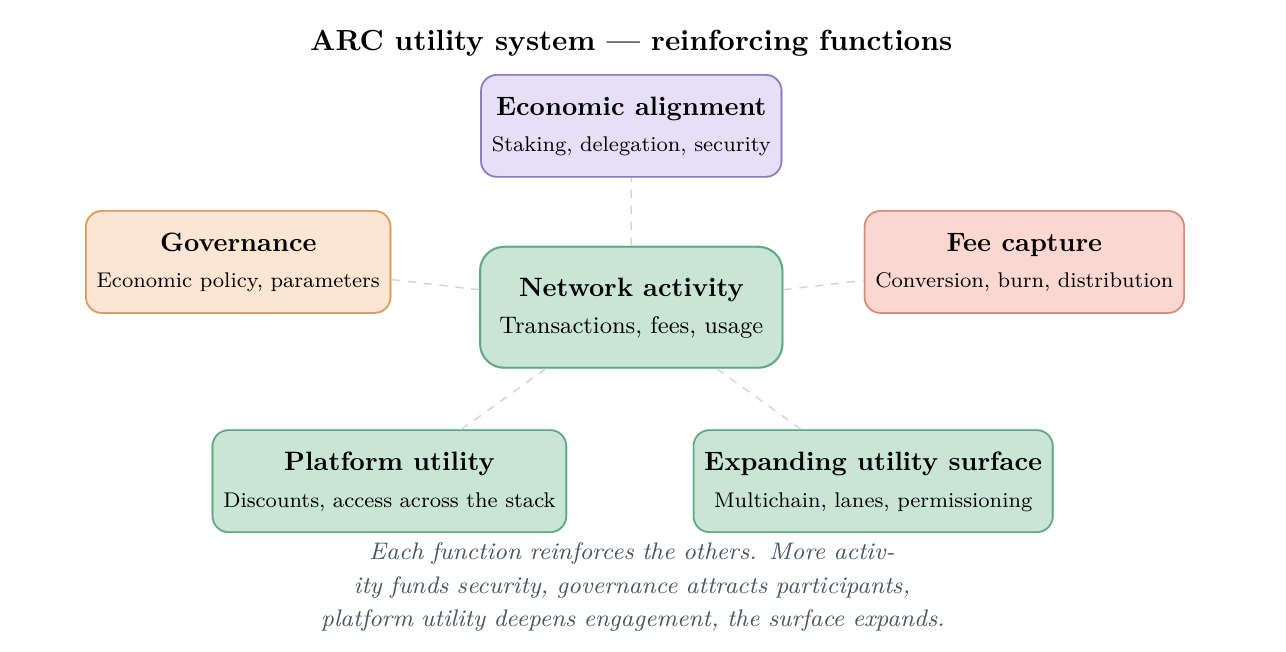
Source: ARC: The Native Asset of the Economic OS
However, it's important to note that the ARC Token system is currently in the discussion and design phase and may undergo significant changes. Circle has repeatedly emphasized that ARC itself is neither a security nor an investment product and does not represent any equity or revenue rights.
On a specialized blockchain like Arc Network, centered around stablecoin payments, significant economic activity stems from banks, payment institutions, corporate users, and capital markets. As regulatory frameworks for stablecoins, on-chain assets, and on-chain financial activities are established and refined globally, the path for these institutions to participate in on-chain infrastructure development is becoming clearer. This trend is also changing the competitive logic of Web3 infrastructure. The era of simply competing on network performance and transaction fees is fading. Liquidity, compliance, stability, sustainability, and ecosystem extensibility will become the new focal points of competition.
Of course, this transition won't happen overnight. The future development of the Arc network will face several potential challenges.
For instance, the current overall architecture of the Arc network still carries a strong centralization tendency. Although Circle attempts to establish a longer-term economic coordination and governance mechanism via the ARC Token and gradually steer the network towards PoS, the system is still under discussion and not yet implemented. Its specific governance structure and economic model remain highly uncertain. Furthermore, the ARC Token mechanism itself could introduce additional governance and security risks to the Arc network. For example, can the economic model design meet real network demand? Could concentrated staking by large nodes lead to the centralization of network governance? These questions await further official discussion and optimization.
Additionally, while stablecoin regulatory mechanisms are gradually being refined, significant differences still exist in the specific regulatory frameworks of different countries and regions. This means Arc Network will need to continuously adapt to evolving compliance requirements in the future.
Currently, traditional public chains like Ethereum, Base, and Solana are actively expanding towards on-chain financial infrastructure, stablecoin payments, and institutional-grade applications. This can be seen as a signal of change among leading Web3 institutions, including Circle. However, it remains to be seen who can ultimately establish the next-generation global on-chain financial infrastructure.
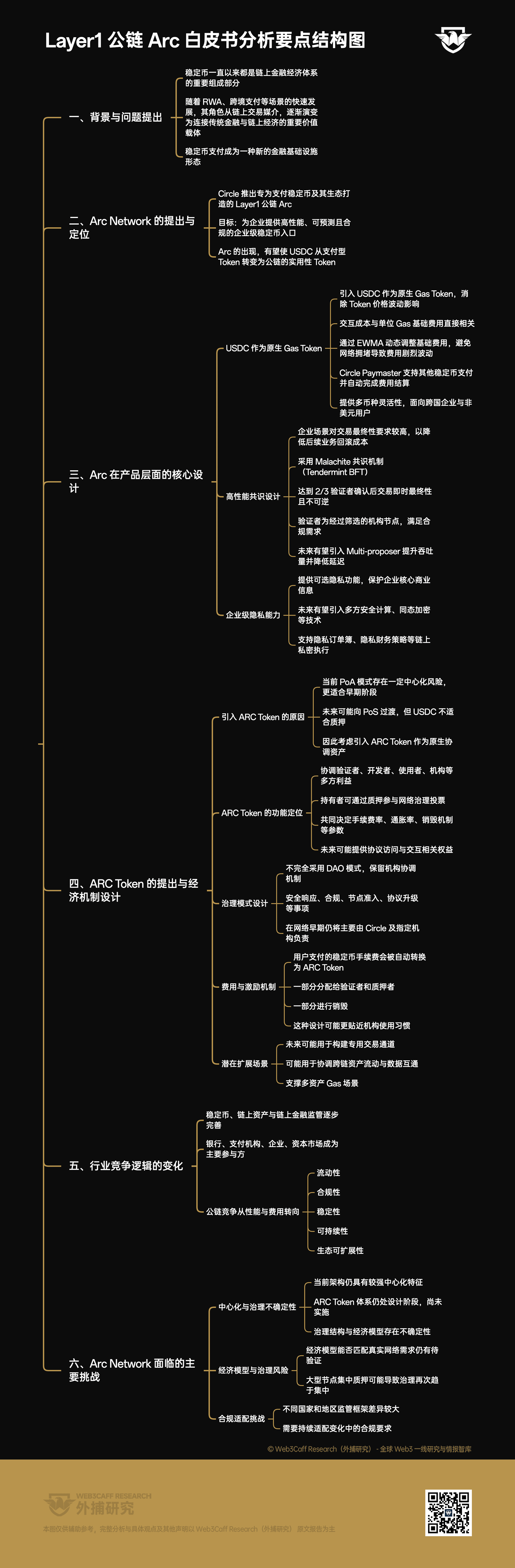
Key Points Structure Diagram:
References:
[1] Introducing the ARC Whitepaper: Exploring Arc’s Native Coordination Asset
Disclaimer: This report is prepared by Web3Caff Research and is for informational purposes only. It does not constitute any forecast, investment advice, proposal, or solicitation. Investors should not rely on such information to buy or sell any securities, cryptocurrencies, or adopt any investment strategies. The terminology used and the opinions expressed are intended to help understand industry trends and promote the responsible development of the Web3 and blockchain industry and should not be interpreted as definitive legal views or the opinions of Web3Caff Research. The views in this report reflect only the author's personal opinions as of the stated date, which are independent of Web3Caff Research's position and may change with subsequent circumstances. The information and opinions contained in this report are derived from proprietary and non-proprietary sources deemed reliable by Web3Caff Research but do not necessarily encompass all data, and their accuracy is not guaranteed. Therefore, Web3Caff Research makes no warranties regarding their accuracy or reliability and assumes no responsibility for errors or omissions arising in any other way (including liability to any person due to negligence). This report may contain "forward-looking" information, which may include forecasts and projections, and this document does not constitute a guarantee of any forecast. It is entirely the reader's decision whether to rely on the information contained in this report. This report is for reference only and does not constitute investment advice, a proposal, or a solicitation to buy or sell any securities, cryptocurrencies, or adopt any investment strategy. Please strictly comply with the relevant laws and regulations of your country or region.