






AI的宿命與歷史的鏡像:距離人類退場還有多久|Peter McCormack專訪 Liberman兄弟


- 核心觀點:AI正重演網際網路中心化劇本,少數巨頭壟斷將導致大多數人淪為系統「活動零件」;未來24個月是去中心化與中心化AI路線之爭的關鍵窗口期。
- 關鍵要素:
- 中心化AI將導致「兩極分化」:極少數精英掌握訪問權,其餘人成為系統附屬品,失去市場競爭力與思維自由。
- 訪問權是核心:AI訪問正變得不可靠(如Anthropic切斷OpenClaw權限),依賴AI的人將因無法退出而受制於少數企業。
- 比特幣是成功範例:其工作量證明機制吸引了超過微軟、亞馬遜等巨頭總和的算力基礎設施投資(23GW),證明去中心化社群可建設超大規模網路。
- 項目「Gonka」採用比特幣代幣經濟學,透過工作量證明激勵礦工提供去中心化AI算力,目前GPU規模已達OpenAI的0.5%。
- 最黑暗情景並非AI失控,而是先爆發人類之間因AI導致的貧富與資源爭奪戰,如俄羅斯2008年社交媒體滲透事件重演。
- 2024-2025年關鍵事件:OpenAI轉為營利機構、Mythos模型發布兩級訪問權限,這些訊號表明窗口期正在關閉。
Original video: https://www.youtube.com/watch?v=HdDNw-VxCvA
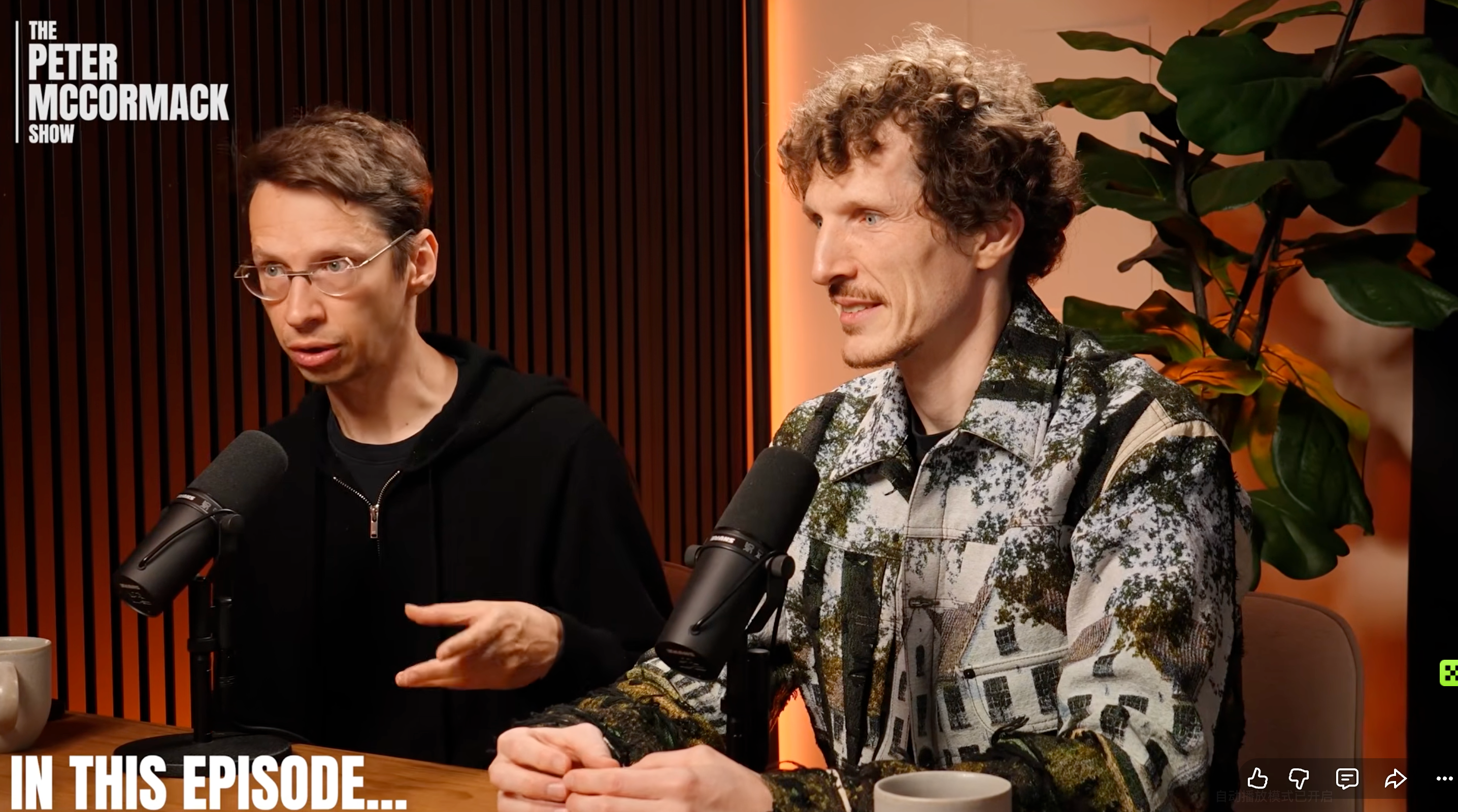
Daniil and David Liberman previously sold their first company to Snapchat. Now, they are racing against time before the window closes to build a decentralized alternative to challenge OpenAI, Anthropic, and Google. In this interview, they explain why centralized AI will ultimately lead to a “bipolar” world: where a tiny elite holds access, and everyone else becomes mere “moving parts” of the system—and why they believe the next 24 months will determine which path we take.
This interview dives deep into the following topics:
- The Fate of AI: Why is AI repeating the playbook of centralized internet?
- Recursive Loop: AI is writing AI, the gears of evolution have spun out of control.
- The Broken “Kill Switch”: Why will attempts to shut down AI inevitably fail?
- Ownership of the Future: How did a few American giants end up “buying out” humanity’s future?
- Mirror of History: How is what they saw in Russia in 2008 replaying in the current AI wave?
- The Only Blueprint: Why is Bitcoin the only paradigm in history to successfully defeat centralization?
- The Darkest Scenario: The ultimate projection they can barely bring themselves to speak out loud.
AI and Human Freedom
Peter: Good morning, both of you.
Both: Good morning.
Peter: I’ve been looking forward to this conversation for a while; we’ve been preparing for some time. I’ve been thinking a lot about AI, and using it a lot, trying to understand what it means for the future of the planet we live on, especially the world my children will grow up in. If AI becomes the infrastructure for everything, or part of it—electricity, the grid, the internet, money—and we can’t survive without it, what happens to human freedom?
Daniil: The answer to that question really depends on how we build this infrastructure. If this infrastructure is equally accessible to every person on Earth, it will only expand freedom. The opposite is true if it is not.
Invisible Enslavement
Daniil: This isn’t even slavery—we wouldn’t even realize we are enslaved. It’s like the state in *1984*. If this AI infrastructure is controlled by a few companies or a few governments, we will see a very bad situation.
Forget the word “propaganda”? It won’t even be seen—it exists in every answer. We already treat this system as our therapist, news source, calculation tool, everything. Our trust in it will keep increasing; the fewer mistakes it makes, the higher the trust will be, eventually reaching 100%. Therefore, once someone with malicious intent—anyone who wants to manipulate your opinions or freedom of thought—targets a specific issue, that’s it, they have total control over you.
Peter: But if it permeates everything, is there a possibility for people to opt out? Like someone says, I don’t want to live in a world constantly answering to AI and talking to AI. Like the phone phenomenon we see, where people are starting to rebel, wanting to return to the real world, to nature, to eat good food—can people live outside the AI system in this world?
David: That’s a good question. You can survive, but the problem is whether you can remain competitive in the market—can your productivity match that of people using AI? That is a problem. It might be possible for a very few, but for most of us—the answer is no.
Peter: Do you think there will be a currency that exists completely outside of AI?
David: Honestly, that’s very interesting. If you take it to an extreme—say, one company controls all AI, a complete monopoly—capable of replacing all human labor: software engineers, designers, management, marketing… then the question becomes: will we all lose our jobs because of it?
The answer can be “no”—if we continue to trade amongst ourselves, without relying on that company. Even if that company becomes ten times more efficient, we can still function among ourselves, just like today, nothing changes—unless it’s used to control our decisions. If we can still opt-out, we can operate as usual in our original market, even if the other market might be ten times its current size.
Bitcoin and AI Centralization
David: So the core issue is the same as it has always been—when the Americans pushed the British out of America and drafted the Constitution, that debate between Federalists and Anti-Federalists was a struggle between decentralization and centralization. We saw the same thing in currency: governments print money, Bitcoin was born.
AI will face the same centralization problem—not “will,” but “is.” Just like Bitcoin’s trajectory, initially only a few people realize this, and what they say even sounds extremist. They’d say we need to be vigilant, need to build alternatives. But then, event after event, more and more people are converted—like every financial crisis, every time the Fed prints money, more people believe an alternative is needed.
We similarly expect this to happen with the decentralization of AI. Take the recent OpenClaw incident—a very popular open-source AI agent used by thousands to call Anthropic’s Claude model. They were excited to use it. But Anthropic simply cut off access for OpenClaw users, and the entire community put in enormous effort to switch to other models.
This shows that access to AI is already proving—we shouldn’t take it for granted, can’t assume these models will always be open to you like they are now. And once you realize that, you see you’re making yourself increasingly dependent on it in your work—whether you’re an engineer, a business owner, or a journalist. Every time people feel their freedom is threatened, we expect more and more will seek alternatives.
Peter: I think the word “enslavement” needs to be used very carefully; it carries heavy implications. But let me tell a short story. Lately, I’ve been trying to quit my phone, because someone explained to me that a phone is like a parasite. I noticed everywhere in life, people staring at their phones—walking on the street, on the bus, on the subway, completely glued. So one day I deleted 130, 150 apps, and since then, I delete one every day. I wanted to turn my phone into a pure tool: book flights, pay parking fees, bank transfers, but no entertainment apps. I want to quit it.
But at the same time, I’m diving deeper and deeper into AI. I’m building AI infrastructure for my company, helping me prepare materials, get work done. I’m wondering, at what point does AI go from being a tool for me to me becoming its slave?
David: I agree, be careful with that word. From what we observe around us—in the startup world, people worth hundreds of millions, billions—they are working more because of AI. They simply can’t stop, because it’s addictive in a way: you say it, and it happens. You type your command, and things start running—software is built, marketing plans are prepared, emails are written, GitHub commits are done. In a sense, you can do so much, it’s the opposite of slavery—you are the slave master.
Peter: Interesting. I was discussing this with someone the other day, and I said I felt like I was experiencing AI fatigue.
The Beginning of AI Addiction
David: Exactly. On one hand, it makes me more productive, able to do more. Actually, I end up working more. On the other hand, keeping up with the pace of AI development and change is nearly impossible. So I’m starting to think—do I really want to go this way? Do I want to be this kind of person? It’s really tiring.
Daniil: The only way to keep up with AI now is to be unemployed—literally, it has to be your full-time job. But at the same time, is it really necessary? If you skip a few months and come back, the model has upgraded two versions, some new tools have appeared, something has replaced another. Honestly, the answer is likely: you won’t be that far behind. It just takes a bit of time to adapt to the new toolset and then keep going.
I think we are all overly excited right now, because magic is happening right before our eyes. At the same time, we are addicted, accompanied by anxiety—fear of missing out on the latest tool, while your friends, peers, competitors, even your girlfriend, know more about AI trends than you. This is a real problem now.
But this anxiety itself creates dependency, and dependency is already very close to enslavement. Because if your livelihood, your ability to remain productive in society, depends on these tools, you simply have no way to stop using them.
Peter: If we think about how the internet aggregated—we have Amazon, a great tool, but a disaster for physical bookstores, everything concentrated in Bezos’s hands. Uber, Uber Eats, Deliveroo, created the gig economy, where workers at the bottom barely get by, upward mobility is extremely difficult. But opening a physical bookstore, you can work hard, slowly expand, open a second, a third. We concentrated everything around tech, making upward mobility very difficult, while creating tons of super-rich at the top.
Now my thought on AI is—I listen to the All-In podcast, hear Sacks and Chamath talk about the power of AI, hear Andreessen talk about the power of AI. But I noticed—this idea came from an Eric Weinstein tweet—these large language models are absorbing all the innovation in human history, concentrating these benefits into the hands of a few. If AI starts taking jobs, these people have no personal stake in the downside risk of AI. At what point will AI start distributing work like the gig economy, and we become functionally slaves to this system?
The End of the Upward Track
Daniil: This is the scariest part, and this is how we see it—there are only two scenarios. One is what you described: we all lose our jobs, a specific company, or five oligarchic companies essentially making the same product, vertically integrate everything—from the top intelligence to toilet paper at the bottom, all within one ecosystem—Apple ecosystem, OpenAI ecosystem, Google ecosystem… all the same, vertically integrated from top to bottom. In this world, we all lose our jobs, we are all just parts.
David: Like ants—moving things from here to there, physical laborers, until robots take even that job.
Daniil: Exactly. That’s one world. But there’s another world—another, good one—where everyone has their own robot, everyone has equal access to superintelligence. If it’s equally distributed, then everyone just has one more tool—a brand new productivity tool. Everyone can be super efficient, achieve their desired level of productivity, and we continue to operate in the same market and economy until we reach a state of complete abundance—the robots and intelligence I own can produce everything I need in life, and the only thing beyond that is relationships with others.
Until that complete abundance arrives, we can move forward with equal access to this tool—the more equal the access, the less turmoil we will see. It’s all about access.
Peter: I think not enough people see this as a problem that needs solving. The hosts of the All-In podcast have no incentive to think about this, because they are Silicon Valley investors who benefit from centralization. In a way, centralization has won over the last one or two hundred years. The Federalists won, the Anti-Federalists lost. But the Anti-Federalists were right, because look at what happened with money—money was centralized. Bitcoin tells such a compelling story, but watching everything go up in price, people being eroded by inflation, they still don’t come to buy Bitcoin.
So in the world of AI, with these amazing tools, these large language models that seem like magic to us—how do we get people to start thinking: there must be an alternative, a decentralized version?
The Good AI Future
Daniil: There is currently a situation—people are getting more and more scared, scared of where things are going, and that’s important. I really hate that real development in human history is driven by fear. That’s why I want to present a positive picture, so we all really fight for that better future. But the fear is real, the problem is real, we feel it more and more now, and we will feel it much more intensely in the next two years, and it will happen very fast.
For example, now you see new layoff announcements almost every week, ten thousand people here, ten thousand there. People should stop and think: if these tools really increase productivity, why are they laying off? Instead, they should be able to do more, accelerate the economy, so why lay off?
Peter: You need different types of talent.
David: Even so, hiring should exceed layoffs, but we don’t see that.
These centralized companies, when they started—like Amazon—brought genuinely good ideas: products delivered to your doorstep with one click, maybe in 15 minutes. We all bought into it, we all wanted that world. Then they changed the policies. Amazon was originally a web platform, just selling goods. But they looked at the data on what you bought, then pushed their own brands at you, of lower quality, ultimately more expensive than the original goods—because once they control the platform, they can manipulate it.
Google is the same. I remember around 2003 or 2004, Google promised ads would never appear in the main feed, only on the side of search results. And they promised “Don’t Be Evil,” but later they said “we don’t say that anymore.”
So the problem is: when we have decentralized protocols, the rules are encoded, they never change. This creates certainty; we can all trust the protocol and commit fully. But these centralized organizations don’t think the promises they made early on have to be kept indefinitely.
Peter: Do you think they are brainwashing us? Because there’s a huge benefit for them.
Daniil: Interesting, “who is ‘they’”? That’s the biggest question. Is it individuals like Sam, Dario? Or companies like Google, Microsoft—thousands of people making decisions for their own benefit, getting bonuses, and then above them a layer of investors, shareholders, mainly faceless funds, where no one is really taking a risk, just making money for others or themselves. It’s a chain of making money for others. Profit isn’t bad unless it forms a monopoly; but once you monopolize an area, it leads to declining service quality and predatory price increases—Netflix is the best example, prices keep going up, content keeps getting worse. They have more users, the cost of digital products should be spread over more users, prices should be lower, but we don’t see that.
Why Monopolists Always Win
Peter: Michael Green talked about monopoly being one of the biggest problems in the economy; without competition, products get worse and more expensive.
About a month ago, Lex Fridman did a podcast with Dario. Lex asked him if the business model of charging per token via API would continue. Dario first said that model might continue, but then he shifted gears—he said not all AI tokens have the same value. He gave an example: when AI helps you fix your MacBook, you might be willing to pay less, but when AI relates to your health, you are willing to pay more.
From the perspective of electricity, we want AI to be like electricity—ubiquitous and cheap. But what he meant is: the kilowatt-hour that lights your home and the kilowatt-hour used during your open-heart surgery naturally have different prices; you’re willing to pay more for the latter.
David: That is the scenario where we become accessories of the system—we are no longer people, but appendages of the AI system. That’s the difference: when access isn’t guaranteed by a protocol and open to all, we inevitably head towards that future. Unfortunately, the industry leaders aren’t even hiding it anymore; they openly express these ideas because they are preparing for their IPOs, showing investors that AI tokens can be sold at higher prices.
These companies also have it hard—they’re all in a race to superintelligence, the cost of running these LLMs is huge, but revenue hasn’t kept up. They have no reason to care about the impact on ordinary people like us.
Daniil: They won’t care, that’s the simple conclusion.
Since 2014, we were part of the group discussing the potential bad scenarios of AI. Back then there were many different views—Terminator-style scenarios, doomsday scenarios… But our judgment has always been: the worst scenarios all start with AI being controlled by a few companies. When you follow those scenarios down the line, you realize—even if those founders truly have good intentions and truly want a better future—the way they build it will ultimately lead us to a bad outcome.
Inflation, AI, and Collapse
Peter: We live in a financial system where we need money to survive, but the system constantly extracts upwards—governments always overspend, banks create money out of thin air, creating inflation, asset inflation but wages can’t keep up. You see increasingly on social media criticism of billionaires and big corporations, people leaning towards some new form of communism. This tendency is understandable





