






L1破冰先鋒:SUI 週漲 24%、TON 三日翻倍,小山寨季敲門中?


- 核心觀點:近兩週加密市場回暖,L1 板塊中 TON 和 SUI 因各自獨特的基本面催化劑走出獨立行情,這可能預示著山寨幣輪動即將開始,但全面輪動仍需宏觀條件確認。
- 關鍵要素:
- 宏觀背景:BTC 主導率升至 60.3% 創年內新高,山寨季指數約 35,市場仍處於「比特幣季」,但 L1 已率先異動。
- TON 催化劑:Telegram 創辦人 Durov 宣布 Telegram 成為 TON 最大驗證者,結合 Catchain 2.0 升級(出塊時間降至 400 毫秒)和手續費降 6 倍,三天內價格從 1.35 美元飆升至 2.89 美元。
- SUI 催化劑:一個月內集齊現貨 ETF、CME 期貨上線和上市公司大額質押(SUI Group Holdings 質押 1.087 億枚 SUI)等機構化「三件套」,並與奈及利亞 Paga 合作落地支付。
- 歷史參照:高位 BTC 主導率與低位山寨季指數的組合,在 2016-2017 和 2020-2021 年曾出現在大規模山寨幣行情啟動前 2 至 6 個月。
- 輪動條件:廣義山寨季啟動需 BTC 主導率跌破 54% 且山寨季指數突破 75,當前指標距離門檻較遠,整體輪動尚待確認。
Original Author: Curry, Shenchao TechFlow
Are we coming back to crypto for a meal?
The crypto market has seen a recovery over the past two weeks. Besides the localized buzz around the Uniswap Hook V4 narrative on-chain, a batch of veteran coins has also rebounded.
Among them, the L1 sector performed well, with ZEC, TON, and SUI showing impressive gains. We introduced ZEC last week, while SUI and TON have moved independently against a flat broader market: TON surged from $1.35 to $2.89 in three days, and SUI broke through $1.24 with a weekly gain of over 24%.
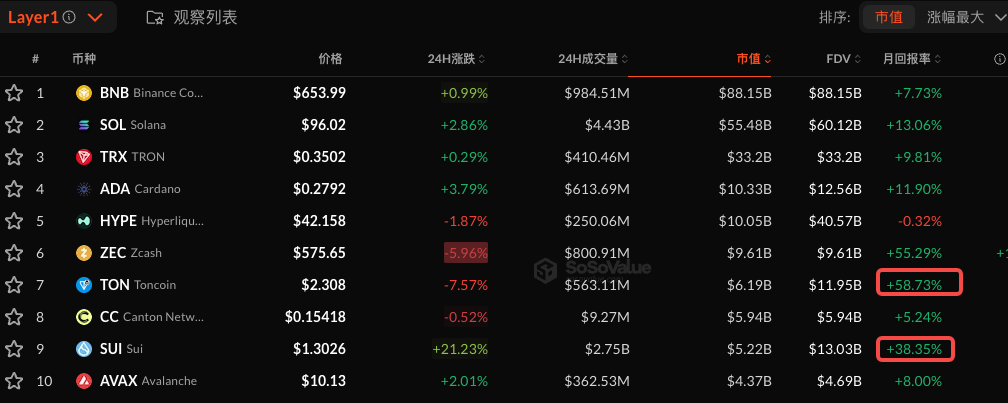
Each chain has its own verifiable catalysts in terms of news and fundamentals. Meanwhile, does the initial movement in the L1 track signal the beginning of a broader altcoin rotation?
BTC Dominance Hits a New Yearly High, But the L1 Track Moves First
Let's first look at the macro backdrop.
According to Bitget data, as of May 9, BTC dominance rose to 60.3%, the highest level of 2026. The Blockchaincenter Altcoin Season Index reads around 35, far below the threshold of 75 needed to confirm an altcoin season. The market is still in "Bitcoin Season."
However, structural signals have emerged. BTC dominance has been consolidating in the 58%-60% range for nearly eight months (August 2025 to April 2026), with the RSI showing signs of stagnation.
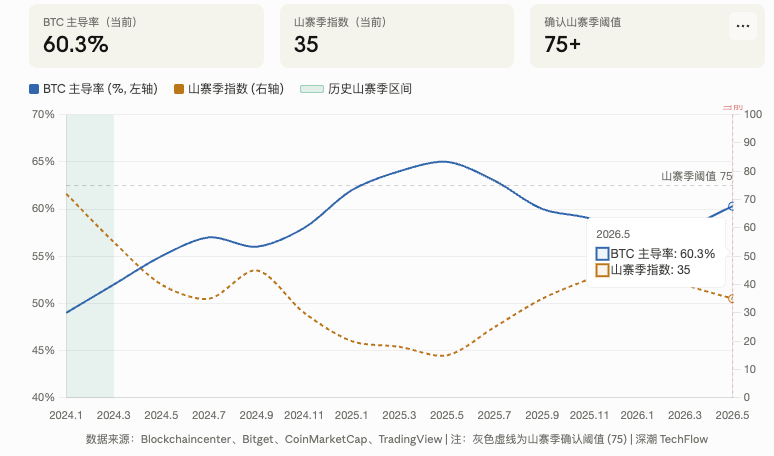
Analyst el_crypto_prof on X pointed out that the weekly structure of the total altcoin market cap (excluding BTC) closely resembles the formations seen before the start of the altcoin seasons in 2016-2017 and 2020-2021. In both historical instances, the combination of high BTC dominance and a low Altcoin Season Index ultimately appeared 2 to 6 months before the most profitable altcoin rallies began.
It is during this window, where the macro environment is yet to confirm while individual stocks are already moving, that SUI and TON have carved out their independent trends.
TON: Telegram Transforms from "Partner" to "Actual Controller"
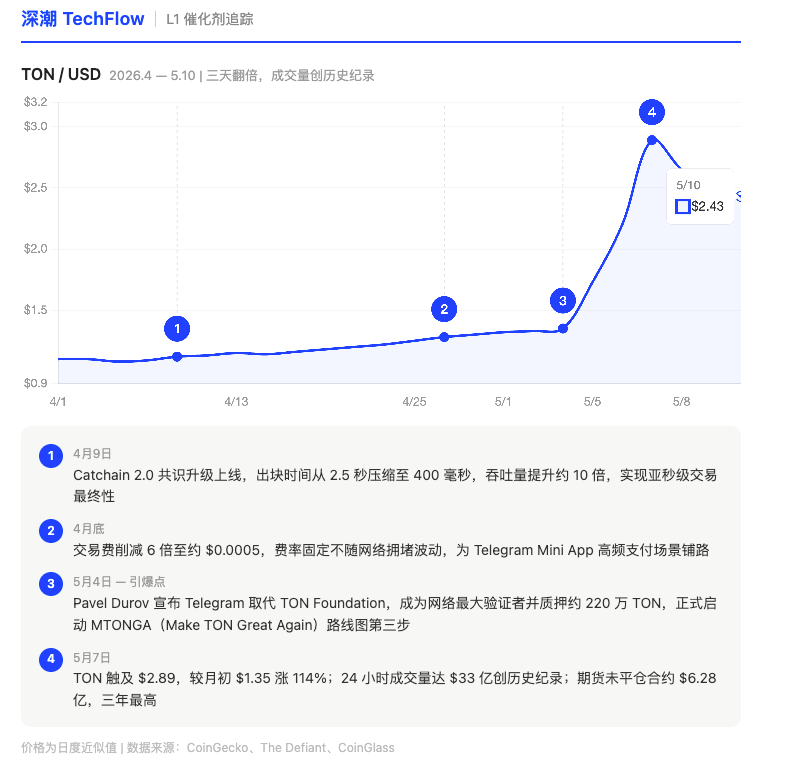
TON's rally had a precise trigger: On May 4, Telegram founder Pavel Durov announced on X that Telegram would replace the TON Foundation to become the largest validator and primary driving force of the TON network.
The significance of this needs to be viewed in a historical context.
In 2020, Telegram was forced to abandon the TON project due to SEC enforcement actions, returning $1.22 billion to investors and paying an $18.5 million fine. Durov announced the project's termination in a blog post. Subsequently, the TON Foundation operated as an independent community for five years.
Six years later, Durov returned personally, staking approximately 2.2 million TON, and the ton.org domain switched to an "MTONGA" (Make TON Great Again) themed page.
According to The Defiant, TON surged 33% on the day, hitting an intraday high of $1.90. By May 7, the price had rocketed from $1.35 at the start of the month to near $2.89, a three-day gain of approximately 114%, with 24-hour trading volume reaching $3.31 billion, a historical high for TON. CoinGlass data shows open interest in futures simultaneously rose to $628 million, a three-year record.
Before the Telegram takeover, Durov spent a month executing a series of intensive technical upgrades:
- On April 9, the Catchain 2.0 consensus upgrade went live, reducing block time from 2.5 seconds to 400 milliseconds and improving throughput by approximately 10 times. As Durov himself stated on X, TON is now "the fastest finality chain among all major L1s."
- At the end of April, transaction fees were slashed from about $0.0023 to about $0.0005, a 6-fold reduction, with rates fixed and not fluctuating with congestion. Durov stated that "most transactions will be completely free" going forward.
Institutional developments followed suit. Japan's Rakuten Wallet listed TON spot trading in mid-April, and CoinShares launched a TON staking ETP on Switzerland's SIX exchange. Reports indicate that the USDT supply on the TON network has exceeded $500 million, and the monthly perpetual contract trading volume through Telegram's in-app wallet surpassed $1 billion.
Technical upgrades for TON continue. Durov's goal is to transform Telegram into a super-app entry point integrating payments, DeFi, AI agents, and private communication, with TON acting as the underlying financial layer.
However, the author believes that Telegram becoming the largest validator essentially increases the network's reliance on a single entity. If Telegram faces regulatory scrutiny again (the lingering effects of the SEC's previous case remain), or if its validator node experiences failures, the impact on the network and price could be far greater than under a decentralized structure.
SUI: Completing the Institutional "Trifecta" Within a Month
SUI's catalysts came from a different direction: a dense rollout of institutional infrastructure within a month.
If you look at which crypto assets simultaneously have a US spot ETF, CME futures contracts, and significant staking by a publicly listed company, previously only BTC and ETH qualified. Starting in May, SUI joined the ranks:
- Spot ETF Cluster (late February): The 21Shares TSUI (Nasdaq, 0.30% fee), Canary Stake SUI ETF, and Grayscale SUI Staking ETF were listed within a week. Bitwise, Franklin Templeton, and VanEck also have related positions.
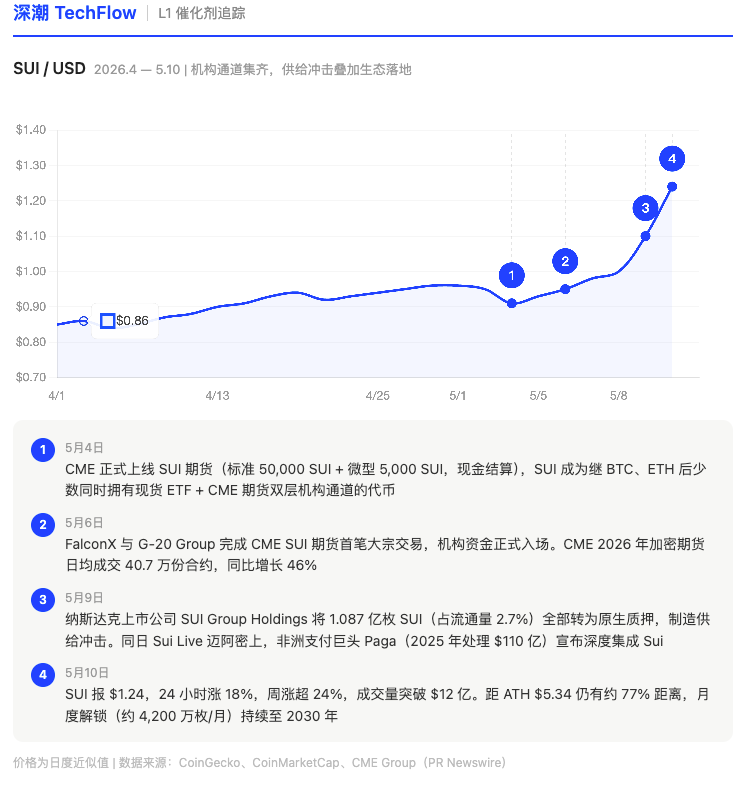
- CME Futures Launch (May 4): Standard contracts (50,000 SUI) and micro contracts (5,000 SUI) were listed, cash-settled. On May 6, FalconX and G-20 Group completed the first block trade. Starting May 29, all CME crypto derivatives will operate 24/7.
- Large-scale Staking by a Public Company (May 9): Nasdaq-listed SUI Group Holdings converted all of its 108.7 million SUI (2.7% of circulating supply) into native staking, causing an immediate 13% price jump.
- Emerging Market Payment Integration (May 9): At Sui Live Miami, Nigerian fintech company Paga announced deep integration with Sui, planning to use the native stablecoin USDsui to offer USD accounts and tokenized bonds to users. Paga processed $11 billion in transactions in 2025.
According to CryptoNews analysis, SUI now possesses a complete "three-tier institutional access structure": spot ETFs for passive allocation, CME futures for active hedging, and staking products for yield generation. Only 18 months ago, such a structure was exclusive to BTC and ETH.
As of May 10, SUI was trading at $1.24, up over 24% for the week, with volume exceeding $1.2 billion. Interestingly, SUI actually dipped slightly to $0.91 on the day CME futures launched; the real rally occurred five days later when the staking lock-up and Paga partnership were confirmed. Concurrently, tokens within the SUI ecosystem also benefited, showing considerable gains.
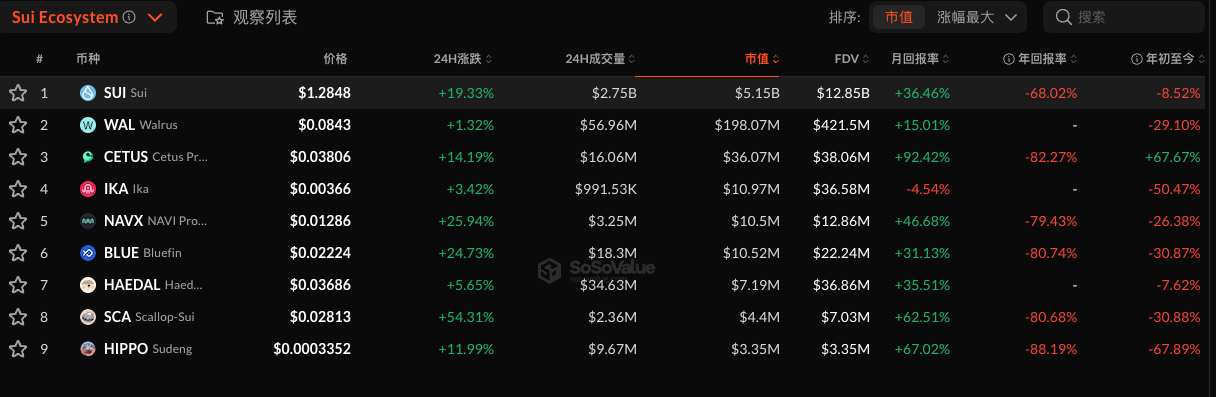
L1 Recovery: Can It Spread to Altcoins?
Looking at SUI and TON together, their catalyst structures are entirely different. However, the commonality is that it is project-specific, verifiable fundamental events driving the price action, not macro liquidity or emotional beta.
Returning to the macro level, the conditions for confirming a broad altcoin season are currently unmet. According to historical patterns compiled by Phemex, BTC dominance needs to break below 54% and sustain for over two weeks, and the Altcoin Season Index needs to surpass 75, to constitute a reliable rotation signal. The current 60% dominance and the index reading of 35 are still a significant distance from these thresholds.
Historical data provides a reference:
In late 2019 and late 2020, the combination of high BTC dominance and a low Altcoin Season Index ultimately led to large-scale altcoin rallies 2 to 6 months later.
Back then, it was also the top projects with independent catalysts that started moving first, followed by a gradual spread of capital to small and mid-cap coins. The recent movement in SUI and TON might be at this stage, where "individual projects lead while the overall rotation awaits confirmation."
The water warms up in spring, and the ducks have already stirred. But the ice on the river hasn't completely melted yet.


