专访Michael Saylor:我是说了要卖币,但绝不会是净卖


- 核心观点:Strategy 执行主席 Michael Saylor 澄清,公司“准备出售比特币以支付股息”并非改变信仰,而是计划通过出售少量增值比特币来支付 STRC 股息,并利用比特币“数字资本”的高增值属性进行套利,确保公司始终是比特币的净买家。
- 关键要素:
- 策略本质:卖出比特币支付股息只是一种“资本收益变现”,公司出售 1 个比特币的同时会再买入 10-20 个,保持净买家地位。
- 数据支撑:STRC 融资 32 亿美元买入比特币,对应股息仅 8000-9000 万美元,公司盈亏平衡率为 2.3%,即比特币年升值超此比例即可永久支付股息。
- 信用工具创新:STRC 作为“数字信用”工具,夏普比率高达 3.0,远超英伟达(1.7)和标普 500(0.9),提供 11%-12% 的高派息率。
- 市场深度:Saylor 强调比特币市场流动性极其充沛,公司曾一小时内买入 2-3 亿美元比特币,也未能影响市场价格。
- 宏观趋势:比特币受贸易战、货币政策等宏观因素驱动,但矿工年新增供应仅约 100-120 亿美元,资本流入(如 ETF 和信用工具)持续推动其增长。
Source: David Lin
Compiled by: Odaily (@OdailyChina); Translator: Azuma (@azuma_eth)
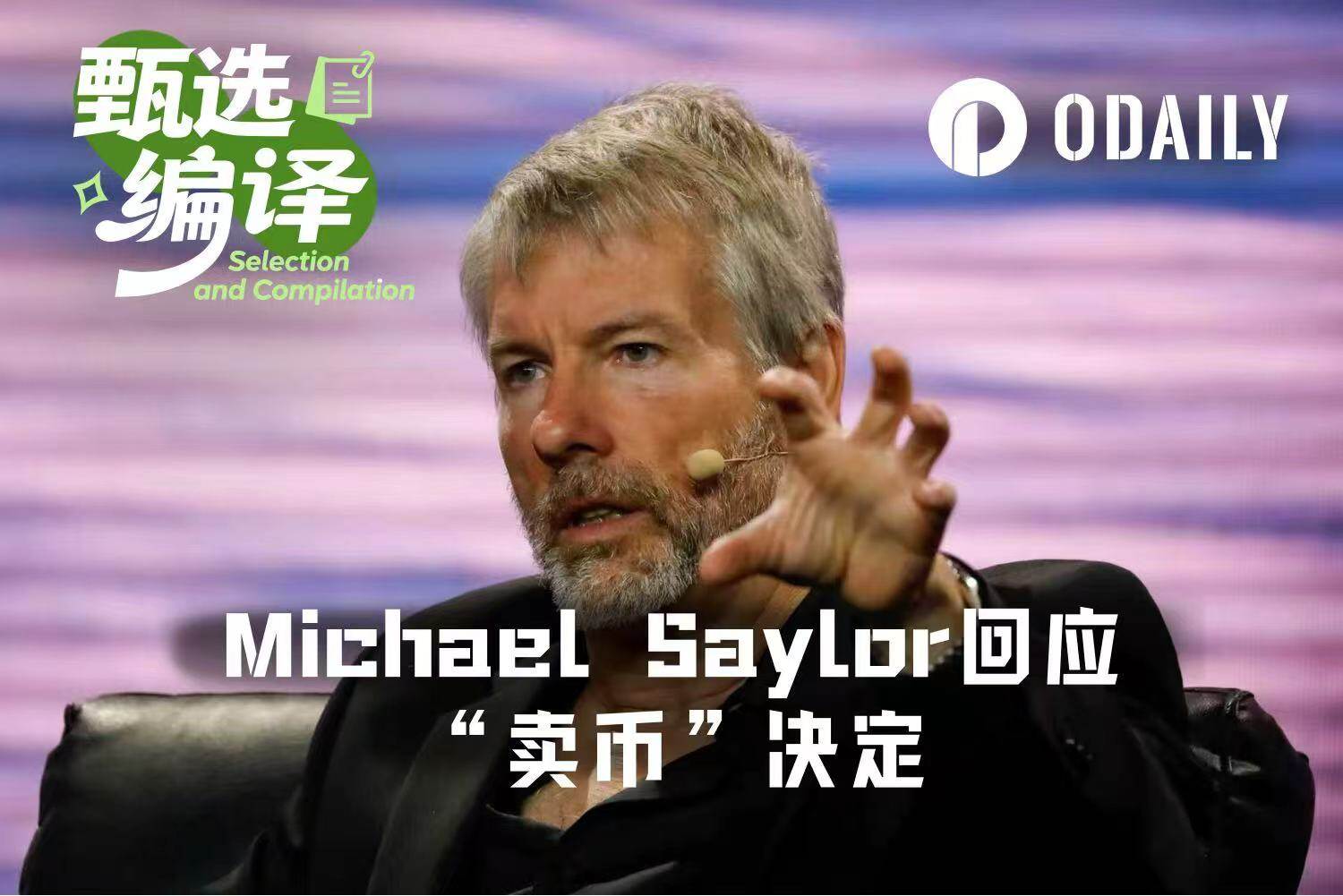
Editor’s Note: During last Monday’s earnings call, Strategy mentioned for the first time that it was “prepared to sell Bitcoin if necessary to pay dividends,” a statement that immediately sparked intense market debate about whether the company was “abandoning its beliefs.”
In response, Strategy Executive Chairman Michael Saylor recently delved into the logic behind this decision during an appearance on David Lin’s podcast. He emphasized that saying “we will sell” does not mean “net selling.” Saylor also noted that Strategy is leveraging Bitcoin’s extremely high appreciation potential as “digital capital” by issuing digital credit instruments (such as STRC) to arbitrage, thereby ensuring a continuous net increase in its holdings. The following is the full transcript of the podcast (with edits), compiled by Odaily.
Podcast Interview
David Lin (Host A): I am truly honored to co-host this exciting interview with Michael Saylor, Executive Chairman of Strategy. Joining me is Bonnie Chang. We'll start with Strategy's recent announcements and Michael Saylor's social media posts. Bonnie, let's begin.
Bonnie Chang (Host B): Last week, you made an announcement that shocked the entire industry.
Michael Saylor: Uh, you are probably referring to our statement during the earnings call – that we are prepared to sell Bitcoin to pay STRC dividends if necessary.
Bonnie Chang: I believe that was a well-considered decision. What was the thinking behind it?
Michael Saylor: The most important point is that we want the market to understand that Bitcoin capital gains can be used to fund credit dividends. When we sell $1 million worth of STRC credit products, we turn around and buy $1 million worth of Bitcoin. Our expectation for Bitcoin is an annual appreciation of about 30%, and in reality, it's been appreciating closer to 40% annually. We can strip out the initial 11% of this capital gain and pay it out as dividends.
The market has been confused about what we would use to pay dividends. For most of history, we paid dividends by selling common stock (MSTR equity). MSTR equity is a derivative of Bitcoin and usually trades at a premium compared to Bitcoin. So we were selling Bitcoin derivatives back then. However, some worried that we might not be able to sell equity in the future.
Then some bearish voices emerged, saying we must sell equity. Others said the company would never sell its Bitcoin. This evolved into: “Well, if they aren't going to sell their Bitcoin, then Bitcoin must be worthless. They can never sell it. If they can't sell it, we can't count Bitcoin as a balance sheet asset.”
It's not great when you own $65 billion worth of something and people want to value it at zero, right? We don't want credit rating agencies to think our assets are zero. We want them to think we have $65 billion in assets. Furthermore, some online “haters” constantly complain it's a Ponzi scheme because we fund preferred stock dividends by selling equity.
What we want to do is strengthen a business model where we sell credit to invest in Bitcoin; over time, this investment appreciates faster than dividends accumulate; then we realize those capital gains and pay the dividends.
We believe the best way to clarify this is to explicitly state that “the company never needs to sell common stock.” We can simply sell some of our substantially appreciated Bitcoin to pay dividends. This is essentially using capital gains to pay credit dividends.
I think of it like a real estate development company. They raise funds through credit instruments, buy land at $10,000 per acre, develop it until it's worth $100,000 per acre, and then realize that capital appreciation. You can sell the land at $100,000 per acre, lease it after full development, or refinance. No one questions a real estate development company that invests capital using credit income. We are doing the same thing with Bitcoin, and we need to ensure the market understands this.
I became famous for saying “never sell your Bitcoin,” which is why the internet blew up when we said we might sell. But if I were more precise, it should be “never be a net seller of Bitcoin.” It's just that “never be a net seller” doesn't sound as catchy or flow as well.
I believe that during these periods, even if we sell 1 Bitcoin, we will buy 10 to 20 more. So, you're essentially talking about a situation of “buying 10, selling 1, and net buying 9.” Once people understand this, it shouldn't be an issue anymore, but for now, it's a controversial topic.
Bonnie Chang: Can you explain how you can sell 1 Bitcoin while buying 10?
Michael Saylor: Sure. Strategy's primary engine for increasing Bitcoin holdings is STRC. We sold $3.2 billion worth of STRC in April, so we bought $3.2 billion worth of Bitcoin. The dividends were around $80 to $90 million. So, in a month where we raised $3 billion, we only need to use $80 or $90 million to pay dividends – essentially, you are buying 30 Bitcoins while selling 1.
Our “breakeven rate” is about 2.3%. This means that if our issued credit debt equals 2.3% of our Bitcoin holdings, even if we sell Bitcoin to pay dividends, we will always be net buyers of Bitcoin. Another point is that if Bitcoin appreciates by 2.3% annually, we can permanently pay dividends and continuously create value without selling any common stock.
In the first four months of this year, we sold about $5 billion worth of STRC. At this rate, the issuance rate for the year will be 15% to 20%. As long as the company is growing, it will buy more Bitcoin than it sells. I expect that in every month and quarter going forward, we will be net buyers of Bitcoin.
Bonnie Chang: I have another question. Many investors follow the almost religious advice of “never sell your Bitcoin.” Do you think they should still follow this advice?
Michael Saylor: Yes, I think you should be a “net accumulator” of Bitcoin. When I say “never sell your Bitcoin,” I mean if you are spending it to buy something, ensure you replenish it while spending it.
Many crypto or Bitcoin believers say they want to use Bitcoin to buy things. I'd say, then make up for the shortfall after spending. Don't be a net seller of Bitcoin, because Bitcoin is capital. At the end of every year, you should have more Bitcoin than you started with.
For example, if Google invests $1 billion in building a data center and makes $10 billion from it, they net $9 billion. This doesn't cause the US dollar market to collapse, right? No one panics saying “Google sold dollars to buy data centers.” The dollar will be fine, and it doesn't shake Google's business model. They spent $1 billion to invest in their business. That's normal and rational. Sometimes you spend money to make more money.
So, if you spend 1 Bitcoin to earn 10 Bitcoins, I think it's good for Bitcoin and good for the company… When the equity capital market is less liquid than the Bitcoin market, we want to be able to utilize that market.
Whenever a company deprives itself of options, says “we will never do something,” whatever it is, it ends up regretting it. For example, if we said we “will never, ever buy back our own stock, only sell stock,” then bears could short our stock relentlessly down to $1. If we can buy back our stock when it trades at a huge discount to Net Asset Value (NAV), those bears would lose big. By exploiting their irrationality, we can make a lot of money.
So, what we really expressed on the earnings call is – we will swap STRC for MSTR, we will swap BTC for MSTR, we will pay dividends in BTC or MSTR. We will do whatever is in the company's best interest. But over time, we expect to be a net accumulator of Bitcoin. This doesn't change how we trade assets day-to-day. Whether we sell credit debt, sell equity, or sell Bitcoin capital will depend on market conditions and pricing errors.
Another thing we said yesterday is that we are ready to buy back our bonds. Currently, our corporate bonds are trading cheap; they are undervalued. So buying them back makes sense, while selling doesn't. We won't sell undervalued assets; we buy undervalued assets and arbitrage any inefficiencies. If the market knows we will do this, it will assign fair valuations to all these assets. This benefits investors in all these instruments and, ultimately, it's our fiduciary duty.
David Lin: One of your biggest critics, Peter Schiff, wrote this morning: “Yesterday, Saylor admitted MicroStrategy would sell Bitcoin if needed to pay STRC dividends. I think this promise is meant to keep the so-called Ponzi scheme going a little longer. But I suspect when that moment comes, he will choose to suspend the dividend and let STRC crash rather than let Bitcoin crash.” What is your response to this?
Michael Saylor: Peter thinks Bitcoin is a Ponzi scheme. Peter doesn't really like anything in this space. Bitcoin is “digital capital,” and by selling equity and credit instruments to buy this capital, we are creating a digital financial company. I think Bitcoin will continue because it represents global economic wealth in tokenized form with complete property rights.
On top of this, we built a credit instrument, STRC, which simply strips out volatility, reduces risk, and extracts or “distills” yield from digital capital. If you don't acknowledge Bitcoin as legitimate, you will never acknowledge any derivatives built on top of it as legitimate. But for those who believe Bitcoin can store economic wealth in tokenized form, what we are doing is very straightforward.
STRC uses an over-collateralization model: for every $5 of Bitcoin, we sell $1 of credit debt, and that $1 of credit debt has a clear yield. Many people who believe Bitcoin is a legitimate asset just can't handle its volatility. They don't want to put their child's tuition money due in the fall into Bitcoin because they pay the bill in 12 weeks. So, for them, digital credit makes a lot of sense because the principal is protected and more stable. Plus, through STRC, they can get 3 to 4 times the yield of the money market. This characteristic of Bitcoin, being superior to other capital assets, allows us to pay this high dividend yield.
David Lin: Here is a theory I'd like your take on, and then I'll hand it back to Bonnie. Some traders noticed that whenever STRC goes ex-dividend, its price trades below par for a period (maybe a day or two). Once it reaches par, that's when Strategy buys Bitcoin. So, they started “front-running” by buying Bitcoin just before STRC reaches par, betting that you and Strategy would buy Bitcoin at par. Can you comment on that?
Michael Saylor: What happens around the dividend date is that demand for STRC is immense because there's an approximately $0.90 dividend coming after the record date. So, billions and tens of billions of dollars worth of STRC trade before the record date. The day after the record date, its price drops by 60 or 70 cents, and then it gradually recovers to par over the next week or two.
So that's normal. Those are arbitrageurs. Their idea is to capture roughly a 42% annualized return by tying up capital for about 12 days a year. They have their own calculations. That's fine; it benefits us too because it creates liquidity and participation. This will continue.
As for the second idea – can you “front-run” the Bitcoin market? The Bitcoin derivatives market sees $50 billion in daily volume. So, I don't think anyone has enough capital to move that market.
My view is that Bitcoin is a bit like “capital squared.” The factors driving the Bitcoin market are trade wars, hot wars, foreign policy, national situations, the situation with Iran in the Strait of Hormuz, and currency wars – for instance, whether we expect SOFR to drop to 200 basis points, or if the yield curve is being distorted. You can see we are currently in a fairly tight monetary environment. So, these macro factors are the primary drivers of Bitcoin.
I can tell you a fact: we bought $100 million worth of Bitcoin in one hour, and it didn't move the price. We bought $200 million worth of Bitcoin in one hour, and it didn't move the price. We bought $200 or $300 million worth and then stopped, and the price went up instead.
So, nobody has enough power to influence Bitcoin's price performance… Well, maybe if you plan to dump $30 billion into the market in one afternoon. But I've spent a lot of money. We've bought more Bitcoin than anyone I know, probably around $62 billion worth. I believe this is a global market with its own momentum.
So, claims that we can influence the price are flattering, but I don't think so.
Bonnie Chang: Why do you say the price doesn't move when you buy so much Bitcoin?
Michael Saylor: Because the market is incredibly liquid. Suppose I want to buy $1 billion today. Even that is only 1/50th of the $50 billion in volume.
If you ask traders, they'll say daily spot market volume is sometimes $20 billion, and the derivatives market can be as high as $80 billion. In such a deep market, what is $100 million? That's what's special about it. On a weekend, if you want to take a $1 billion position with 20x leverage, you can completely do it in the Bitcoin market. If you want to get a $1 billion credit line in one hour, you can do it in the Bitcoin market.
I do think macro factors drive Bitcoin, and sometimes Bitcoin has its own life force. Micro factors also drive it – I mean industry factors like the formation of digital credit, the formation of banking credit, and investor sentiment towards Bitcoin assets. These all drive the market. But I think Bitcoin is bigger than all of us, and that's why we are confident in it – because no single participant can support it or hinder it.
David Lin: If the Strait of Hormuz remains closed for the foreseeable future, several forces will intertwine. First, some say inflationary pressures will persist. Second, the Fed might eventually need to cut rates because they are trapped by high inflation. So, what happens to liquidity ultimately? What happens to Bitcoin if the Fed remains trapped?
Michael Saylor: I think when you face tight monetary policy, high tension in global trade, and high geopolitical tension due to foreign policy or war (whether in Ukraine or Iran), all of these are somewhat binding. They are headwinds. I believe when these factors reverse, they will become tailwinds.
But regardless, Bitcoin will grind up because the annual organic supply from miners is only about $10 to $12 billion, roughly 450 Bitcoins per day. You can do the math yourself. Then, every time we raise another $10 billion in capital, we buy the entire year's supply. So, if a bank creates $10 billion in credit, that's “one turn of the crank.” If we sell $10 billion in STRC digital credit, that's “the second turn of the crank.” When $10 billion flows into IBIT (BlackRock’s Bitcoin spot ETF), that's “the third turn of the crank.”
So, capital flows, digital credit, digital capital packaging vehicles, and bank credit – all of these drive the fundamentals of the market, and they are all positive. Regardless of macro factors, you will see continuous adoption. The macro winds just determine whether, when we would have grinded up 30%, a tailwind turns it into a surge of 50%, while a headwind slows our pace to some degree.
David Lin: Has your logic on Bitcoin changed?
Michael Saylor: No, it hasn't. But I will say it's now clear that Bitcoin is “digital capital,” and one thing has become very clear in the last 12 months: one of Bitcoin's killer apps is digital credit.
Many people are wondering: what is the killer app for a $1.5 trillion asset class that trades hundreds of billions of dollars daily? The answer is serving as collateral for credit. Since digital capital is the best-performing capital asset (and it is, outperforming the S&P 500 by two to three times), it logically follows that we can create the best-performing credit assets on top of this capital asset.
What we have seen over the past year is that STRC is the most liquid credit instrument. It's the most liquid preferred stock in the entire market, and the largest preferred stock by