特朗普一條推文,BTC 時隔 3 個月重返 8 萬美元


- 核心觀點:特朗普宣布「自由計劃」以武力介入霍爾木茲海峽,釋放被困船隻,該消息引發全球金融市場波動:比特幣突破 8 萬美元、亞洲股市上漲、油價微跌。但實際執行存疑,市場普遍認為這可能又是一次「虛張聲勢」。
- 關鍵要素:
- 比特幣時隔 3 個月再次突破 8 萬美元關口,過去 12 小時全網爆倉 2.86 億美元,其中空單爆倉 2.51 億美元。
- 亞洲股市同步上漲,MSCI 亞太指數上漲 1.9%,科技股反彈,SK 海力士、台積電等大漲。
- 特朗普宣布於中東時間週一啟動「自由計劃」,承諾引導被困船隻離開霍爾木茲海峽,並獲美軍軍事支持。
- 伊朗強烈反對該行動,稱其為侵犯主權,同時重申將透過「霍爾木茲海峽管理法」限制船隻通行。
- 特朗普的不支持率達到 62%,創其任期新高,他急需透過恢復海峽通行來提振政績、降低油價並穩定經濟。
Original by Odaily Planet Daily (@OdailyChina)
Author: Golem (@web3_golem)
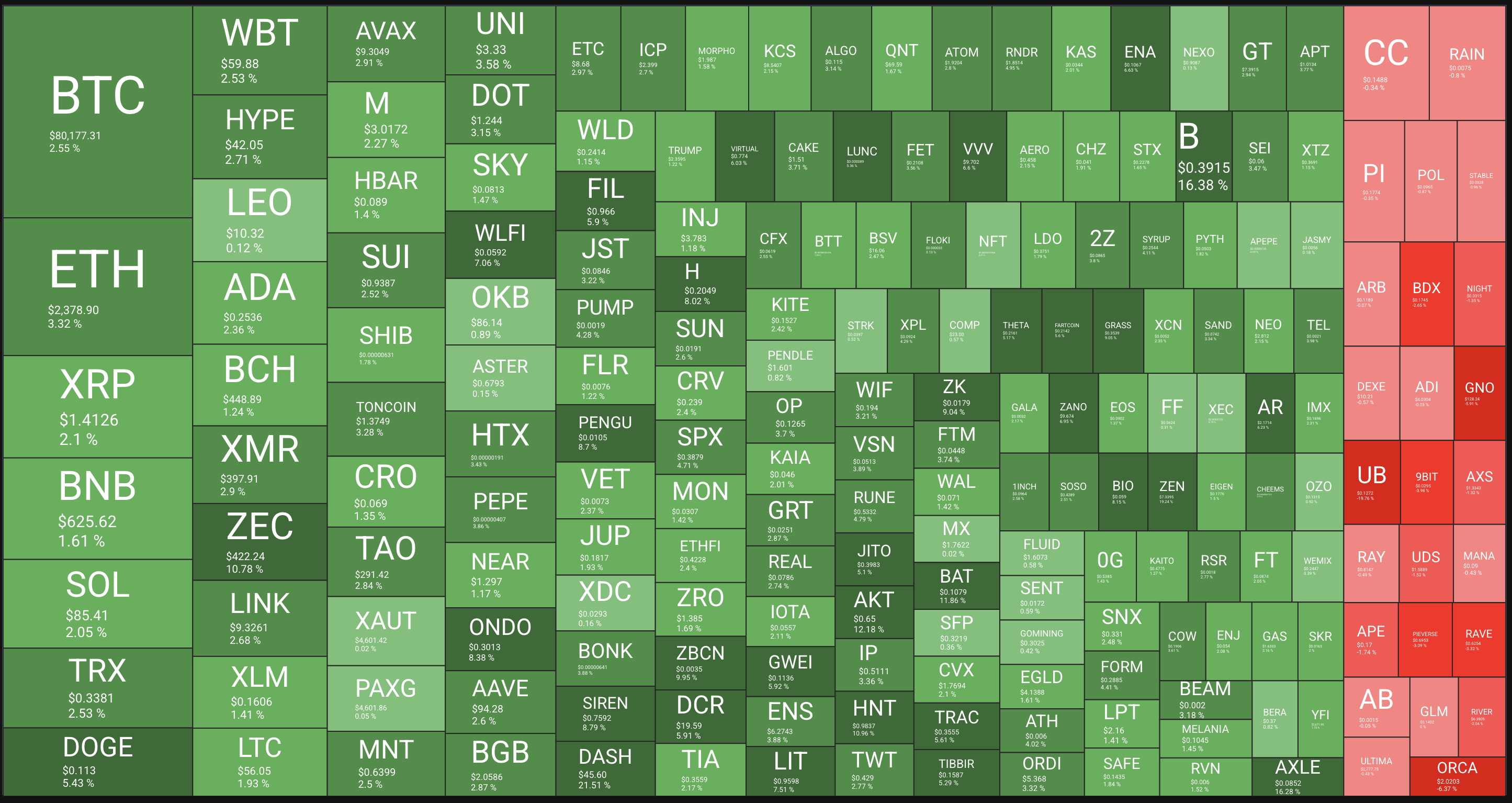
Crazy Monday! After a three-month hiatus, Bitcoin once again broke through the $80,000 mark.
The altcoin market is also showing signs of recovery. According to Quantify Crypto data, over the past 24 hours, more than 80% of the top 200 altcoins by market cap have seen varying degrees of increase. Among them, DOGE rose over 5.43%, ZEC over 10.78%, and WLFI over 7.06%.
In terms of derivatives, data from Coinglass shows that total liquidations across the network reached $286 million in the past 12 hours, with short positions accounting for the bulk at $251 million. The liquidation events were concentrated around the time Bitcoin broke through $80,000. Additionally, BTC liquidations totaled $152 million, and ETH liquidations amounted to $75.5 million.
This rally wasn't exclusive to the crypto market. Asian stock markets opened sharply higher on Monday, with the MSCI Asia Pacific Index rising 1.9%, erasing losses since the outbreak of the Iran war. Tech stocks rebounded, with SK Hynix surging nearly 10%, TSMC jumping over 6%, and Hong Kong-listed tech and internet stocks also moving higher collectively. Xiaomi Group rose over 10%, and Alibaba (09988.HK) gained over 6%.
Meanwhile, according to Gate data, WTI crude oil and Brent crude oil prices saw slight declines, with WTI crude maintaining around $101 per barrel.
When both the crypto and stock markets rise on a Monday, accompanied by minor fluctuations in oil prices, savvy investors might suspect the involvement of the market's maestro, Donald Trump, once again.
Market Expects Trump's "Project Freedom" Could Potentially Open the Strait of Hormuz
On the evening of May 3rd, Eastern Time, Trump posted a message stating he would begin helping ships leave the Strait of Hormuz starting Monday (Middle East time). He claimed that many countries not involved in the current Middle East dispute are seeking US help to release ships blocked in the Strait of Hormuz. For humanitarian relief, the US would safely guide their vessels out of the restricted waters, naming the operation "Project Freedom."
Following Trump's post, the US Central Command also stated it would provide military support for the operation to guide stranded ships in the Strait of Hormuz, including missile destroyers, over 100 land and sea-based aircraft, multi-domain unmanned platforms, and 15,000 military personnel. It described this as a response to Iranian military attacks on merchant vessels transiting the strait.
Such a unilateral action by Trump naturally angered Iran. As early as May 2nd, Ali Nikzad, Vice Speaker of the Islamic Consultative Assembly of Iran, emphasized while speaking on the coast of the Strait of Hormuz that Iran would absolutely not take a single step back from the strait. He stated that the parliament had approved a "Strait of Hormuz Management Law," which includes permanently banning Israeli ships from passing through this key waterway, requiring ships from "hostile nations" to pay "war reparations" to obtain passage permits, and mandating that other ships need Iranian authorization to pass.
Therefore, Iran views Trump's "Project Freedom" as an infringement by the US on Iran's managerial rights over the Strait of Hormuz. Shortly after Trump announced "Project Freedom," Ebrahim Azizi, Chairman of the Iranian Parliament's National Security and Foreign Policy Committee, stated, Any US intervention in the new maritime order of the Strait of Hormuz will be considered a violation of the ceasefire agreement.
On April 8th, the US and Iran signed a two-week interim ceasefire agreement. As the temporary ceasefire was about to expire on April 21st, Trump announced an indefinite extension of the ceasefire to continue negotiations with Iran. Although the US and Iran have a ceasefire, control of the Strait of Hormuz has remained in Iran's hands throughout this period, and it has never fully opened the passage.
In terms of consequences, if Trump forcefully implements "Project Freedom," the current situation between the US and Iran could escalate from negotiations back to open conflict. In that case, not only would the Strait of Hormuz be unable to operate normally, but in the long run, the impact of war on global financial markets would be far greater than today's market gains.
Of course, whether the "king of bluff," Trump, will actually execute the "Project Freedom" plan remains uncertain. It is already Monday morning (May 4th) Middle East time, but there has been no news of US forces successfully escorting merchant ships through the Strait of Hormuz. Could this be another classic T.A.C.O. (Trump Always Chickens Out) trade? (Related reading: Win or Lose the War? Trump: Made a Profit)
Iran seems accustomed to this "crying wolf" Trumpian tactic. Iranian scholar Seyed Mohammad Marandi remarked back in late March when Trump posted about manipulating oil prices, "Every week when the market opens, Trump makes such statements to drive down oil prices." Similarly, Ebrahim Azizi lightly dismissed Trump's "Project Freedom" announcement, saying no one believes in such "passing the buck" tricks.
Although we don't know yet whether "Project Freedom" will actually be implemented, Trump's eagerness to restore normal passage through the Strait of Hormuz is evident. This is not only related to US national interests but also crucial for Trump's political survival.
On May 3rd, according to the latest ABC/Washington Post/Ipsos poll, Trump's disapproval rating reached 62%, the highest in his two terms. With midterm elections approaching, such approval ratings are quite unfavorable for him, making it urgent for him to achieve significant political accomplishments. Reopening the Strait of Hormuz is the ideal goal (even though the current problems are largely of his own making).
On one hand, externally, opening the Strait of Hormuz would be another demonstration of US global deterrence. Trump could package it as a complete victory over Iran, showcasing American strength. On the other hand, domestically, restoring passage through the Strait of Hormuz could lower global oil prices, quelling dissatisfaction from the American public and relevant stakeholders. Furthermore, lower price levels could increase the chances of newly appointed Federal Reserve Chairman, Warsh, convincing other officials to agree on a rate cut at the June FOMC meeting, injecting vitality into the market. (Related reading: Powell Bows Out But Doesn't Leave Stage; Trump's Rate Cut Hopes May Be Dashed)
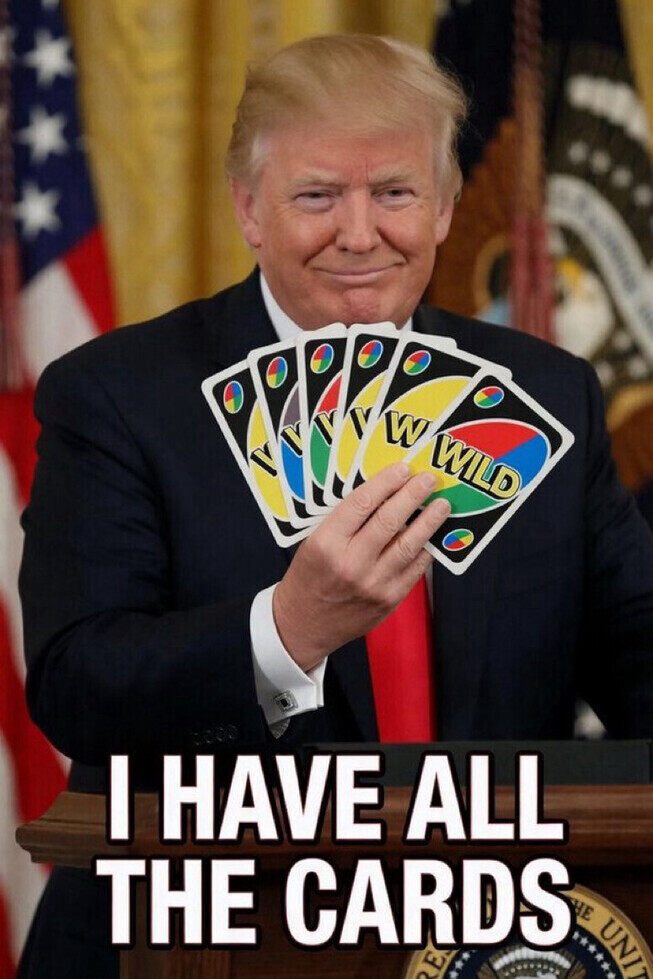
On the morning of May 4th, Trump also posted a photo on Truth Social showing himself holding multiple cards with the caption, "I have all the cards." On the surface, this exudes confidence, but often, those with the slimmest chances are the ones who bluff the most.