






Where is Bitcoin’s Bottom? From $59,000 to $40,000, Institutions Are Divided


- Core View: Bitcoin retreated from its all-time high of approximately $126,000 in July 2026 to $57,800. Multiple institutions predict its bottom range to be concentrated between $50,000 and $60,000, or $40,000 and $46,000, but there is a lack of consensus. The divergence in predictions stems from differences in the macro environment and market variables.
- Key Factors:
- Standard Chartered predicts that $59,000 may have already formed the cycle bottom, maintaining a $100,000 year-end target for 2026; however, Bitcoin subsequently fell below this level to $57,800.
- 10x Research revised its bottom estimate down to around $50,000, projecting a range of $46,628 to $50,732 based on the Elliott Wave model, suggesting long-term allocation value is emerging.
- CryptoQuant points to the realized price of approximately $53,600 as a valuation floor, but demand is weak. Bottom formation requires improvement in spot demand, ETF inflows, and stablecoin liquidity.
- Galaxy Research provides a lower baseline bottom of $40,000 to $46,000, based on a monitoring framework of 13 indicators, of which only 4 have been fully triggered, indicating insufficient market clearing.
- Some institutions, such as NYDIG and Citi, offer lower targets (ranging from $37,900 to $53,000) under pessimistic scenarios, but these are hypothetical conditions rather than baseline judgments.
Original Author: WuSays Blockchain
TL;DR
After hitting an all-time high of approximately $126,000 in October 2025, Bitcoin entered a downward cycle. On July 1, 2026, BTC briefly fell to around $57,800, a maximum drawdown of about 54% from its peak; as of July 14, the price had recovered to near $62,000.
As the market enters a phase of searching for a bottom, institutions such as Standard Chartered, Galaxy Research, CryptoQuant, NYDIG, and 10x Research have successively provided their assessments. However, the nature of these predictions varies: some institutions provide a base bottom, others only key support levels or bearish scenarios, and some are technical targets following a break below specific price levels.
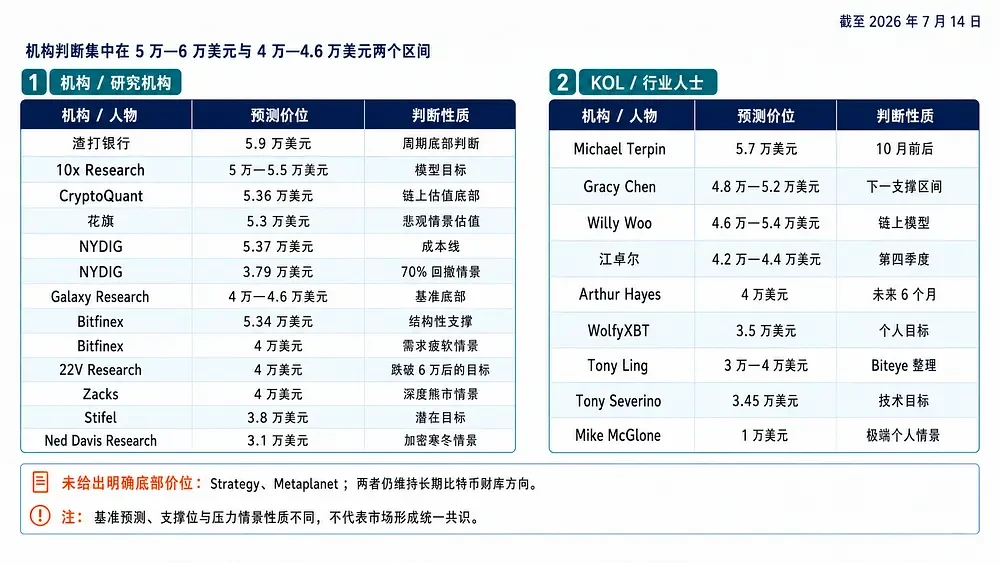
Aggregating current public views, institutional predictions mainly cluster around two ranges: $50,000 – $60,000 and $40,000 – $46,000. KOL opinions are more scattered, with the lowest extending below $30,000.
Standard Chartered: $59,000 Could Be the Cycle Bottom
On June 12, Geoffrey Kendrick, Head of Digital Assets Research at Standard Chartered, stated that Bitcoin may have formed a cycle bottom around $59,000, believing this "crypto winter" is over.
Kendrick attributed the previous market decline to outflows from spot ETFs, reduced purchasing power from digital asset treasury companies like Strategy, and investor capital rotation towards AI-related assets. Standard Chartered maintained its Bitcoin year-end 2026 target of $100,000 at that time.
However, Bitcoin subsequently fell to about $57,800 on July 1, briefly breaking below Standard Chartered's $59,000 bottom. Its prediction was relatively close to the actual low, but it cannot confirm that the market has completed its final bottoming process.
10x Research: Further Downgraded from $55,000 to Around $50,000
On June 24, Markus Thielen, founder of 10x Research, suggested that Bitcoin might form a low after falling to around $55,000. He noted that a strengthening US dollar, tightening liquidity, and seasonal market factors could still pressure BTC.
On July 1, 10x Research further updated its Elliott Wave model. The institution had previously expected Bitcoin to complete its Wave A decline around $63,000, then rebound to the $80,000 – $90,000 area, before falling via Wave C towards approximately $50,000. The updated model provides a potential price range of roughly $46,628 – $50,732.
Therefore, 10x Research's assessment has been progressively revised downwards from the initial $55,000 to around $50,000. However, the firm also believes that once Bitcoin falls below $55,000, its long-term value proposition begins to emerge.
CryptoQuant: $53,600 Could Constitute a Valuation Bottom
In a June report, Julio Moreno, Head of Research at CryptoQuant, pointed out that Bitcoin had entered an on-chain valuation range, but demand remained weak, and the market had not yet shown complete capitulation signals.
The report indicated that Bitcoin's realized price at the time was approximately $53,600. The realized price reflects the average cost of all BTC at their last on-chain transfer and has historically been considered an important valuation floor during bear markets.
Combining indicators like the MVRV Z-Score, CryptoQuant identified the $55,000 – $60,000 range as a potential bottoming area requiring close observation. However, the firm emphasized that a confirmed cycle bottom would require simultaneous improvements in spot demand, ETF flows, and stablecoin liquidity.
Citigroup: $53,000 in a Bearish Scenario
On July 1, Citigroup lowered its 12-month Bitcoin target from $112,000 to $82,000, primarily citing persistent spot ETF outflows, stalled US crypto legislation progress, and weakening investor demand.
In a bearish scenario involving a recession and continued ETF outflows, Citigroup's valuation for Bitcoin was approximately $53,000.
It's important to note that $53,000 is not Citigroup's explicit prediction for the cycle bottom, but rather a 12-month bearish scenario valuation based on assumptions of economic recession and sustained capital outflows.
NYDIG: $53,700 as Cost Basis, Extreme Drawdown Scenario at $37,900
In a June 5 report, NYDIG stated that Bitcoin was not far from historical bear market bottom zones, but market evidence remained complex and insufficient to confirm a final bottom.
The report considered the 1x MVRV level of approximately $53,700 as an important cost basis. This position implies Bitcoin's market price is near the average on-chain cost basis of all network holders.
NYDIG also calculated that if Bitcoin were to decline about 70% from its high of $126,000, the price would fall to approximately $37,900. However, this figure is a stress scenario derived from historical bear market drawdowns, not NYDIG's base case prediction.
Galaxy Research: Base Bottom at $40,000 – $46,000
Galaxy Research provides one of the clearer and more conservative base predictions among current institutions. Its June report suggests Bitcoin could form a cycle bottom in the $40,000 – $46,000 range between now and Q4 2026.
Galaxy built a Bitcoin bottom monitoring framework comprising 13 indicators, covering price retracements, holder losses, realized price, miner stress, long-term holder behavior, and market time cycles. As of the report's publication, only four indicators had fully triggered, indicating that while Bitcoin has entered the latter half of the bear market, the market may not have fully completed the cleansing process in terms of decline magnitude and duration.
Therefore, Galaxy lists $40,000 – $46,000 as its base bottom range, while also cautioning that further deterioration in the macro environment or digital asset treasury companies could lead to deeper tail risks.
Bitfinex: $53,400 as Structural Support, Insufficient Demand Could Test $40,000
In a June 29 report, Bitfinex Alpha identified the realized price of approximately $53,400 as an important structural support level for Bitcoin.
The report argues that if ETF outflows slow and spot buying resumes, Bitcoin could bottom in this area. However, if demand remains persistently weak, the market might test the $40,000 level further in Q4.
On July 1, Bitcoin quickly rebounded after falling to around $57,800. In subsequent reports, Bitfinex noted this move might have been a "bear trap," but it was still insufficient to confirm a final bottom.
22V Research: Below $60,000, Technical Target Could Point to $40,000
John Roque, Technical Strategist at 22V Research, stated that Bitcoin was testing its first downside target of $60,000. If the price effectively breaks below this level, it could potentially fall to $40,000.
Thus, $40,000 is a conditional target following a break of a key technical level, not an unconditional prediction for the cycle bottom from 22V Research.
Other Institutions: $31,000 – $40,000 Primarily Deep Bear Market Scenarios
John Blank, Chief Equity Strategist at Zacks Investment Research, said in February that if the current crypto winter lasts 12–18 months, Bitcoin could fall to around $40,000 over the next 6–8 months. His judgment was mainly based on technical patterns, declining liquidity, and historical bear market cycles.
Stifel previously suggested a potential target around $38,000. Ned Davis Research indicated that if the market enters a full-blown "crypto winter," Bitcoin could fall to approximately $31,000. These figures are more representative of long-term bear market or deep stress scenarios, rather than the institutions' current unified base case views.
Strategy and Metaplanet: No Explicit Bottom Forecast, but Long-Term Treasury Strategy Continues
Strategy and Metaplanet have not given explicit Bitcoin bottom prices, but their treasury activities are important variables for institutions assessing market demand.
Michael Saylor stated that the recent outflow of about $4 billion from Bitcoin ETFs reflects capital rotation towards the AI sector, not damage to Bitcoin itself; in his view, volatility still creates opportunities.
However, Strategy has begun managing its balance sheet more flexibly. The company sold 3,588 BTC between June 29 and July 5, realizing approximately $216 million, primarily to pay preferred stock dividends. In the most recent week, the company did not buy or sell BTC but instead raised about $467 million through the sale of common stock, increasing its dollar reserves to approximately $3 billion. As of disclosure, Strategy holds 843,775 BTC.
Metaplanet continues its long-term direction of expanding its BTC reserves, targeting 100,000 BTC by the end of 2026 and 210,000 BTC by the end of 2027. The stance of these two companies is better categorized as long-term treasury allocation rather than short-term bottom prediction.
KOL Predictions: From $57,000 to Below $30,000
Beyond institutions, on-chain analysts, traders, and industry figures have also offered diverse views on the potential bottom.
Michael Terpin stated in April that Bitcoin had not yet reached its final bottom, predicting a potential decline to around $57,000 around October. The low of $57,800 seen on July 1 is close to his prediction, but whether it is the final bottom remains unconfirmed.
Bitget CEO Gracy Chen stated in June that $59,000 is a key initial support to watch; if broken, the next important zone is $48,000 – $52,000. Biteye thus summarized her bottom estimate as approximately $50,000.
On-chain analyst Willy Woo, based on traditional on-chain models like CVDD, placed the potential bottom range between $46,000 and $54,000 in March. The CVDD floor was around $45,500 at the time and increases over time. He also cautioned that these models have only experienced four complete bear markets, and actual prices could fall deeper if the macro environment deteriorates significantly.
Jiang Zhuocr, founder of the Laibit mining pool, predicted that Bitcoin might fall to $42,000 – $44,000 in Q4 2026. He based this on the ratio of Strategy's market cap to its Bitcoin net asset value, combined with characteristics of the four-year cycle and Bitcoin's decreasing volatility over successive cycles.
BitMEX co-founder Arthur Hayes believes Bitcoin could fall to around $40,000 over the next six months. He has hedged downwards using options structures but remains a long-term net long on Bitcoin. Therefore, $40,000 represents his medium-term risk assessment, not a long-term bearish target.
KOL Shapolang WolfyXBT stated he is still waiting for Bitcoin at $35,000, representing a more pessimistic view among some traders regarding this drawdown.
According to Biteye's compilation, crypto investor Tony Ling predicts Bitcoin could enter the $30,000 – $40,000 range in Q4 2026, believing the market could subsequently be affected by a long-term Nasdaq bear market and the bursting of the AI bubble. As the original full post hasn't been found, this view should retain the "compiled by Biteye" source qualifier.
Technical analyst Tony Severino maintains a long-term target of approximately $34,500, corresponding to a drawdown of about 72% from Bitcoin's all-time high. He expects the cycle low could occur around October.
Mike McGlone, Senior Commodity Strategist at Bloomberg Intelligence, offers the most pessimistic assessment. He believes that if Bitcoin cannot reclaim $75,000, the price could potentially fall to $10,000 in an extreme scenario. It is crucial to emphasize that this is McGlone's personal analytical view, not an official Bloomberg institution forecast, and is not part of the current mainstream market expectation.
No Unified Consensus Formed Around $44,000 – $46,000
Aggregating all views, it is currently impossible to conclude that "institutions generally believe the cycle bottom lies between $44,000 and $46,000."
Standard Chartered believes $59,000 may have already constituted the cycle bottom. The key zones for CryptoQuant, NYDIG, Citigroup, and 10x Research are mainly concentrated between $50,000 and $55,000. Galaxy Research, Bitfinex, and Arthur Hayes place a deeper risk zone between $40,000 and $46,000. Predictions below $30,000 – $40,000 are mostly based on assumptions of a deep bear market, macro recession, or further deterioration of technical structures.
The core divergence in predictions stems not only from the different models used but also from different assumptions about the future macro environment. Whether spot ETFs can resume inflows, whether digital asset treasury companies like Strategy continue selling BTC, Fed policy and US dollar trends, and whether investor capital continues rotating towards AI assets, all could influence the final bottom.
Therefore, $40,000 – $46,000 can be viewed as a currently notable second-layer support and the base bottom range for some institutions, but it cannot be described as a unified consensus already formed by the market.


