万字解析2026年互联网资本市场:美国结构性转变与亚洲机构的战略窗口


1. The Crypto Industry is Completing the Leap from Experiment to Industry
This article is from Tiger Research. New technologies transitioning from experiment to industry typically go through four stages: the experimental phase, the hype phase, the regulatory intervention phase, and the industry formation phase. The internet completed its experimental phase in the 1990s, experienced the hype of the dot-com bubble, and eventually evolved into a mature industry after the bubble burst, following the establishment of regulations and standards. Fintech and artificial intelligence are following the same path, albeit with different paces and forms.
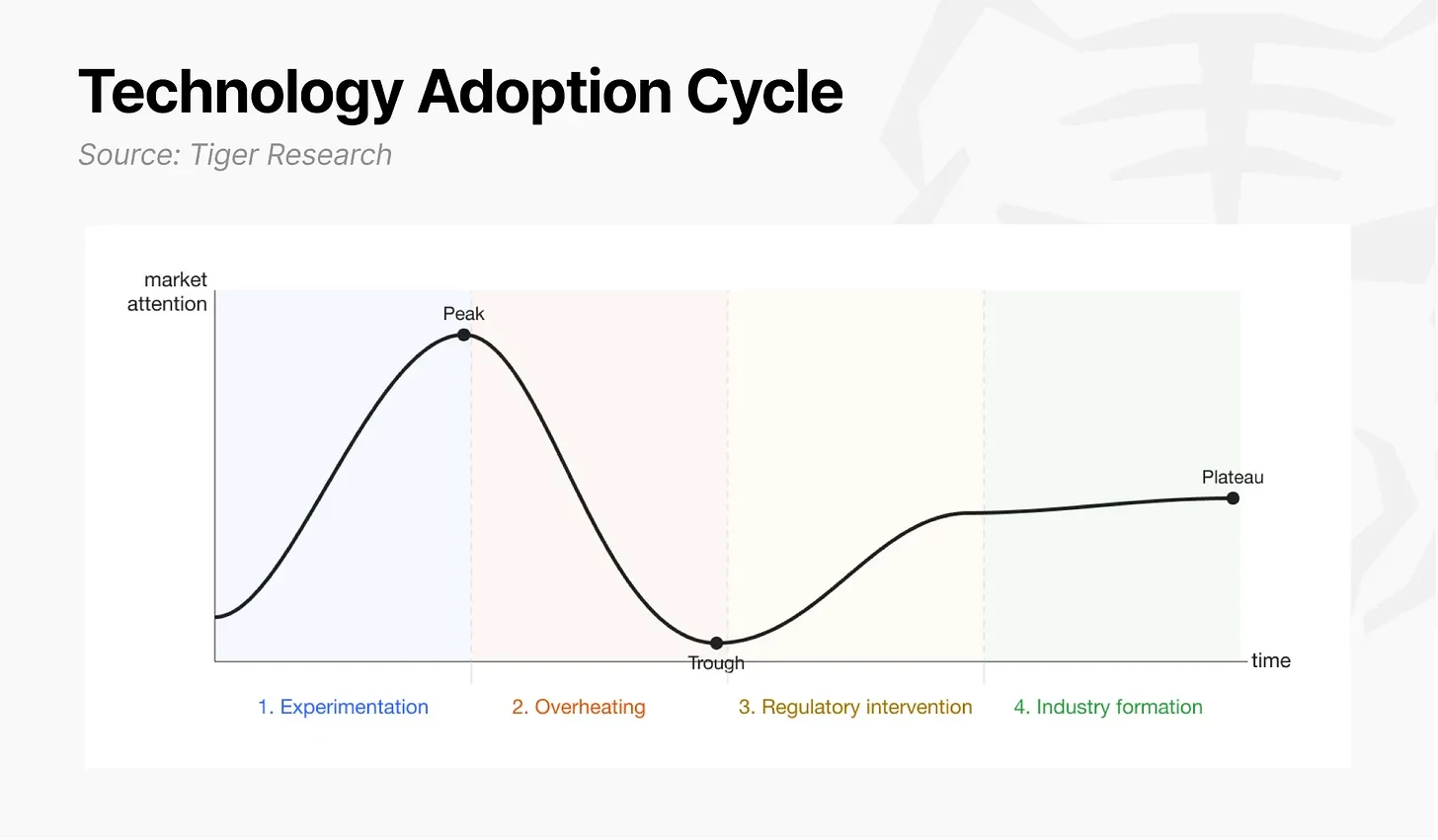
The crypto industry is currently in the transition zone between the third and fourth stages. After Bitcoin's inception, a small group of developers verified its potential for payments and settlement (experimental phase). During the ICO boom of 2017 and the DeFi wave of 2021, investors repeatedly flooded in and exited (hype phase). The collapse of FTX in 2022 was both a peak and a turning point. After multiple shakeouts, speculative demand was filtered out, real-world use cases were validated, and US regulators began shifting towards formalization rather than laissez-faire or suppression (regulatory intervention phase).
Because the crypto industry seeks to directly replace core financial functions like settlement, payments, and issuance, it creates greater friction with traditional financial institutions, thus taking longer to be absorbed. Today, the crypto industry has finally reached the intersection of regulatory intervention and industry formation.
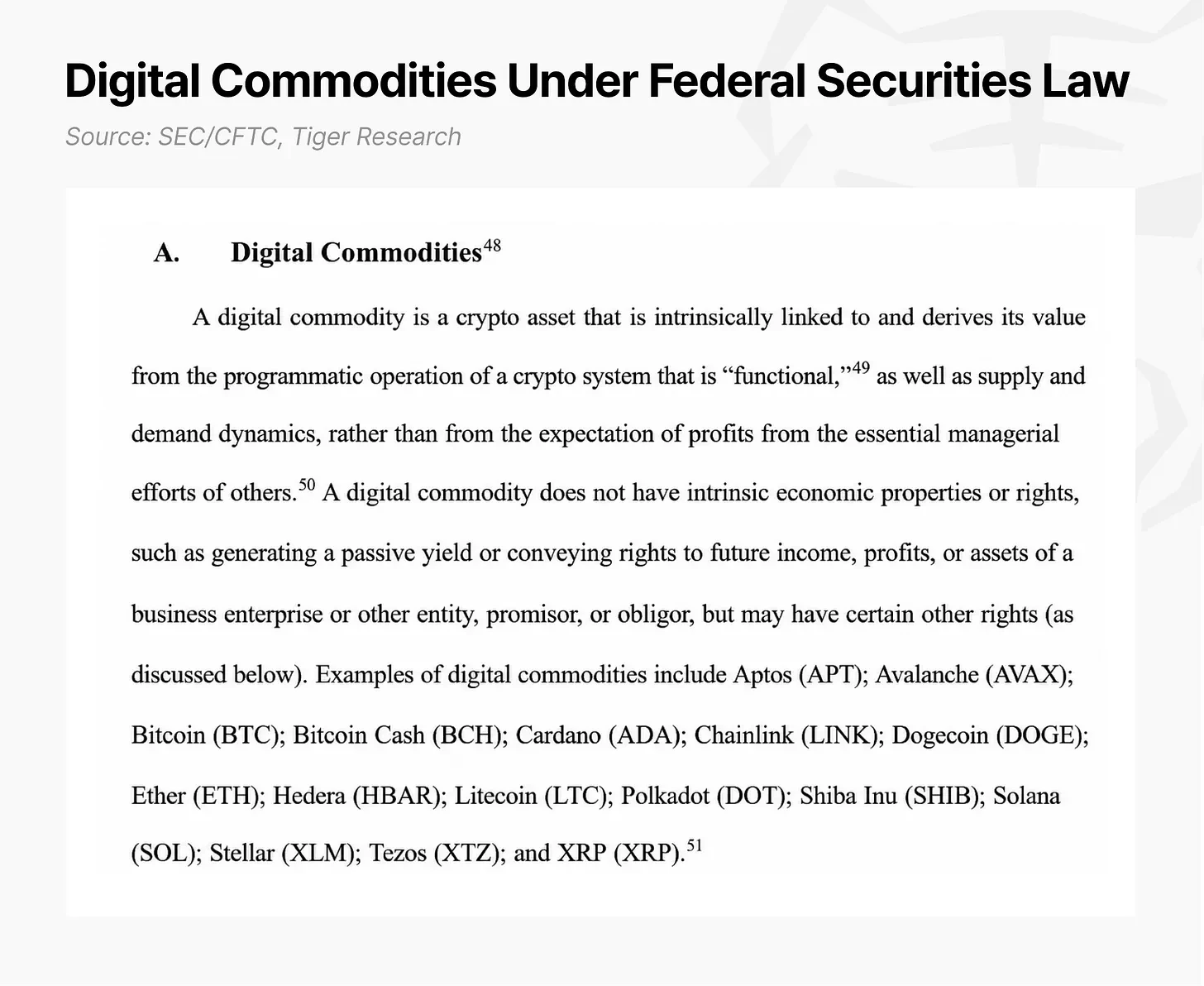
Regulatory progress is significant. The US Congress passed the GENIUS Act, clarifying the legal status of stablecoins. In March 2026, the SEC and CFTC issued joint interpretive guidance, designating 16 assets, including Solana (SOL), as digital commodities. It categorized assets into five classes, abandoning the old "security/non-security" binary classification, and formally excluded protocol staking from securities law oversight.
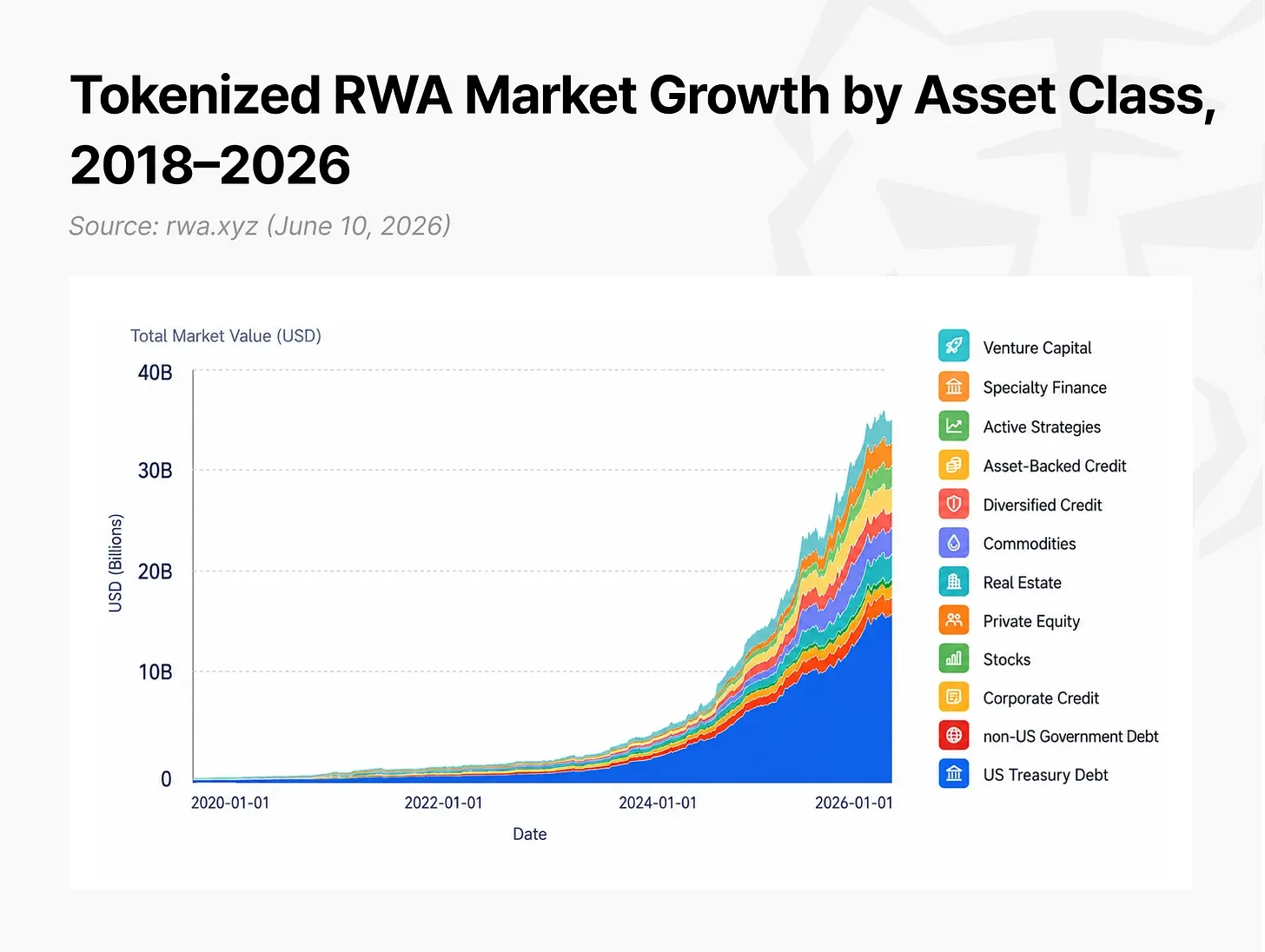
Institutional adoption continues to accelerate. The market for tokenized real-world assets (RWA) grew approximately 257% in 15 months, from $5.4 billion at the start of 2025 to $19.3 billion by the end of March 2026; if stablecoins are included, the total on-chain asset size has approached $300 billion.
This is not yet enough to be called a mature industry, but industry formation has already begun in parallel with regulatory construction.
2. Internet Capital Markets: The Final Form of the Crypto Industry
The future the crypto industry points to as it enters the industrial phase is a reconstruction of the capital market itself. This future can be defined as "Internet Capital Markets" (ICM): a capital market where the issuance, trading, and settlement of assets all occur on a single public blockchain.
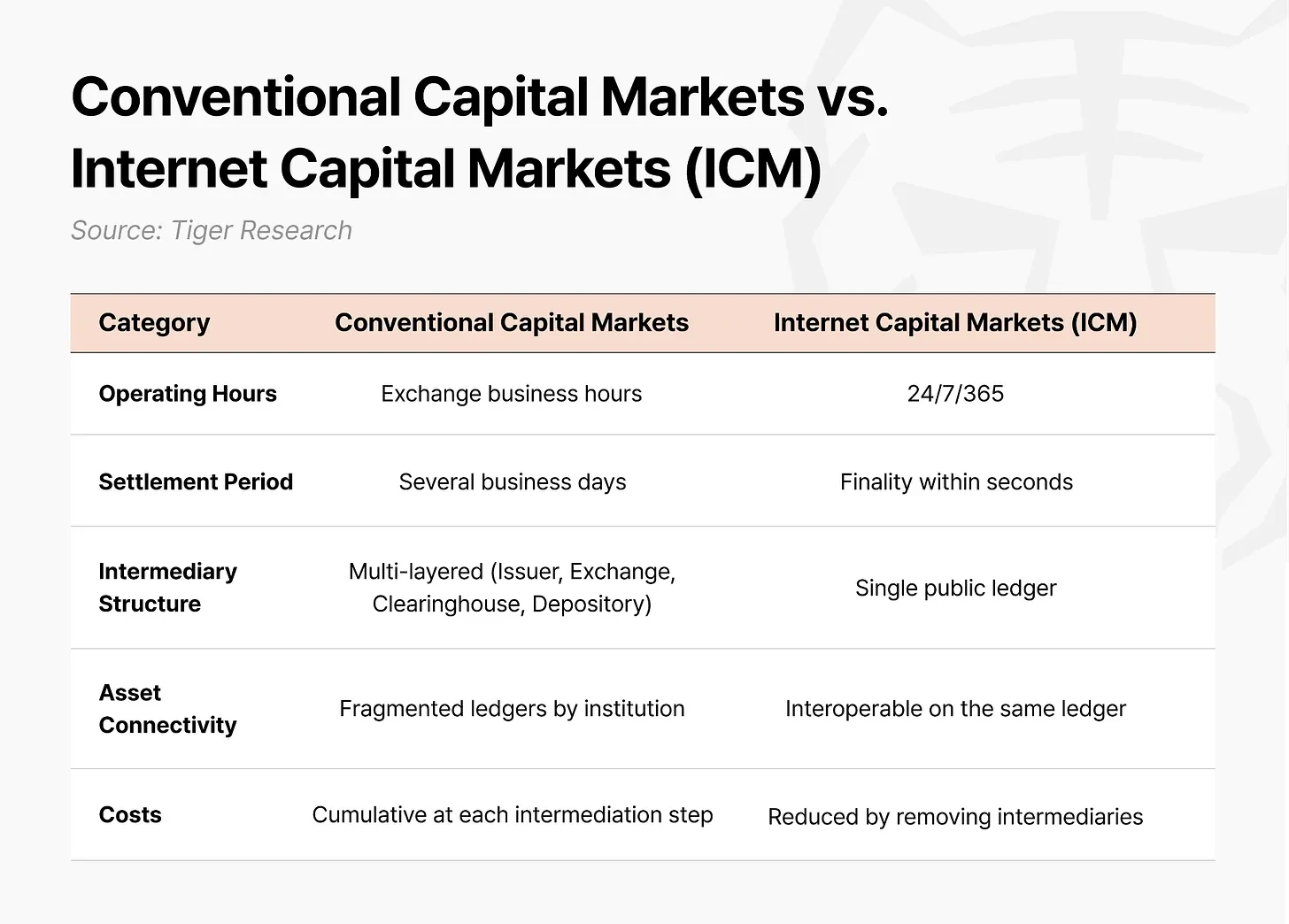
Today's capital markets operate on an architecture designed before the internet was born. When buying and selling a stock, the asset and funds do not complete delivery at the moment of execution. A clearinghouse sits between the buyer and seller, assuming default risk and requiring margin from both parties, funds which are locked until settlement is complete. In the US market, title transfer at the depository doesn't occur until the business day after execution. Because brokers, exchanges, clearinghouses, and depositories each maintain independent ledgers, they must reconcile with each other daily; any discrepancy delays settlement. Cross-border transactions add currency conversion and national depositories, extending settlement times to T+3 or even longer. This architecture, designed for an era when trading counterparties didn't trust each other, has itself become a cost.
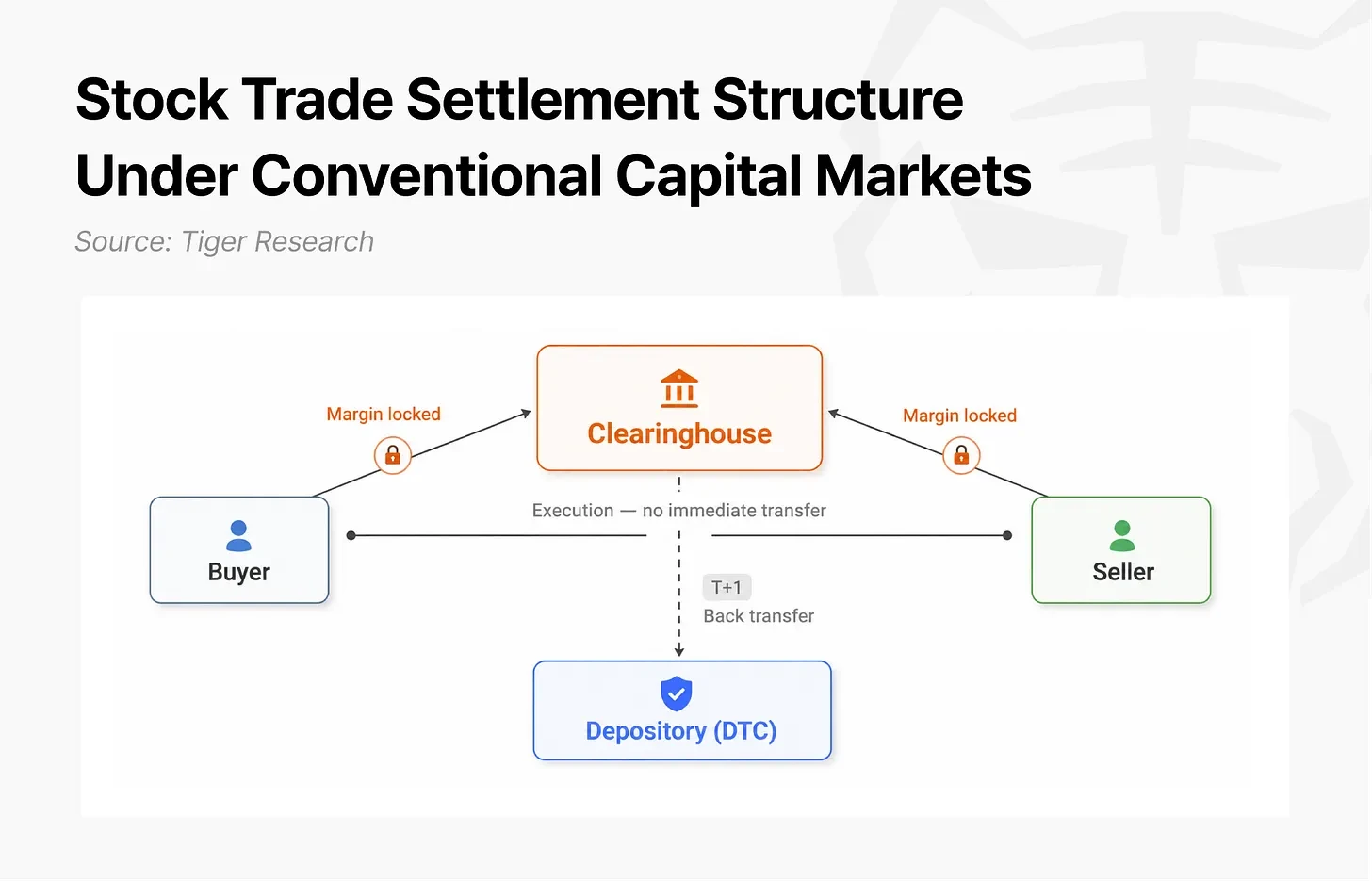
In Internet Capital Markets, code takes over the role of the clearinghouse. The buyer's payment and the seller's asset are placed into a smart contract simultaneously; the two transfers are executed as a single transaction. If either party's conditions are unmet, the entire transaction is automatically cancelled; there is no scenario where only one party's funds flow out. Since default risk is eliminated at the code level, margin requirements from the clearinghouse are no longer necessary. As all participants share the same ledger in real-time, inter-institutional reconciliation disappears. Execution and settlement complete synchronously within seconds.
The entities driving this change are expanding from crypto startups to traditional financial institutions. Those institutions that once earned revenue from multi-layered intermediary structures are now themselves participating in this transformation. History repeatedly shows: at every inflection point of infrastructure change, institutions that are slow to follow either pay higher costs or lose their leadership position. The transition to electronic trading in the 1990s is a classic example. Large institutions reliant on floor trading initially resisted electronic platforms like Island ECN and Instinet, only passively following through acquisitions and adoption after these platforms became the standard. The fintech transformation followed the same pattern.
This change is progressing fastest in the United States. After the dollar became the reserve currency under the Bretton Woods system in 1944, global trade and financial transactions are denominated and settled in dollars. CHIPS processes over $2.2 trillion in payments every business day. The SEC's disclosure standards serve as a reference for capital market systems in other countries. Over 99% of stablecoins are dollar-denominated. The US is replicating this same model within Internet Capital Markets.
3. Concrete Implementation of Internet Capital Markets
For example, within the landscape of US Internet Capital Markets, Solana is a public blockchain network that integrates technology infrastructure, institutional practice, and regulatory design.
Solana's technology base has been tempered in the retail market. The DeFi demand surge in 2021 caused network overload, which Solana treated as an opportunity to improve throughput and transaction scheduling. During the meme coin cycle of 2023, it validated its throughput claims by sustaining high-intensity retail traffic over a long period. In October 2025, during a simultaneous market crash and AWS outage, transaction fees on other chains soared to $100 per transaction, while Solana continued operating without interruption at $0.0013 per transaction. The infrastructure stability required for institutional finance was first validated through stress tests in the retail environment.
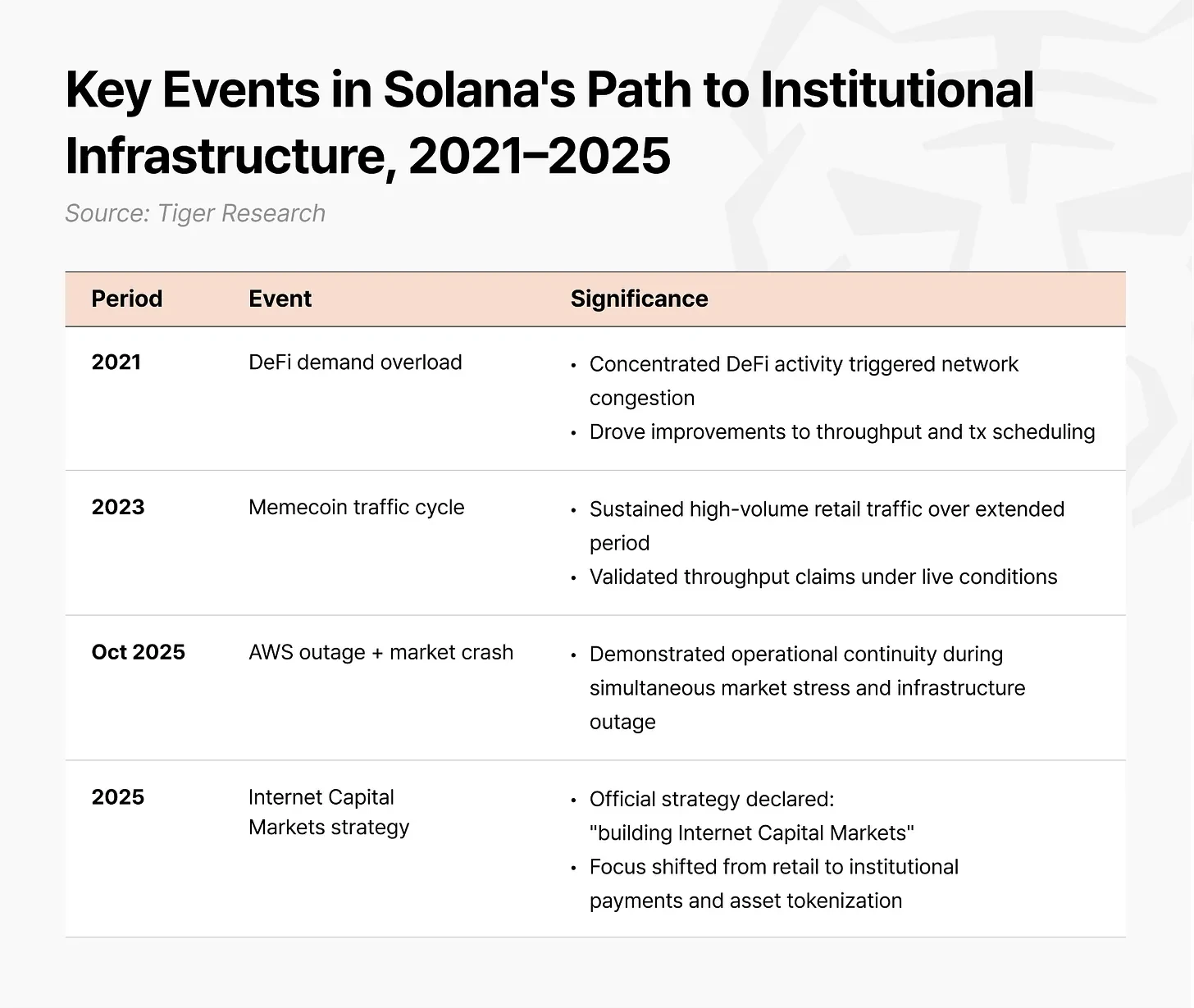
In 2025, Solana established "Building the Internet Capital Market" as its official strategy, shifting focus towards institutional payments and asset tokenization. The Token-2022 standard introduced for this purpose embeds functionalities like freezing, confiscation, whitelist management, and confidential balances directly into the token code. Issuers can achieve compliance requirements within the token itself without needing external systems, addressing the core financial needs for asset holding and transaction eligibility at the protocol level.
On this infrastructure, seven major US financial institutions have initiated proofs-of-concept or completed real transactions on Solana: J.P. Morgan, State Street, Citi, Franklin Templeton, Visa, PayPal, and Western Union. Three of these are among the eight US globally systemically important banks (G-SIBs).
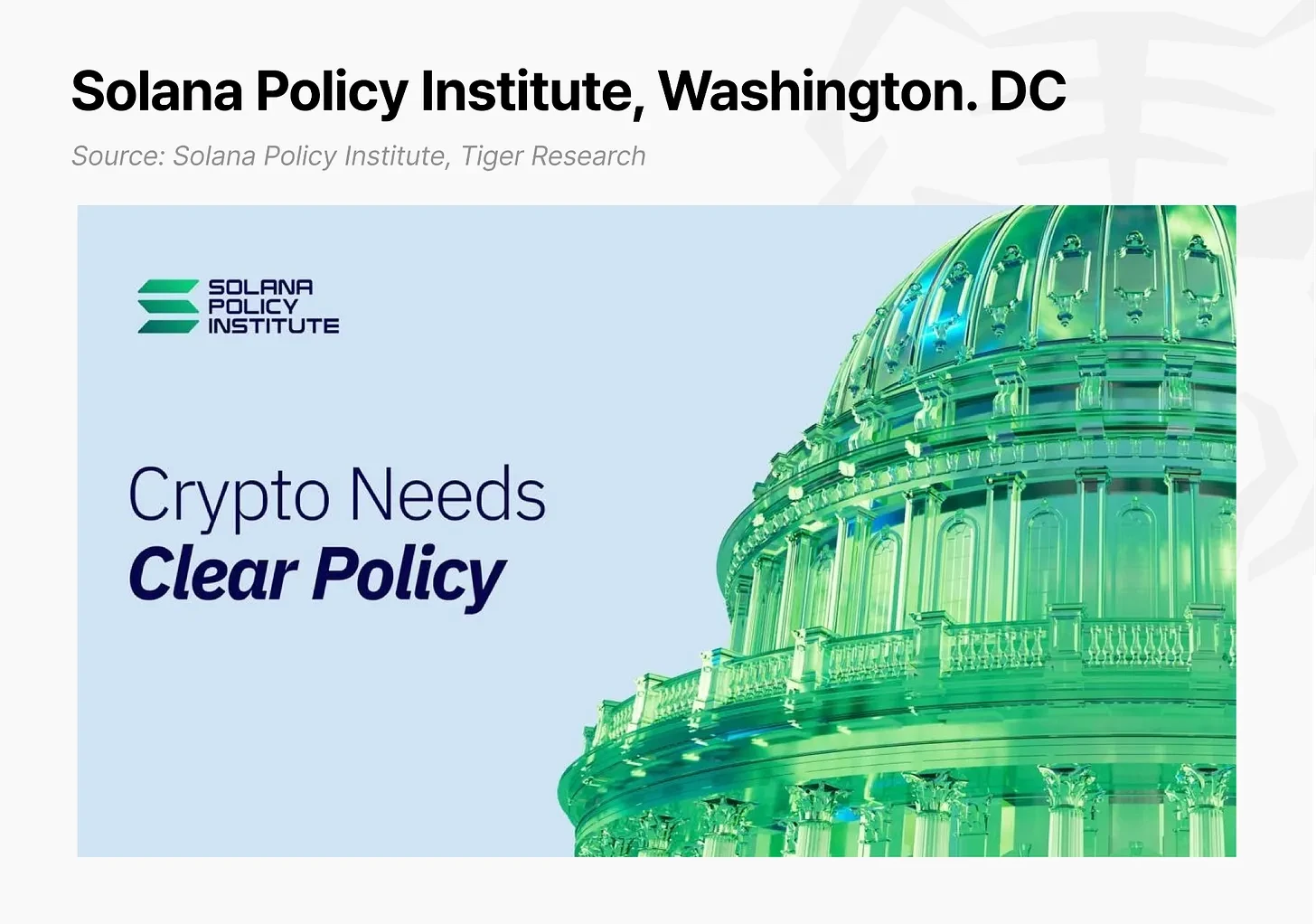
Concurrently, the Solana Policy Institute (SPI) was established in Washington, D.C. in the spring of 2025, recruiting the former CEO of the DeFi Education Fund and the former CEO of the Blockchain Association. Rather than waiting for legislation to pass before reacting, it proactively submitted a pilot framework called "Project Open" to the SEC's Crypto Task Force, attempting to establish regulatory precedent first, while simultaneously advancing business diversification and regulatory development.
4. Institutional Practice: Case Study Analysis Across Four Areas
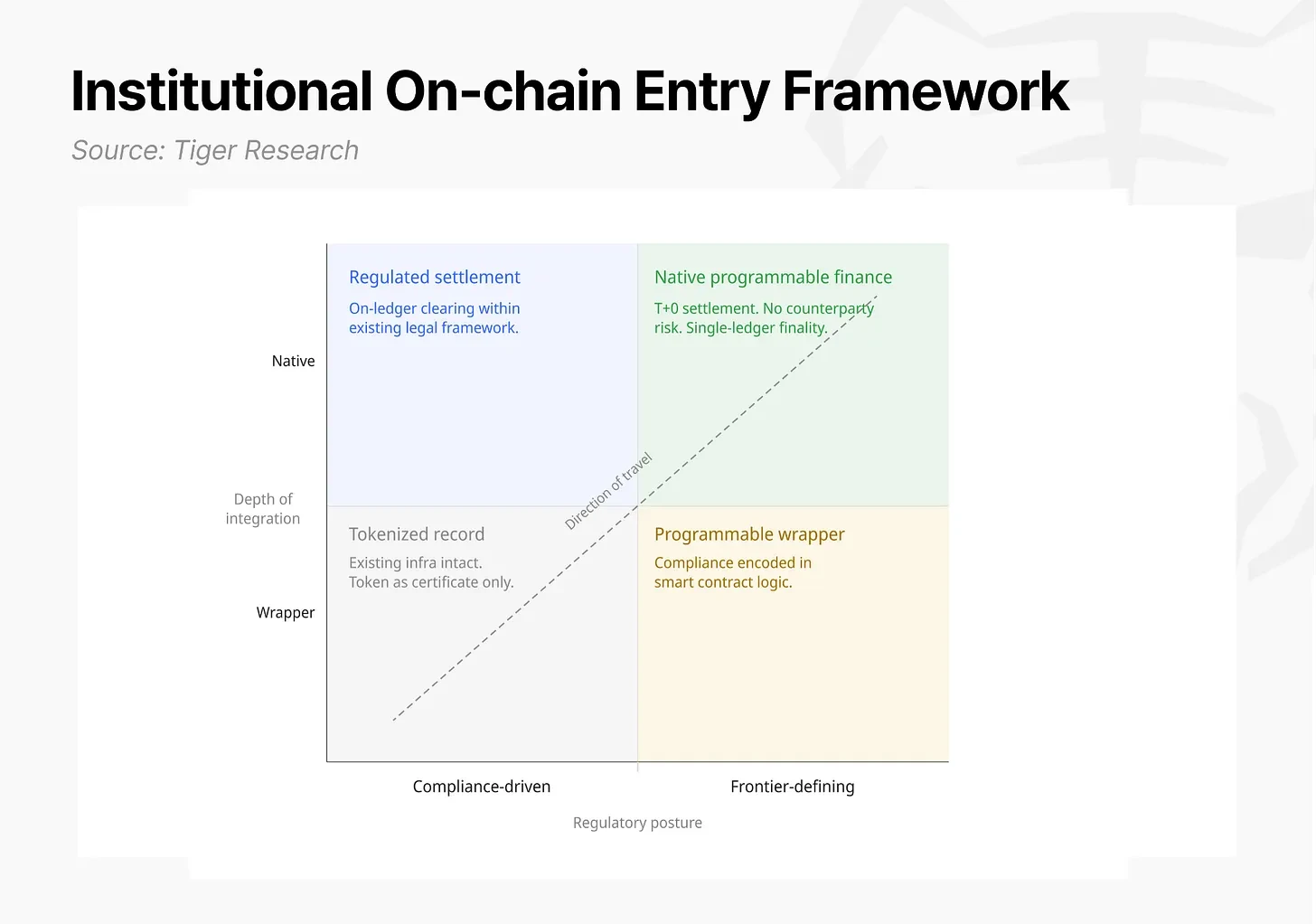
Institutional participation in the Solana Internet Capital Market is unfolding across multiple fronts, but not all participants share the same goals. Understanding this layered activity requires an analytical framework built around two core axes: regulatory posture (compliance-driven vs. frontier-defining) and depth of value chain integration (wrapping layer vs. native layer).
4.1 Banking and Capital Markets: The Hidden Cost of Settlement Delays
The banking and capital markets sector, encompassing bond issuance, trade finance, and treasury management, is a core revenue source for traditional financial institutions and the area where the cost advantages of Internet Capital Markets are most directly apparent. Three sub-areas share one critical issue: the time lag between trade execution and the actual movement of funds.
According to Tiger Research estimates, the opportunity cost from idle funds due to settlement delays in just the US Treasury market amounts to approximately $32 billion annually. When extended to the entire US fixed-income market, the annual opportunity cost exceeds $45 billion. The speed limitations of the existing financial system impose significant hidden costs on market participants.
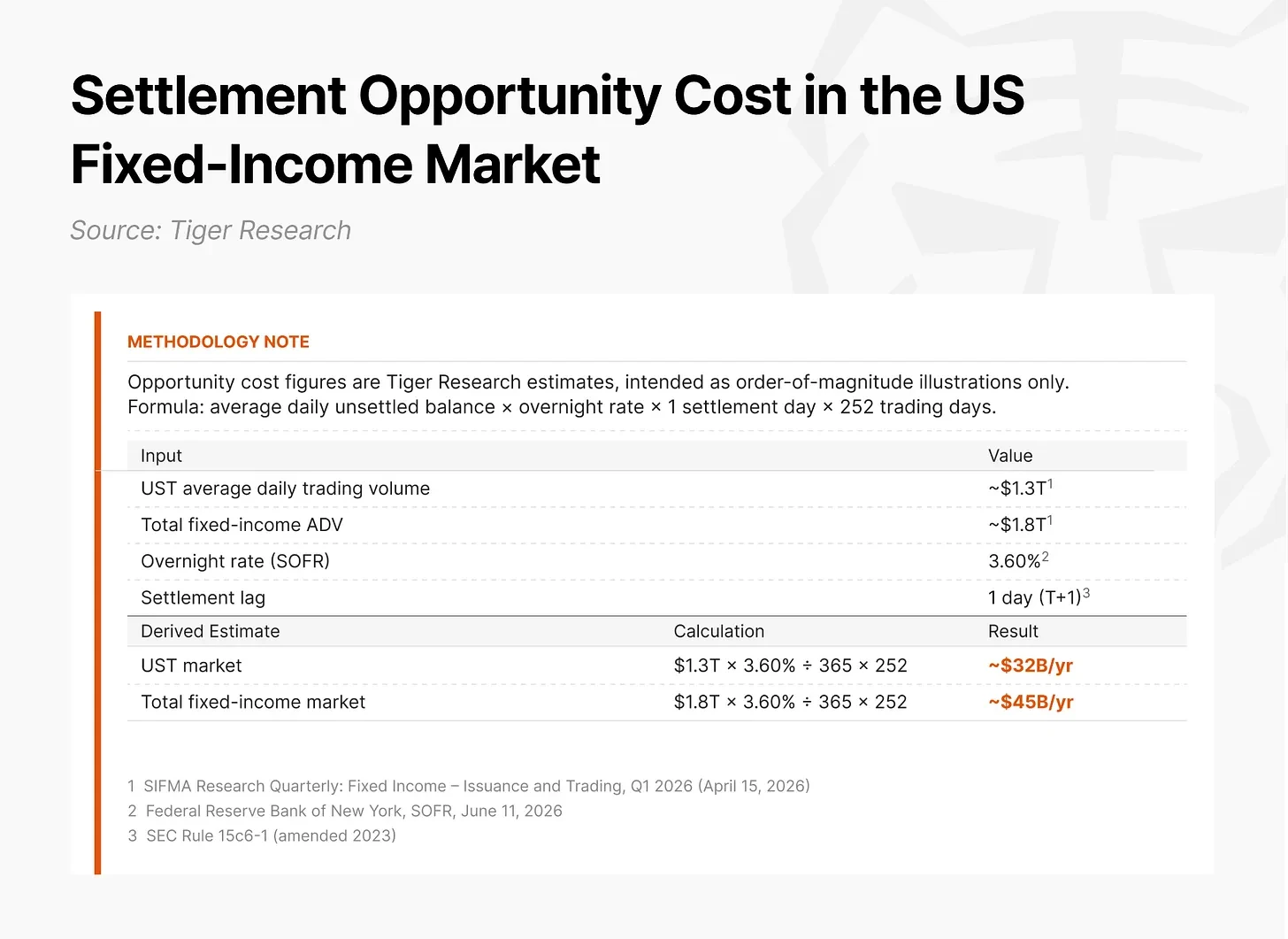
On Internet Capital Market infrastructure, this chronic time lag disappears. Atomic settlement (DvP) bundles asset transfer and payment into a single transaction processed in real-time. The clearinghouse becomes unnecessary, and the separate reconciliation processes run by institutions vanish. Execution and settlement complete within seconds (T+0).
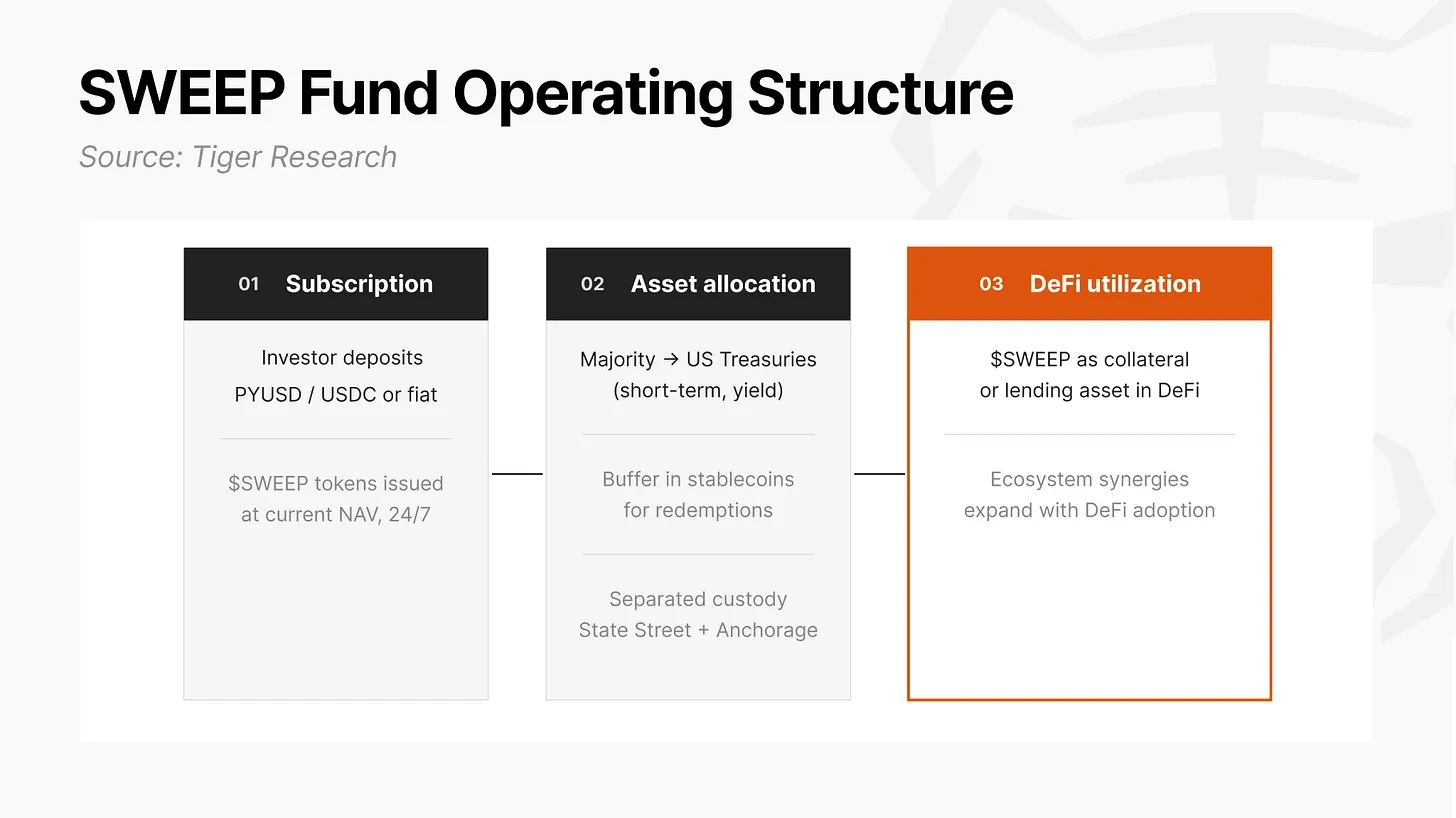
State Street × Galaxy: On-Chain Treasury Management (SWEEP). Launched on Solana in May 2026, SWEEP is an on-chain fund for institutional investors, accepting stablecoins (PYUSD, USDC) or fiat deposits and investing in short-term US Treasuries to generate yield. It implements the traditional finance concept of a "sweep account" as an on-chain fund. For Web3 foundations holding large amounts of stablecoins, using traditional financial services under existing infrastructure first requires converting stablecoins into dollars, incurring conversion fees and time delays. SWEEP allows institutions to deposit and redeem treasury yield assets directly from their wallets. Ondo Finance's flagship fund, OUSG, made an anchor investment of approximately $200 million at SWEEP's launch, representing about 26% of its TVL at the time.
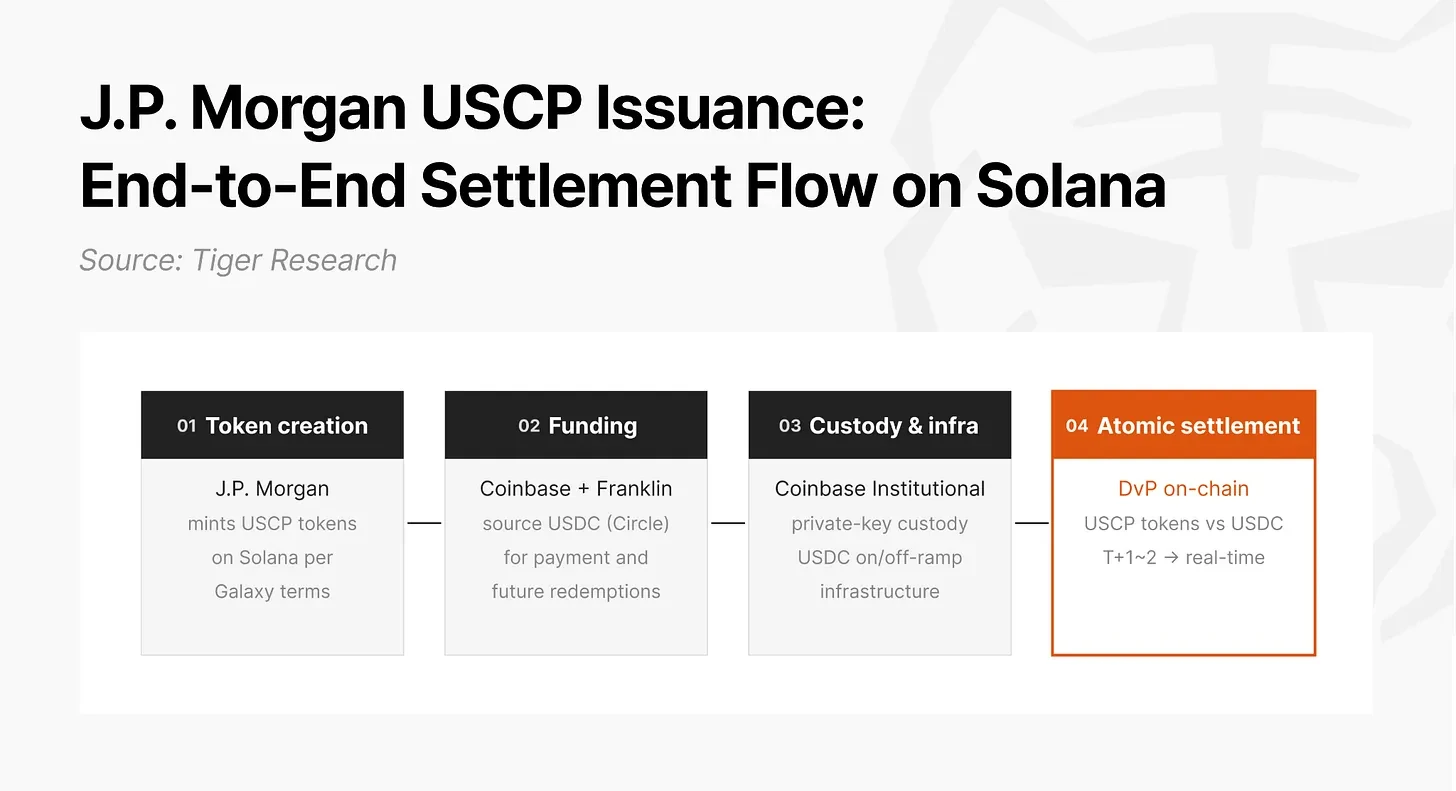
J.P. Morgan × Galaxy: Commercial Paper Issuance (USCP). In December 2025, J.P. Morgan arranged a $50 million US commercial paper issuance on the Solana public blockchain. This was not a simulation test but one of the earliest real debt securities transactions on a public blockchain. J.P. Morgan acted as arranger, creating USCP tokens directly on the Solana blockchain. Coinbase and Franklin Templeton acted as lead investors and buyers, paying with USDC (issued by Circle), with Coinbase providing private key custody and USDC on/off-ramp infrastructure. By combining the stablecoin payment network with on-chain atomic settlement (DvP), the corporate financing cycle, which previously required T+1 to T+2 settlement across multiple intermediaries, was compressed to real-time completion.
Citi × PwC: Trade Finance Tokenization (Drafts). Citi and PwC completed an internal proof-of-concept on Solana, transforming traditional drafts into tokenized digital assets. In the simulated environment, the full lifecycle of a draft (issuance, financing, circulation, settlement) was automated via smart contracts, reducing settlement time from days to minutes and eliminating manual reconciliation costs. This case holds strong relevance for Asian financial markets, as the global trade hub is highly concentrated in Asia.
4.2 Payments and Stablecoins: Redesigning the Settlement Paradigm
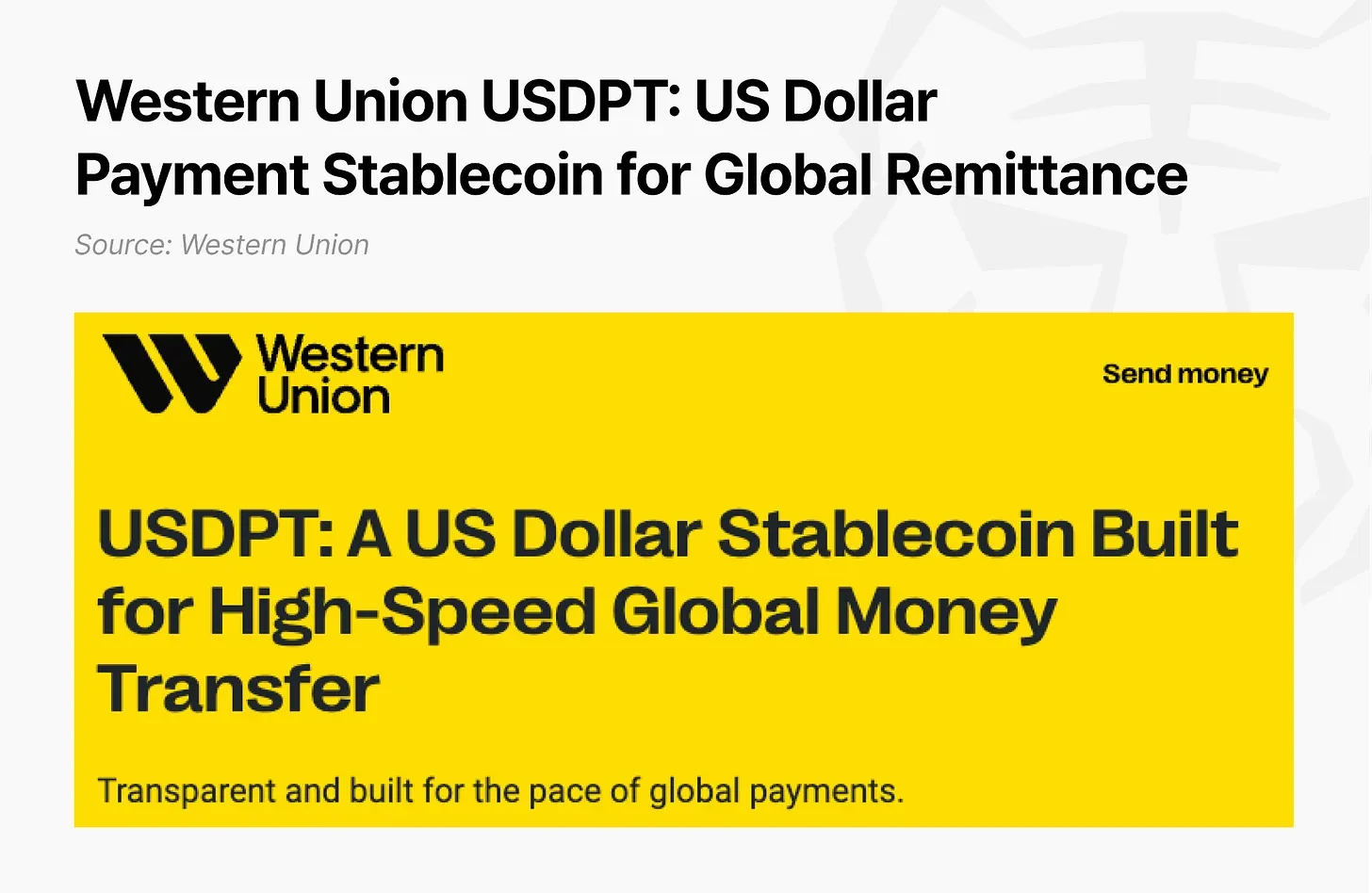
Western Union: Global Remittances (USDPT). In May 2026, Western Union, a 175-year-old company processing approximately $150 billion in cross-border remittances annually across over 200 countries, issued the US Dollar Payment Token (USDPT) on Solana. In the traditional correspondent banking system, each intermediary bank processes only within its own system and working hours; settlement typically takes one to two business days and completely stops on weekends and holidays. To instantly respond to real-time payment requests from base countries, Western Union must pre-lock substantial dollar amounts in local bank accounts in each country. These pre-funded correspondent account balances are locked and non-yield-bearing until a transfer occurs.
USDPT fundamentally redesigns this settlement process, shifting the paradigm from "pre-funding reserves" to "real-time, on-demand supply." When the cash inventory of an agent in a specific country drops below a threshold, the US headquarters treasury team immediately sends USDPT (issued by Anchorage Digital) to the agent's institutional on-chain wallet. Final settlement is achieved rapidly, regardless of weekends, nights, or holidays, based on Solana's 0.4-second block time. Western Union is also building a Digital Asset Network (DAN), planning to roll out its consumer-facing stablecoin payment service, "Stable by Western Union," to over 40 countries within 2026.
Fiserv: White-Label Stablecoin for Financial Institutions (FIUSD). Fiserv announced the launch of its FIUSD white-label stablecoin platform, scheduled to go live on Solana in July 2026. Under the white-label structure, Fiserv provides the technology infrastructure and dollar backing system, while individual financial institutions issue and offer the stablecoin under their own brand. Banks can offer their own digital dollars to customers without needing to build blockchain infrastructure themselves. The Bank of North Dakota (the only US state-owned bank) has already announced it will launch the "Roughrider Coin" on this platform. Fiserv's multi-sided network covers approximately 10,000 financial institution clients and 6 million merchants, processing 90 billion transactions annually. It plans to leverage existing technology to offer FIUSD for free to its member financial institution clients.
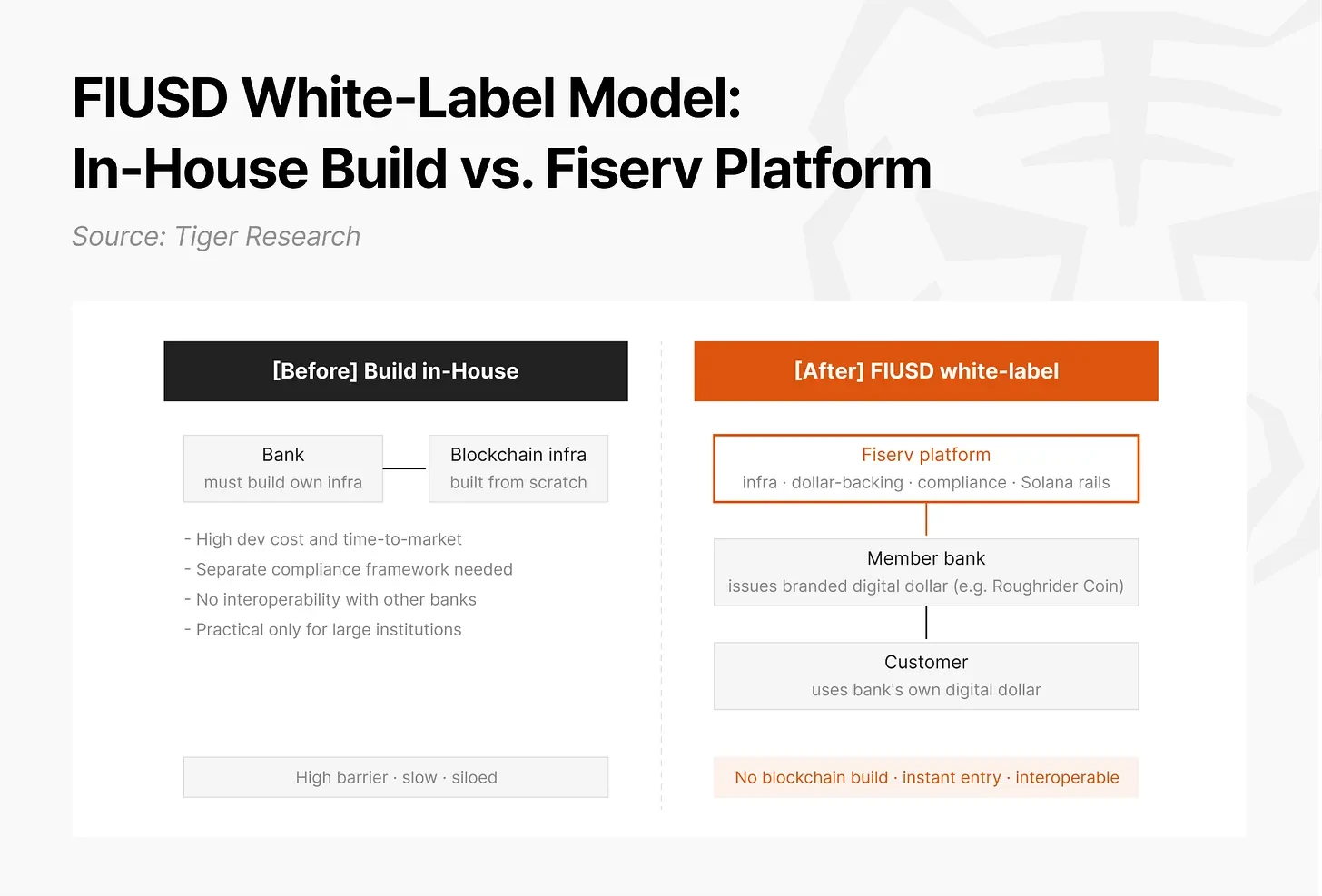
This structure can be directly referenced by Asian financial institutions. For South Korea, the white-label model directly maps onto the current debate about whether banks or non-bank institutions can issue stablecoins. Once the Financial Services Commission (FSC) establishes boundaries and creates rules for the Korean won, this model becomes transplantable.
4.3 Real-World Asset Tokenization: A Closed Loop from Issuance to Circulation
Orca × Streamex: Compliant RWA Distribution (GLDY). The market for tokenized listed stocks has long faced a disconnect between issuance and distribution. While multiple exchanges provide secondary trading paths for tokenized assets like listed stocks, non-equity tokenized securities such as bonds, commodities, and private loans lack a liquidity infrastructure controlled by the issuer and accessible based on eligibility after issuance. Issuance technology has advanced, but distribution infrastructure has not kept pace.
In May 2026, Orca launched a permissionless AMM infrastructure, allowing issuers to create customizable permissioned pools based on their regulated asset requirements. Nasdaq-listed company Streamex, as the first issuer, utilized this solution to provide secondary liquidity for its gold yield token, GLDY. The operation of the GLDY permissioned pool occurs in three stages: all investor wallets are initially frozen; only wallets that pass Streamex's KYC verification are automatically unfrozen by the on-chain access control layer; unfrozen wallets then conduct peer-to-peer real-time trading within the Orca AMM pool, requiring no broker or reviewer intervention. Unlike traditional gold investment products restricted by exchange trading hours, GLDY trades 24/7 on Solana, with yields from Monetary Metals' gold lease contracts paid directly to GLDY holders.
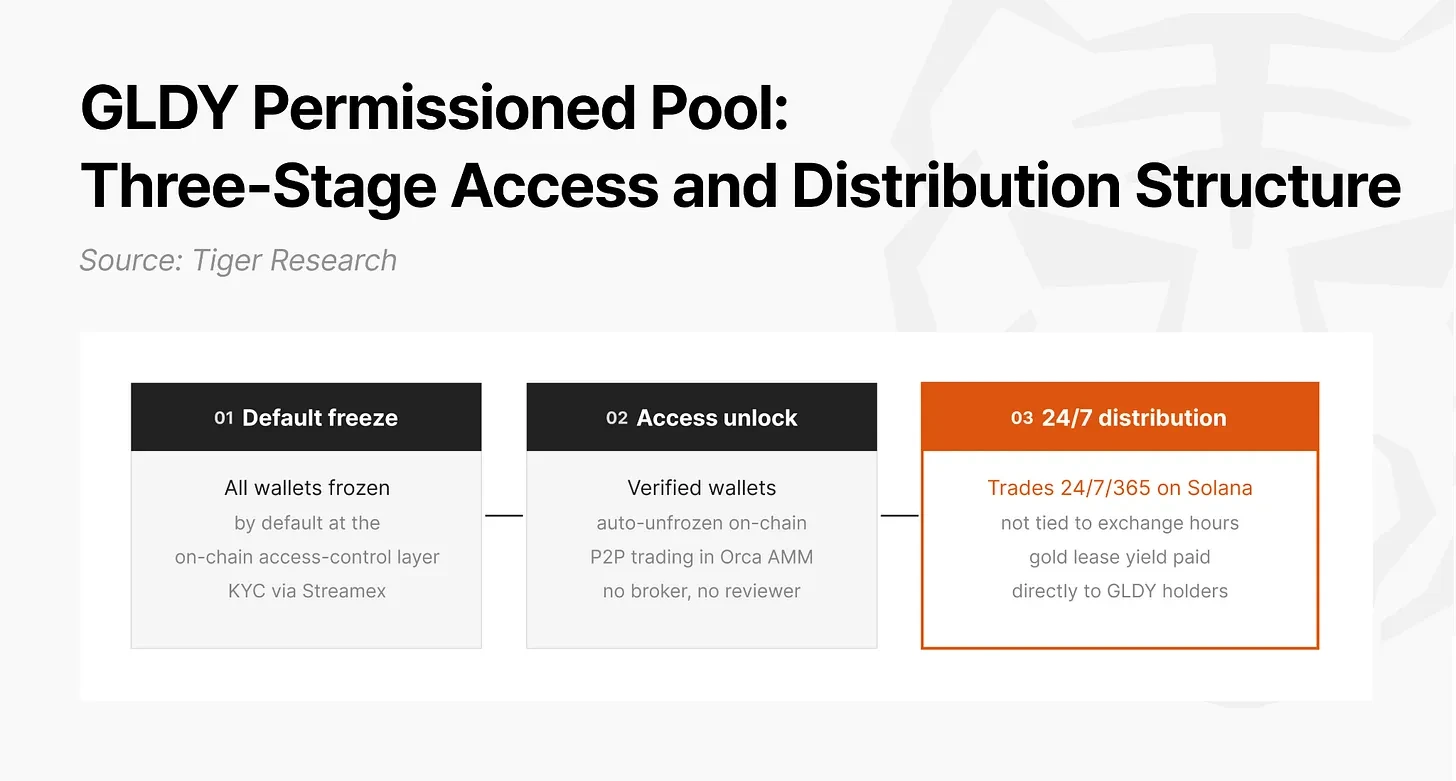
This token-level freeze/unfreeze control mechanism is not limited to gold and can be directly applied to any regulated asset such as Treasuries, corporate bonds, and private credit. This is precisely why Orca proposed this structure as the trading infrastructure proposal for the Project Open pilot framework.
Apollo: Private Credit Tokenization (ACRED). Despite high yields, the traditional private loan market has two major structural barriers: high minimum investment amounts making them accessible only to institutions and ultra-high-net-worth individuals, and an illiquidity problem where capital is locked until maturity once invested. In January 2025, Apollo, via Securitize, issued ACRED, a tokenized feeder fund based on its diversified credit fund (ADCF), with a minimum investment of $50,000. Within the Solana ecosystem