






Leverage Exhausted, Buying Pressure Absent: Bitcoin Still Trapped in Wait for 'Final Drop'


- Core Thesis: The current Bitcoin market is in a deep correction phase of the late bear market. Key indicators show widespread losses among short-term holders and institutional buying retreat. However, the ultimate panic selling historically capable of triggering a sustained rebound has not yet materialized, leaving the market's bottoming process incomplete.
- Key Factors:
- The AVIV Index Z-score has fallen to -1.06, deep in a discount zone, indicating prices are severely oversold relative to the cyclical average. Yet, no effective rebound has occurred from these lows.
- Over 95% of short-term holders are in a loss position. The STH-MVRV metric indicates new investors are facing an average unrealized loss of 17% to 19%, leaving the market structure fragile.
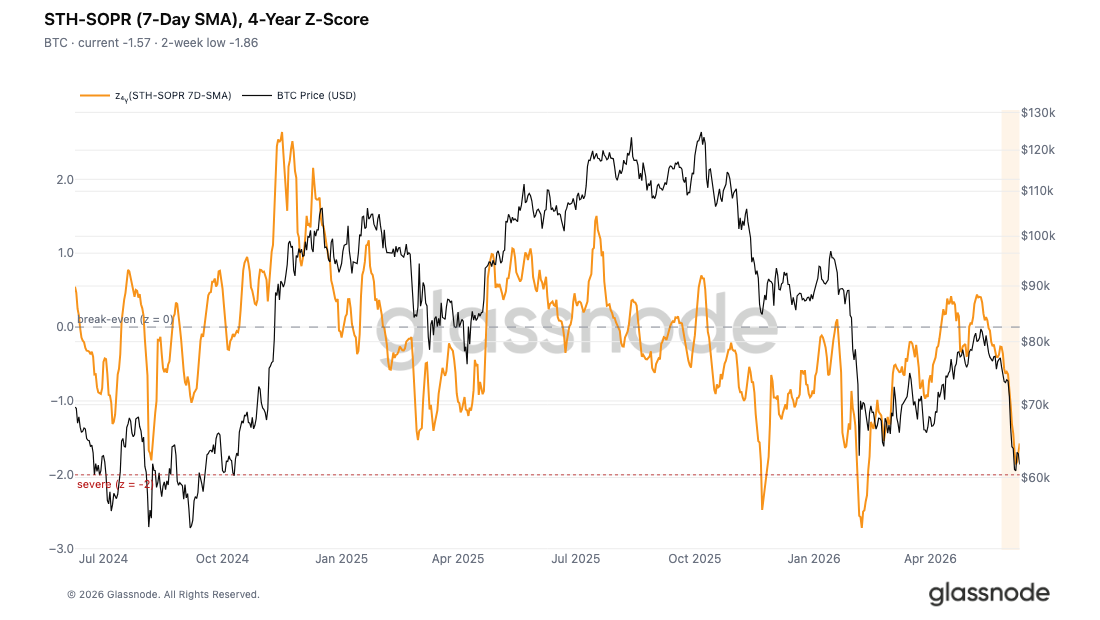
- The STH-SOPR Z-score has hit a low of -1.86, approaching the -2 threshold for deep panic selling. While short-term holder capitulation is intensifying, it has not yet reached historical bottoming levels.
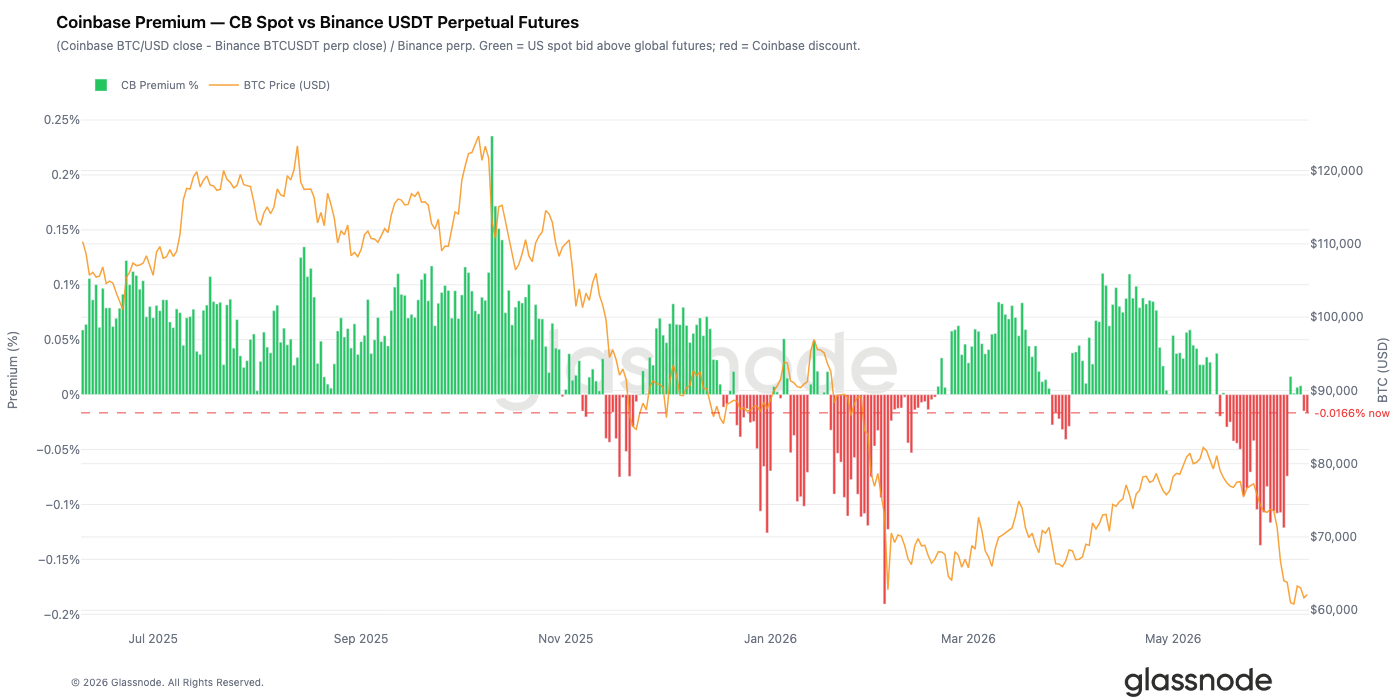
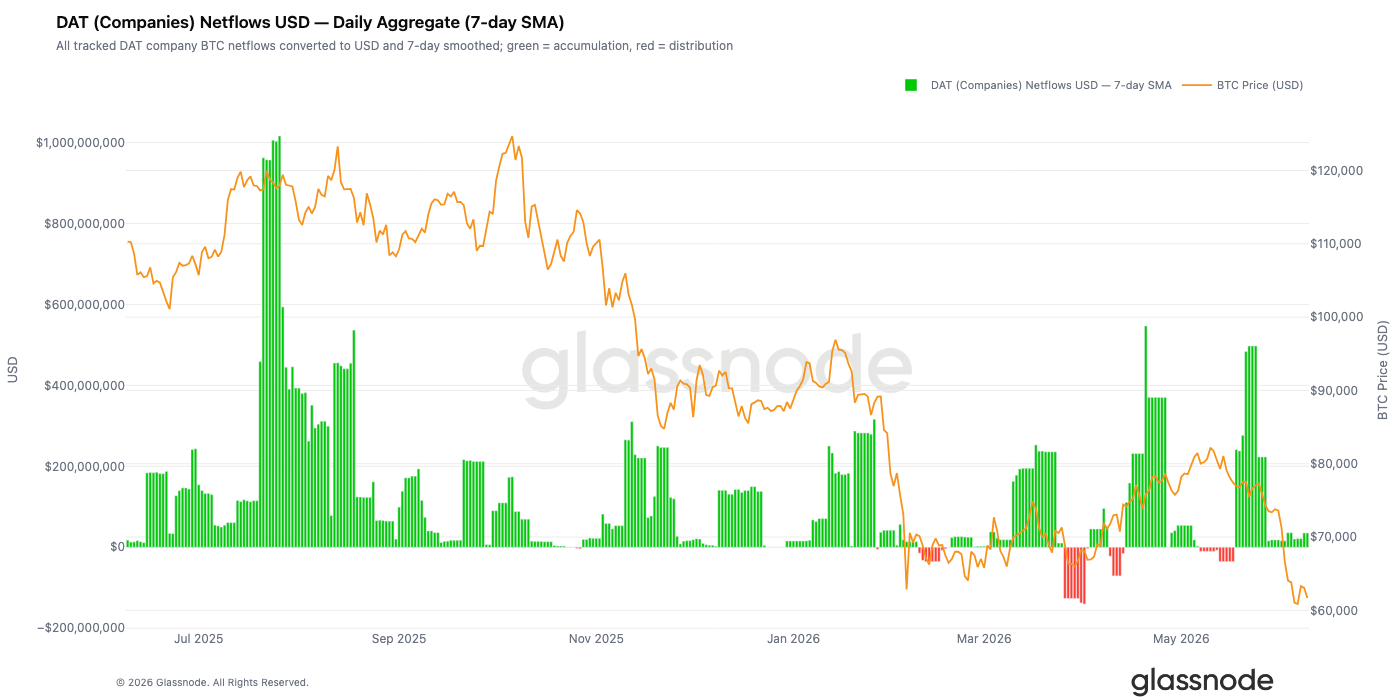
- US institutional demand has notably cooled. The Coinbase premium continues to show a discount, and the daily increase in corporate treasury Bitcoin holdings has fallen from over $500 million to near zero, weakening core buying power.
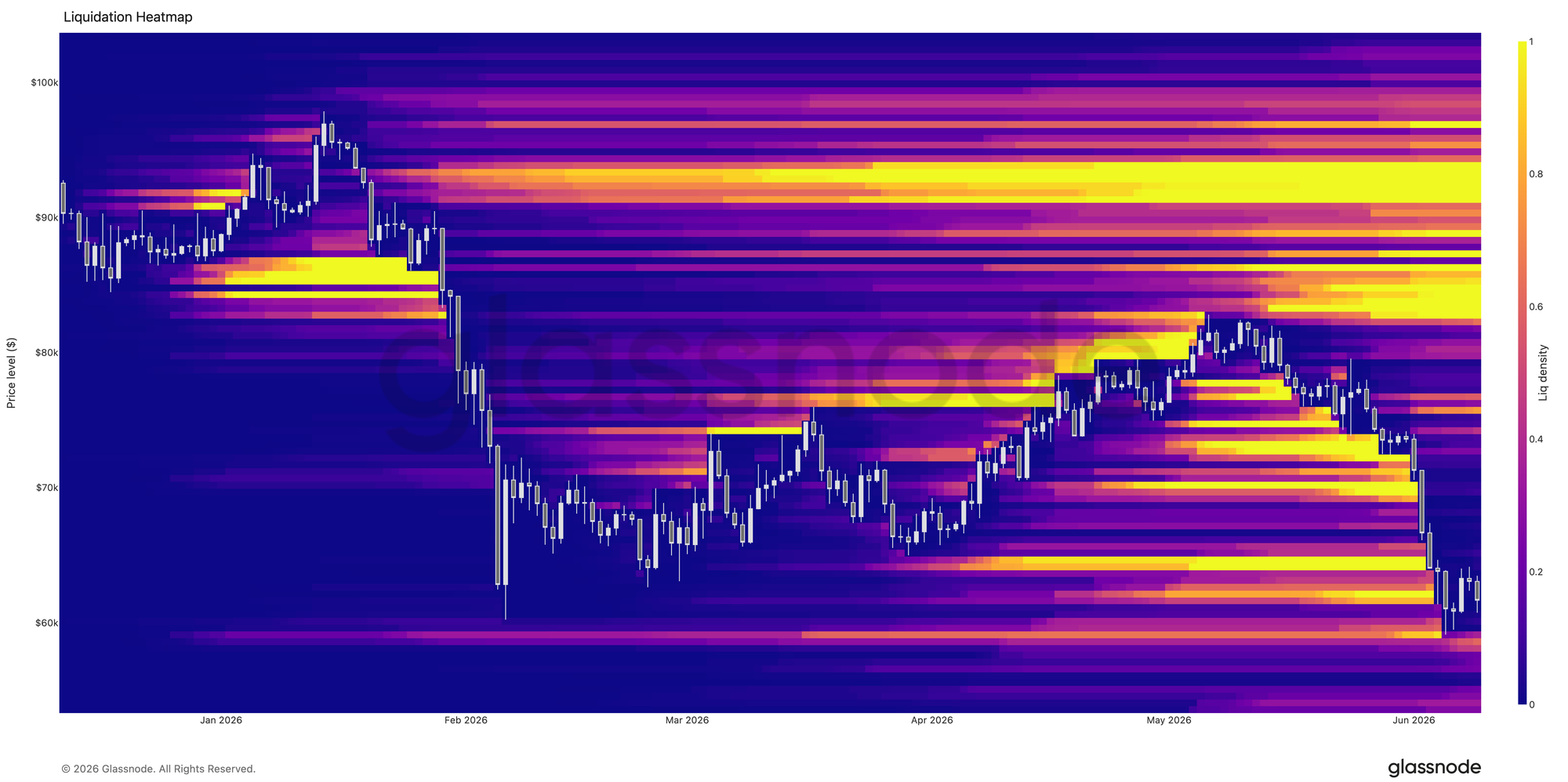
- Bitcoin's drop below $70,000 triggered significant deleveraging. The liquidation heatmap shows concentrated liquidation of long positions in the $64,000 to $70,000 range.
- Implied volatility has risen sharply, with the volatility risk premium remaining elevated. The options market is pricing in future uncertainty far exceeding actual recent volatility risks.
- The full-term 25-delta volatility skew indicator has surged, as the market concentrates on downside protection. Market makers' maximum negative gamma exposure sits near the $65,000 level.
Original Authors: Chris Beamish, CryptoVizArt, Antoine Colpaert, Glassnode
Original Translation: Chopper, Foresight News
TL;DR:
- The AVIV Z-score dropped to -1.09 before slightly recovering to -1.06, indicating the current price has entered a deeply oversold territory relative to the cyclical average. Prices failed to stage an effective rebound at these lows, with market panic continuing to spread.
- Over 95% of short-term holders are in a loss position. The proportion of profitable supply held by short-term holders has only marginally recovered to 3.3%, far below the four-year average of 55%. This highlights a fragile market structure highly susceptible to external shocks.
- The Short-Term Holder Spent Output Profit Ratio (STH-SOPR) Z-score bottomed at -1.86, dangerously close to the -2 threshold for deep panic selling. This indicates escalating stop-loss behavior, though the selling pressure hasn't yet reached the historical intensity required to fuel a sustained rebound.
- Institutional demand in the US has noticeably cooled. During Bitcoin's pullback towards $60,000, the Coinbase Premium remained persistently negative, suggesting a lack of active institutional bottom-fishing in the spot market on that platform.
- The pace of Bitcoin accumulation by corporate treasuries has slowed dramatically. Since June, net daily institutional buying has fallen from peaks exceeding $500 million earlier to near zero, removing another key pillar of market support.
- Bitcoin's breakdown below key support triggered a significant deleveraging event, leading to the concentrated liquidation of leveraged long positions and clearing out excessive speculative bets in the market.
- Implied volatility surged sharply after Bitcoin broke its trading range. The volatility risk premium has risen considerably, with the uncertainty priced into the options market far exceeding the risk implied by recent actual price movements.
- Volatility skew metrics across all tenures have spiked, signaling a marked increase in demand for downside protection instruments, with traders paying higher premiums for put options.
- Market activity remains predominantly defensive. The largest negative gamma exposure is concentrated near the $65,000 level, which is not far from the current spot price.
Macro Market Insights
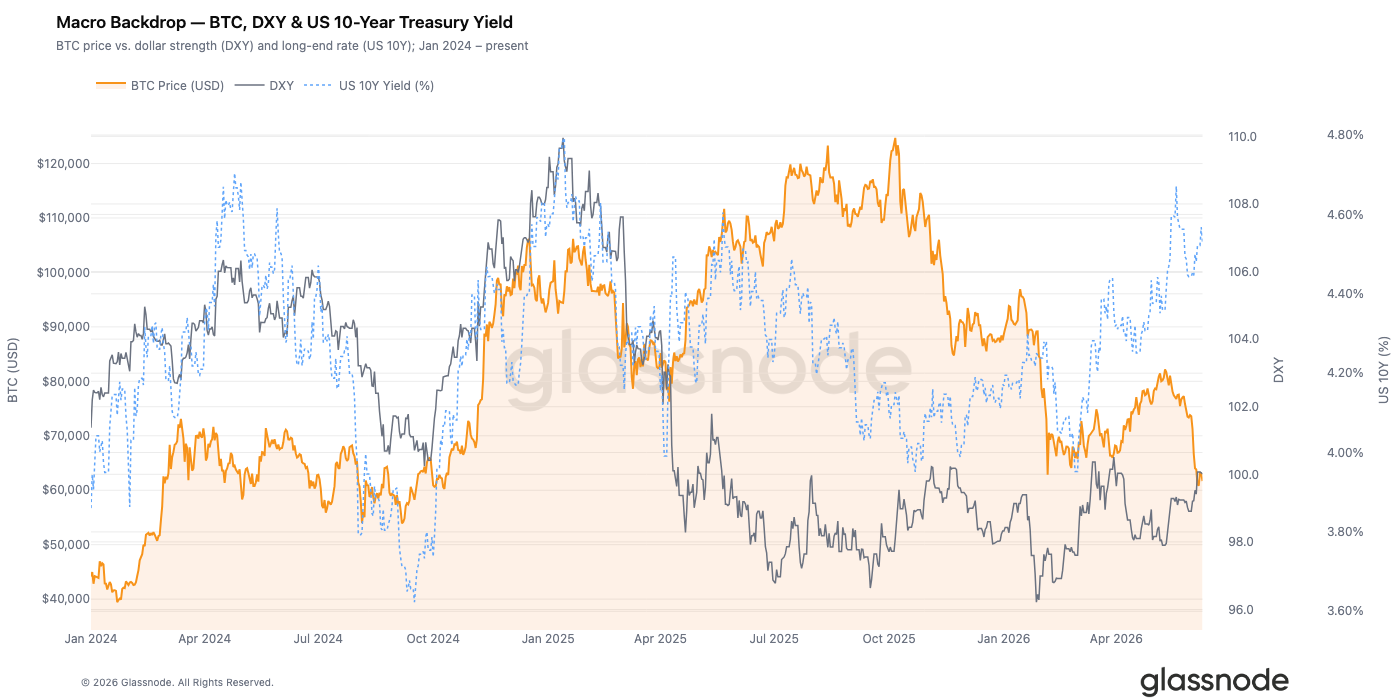
The US Dollar Index (DXY) closed at 100.01, up 0.8% for the week and 2.1% over the past thirty days. The continued strengthening of the dollar indicates a general tightening of global liquidity over the past month. The US 10-year Treasury yield held steady at 4.53%, while the 2-year yield was 4.14%, resulting in a spread of 0.39%. This yield curve shape suggests the US economy is in a late-cycle phase, with the Fed yet to make substantial policy adjustments.
Amidst these macro headwinds, Bitcoin fell 7.5% this week to $61,700. After a period of divergence, the negative correlation observed during 2022-2023, where a stronger dollar weighs on crypto assets, has re-emerged. With the DXY firmly above 100 and the 10-year yield breaking above 4.5%, historical patterns suggest this combination of rates and dollar strength typically compresses the speculative premium on risk assets.
For Bitcoin to stage a sustainable rebound, one of two conditions needs to be met: the DXY effectively breaking below 99, or the 10-year yield retreating towards the 4.2% level. Currently, neither condition has been fulfilled.
On-Chain Analysis
Valuation Deep in Oversold Territory
Our previous analysis suggested the May rally was a bear market rally. For the first time since January 2022, the Short-Term Holder Cost Basis fell below the True Market Mean Price, a signal indicating the market had entered a late-stage bear phase. This report continues to analyze the subsequent decline, including the price drop to $59,000 and the ensuing fragile consolidation.
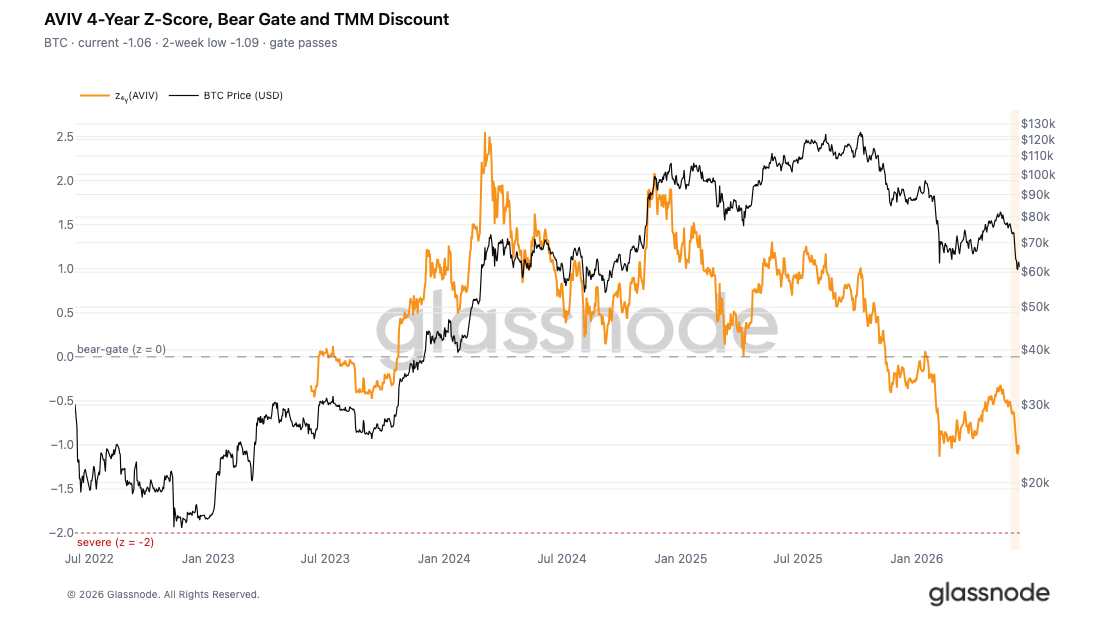
We utilize the Active Investor Value Deviation (AVIV) metric to gauge how far the current price is deviating below the cyclical average. This metric compares the spot price to the True Market Mean (the aggregate cost basis of active investors, excluding miners). Its four-year Z-score measures the deviation from this baseline, with a Z-score of 0 being the dividing line between valuation premium and discount.
The current AVIV reading is 0.80, corresponding to a Z-score of -1.06, having touched a low of -1.09 over the past two weeks. This places the current valuation in a deep discount zone within the historical range. The failure of the price to effectively rebound from these cyclical lows over the past week underscores the persistent and lingering market panic.
New Entrants Universally Underwater
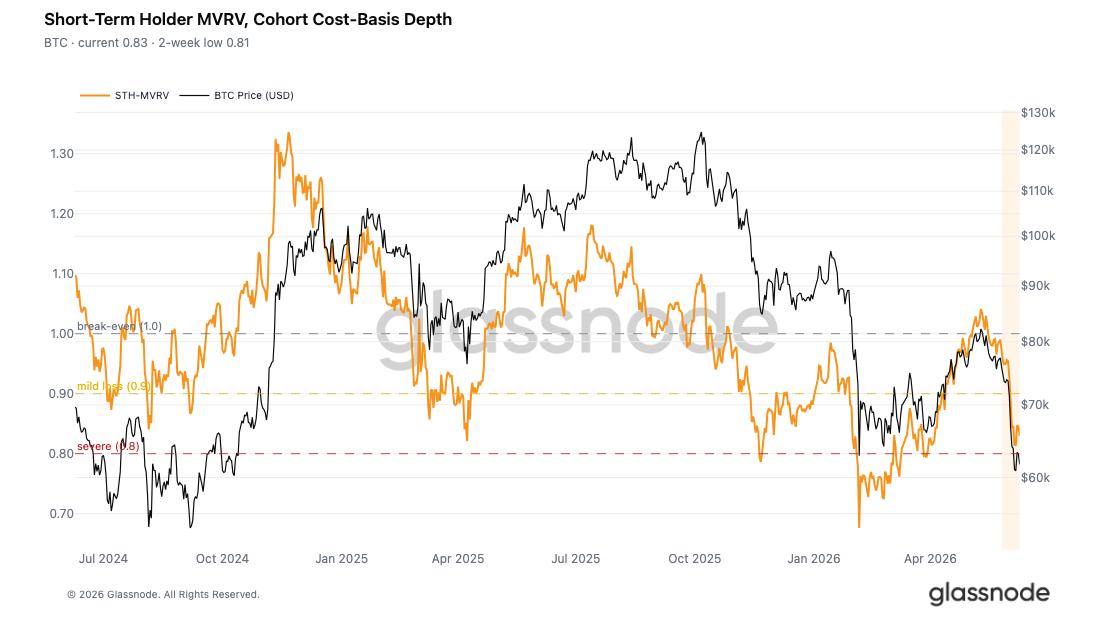
Building on the market-wide discount, we isolate the situation of recent capital inflows. The Short-Term Holder Market Value to Realized Value (STH-MVRV) ratio compares the spot price to the cost basis of short-term holders. A value below 1 signifies that this cohort, on aggregate, holds unrealized losses.
The metric recently bottomed at 0.81 before slightly recovering to 0.83, implying an average unrealized loss of 17% to 19% for new investors. This corroborates our previous assessment of pressure on new entrants, confirming that the dense accumulation zone formed between $78,000 and $82,000 during the May rally is now broadly underwater.
A brief stabilization of price at lows is a common pattern in downtrends. After the most severely underwater investors complete their initial wave of passive selling, the remaining market participants enter a 'wait-and-see' mode. Whether this consolidation phase eventually builds a solid bottom or serves as a bearish continuation pattern depends on the emergence of new buying demand at current levels.
95% of Short-Term Holders in Loss
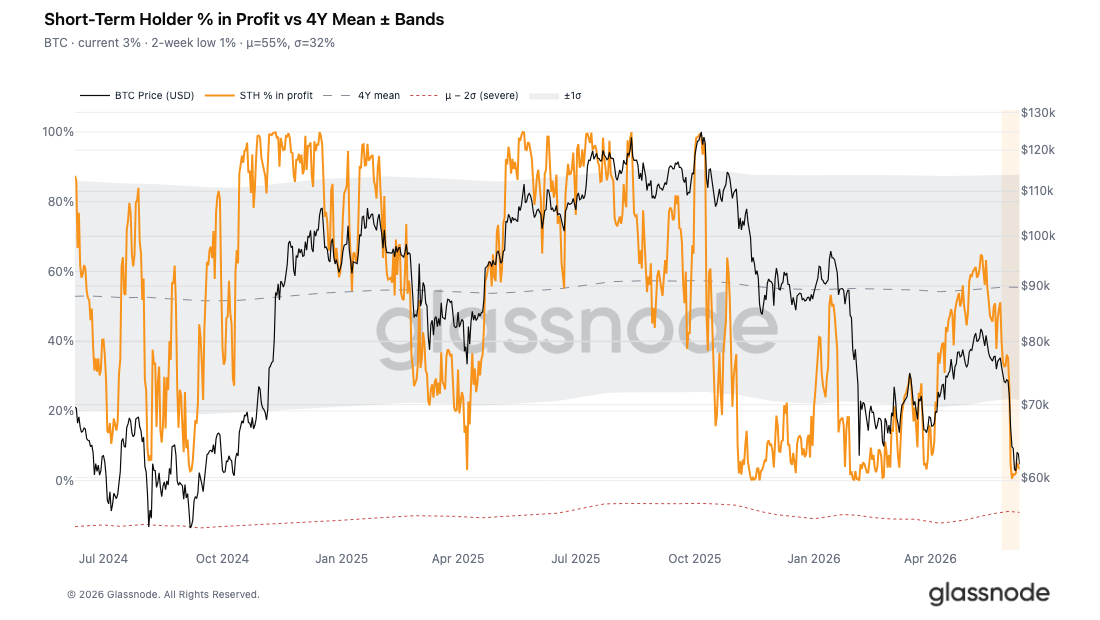
To further assess the stress on short-term holders, we examine the Short-Term Holder Supply in Profit metric. This metric calculates the proportion of short-term supply in profit relative to the total short-term supply. It helps gauge the *breadth* of losses, distinct from the *depth* of losses measured by MVRV.
This metric recently hit a low of just 0.6% and has only marginally recovered to 3.3%, far below the four-year average of 55%. In practical terms, over 95% of short-term holders are currently sitting on unrealized losses. This level of distress historically falls within significant 'capitulation' zones, where widespread pain among new investors creates a fragile market structure highly vulnerable to any negative external catalyst.
The near-universal state of loss and the lack of any meaningful recovery in this metric strongly suggest that the current sideways price action represents a temporary exhaustion of selling pressure, not the completion of a market bottoming process.
Market Approaches Panic Selling Threshold
Beyond unrealized loss data, the actual selling behavior of investors further confirms the severe market conditions. Using a four-year cyclical average as a baseline, we calculate the Z-score of the 7-day moving average Short-Term Holder Spent Output Profit Ratio (STH-SOPR) to measure the intensity of loss realization among recent buyers in this cycle.
The current Z-score for this metric is -1.57, with a two-week low of -1.86. This is just 0.14 standard deviations away from the historical extreme panic selling threshold of -2.
Currently, the frequency and speed of loss-taking among short-term holders are increasing, aligning with the previously noted single-day total realized loss of $1.35 billion and the deep unrealized losses reflected by STH-MVRV. However, the type of extreme panic selling historically associated with seeding medium-to-long-term rallies has not yet materialized.
The market is in an awkward intermediate state: the scale of realized losses confirms the depth of the bear market, but it hasn't reached the point of complete exhaustion of selling pressure required to forge a solid bottom.
Off-Chain Market Insights
Coinbase Premium Evaporates
The Coinbase Premium metric, which tracks the difference between Coinbase's spot price and Binance's perpetual futures price, serves as a key window into US institutional demand. A premium on Coinbase suggests institutions are actively buying spot Bitcoin, pushing its price above the offshore derivatives market quote.
In recent weeks, the market dynamic has completely reversed, with this premium persistently remaining in discount territory. During Bitcoin's decline towards $60,000, buying pressure in the US spot market cooled substantially. The typical dip-buying behavior seen in previous corrections was absent this time, with institutions generally opting to wait on the sidelines, removing another key source of market support.
Corporate Treasury Demand Cools
Throughout April and May, corporate treasuries were a core market support pillar, consistently accumulating Bitcoin with multiple instances of single-day net purchases exceeding $500 million. However, since June, this demand has noticeably weakened.
As Bitcoin retraced from above $75,000 to $60,000, the scale of net purchases by corporate treasuries contracted significantly, dropping to a fraction of the previous levels. While these entities remain net buyers overall, the diminished pace of accumulation signals a more cautious risk appetite within this cohort. Marginal buying pressure has further decreased against a backdrop of generally subdued market sentiment.
Widespread Deleveraging Below $70,000
Liquidation heatmap data reveals a significant concentration of leveraged long positions in the $64,000 to $70,000 range. As Bitcoin rapidly declined last week, long positions in this zone were liquidated in a cascade, pushing the price briefly below $60,000 before finding support.
Long liquidity in the immediate vicinity is now largely exhausted, and the market has undergone a significant deleveraging event. Compared to data from a week ago, the current leveraged positioning structure is healthier, with the bulk of excessive speculative leveraged positions that accumulated during the recent trading range having been cleared out.
Implied Volatility Surges
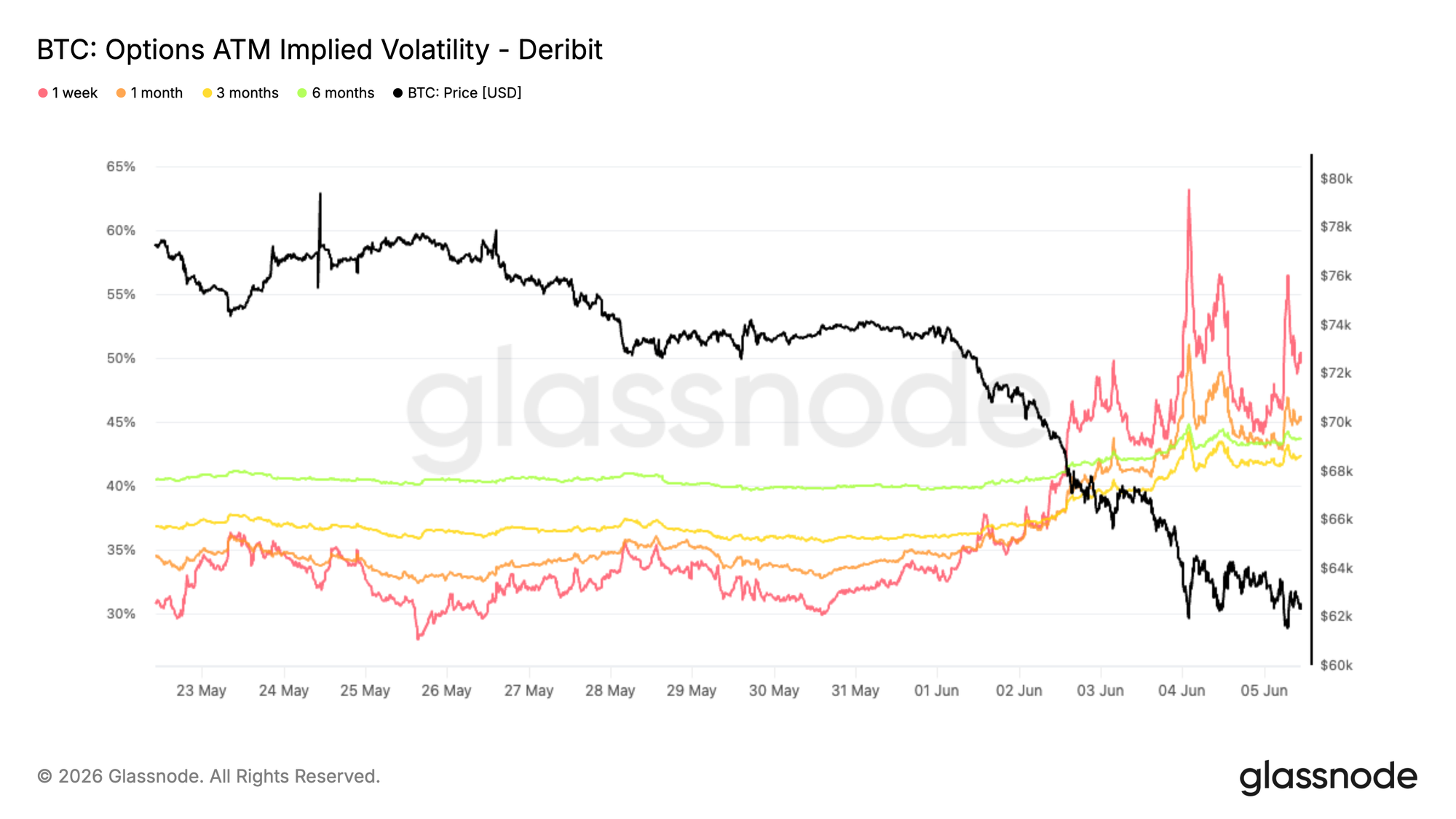
Following Bitcoin's breakdown from its multi-month trading range, the entire volatility surface was repriced. As the spot price approached February lows, demand for options across all tenures increased broadly.
The short-term volatility reacted most sharply. The 1-week at-the-money (ATM) implied volatility briefly spiked above 60% before retreating to around 50%. The 1-month implied volatility rose from approximately 34% to 45%. Longer-dated tenures also increased, with the 6-month implied volatility rising from around 40% to 44%.
This volatility expansion represents a comprehensive reassessment of future uncertainty, not just a short-term sentiment shock. Although volatility has eased from its peaks, demand for options hedging remains strong. Even as the spot price temporarily stabilizes, traders are willing to pay a higher cost for risk protection. This downturn has fundamentally altered market expectations for volatility, pushing hedging costs higher across all tenures and keeping risk aversion elevated.
Volatility Risk Premium Remains Elevated
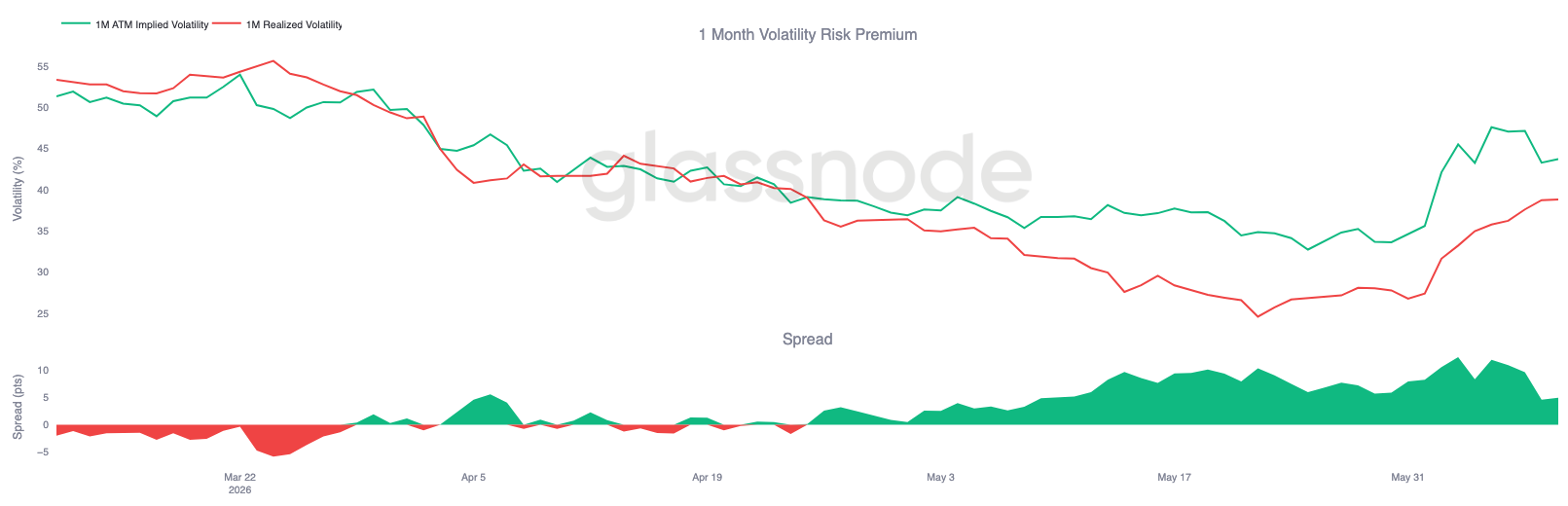
Comparing implied volatility (IV) to realized volatility (RV) after the surge in IV reveals that the options market is still pricing in more future turbulence than the spot market has actually experienced recently.
The 1-month implied volatility rose from around 35% to 44%. During this same decline, realized volatility also increased, from 27% to 39%. While both metrics moved higher, the increase in implied volatility was more aggressive, keeping the volatility risk premium (VRP) positive.
Following the breakdown of a key support level, the market urgently repriced risk, causing the volatility spread (IV minus RV) to widen to as much as 10 volatility points. Although the spread has since narrowed somewhat, options prices remain elevated relative to the volatility justified by actual price movements. This reflects a prevailing market expectation of continued high turbulence.
The uncertainty priced into the options market significantly exceeds the risk implied by recent spot price action, keeping the volatility risk premium persistently high.
25-Delta Volatility Skew Spikes Higher
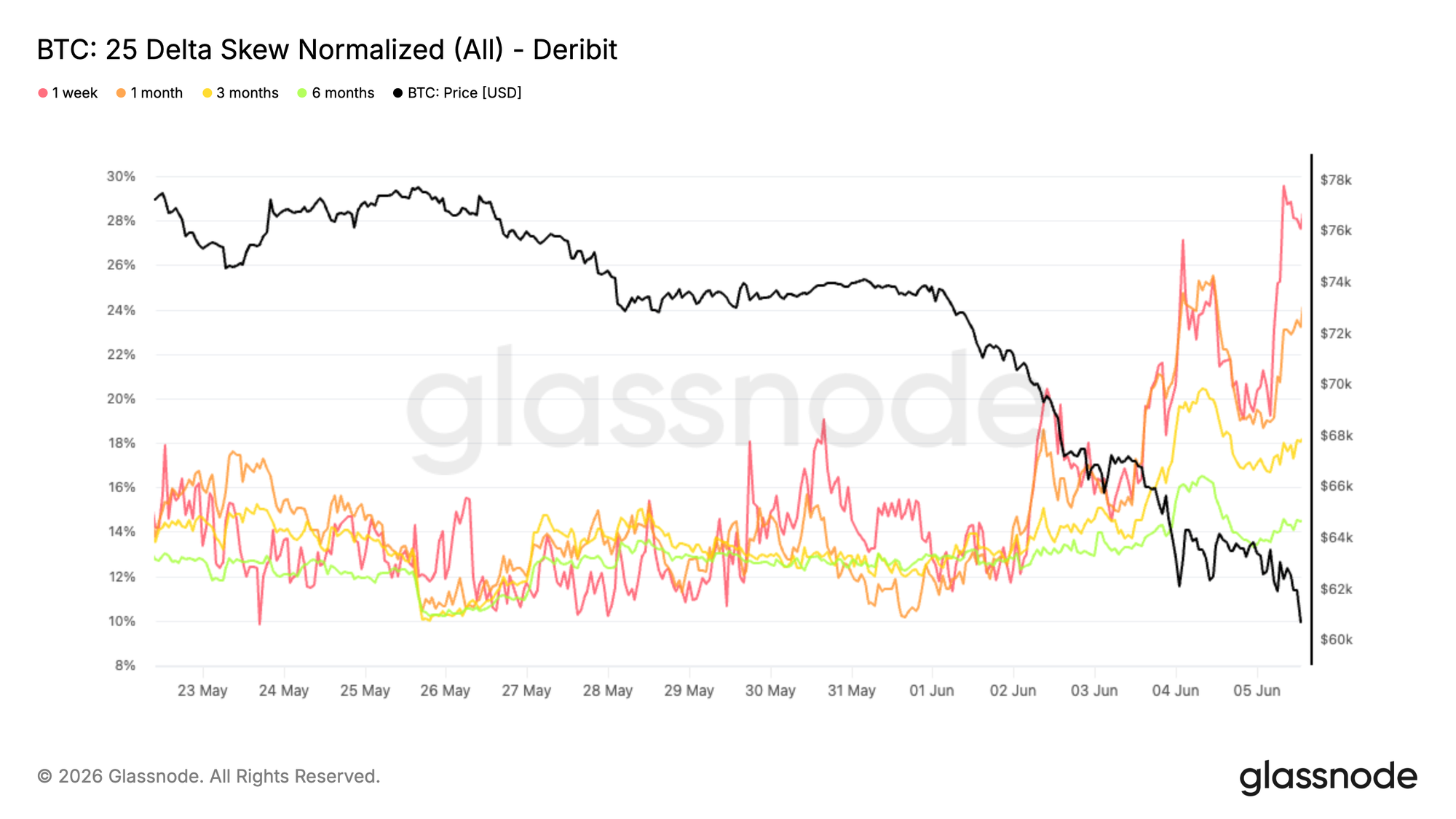
Against the backdrop of a general rise in volatility premiums, the volatility skew metric clearly reveals the directional bias of capital flows. During Bitcoin's breakdown towards February lows, traders aggressively purchased downside protection instruments.
Volatility skew is calculated as put option implied volatility minus call option implied volatility. A positive value indicates that put options are more expensive than equivalent call options. This downturn led to a collective rise in skew across all tenures: 1-month skew rose from around 11% to 24%, while 3-month and 6-month skew climbed to 18% and 14%, respectively.
The short-term tenor reacted most intensely, with 1-week skew briefly approaching 30%. During the decline, demand for short-term downside hedging erupted. If the rise in implied volatility represents broad market risk awareness, then the surge in volatility skew points unequivocally to a single direction: capital flowing into downside hedges.
As market conditions continue to weaken, demand for downside protection has increased significantly, with traders paying consistently higher premiums for put options.
Significant Gamma Exposure Clustered Near $65,000
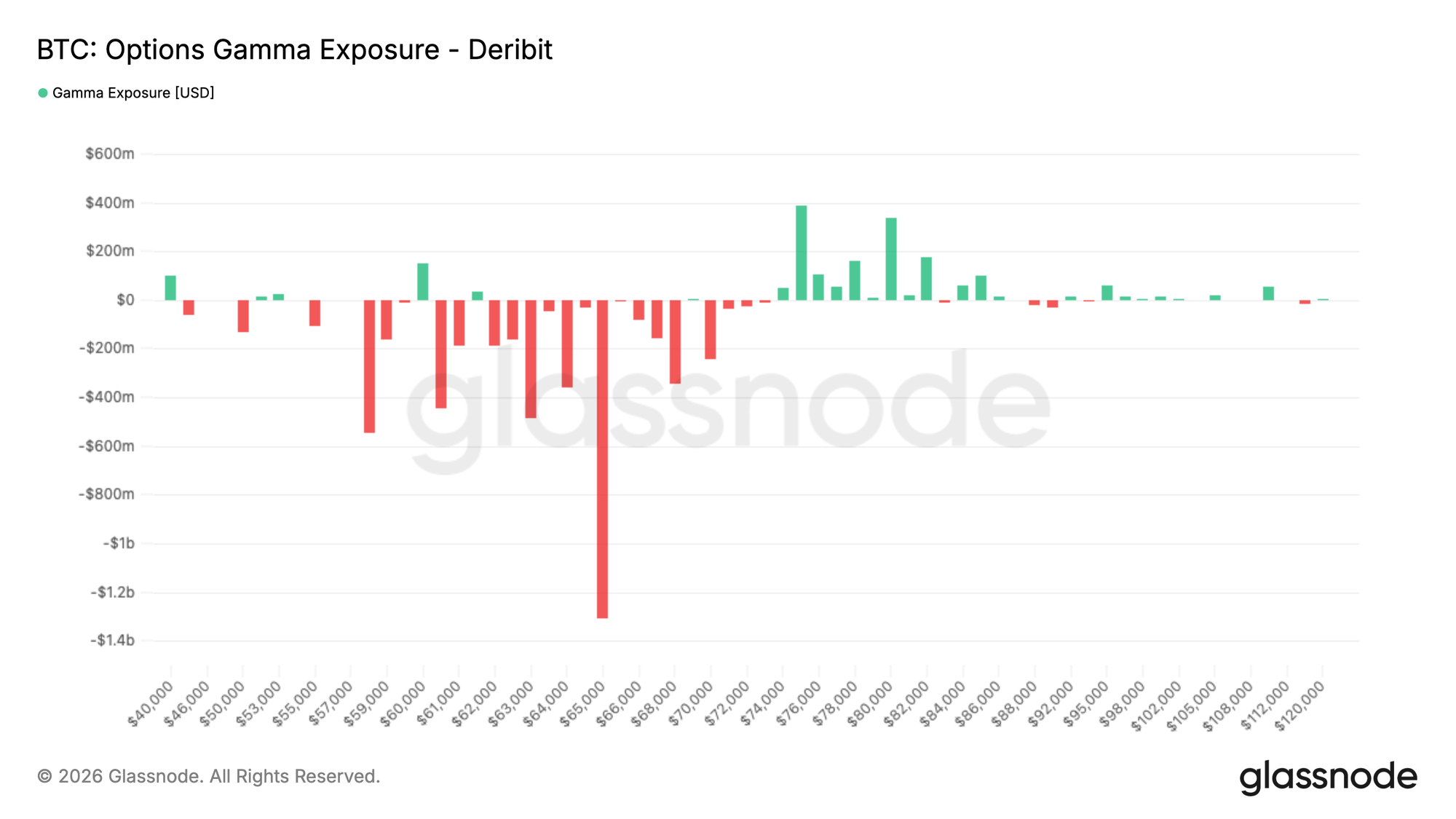
Beyond options pricing, gamma exposure helps identify the strike prices where options market makers' hedging activities will have the most significant impact on price action.
The current market trading style is predominantly defensive. Over the past seven days, put option volume has accounted for 32.4% of total options turnover; in the last 24 hours, this proportion increased further to 35.9%. Even after a significant downturn, market trading remains focused on buying downside protection.
This trading behavior is directly reflected in the gamma exposure profile. Currently, the largest negative gamma exposure is concentrated at the $65,000 strike, with substantial negative gamma also distributed across the $59,000 to $70,000 range. With Bitcoin's current price around $62,000, the spot price sits just below the zone of maximum short-term negative gamma. Positive gamma exposure is mainly concentrated higher up, in the $76,000 to $82,000 range.
Defensive trading dominates market makers' positioning. The market's largest negative gamma zone sits at the $65,000 level, perilously close to the current spot price.
Conclusion
The current market exhibits classic characteristics of a late-stage bear market correction: deeply underwater recent buyers, persistently high levels of realized losses, and the weakening of multiple core buying forces.
Bitcoin's decline towards $60,000 triggered a significant deleveraging event, forcibly clearing out speculative positions. While leverage levels have normalized, the spot market has yet to see any meaningful influx of new buying demand.
The options market maintains a defensive posture, characterized by high implied volatility, strong demand for downside hedges, and key market maker exposures tightly clustered around the current spot price. Coupled with declining institutional participation and diminished corporate treasury accumulation, this paints a picture of persistently low risk appetite.
Aggregating the data, the market appears to be progressively moving towards deeper phases of panic selling. Although market leverage has been largely cleared and valuation metrics have reached historically deep discount zones, the incremental buying demand typically associated with forging a solid bottom in history has not yet appeared.


