






Trading 30 Years of Life for a Trillion-Dollar Valuation: Silicon Valley is Rewarding Recklessness Again


- Core Thesis: Using the extreme work culture of AI insurance startup Corgi's founder, this article critiques Silicon Valley's narrative logic of packaging self-destruction as "mission" and "loyalty" to inflate valuations. It reveals the hidden exploitation of workers (especially the young) and highlights the paradox with the insurance industry's core principle of "acknowledging failure."
- Key Elements:
- Corgi, founded just two years ago, has an annualized revenue of $40 million, covering over 40,000 clients. However, its valuation doubled from $1.3 billion to $2.6 billion in May 2026, with total funding reaching $269 million.
- Founder Nico Laqua sleeps in the office, clocks only 3-4 hours of sleep a day, has developed psoriasis and heart palpitations, and publicly stated that "fixed weekend breaks don't exist," emphasizing that those who want to "do big things" shouldn't have a normal life.
- Two-thirds of the first 30 employees have the company logo tattooed on them. In an interview, he said he would rather live to 50 for the company than 80, citing that "98% of Olympic athletes would trade 10 years of life for a gold medal" as supporting evidence.
- The article argues that this ascetic culture is essentially the "narrative art" of the valuation bubble. By physically embodying vague visions, founders make investors believe, "If someone is willing to sacrifice everything, it can't be a lie."
- Corgi's technological innovations (AI underwriting, claims processing) are real, but the company deliberately chose the story of "not sleeping, not fearing death" to bolster its high valuation, rather than relying solely on the product itself.
- Referencing Camus's myth of Sisyphus, the article posits that Silicon Valley's version of Sisyphus refuses to accept that "the boulder will roll back down." The very essence of the insurance industry, however, is acknowledging the inevitability of failure and preparing for risks in advance.
Original Author: Sleepy
Recently, Silicon Valley has been debating a question: what is the price of a life?
A young man named Nico Laqua, twenty-five years old, grew up in San Diego. His father spent his entire career as a lawyer at the USAA, a military insurance company. Nico grew up watching his father type, fill out forms, and review clauses at his computer, with rooms full of paper.
Then ChatGPT came out. Staring at all that paper, he thought: insurance is arguably one of the industries that deals with text the most in the world. Using ChatGPT to handle it should be a perfect fit.
So, in the summer of 2024, along with Stanford dropout Emily Yuan, he took this idea into Y Combinator. They founded an insurance company named Corgi, complete with a Corgi dog logo.
Corgi is not a middleman. They underwrite their own policies, issue them, and handle claims, holding a full-stack insurance license. To obtain this license, they spent $35 million acquiring a decades-old traditional insurance company, buying the entire entity along with its qualifications.
Corgi officially launched in July 2025. By the end of the year, their annualized recurring revenue had surpassed $40 million, covering over 40,000 startup clients across 49 states, with a customer churn rate of less than 1%. In an industry with razor-thin margins, these numbers are undeniably solid.
But recently, people have been seeing Corgi in the news, and not just for this impressive performance.

At the end of May 2026, Nico appeared on Harry Stebbings' podcast, 20VC. The episode was titled "The Most Extreme Workplace Culture in America."
He lives in his office in San Francisco's Financial District, with a mattress directly on the floor, and uses the Equinox gym down the street for showers. "They close at 8 p.m. on Fridays," he said. "That's not great."
He sleeps three to four hours a night, has developed psoriasis, and experiences heart palpitations. He described these conditions in a very calm tone, as if reading someone else's medical report.
He also complained that the cafes in the Financial District close too early. After 6 or 7 p.m., there's virtually no "nightlife" in the area. So, he took over an old barbershop space in his office building's ground floor, spent less than $100,000 converting it into a 24/7 cafe, ensuring he and his employees always have coffee available during their 24/7 work hours.
Interviews at Corgi are deliberately scheduled on weekends. Nico stated, "If your days off happen to be every Saturday and Sunday, then Corgi has no place for you."
He believes that the office of a high-growth startup should be bustling every day. Employees can take a day off occasionally, but the concept of fixed weekends doesn't exist. "If you can get things done in five days, you can definitely do more in six or seven days. You should be all in."
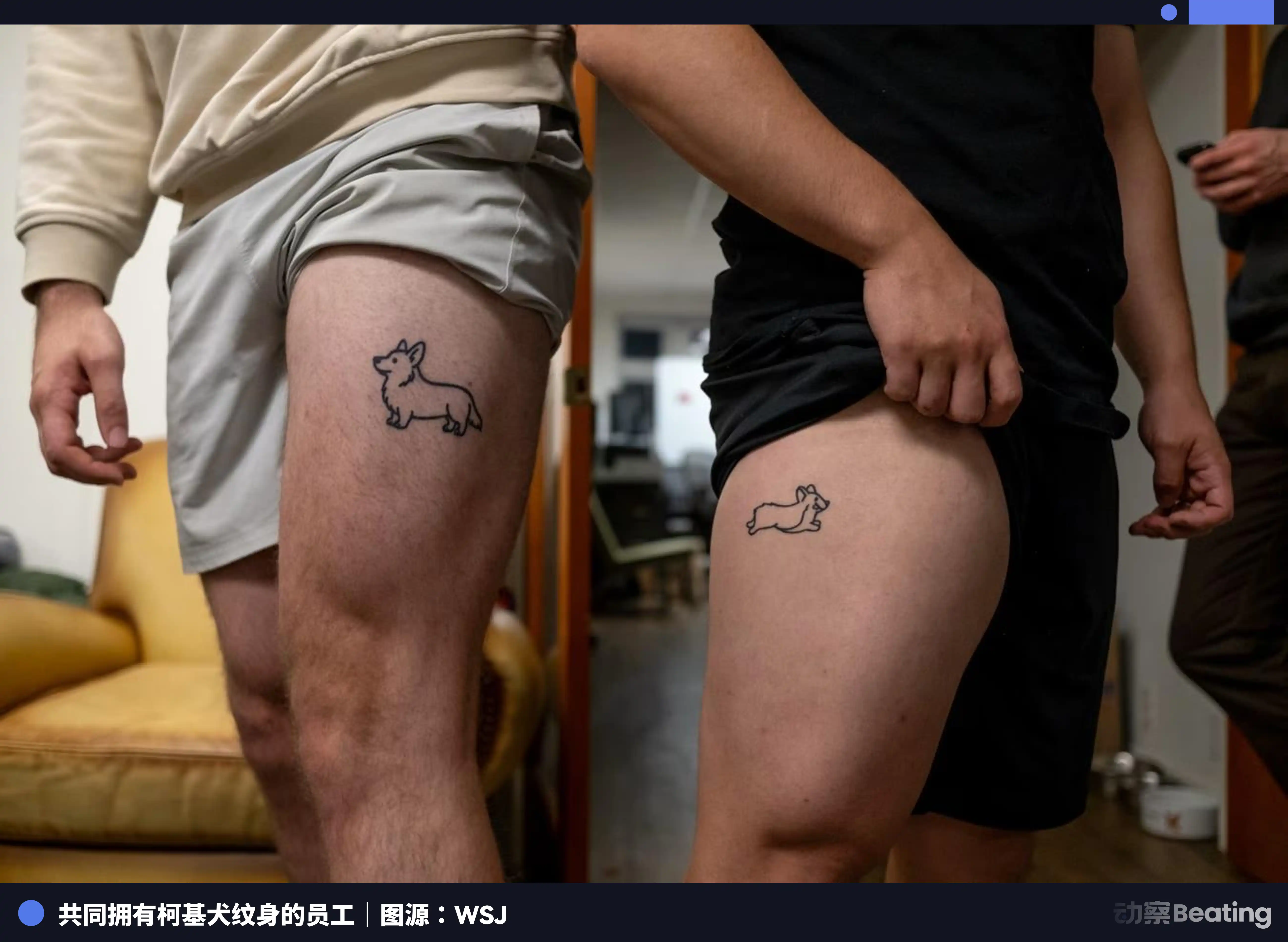
Yet, at such a company, two-thirds of the first 30 employees have the Corgi dog logo tattooed on themselves.
Near the end of the interview, the host asked a hypothetical question: Would Nico prefer Corgi becoming a trillion-dollar company, but he dies at 50? Or the company fails, and he lives to 80? Which would he choose?
"Too easy. I'm going to die eventually anyway." Nico also cited a statistic, saying that 98% of Olympic athletes would trade ten years of their life for a gold medal.
I listened to that part several times and felt something was off.
Not because he chose to die thirty years earlier – that's his choice. What puzzled me was that he found the question easy. A question about putting a price on life, and he answered without hesitation, as if he had already thought it through, or perhaps he never felt there was anything worth pondering.
Someone so decisive about their own life is either truly enlightened or has never really thought about it. From the outside, these two states look exactly the same. But what worries me more is a third possibility: he has thought about it, but the logic itself is flawed, and he is completely unaware.
After the episode aired, he received death threats and countless private messages. Linear founder Karri Saarinen wrote on X that this kind of thinking "often represents young founders who make entrepreneurship their entire identity. They find it hard to do anything outside of work and can't understand that your job is not who you are."
Nico replied: "If you truly care about a problem, you will naturally work your ass off."
He doesn't think he's crazy.
You Will Have Bad Luck
To understand why this situation is so contradictory, we need to talk about the origins of the insurance business.
In 17th-century London, there was an unremarkable coffeehouse on Tower Street by the River Thames, owned by a man named Edward Lloyd. Shipowners, merchants, and brokers crowded inside, drinking coffee and discussing nothing but bad news. This ship might sink, that cargo might be lost; the storm is ruthless and treats every brave sailor equally. Maritime trade was hugely profitable, but also extremely risky. When a ship set sail, no one could guarantee its return.
From their conversations, they invented a trade. You pay a sum, and I take on the risk you can't bear. Lloyd's Coffee House eventually became Lloyd's of London, a global icon in the insurance industry to this day.
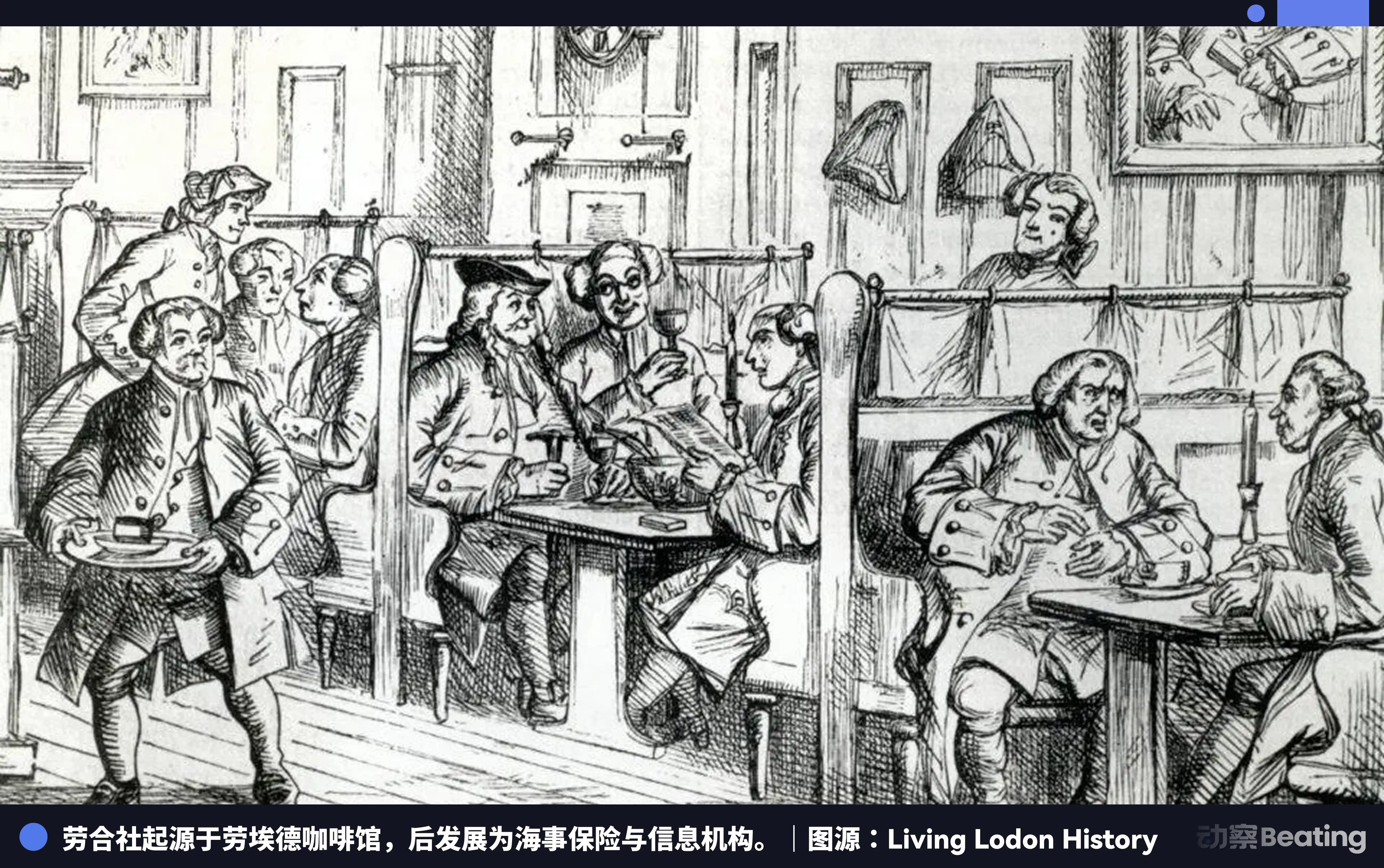
One coffeehouse, over three hundred years. From the moment insurance was born, it has had five words written on its forehead: "You will have bad luck."
This isn't a curse; it's a statement of fact. Houses will burn, people will get sick, cars will crash, businesses will fail, and you will have an accident at the worst possible time.
The Industrial Revolution came, machines took off workers' fingers, and workers' compensation insurance was born. Your product might harm someone, so liability insurance appeared. The economic cycle turns unforgiving, leading to unemployment insurance. Life becomes increasingly complex, so complex that no one can grit their teeth and endure all misfortunes alone.
Insurance never expects people to tough it out alone. It directly assumes you won't make it through and has the money ready in advance.
This is the last industry that should worship someone who doesn't value their life. But Corgi does the opposite. A company selling risk management tries to prove its reliability through its founder's disregard for their own life.
Asceticism is a Valuation Art
But actually, this isn't complicated. Don't think about it spiritually; think about it in terms of valuation.
AI is making companies leaner and lighter. Where before you needed fifty people working for five years before daring to ask for funding, now five people with a demo can get a seat at the table. Corgi has 177 people generating $40 million in annualized revenue. The per-person output is truly astonishing. Their AI system handles the entire process of underwriting, issuing policies, and claims. The efficiency is there, and investors can see it.
But its valuation growth is still too exaggerated. It was valued at $1.3 billion at the beginning of May 2026, then doubled to $2.6 billion by the end of the month – doubling in three weeks. Total funding raised is $269 million. A two-year-old insurance company is now valued higher than many established peers that have been around for decades.
Valuation is something built on "the future," but the "future" here feels weightless. For something without weight to stand, it needs something heavy below it. So, the office mattress is brought out, the lights stay on all night, employees' tattoos are shown off, and Nico's psoriasis and heart palpitations are used in the narrative.
Asceticism has never been just a management technique, or even a work attitude. Asceticism is a narrative art, especially in this era of narrative inflation. Co-working spaces claim to "elevate human consciousness," ride-hailing apps say they are "reshaping the city of the future," and cryptocurrency traders talk about "rebuilding financial freedom."
In the AI era, this inflation has intensified. The technology truly does things previously impossible, which makes the line between hype and reality even blurrier. Asceticism is the best disguise for a bubble. It brings the grandiose vision back down to the body, making you feel it's not just rhetoric from a PowerPoint presentation. If someone is willing to risk their life, it can't all be fake, right?
"I Do"
The greatest talent of startups isn't paying salaries or offering stock options; it's offering identity. It makes a twenty-five-year-old feel they aren't just working a job, but participating in something significant worthy of their life. Nico says he wants to hire people who "want to do something important with their lives."
The words sound beautiful and sincere. But look at the other side. A system that specifically selects people who tie their self-worth to work, replaces normal labor protections with mission and meaning, and defines those who need sleep, weekends, or time to go home and cook for their kids as not being committed enough. Is this system fulfilling young people's dreams, or is it consuming them?
Young people in the AI era fear being left behind by the world. They fear that if you're not moving forward, you fall behind. They fear waking up one day to find themselves relics of a bygone era.
And so, they say those three words: I do.
But behind these three words stands much more than they realize: imaginations of wealth, fear of falling behind, the anxiety this era feeds them. Whether a choice made in the face of these things constitutes free will is something I question.
They reframe burnout as choice, anxiety as ambition, and overwork as passion. Finally, they teach you to say the phrase that costs the company the least to manage. Once said, management costs drop to zero. You are no longer a worker needing protection; you are a willing believer ready to burn bright. The boss doesn't owe you overtime pay; you owe yourself a great future.
This set of rules has another effect: it acts as a filter. It doesn't filter out those lacking ability; it filters out those with a normal life – people who need to pick up their kids, care for elderly parents, have had health scares, want to be in a good relationship, or want to sleep in on weekends.
Those filtered out, of course, won't know these are the reasons. The only feedback they get is that they weren't "all in" enough.
One Must Imagine Sisyphus Happy
Camus ends his essay "The Myth of Sisyphus" with the line: "One must imagine Sisyphus happy."
The gods condemned Sisyphus to roll a boulder up a mountain. Nearing the top, the boulder would crash down. He would descend, start over, for eternity.
Camus says he is happy. Not because the boulder reaches the top, but because he knows it will fall and still pushes it. No end goal, yet he acts. The boulder is his, the mountain is his, the absurdity is his. Limpid consciousness is itself freedom.
Silicon Valley also talks about Sisyphus, but completely unlike Camus' meaning. Silicon Valley's Sisyphuses never accept that the boulder will roll back to the bottom. They believe that this time, with enough effort, the boulder will stay firmly on top. They always say this time is different, always believing this is the time they'll make it.
Camus' Sisyphus possesses his fate; Silicon Valley's Sisyphus is possessed by his fate.
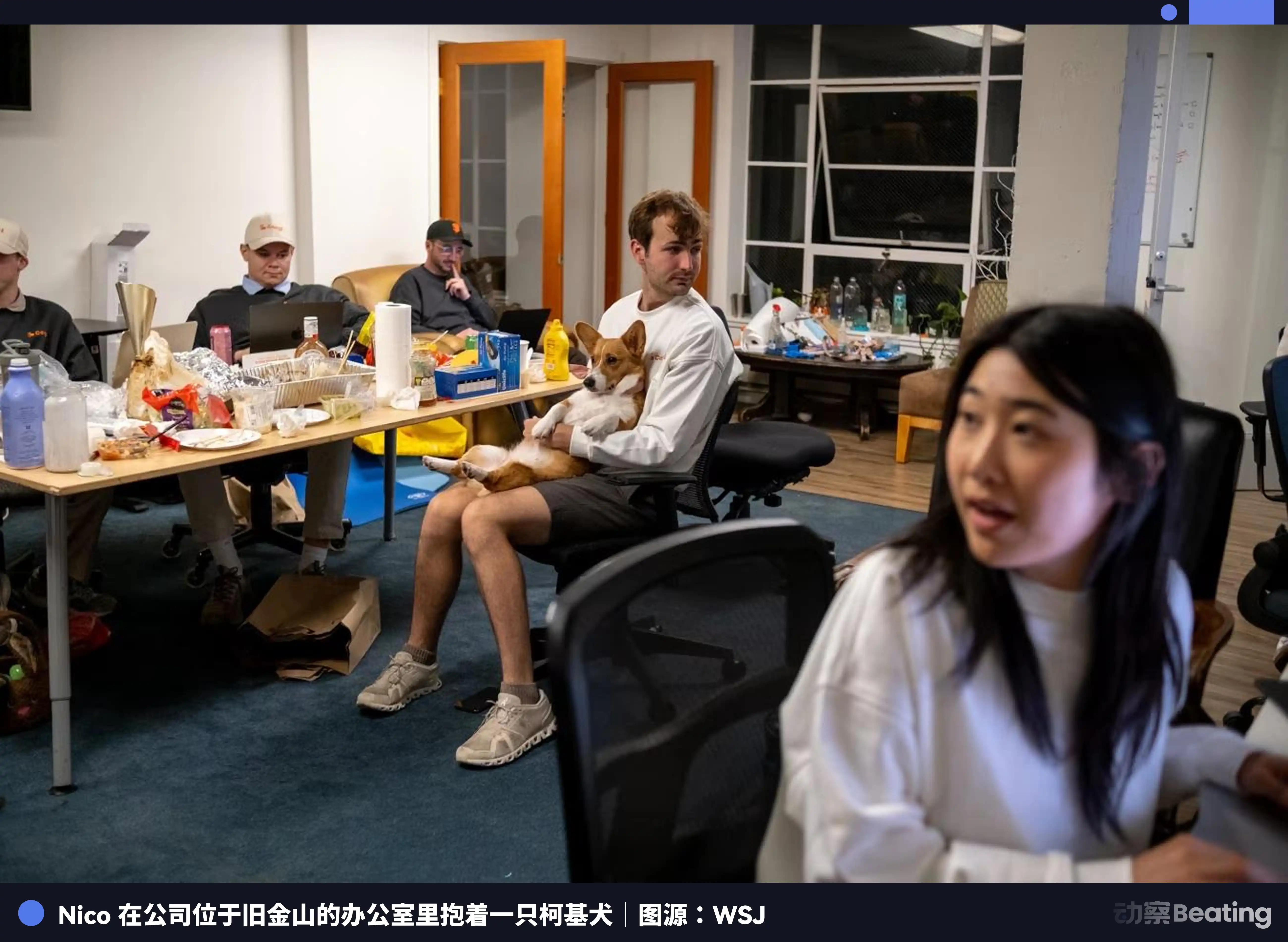
Nico has founder shares. Before 25, he had already started companies, made the Forbes list, and gone through YC. If he fails, he can just tell another story. But those 23 or 24-year-olds who pack their suitcases, move to San Francisco, and sleep on office floors – what can they restart if they fail?
Insurance fundamentally functions by acknowledging that failure is a matter of probability, not a personal fault. It acknowledges that people will break down, have bad luck, and make wrong decisions at the wrong time. It acknowledges that some boulders are destined to roll down the mountain, regardless of how hard you push.
There is a kind of kindness in this understanding. It doesn't ask why you fell, but simply puts a cushion down before you fall. This is a severely underestimated form of kindness.
Corgi's technology is real; its efficiency is real. Issuing policies within 24 hours, handling claims with AI. If they only talked about this, they would be a very good company.
But they insist on telling another story. A story of not sleeping, of not fearing death, of working overtime. Making you believe it's worth $2.6 billion not just because of its product, but because the people here are more willing to risk their lives than others.
One must imagine Sisyphus happy, provided that the boulder is his own.


