Satoshi Nakamoto Sued? $83.7 Billion in BTC Could Be "Legally Claimed"


- Key Takeaway: A plaintiff using the pseudonym Noah Doe has filed a lawsuit in a New York state court, seeking to claim ownership of approximately 3.7 million Bitcoin held across 39,069 dormant Bitcoin addresses (including addresses suspected to be linked to Satoshi Nakamoto), based on New York's lost property law. The essence of the case is to obtain a legal declaration of a "title defect," enabling the plaintiff to challenge custodians within regulated venues, rather than directly acquiring the private keys or transferring the Bitcoin.
- Key Elements:
- The plaintiff leverages Article 7-B of New York's Personal Property Law, treating a USB drive containing the public addresses as found property surrendered to the police. The plaintiff hired experts to value each address at under $10, thus qualifying for the shortest possible procedure where ownership vests one year after the property is found.
- The defendant addresses include approximately 1.096 million Bitcoin from addresses suspected to belong to Satoshi Nakamoto (Patoshi addresses), 79,000 from the Mt. Gox hacker addresses, and about 2.62 million from other dormant addresses, totaling an estimated value of approximately $293.5 billion.
- The risk of the lawsuit lies in the fact that, even if the plaintiff cannot obtain the private keys, a favorable court declaration could serve as a "title defect." If the relevant Bitcoin is transferred to a centralized exchange or custodian, the plaintiff could use this declaration to challenge those entities, leading to asset freezes or ownership disputes.
- Data analysis reveals a 99.7% overlap between the plaintiff's addresses and the 16,404 early addresses that Craig Wright claimed to own in the Kleiman v. Wright case, suggesting the plaintiff may be connected to him.
- The case is riddled with inconsistencies: the lost property law is not applicable to addresses on a public blockchain where the private keys are not physically held; the valuation is clearly inaccurate (each address holds an average of approximately $7.5 million worth of Bitcoin); and the plaintiff's anonymity contradicts their action of trying to force the defendants to reveal their identities.
Original article fromGalaxy
Translated and compiled by Odaily (Golem, @web3_golem)
Who would have thought that Satoshi Nakamoto, the creator of Bitcoin, would one day face a lawsuit, with the "ownership" of wallet addresses potentially being taken away. And you, reading this article right now, could also be one of the "defendants," as long as you have a dormant Bitcoin address.
In March of this year, the New York State Supreme Court accepted a lawsuit: the plaintiff seeks to establish ownership of over 3.7 million Bitcoin (approximately $274 billion) associated with 39,069 Bitcoin addresses. The plaintiffs are pseudonymously named Noah Doe and two unnamed Wyoming limited liability companies (pseudonymously "ABC Company" and "XYZ Company").
The plaintiffs are asking the New York State Supreme Court to confirm their ownership of these dormant assets through a declaratory judgment lawsuit, under New York's lost property law. Most importantly, these 39,069 addresses include those suspected to belong to Bitcoin creator Satoshi Nakamoto (a total of 21,744 addresses, holding approximately 1.09 million Bitcoin, valued at about $83.7 billion at current prices).
In simple terms, an anonymous individual and his Wyoming-registered companies are attempting to get a New York court to rule that Bitcoin belonging to its creator, Satoshi Nakamoto (and many other cryptocurrencies), constitutes lost property, and that they rightfully own it because they "found" these Bitcoins. Galaxy analyzes the plaintiffs' potential motives and identities, the impact on Bitcoin, and the likelihood of the plaintiffs winning.
Odaily has compiled and edited the full article as follows, enjoy~
Case Overview and Breakdown of Plaintiff's Strategy
The plaintiffs have filed a motion with the New York State Supreme Court, requesting the court declare that they own these 39,069 dormant Bitcoin addresses and all assets within them. The legal basis is a declaratory judgment confirming ownership under Article 3001 of the New York Civil Practice Law and Rules, with its fundamental basis in New York's lost property law, Article 7-B of the Personal Property Law. This provision states that a finder of lost property who turns it over to the police, and whose claim is not contested by the owner within the specified waiting period, may eventually acquire ownership of the lost item. The plaintiffs are attempting to apply this old framework to Bitcoin.
The specific strategy is as follows: Noah Doe, as the finder, delivered a USB drive containing the addresses (not private keys or proof of address ownership, merely public addresses) to the 17th Precinct of the New York City Police Department, as a substitute for turning over lost property to the police; subsequently, he initiated an OP_RETURN notification on the Bitcoin blockchain and issued a press release, as a substitute for contacting the owner; finally, he had an expert appraise each address as worth less than $10, placing the entire case under the fastest procedure stipulated by the provision.
It is important to note that even if the plaintiffs win entirely, they would only receive a piece of paper, a court declaration, and nothing more. They would not receive any private keys and would not be able to transfer any Bitcoin.
The real value of a New York judgment lies elsewhere. It would function as a "cloud on title": if any of these Bitcoins ever appear on a regulated platform, the plaintiffs could present this document to contest the exchange or custodian. This is the potential risk posed to Bitcoin holders by this case, and it's precisely why this seemingly absurd lawsuit is still worth careful scrutiny.
Case Timeline
The following timeline includes two parts: one is the factual account of the plaintiff's discovery of the addresses, and the other is the procedural history of the case as it moves through the court.
- October 2024: Noah Doe claims he discovered a "security issue" with certain addresses and developed an "algorithm" to mark abandoned addresses (In reality, these addresses did not have a "security issue");
- December 26, 2024: Noah Doe first "finds" approximately 1,625 addresses. A USB drive containing the addresses is taken to the 17th Precinct of the NYPD on January 1, 2025;
- February 2025: Noah Doe hires Salomon Brothers Strategic Advisors as consultants;
- March 31 and April 14, 2025: Noah Doe "finds" an additional 546 and 39,911 addresses respectively, each time taking a USB drive with the addresses to the police precinct;
- June 30 to July 10, 2025: Noah Doe sends "abandonment notices" to each address via OP_RETURN;
- August 7, 2025: A press release is issued to global media, reported by CoinDesk, Bitcoinist, Yahoo Finance, Investing.com, and a research report by Galaxy Digital;
- August 2025 to February 2026: Salomon Brothers receives threatening emails, including over 50 messages containing only "4 8 15 16 23 42," demanding payment of $1.5 million and 50 Bitcoin;
- October 10, 2025: The 90-day claim period for owners ends;
- December 2025: Noah Doe transfers these addresses to ABC Company and places 98% of his interest into an irrevocable trust; ABC Company transfers 17.7% of its interest to XYZ Company;
- March 11, 2026: Original summons and complaint filed. Judge Arlene P. Bruce annotates the initial order for appearance;
- March 23, 2026: Judge Emily Morales-Minerva recuses herself from the case;
- March 25 to April 17, 2026: Judge Carlos J. Voltron signs orders for appearance (allowing pseudonyms) and orders authorizing alternative service via OP_RETURN (without notice to opposing parties);
- May 1, 2026: First amended complaint expands defendants to 1 through 39,069 and includes the full list of addresses;
- May 21-22, 2026: On-chain execution service: 98 batch transactions in Bitcoin blocks 950,446 to 950,576;
- May 22, 2026: Judge Carlos J. Voltron files affidavits of service, including verification reports for each batch of transactions and verification details for 39,069 addresses (Documents 27-29).
Plaintiff's Legal Basis and Strategy
Article 7-B of the New York Personal Property Law (Sections 251-258) establishes a streamlined procedure for lost property. It provides two different pathways for a finder to acquire ownership, and the plaintiff in this case has invoked both.
- Pathway A: Custody (Sections 252, 253/254, 257(1)). Section 252 requires a person finding a lost item valued at $20 or more to either return it to the owner or deliver it to the police within 10 days. Sections 253(7) and 254 specify the duration police must hold the item based on its value: 3 months for items under $100, 6 months for $100-$500, 1 year for $500-$5,000, and 3 years for items valued at $5,000 or more.
- Pathway B: Shortcut for items under $10 (Section 257(2)). For lost items valued under $10, if the finder "has used reasonable diligence to find the owner and restore it to him, but has been unable to do so," ownership vests in the finder after one year without needing police involvement.
The complaint's unnamed "independent expert" valued each address at "as-is" value of less than $10, arguing the likelihood of recovery is slim. This valuation dictates the procedural progress of the entire case, as it brings each address under the uniform one-year vesting period of Section 257(2). It also shortens Pathway A; police seizure for items under $100 is only three months per Section 254.
Plaintiff's Arguments
The complaint lists several arguments by the plaintiff, each dependent on the validity of the preceding one, forming a chain.
- These addresses are lost property. Addresses are considered property, like a bank account. Under this view, losing a private key does not destroy the property; the contents are merely "lost" and can be claimed by a finder.
- Noah Doe is the finder, and the NYPD's custody meets statutory requirements. Section 252 of Article 7-B requires the finder to deliver the property to the police. Plaintiffs argue that the USB drive with the address information, delivered to the 17th Precinct, satisfies this requirement.
- Ownership has vested in the finder. For items valued under $10, Section 257(2) states that if the finder has used reasonable diligence to find the owner but failed, ownership vests in the finder after one year. The OP_RETURN notifications, press release, and 90-day claim period are considered reasonable diligence.
- These addresses have been abandoned. Noah Doe's "algorithm" identifies addresses held by him that have been inactive for at least five years and untouched during significant price increases. Approximately 424 owners who reacted by moving tokens were removed from the list; the remaining 39,069 non-responding owners became defendants.
- Service via OP_RETURN is legal. As the alleged owners are unknown and unlocatable, the court authorized alternative service under CPLR 308(5), i.e., sending an on-chain notice referencing the complaint to each address.
- Plaintiffs can sue anonymously. Given the known risk of kidnapping for large Bitcoin holders, the plaintiffs were permitted to use pseudonyms in the lawsuit.
Who Are the Owners?
Galaxy analyzed the addresses Noah Doe claims to have "found" using its full Bitcoin node and internal research database.
As of May 25, 2026, the 39,069 "Noah Doe Addresses" held 3,799,629 Bitcoin, valued at approximately $293.5 billion at a price of $77,245 per Bitcoin. This value is not evenly distributed but concentrated in several distinct sets, each telling a different story.
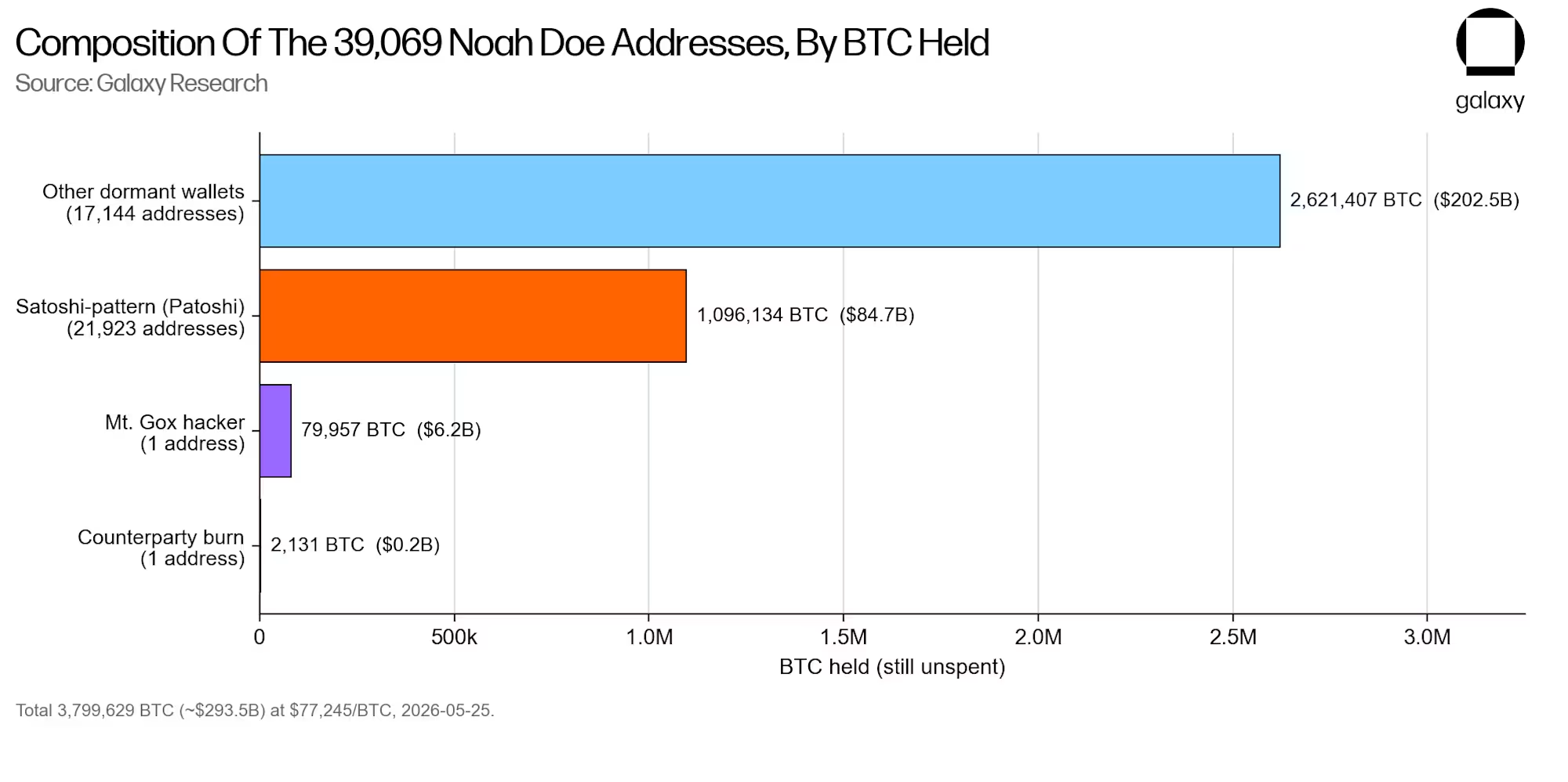
Composition of Noah Doe's Aaddresses
Satoshi (Patoshi) Addresses
Includes 21,923 addresses, holding approximately 1,096,134 Bitcoin (~$84.7 billion). These are early-mined Bitcoins linked to Bitcoin's creator through the "Patoshi" nonce pattern and have never been moved.
Mt. Gox Hacker Address
Just 1 address, holding approximately 79,957 Bitcoin (~$6.2 billion). This is John Doe #1, representing Bitcoins stolen from the early Bitcoin exchange Mt. Gox, untouched since 2011. These are disputed property, tracked by investigators for years.
Counterparty Burn Address
Just 1 address, holding approximately 2,131 Bitcoin (~$160 million). This is John Doe #104, a provably unspendable "burn" address. No one holds its keys because, by design, no such key exists.
Other Dormant Addresses
7,144 addresses, holding approximately 2,621,407 Bitcoin (~$202.5 billion). These address contain a large volume of Bitcoin from early holders and the era of exchanges, unmoved for years.
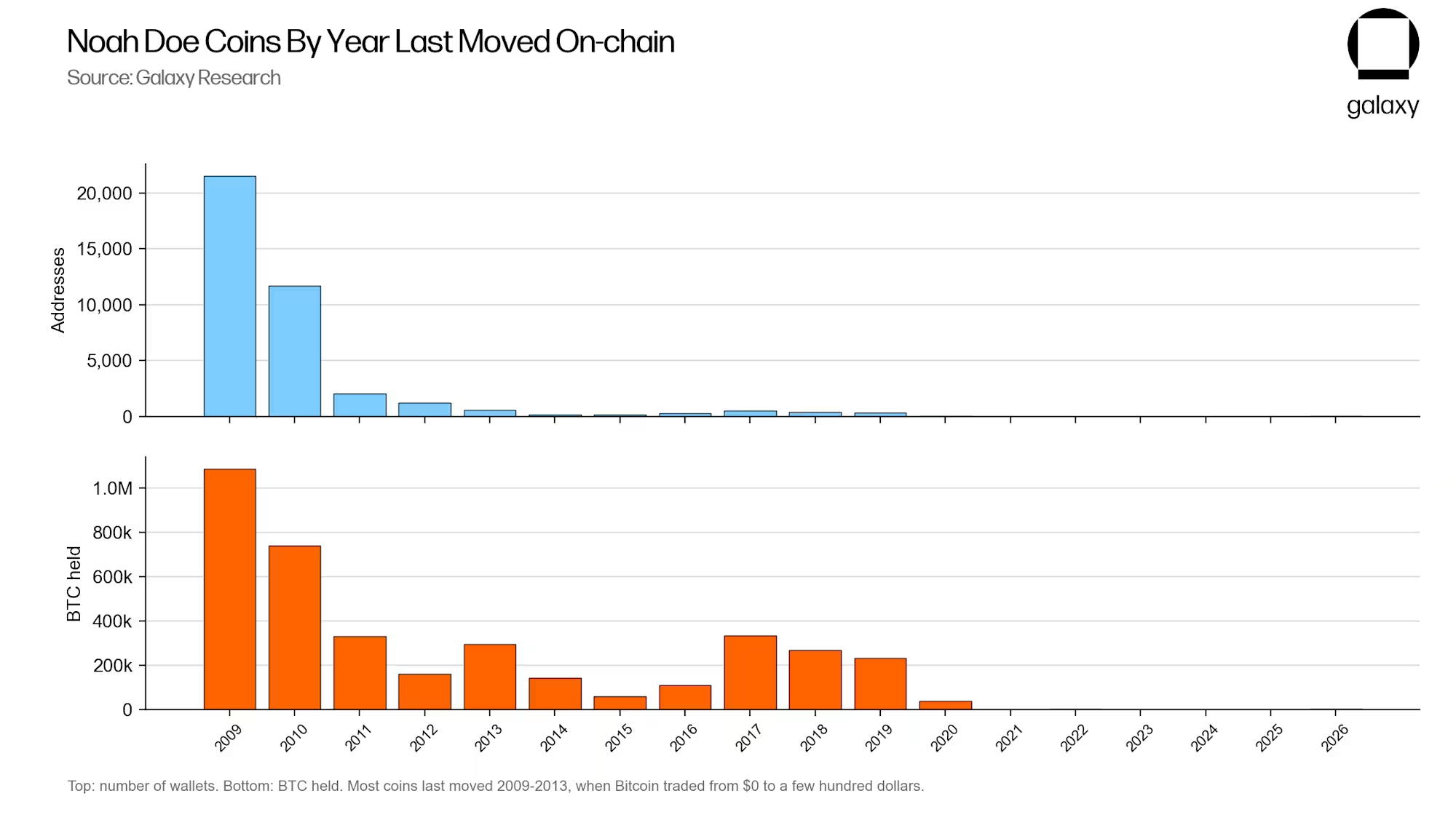
This dormancy has deep roots. If we sort each address by the year of its last on-chain transaction, most Bitcoins have transfer years concentrated in Bitcoin's early days. The vast majority of these Bitcoins had their last transaction between 2009 and 2013, during which time Bitcoin's price soared from nearly zero to hundreds of dollars.
However, many of these addresses have been claimed before. In the case of Kleiman v. Wright (S.D. Fla., 2018), Australian businessman Craig Wright submitted a list of 16,404 early block addresses he claimed belonged to him, as part of his ultimately dismissed claim to be Satoshi Nakamoto.
We compared the Bitcoin addresses Wright claimed ownership of in the Kleiman lawsuit with Noah Doe's addresses to see how much they overlapped.
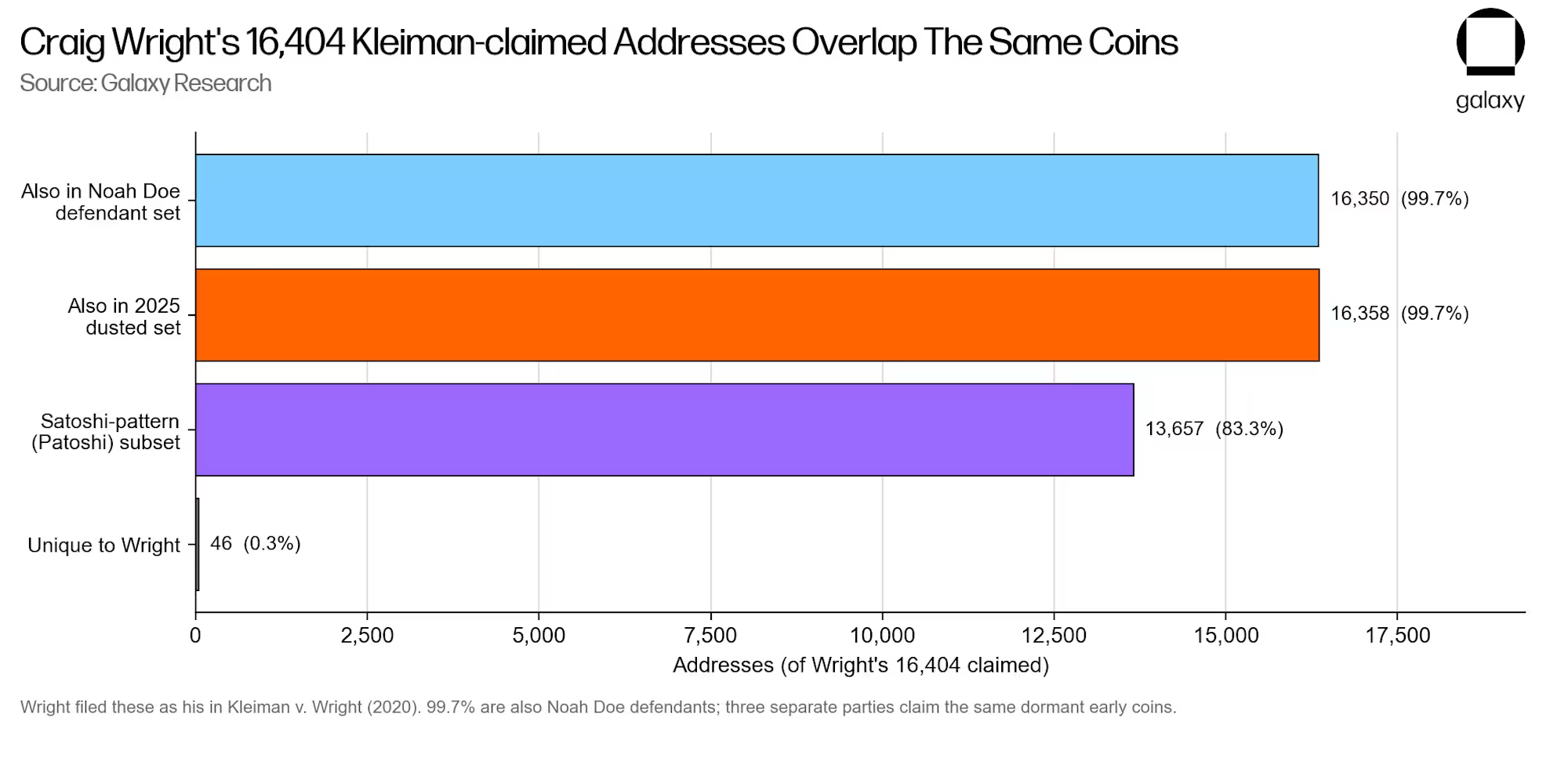
Overlap between Noah Doe and Craig Wright addresses
The overlap is almost perfect: 16,350 of Wright's claimed 16,404 addresses (99.7%) are also claimed by Noah Doe's defendants, holding approximately 817,513 Bitcoin. We cannot determine if Craig Wright is in any way connected to the Noah Doe case, but the overlap is still noteworthy. Craig Wright has tried for years to claim these Bitcoins through litigation but was found in contempt by a UK court in 2024.
Questionable Aspects of the Case
While we are not lawyers, based solely on the court docket and relevant statutes, this case presents many suspicious points.
Does the Lost Property Law Apply?
Before any valuation or service issue arises, there's a more fundamental question: The lost property law is designed for physical objects that a finder picks up, holds, and turns over to the police. Noah Doe never held these coins or keys. He merely looked at public addresses on a ledger, addresses readable by anyone. Looking at a public address is far from holding lost property. Delivering a USB drive with addresses to the police is different from actually handing over the lost item.
The law envisions a finder who can return the item when the owner claims it. Here, the finder never held the coins and cannot give them to anyone, whether to the police acting as custodian or to a claimant owner. The core issue goes far beyond ownership. Losing a private key does not deprive the true owner of any rights. Bitcoin remains on the chain; the true key holder can move them at any time, and hundreds of owners who lost Bitcoin have done exactly that.
Simply put, ownership cannot be effectively transferred to a finder who can never access the asset.
Valuation is Unconvincing
The average holding in Noah Doe's addresses is 97.25 Bitcoin, valued at approximately $7.5 million; the median is 50.00 Bitcoin, worth about $3.86 million. Compared to these numbers, the claim that each address is worth less than $10 is completely untenable and appears to be a tactic to push these assets through the legal process as quickly as possible.
Two additional details further weaken this valuation. The expert who provided the "under $10" figure is not named in the filings. Thus, this single number, which governs the entire timeline, cannot be scrutinized or challenged. If the "as-is recoverable value" logic were applied generally, almost all user-custodied Bitcoin would have a value near zero, contradicting how any user treats their Bitcoin, especially plaintiffs going to such lengths to sue.
Anonymity of the Parties
Noah Doe's use of anonymity in this case is also highly suspicious. He claims anonymity to avoid being targeted as a large holder, yet the very rights he seeks would force the actual holders of those addresses to reveal their identities to defend their cryptocurrency. The plaintiffs seek protection for themselves that they are trying to strip from all defendants.
Even if an individual can present a genuine theory of personal safety, the theory exists to protect natural persons. ABC Company and XYZ Company are shell LLCs. Corporations have no physical form to threaten, no privacy to expose. Therefore, the logic of fearing extortion does not apply to them. Allowing two companies to claim hundreds of billions of dollars in property through shell entities is frankly absurd.
Furthermore, New York does not favor anonymous entities. New York courts rarely allow pseudonyms. Although New York has historically allowed anonymous LLC ownership, the state's LLC Transparency Act now mandates disclosure of beneficial ownership, though federal regulations have narrowed its scope to foreign-formed LLCs.
Future Directions of the Lawsuit
Even setting aside these details, one can see the "audacity" of this lawsuit. The idea that a