






Làm thế nào để định nghĩa "cổ phiếu Mỹ thực sự": Sự khác biệt giữa token on-chain, hợp đồng giá và kết nối trực tiếp với sàn môi giới


- Quan điểm cốt lõi: Ba mô hình chính để mua sản phẩm cổ phiếu Mỹ bằng stablecoin vào năm 2026 (cổ phiếu token hóa, hợp đồng vĩnh viễn cổ phiếu, mô hình kết nối trực tiếp với sàn môi giới) có sự khác biệt hoàn toàn về rủi ro-lợi nhuận, quyền lợi pháp lý và logic nền tảng. Chỉ có mô hình kết nối trực tiếp với sàn môi giới mới thực sự mang lại đầy đủ quyền lợi khi nắm giữ cổ phiếu Mỹ và trong mô hình này, cấu trúc tuân thủ (ví dụ: kết nối với hệ thống thanh toán bù trừ của Mỹ) là chìa khóa để bảo vệ tài sản của người dùng.
- Các yếu tố chính:
- Cổ phiếu Token hóa (ví dụ: Ondo Finance) nắm giữ bản sao kinh tế trên chuỗi, tư cách cổ đông thuộc về bên phát hành, hỗ trợ kết hợp DeFi, nhưng quyền lợi không đầy đủ và cổ tức không được ghi nhận bằng tiền mặt.
- Hợp đồng tương lai cổ phiếu theo dõi giá cả, không liên quan đến quyền sở hữu cổ phiếu, phí tài trợ có thể lên tới hơn 100% mỗi năm, phù hợp cho các ván cược giá ngắn hạn hơn là nắm giữ dài hạn.
- Mô hình kết nối trực tiếp với sàn môi giới (ví dụ: BIT) kết nối với hệ thống thanh toán bù trừ NSCC/DTC thông qua các nhà môi giới được cấp phép, là con đường duy nhất để đạt được quyền sở hữu cổ phiếu thực sự, cổ tức tiền mặt và quyền biểu quyết chính thức.
- Trong mô hình kết nối trực tiếp với sàn môi giới, việc bảo vệ tài sản phụ thuộc vào cấu trúc nền tảng: Lộ trình IB được tiết lộ đầy đủ có sự bảo vệ SIPC rõ ràng nhất, trong khi lộ trình IB tổng hợp thì sự bảo vệ được truyền tải thông qua thỏa thuận khách hàng.
- Sự khác biệt chính còn bao gồm chi phí nắm giữ dài hạn: Mô hình kết nối trực tiếp với sàn môi giới không có phí tài trợ, chỉ bao gồm chi phí giao dịch truyền thống; Cổ phiếu Token hóa có chênh lệch giá mua/bán, Hợp đồng tương lai cổ phiếu có phí tài trợ liên tục.
In 2026, using stablecoins to buy US stocks has become a mainstream trend. However, behind the phrase "buying US stocks with USDT," although various products claim to offer users exposure to the US stock market, they are actually selling entirely different assets. Some products convert US stock economic exposure into on-chain tokens; some launch perpetual contracts tracking US stock prices; and others provide real US stock buying and selling services through licensed brokers. The risk-return characteristics, rights structures, and underlying logic of these three approaches are completely different.
I. Overview of US Stock Trading Platforms
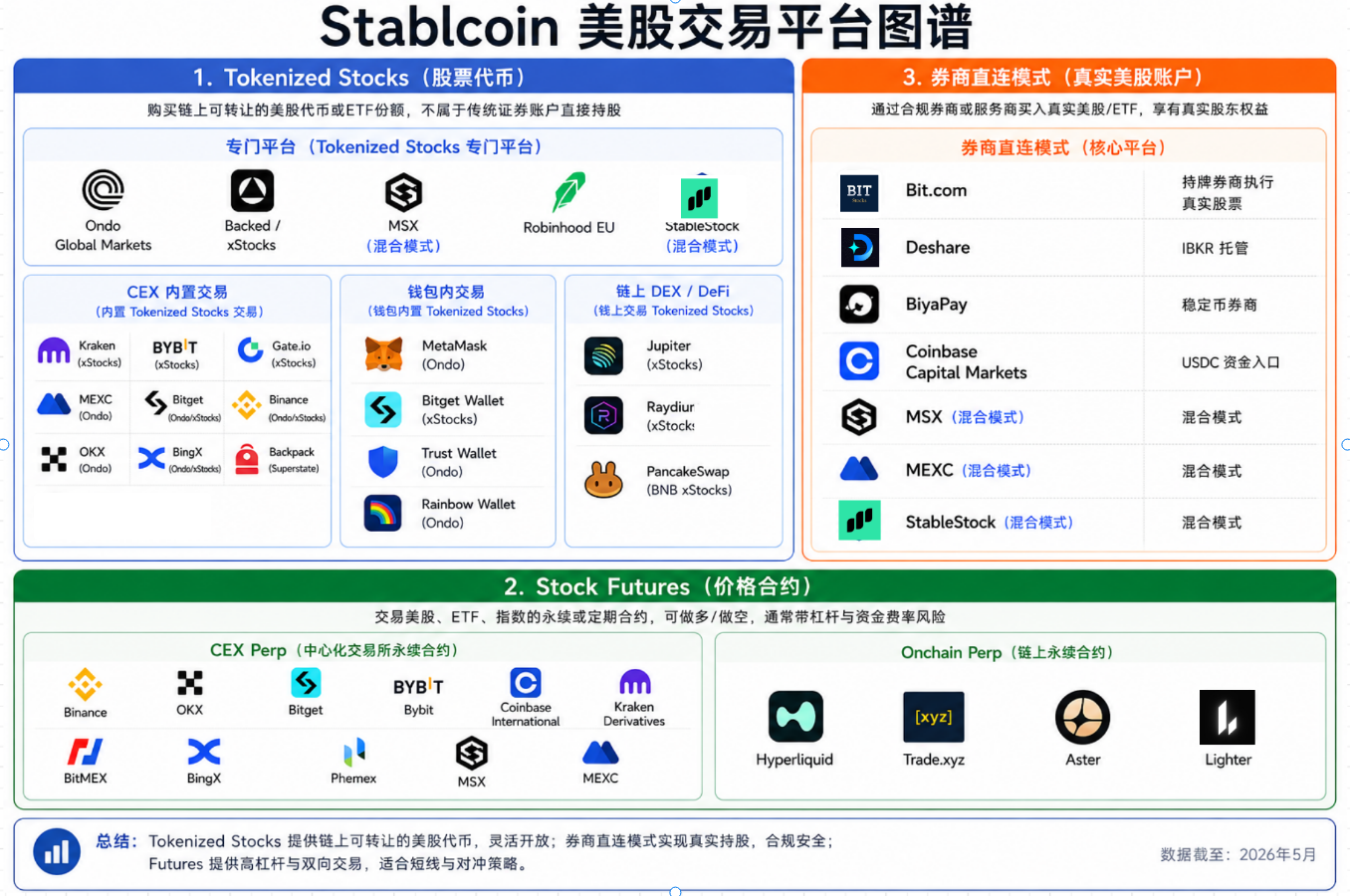
The current mainstream "buy US stocks with USDT" solutions on the market can be clearly categorized into three types: Tokenized Stocks, Stock Futures, and the Brokerage Direct Connection Model.
1. Tokenized Stocks
Tokenized Stocks are typically held by the issuer or its SPV/custodial arrangement. Users hold the economic rights represented by the on-chain token, not the direct shareholder identity in a traditional securities account. The most representative issuer, Ondo Finance, has a TVL exceeding $1 billion, supports over 200 major stocks and ETFs, and the overall market size has reached tens of billions of dollars.
2. Stock Futures
Stock contracts are the most efficient trading tools, but they have the least connection to "holding US stocks"—users are buying a price contract with no legal association to stock ownership.
In 2026, several major trading platforms have launched stock-related perpetuals/CFD products. The number of underlying assets, leverage multiples, and available regions vary significantly (approximately 5x-25x). On-chain platforms represented by Hyperliquid HIP-3 / Trade.xyz are also expanding the traditional asset perpetual contract market, with the core value being to allow global traders to express long or short views on traditional asset prices using stablecoins.
3. Brokerage Direct Connection Model
The operational logic of the Brokerage Direct Connection model is similar to traditional brokers: users execute stock or ETF trades through a Broker-Dealer, and assets are held via the U.S. clearing and custody system. This is the only path among the three models that actually purchases the stock itself. However, it's important to note that significant differences exist among platforms within this model.
Source: Public Information Compilation
II. Comparison of Differences in US Stock Trading Products
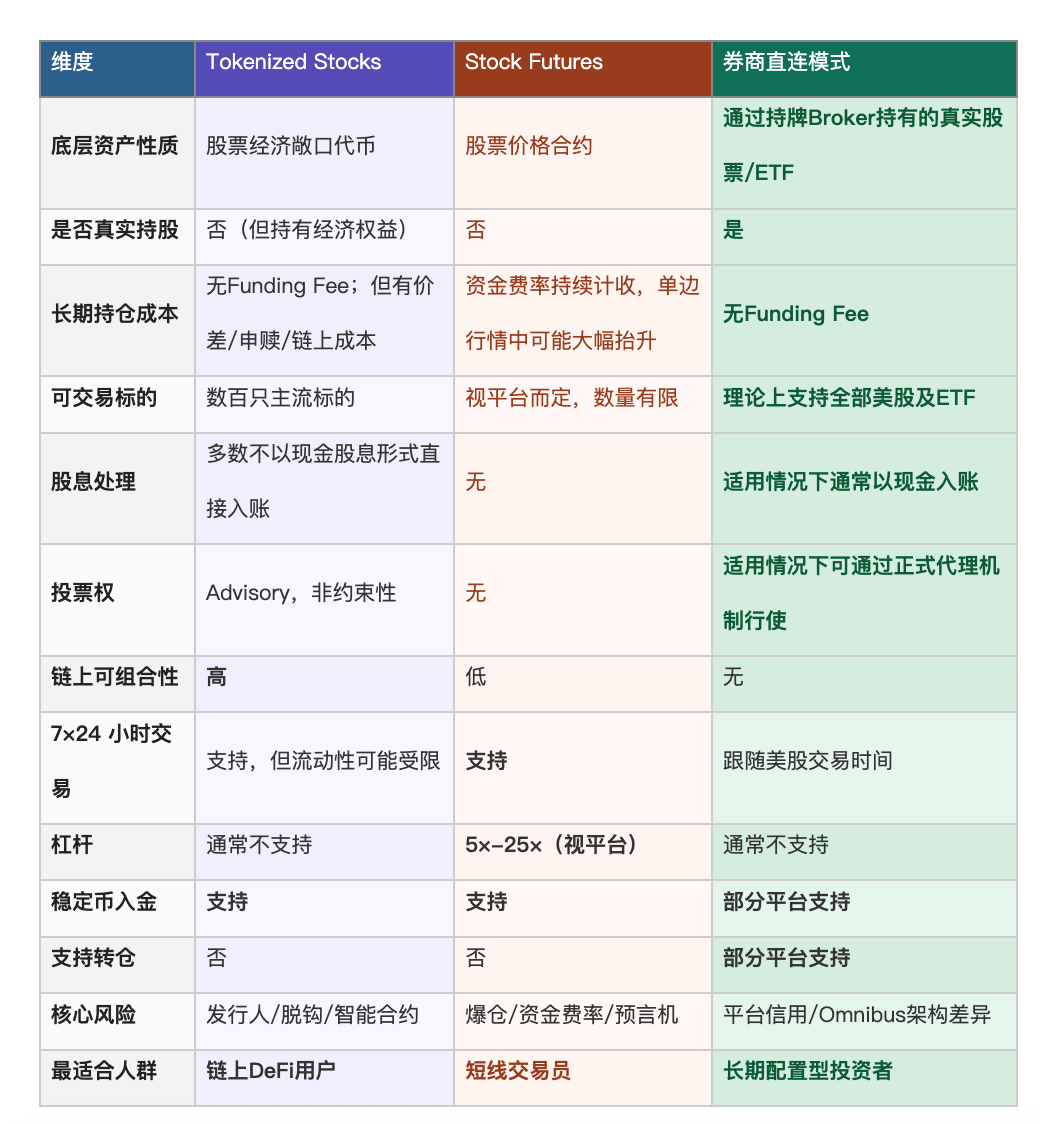
The differences among the three models are not only reflected in the trading experience but also in three core dimensions: legal rights, holding cost structure, and regulatory protection.
Source: Public Information Compilation
(1) Tokenized Stocks
The essence of Tokenized Stocks is a "shadow of the stock on-chain"—convenient and composable, but with incomplete rights; the shareholder identity rests with the issuer.
On-chain composability is the real differentiating advantage of this model: tokens can be used as collateral in DeFi lending protocols to earn additional yield, can be traded 24/7 on-chain, and can be bought in fractional shares—things a traditional securities account cannot do. The limitations are equally clear: the shareholder identity is with the issuer, not the user; dividends on most platforms are not credited directly as cash; and voting rights are advisory in nature and not legally binding. Although there is no Funding Fee, subscription/redemption spreads, on-chain gas fees, and market-making spreads also constitute holding costs.
(2) Stock Futures / Equity Perps
Stock Futures are a "price betting tool" for stocks—efficient, flexible, and available 24/7, but the funding rate erodes holding costs over the long term, and they are unrelated to actually holding the stock.
Stock Futures are the path most familiar to crypto traders—margin, take-profit/stop-loss, and the ability to go long or short. The operational logic is identical to trading BTC perpetuals, just with a different underlying asset, and the market is open 7×24. The core cost is that the funding rate can increase significantly during trending markets, with annualized costs reaching double digits or even exceeding 100%, acting as a slow bleed for a "buy and hold" strategy. Once the contract is closed, there are no shareholder rights, leaving only the USDT profit or loss.
(3) Brokerage Model
The Brokerage Model is the path closest to "buying the stock"—offering the most complete rights and the cleanest long-term holding costs, at the expense of forgoing on-chain composability and 24/7 trading.
The Brokerage Model offers the most complete rights: real stocks, cash dividends credited directly, formal voting rights (where applicable), and coverage of thousands of underlying assets. The main limitations are that trading hours follow the U.S. stock market opening, holdings are not on-chain, and they cannot interact with the DeFi ecosystem. It's important to note that the brokerage architecture differences between platforms directly impact the transmission path of user rights, so it's worth carefully understanding the specific compliance structure before choosing a platform.
III. How to Define "Actually Buying US Stocks"
The characteristics and target groups of the three paths have certain differences. However, for users who wish to conveniently use stablecoins for long-term US stock allocation, the advantages of the Brokerage Model are very direct—every core difference point precisely addresses the most prominent shortcomings of the first two models, including:
Advantage 1: No Funding Fee, Cleanest Long-Term Holding Cost Structure
Real US stock spot holdings do not have the concept of a funding rate. Holding the same underlying asset for over a year incurs no additional funding fee, regardless of market sentiment.
Stock Futures can have annualized holding costs reaching high double digits in strong market conditions; Tokenized Stocks have no Funding Fee but have subscription/redemption spreads and on-chain transaction costs. In comparison, the holding cost structure of real US stock spots is the cleanest among the three.
Advantage 2: Deeper Underlying Asset Coverage, Incomparable by the Other Two Models
The Brokerage Model covers thousands of U.S. listed stocks and ETFs, far exceeding the ~200-260 stocks covered by Tokenized Stocks and the limited set of underlying assets for Stock Futures. For users needing to allocate to mid-cap companies, sector ETFs, or REITs, the Brokerage Model is a more reliable method for stablecoin funding.
Tokenized Stocks and Stock Futures mainly cover popular, top-tier underlying assets, offering almost no choices for allocating to mid-cap companies, sector ETFs, or REITs. In terms of the number of available assets, the Brokerage Model currently has no comparable competitor.
Advantage 3: Real Shareholder Rights – A Difference in Nature, Not Just Degree
When holding real stocks, dividends are typically credited to the account in cash; voting rights (where applicable) can be exercised through formal proxy voting mechanisms (specific rights are subject to account structure and regional restrictions).
Stock Futures have no shareholder attributes; the so-called voting for Tokenized Stocks is merely "expressing preferences to the issuer" and is not legally binding. The Brokerage Model is the only path among the three that provides shareholder rights at the legal level.
Advantage 4: Stablecoin Funding Reduces Reliance on Traditional Banking Channels
Some brokerage agency platforms support USDT/USDC deposits and withdrawals, reducing reliance on traditional USD wire transfer paths. For users without overseas bank accounts, this represents a substantial lowering of the entry barrier.
Traditional Hong Kong and US stock brokers generally require bank wire transfers, which is very troublesome without an overseas account. Supporting stablecoin deposits is currently the biggest practical advantage for platforms that offer this function.
Advantage 5: Transferable Holdings, Open Exit Path
Under the Brokerage Model, if the platform supports standard securities transfer mechanisms like ACATS/DTC, users can directly transfer their positions to other licensed brokers without having to sell and then rebuild the position. This means the exit path is open, and users are not passively locked in due to platform changes.
Tokenized Stocks can only be redeemed for stablecoins; after closing a contract position for Stock Futures, only USDT remains. Neither option offers the possibility of position transfer. The ability to transfer means users are not passively tied to a single platform.
However, the "Brokerage Model" is not monolithic. Platforms that also claim to offer "real US stocks" can have vastly different underlying broker architectures—directly determining where user assets are held, how SIPC protection is transmitted, and whether users can effectively assert their rights if platform issues arise.
While US stock trades appear to be executed on the NYSE or Nasdaq, what truly determines the change in ownership of funds and securities is the clearing and settlement system regulated by the SEC. This system is centered around the DTCC: DTC (Depository Trust Company, holding over $100 trillion in assets under custody) handles the final settlement for almost all US stock trades.
The core mechanism of the system is CCP novation—after any buy or sell order is matched, the NSCC immediately becomes the central counterparty for all trades. This central counterparty mechanism reduces the direct counterparty risk from a broker's bankruptcy. The key is that user assets entering this clearing system share the same underlying infrastructure as clients of large, established brokerages. They are not on any public blockchain, not in a platform's custom accounts, and do not rely on the platform's own balance sheet.
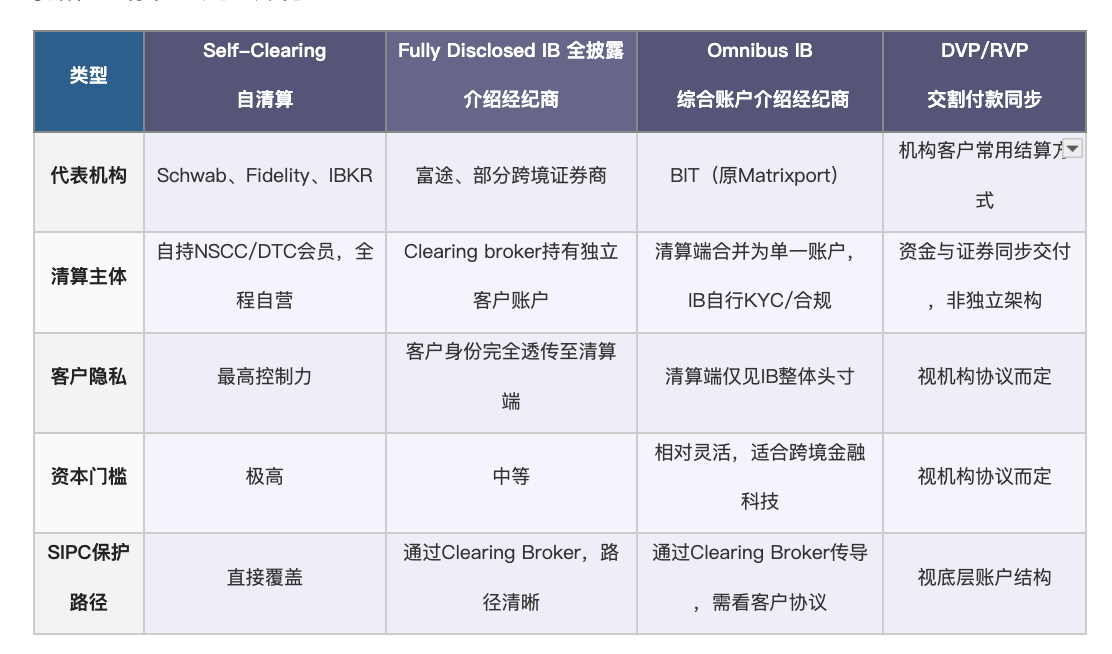
Currently, the industry has four mainstream architectures for accessing the clearing system, with certain differences in capital requirements, customer identity disclosure, and SIPC transmission paths:
Source: Public Information Compilation. Note: DVP/RVP are settlement methods commonly used for institutional clients and are not directly parallel to retail brokerage architectures.
For the user:
- Fully Disclosed IB: Customer identity is fully transparent to the Clearing Broker, providing the clearest SIPC protection path. This is suitable for users who value legal certainty.
- Omnibus IB: The clearer only sees the IB's overall position. SIPC protection is transmitted through the Clearing Broker, with the specific path depending on the client agreement. This is a more common access model for international cross-border securities services.
- Self-Clearing: Directly holds NSCC/DTC membership, offering the most direct protection. However, the capital requirements are extremely high, typically only met by large, established brokers like Schwab, Fidelity, or IBKR.
So, when a platform claims to offer "real US stocks," the truly worthwhile question to ask is: through which architecture does it access the US clearing system, and at which layer are user assets protected?
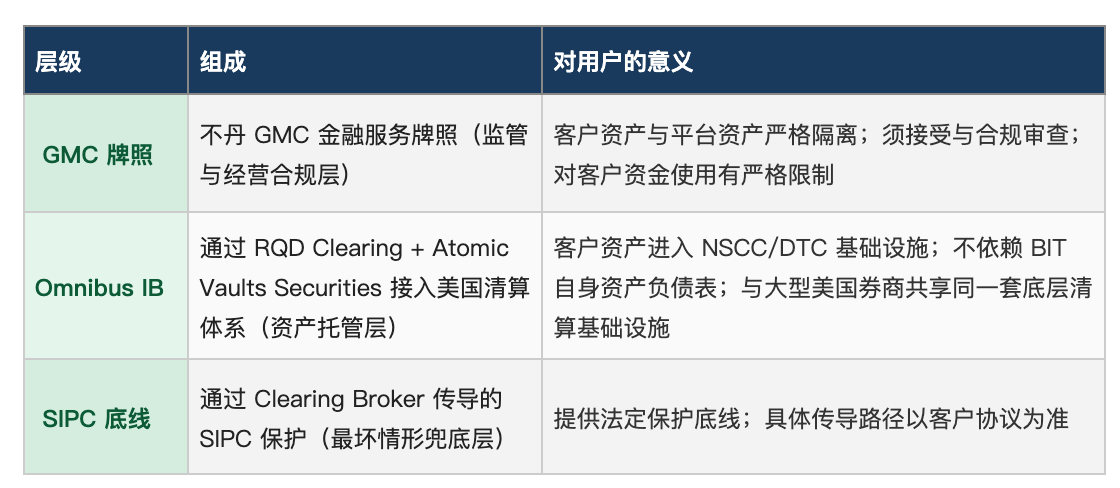
Taking BIT (formerly Matrixport) as an example, its compliance architecture is divided into three layers:
- Layer 1: The GMC License addresses the issue of "whether user assets are segregated." The Bhutan GMC license has strong requirements regarding the segregation of client funds from the platform's own funds, with user funds held by an independent custodian. This means BIT cannot use user stocks for the platform's own financing or positions. This is the first institutional safeguard distinguishing it from non-transparent platforms and a prerequisite for "real holding."
- Layer 2: The Omnibus IB architecture addresses the core question of "where exactly are user assets?" BIT accesses NSCC clearing and DTC custodial services through two U.S. licensed Clearing Brokers. Both institutions can be independently verified on FINRA BrokerCheck. The US stocks users buy through BIT are ultimately deposited with these two institutions, not in BIT's own accounts or internal platform ledgers. The assets share the same U.S. securities clearing and custody infrastructure used by Schwab and Fidelity clients.
- Layer 3: SIPC protection addresses the "worst-case scenario safety net." Because BIT's clearing institutions are SIPC members, this layer of protection can be transmitted to end-users through account structures and client agreements via the Clearing Broker, providing a statutory baseline guarantee (the specific transmission path is subject to the client agreement).
Source: Public Information Compilation
IV. Summary
Buying US stocks with USDT involves three different underlying assets. Tokenized Stocks represent an on-chain economic mirror, with shareholder identity residing with the issuer. Stock Futures track prices and are unrelated to owning the stock. The Brokerage Model is the only path that truly buys the stock itself—offering the most complete rights and the cleanest long-term holding costs. Even within the Brokerage Model, architectural differences determine the actual level of asset protection. Whether the underlying clearing institution and compliance architecture are publicly verifiable is worth carefully checking before choosing a platform.
This article is for educational and informational purposes only and does not constitute investment advice. It should not be interpreted as a recommendation to buy, sell, or hold any security or financial instrument. All investments involve risk. Readers should conduct their own thorough research and consult a licensed financial advisor before making any investment decisions.


