






Perp DEX được thị trường chú ý trở lại: Năm nay, các dự án hàng đầu đang làm gì?


- Quan điểm cốt lõi: Đường đua Perp DEX đã vượt xa sự thay thế đơn thuần cho hợp đồng tương lai trên CEX, đang mở rộng sang các lĩnh vực như stablecoin, RWA, thị trường dự đoán, blockchain riêng và ký quỹ sinh lời, nhằm tranh giành nhu cầu giao dịch tài sản toàn cầu. Trọng tâm cạnh tranh đang chuyển từ tài sản tiền điện tử sang giao dịch tài sản tài chính truyền thống.
- Yếu tố then chốt:
- Hyperliquid mở rộng sang RWA và thị trường dự đoán thông qua HIP-3 và HIP-4. Khối lượng giao dịch 24 giờ của các thị trường hàng đầu (ví dụ: dầu thô) theo HIP-3 gần bằng mức tài sản chủ lực của Binance.
- Aster khởi động blockchain riêng Aster Chain, giới thiệu chế độ giao dịch bí mật Shield Mode, và niêm yết các tài sản tài chính truyền thống như SpaceX Pre-IPO thông qua Permissionless Listing Vote.
- StandX xây dựng sự khác biệt xoay quanh "ký quỹ sinh lời", ra mắt Maker Points để khuyến khích thanh khoản đặt lệnh, Position Yield để nâng cao hiệu quả sử dụng vốn nắm giữ, và Block Trade phục vụ giao dịch khối lượng lớn.
- Lighter khởi động chương trình mua lại LIT và ra mắt Liquidity Partner Program, đầu tư khoảng 250.000 USD mỗi tuần để thưởng cho những người tham gia cung cấp thanh khoản cho thị trường RWA (ví dụ: dầu thô, kim loại quý, cổ phiếu).
- Sau khi nhận đầu tư từ Circle Ventures, edgeX ra mắt bản Beta của Hợp đồng V2, hỗ trợ giao dịch đa dạng tài sản bao gồm tiền điện tử, tài chính truyền thống (ví dụ: vàng, dầu thô) và thị trường dự đoán.
Original author: Changan I Biteye Content Team
This week, Hyperliquid once again became the market's focus.
The HYPE price surged over 40% in a week, reaching an all-time high. Concurrently, other Perp DEX projects such as Aster, Lighter, and edgeX also saw varying degrees of increase, bringing the entire track back into the market's spotlight.
Over the past year, the Perp DEX track has undergone significant changes. They are no longer just on-chain alternatives to CEX perpetuals, nor do they compete solely through trading mining, points, and fee wars. Instead, they are actively expanding into areas like stablecoins, RWA, prediction markets, proprietary chains, revenue buybacks, and yield-bearing margin.
In this article, we will chronologically review the changes in several representative Perp DEXs over the past year, examining their achievements in recent months and their respective strategic focuses.
1️⃣ Hyperliquid: From Trading Platform to On-Chain Financial Infrastructure
Over the past year, Hyperliquid's transformation isn't just about expanding trading volume; its product boundaries have clearly broadened. It has evolved from a platform centered on perpetual swaps to one that simultaneously extends into stablecoins, prediction markets, and an open platform for deploying contracts.
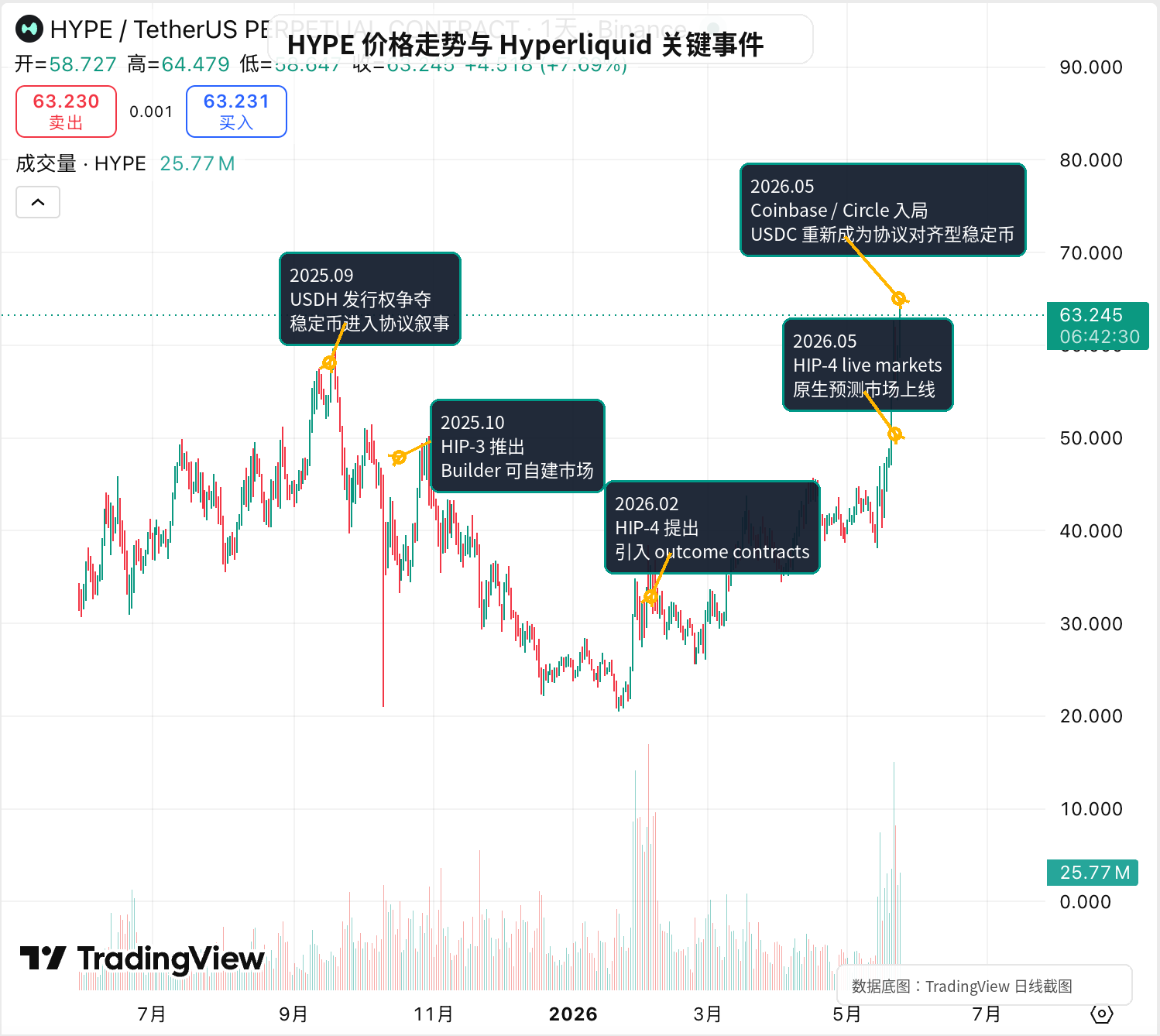
September 2025: USDH Competes to Become Hyperliquid's Settlement Asset
In September 2025, Hyperliquid advanced its native stablecoin, USDH. What makes USDH more unique compared to standard project-issued stablecoins is that it directly competes to become the primary on-ramp for USD liquidity within the Hyperliquid ecosystem.
October 2025: HIP-3 Transitions from Official Listings to Builder-Created Markets
In October 2025, Hyperliquid launched HIP-3. Before this, which assets were listed on Hyperliquid's perpetual markets was primarily decided by the core team. After HIP-3, external Builders can also deploy their own perpetual markets on Hyperliquid.
Now, HIP-3 markets are beginning to cover traditional finance, commodities, stocks, and other asset classes.
- WTI Crude Oil's 24-hour volume is approximately $877 million, with open interest around $209 million;
- Brent Crude Oil's 24-hour volume is approximately $368 million, with OI around $323 million.
If these numbers seem abstract, consider this: the 24-hour trading volume of the top HIP-3 markets is now comparable to the mid-tier mainstream assets ranked 10th to 20th on Binance's volume leaderboard.
May 2026: HIP-4 Goes Live, Hyperliquid Launches Native Prediction Markets
In February 2026, Hyperliquid proposed HIP-4, introducing outcome contracts; it subsequently progressed on the testnet, with the first live outcome markets appearing in early May.
HIP-4 differs from traditional perpetuals as users trade on the price range the underlying asset will fall into at settlement.
Currently, HIP-4 has launched two BTC price prediction markets, including "Will BTC be above a certain price at a specific time" and "Which price range will BTC fall into."
The key difference from Polymarket is that HIP-4 is not a standalone product but is integrated directly into Hyperliquid's account system and matching engine. Users don't need to move funds; they can participate in prediction markets using the same trading account.
Based on current data, HIP-4 is still in its early stages. The top market has a 24-hour volume of about $32,900 and open interest of about $34,900.
For comparison, Polymarket's single-day BTC price prediction market volume is around $433,700. Meanwhile, Hyperliquid's current top HIP-4 market volume is about $32,900, roughly 1/13th of Polymarket's, indicating it is still at a very early stage.
May 2026: Coinbase and Circle Enter, USDC Re-emerges as the Aligned Stablecoin
Also in May 2026, Hyperliquid's stablecoin strategy saw a new development.
Coinbase announced plans to act as a capital deployer to activate AQAv2 on USDC; Circle will serve as the technology deployer, responsible for CCTP and native cross-chain infrastructure. Both Coinbase and Circle have committed to staking HYPE to activate AQAv2. As part of the transitional arrangement, Native Markets has agreed to grant Coinbase the right to purchase the USDH brand assets.
This signifies that the focus of the protocol-aligned stablecoin within the Hyperliquid ecosystem is shifting from USDH to USDC.
With Coinbase acting as a capital deployer, sharing a majority of the reserve yield proceeds with the protocol, USDC will become the stablecoin that better aligns with Hyperliquid's revenue distribution logic.
In future network upgrades, the HIP-4 outcome markets will also use USDC as the quote asset.
2️⃣ Aster: From Volume Explosion to Building Its Own Trading Ecosystem
Unlike Hyperliquid, which spent a year expanding its protocol boundaries, Aster's growth path is more direct: first build volume, then gradually expand products and infrastructure.
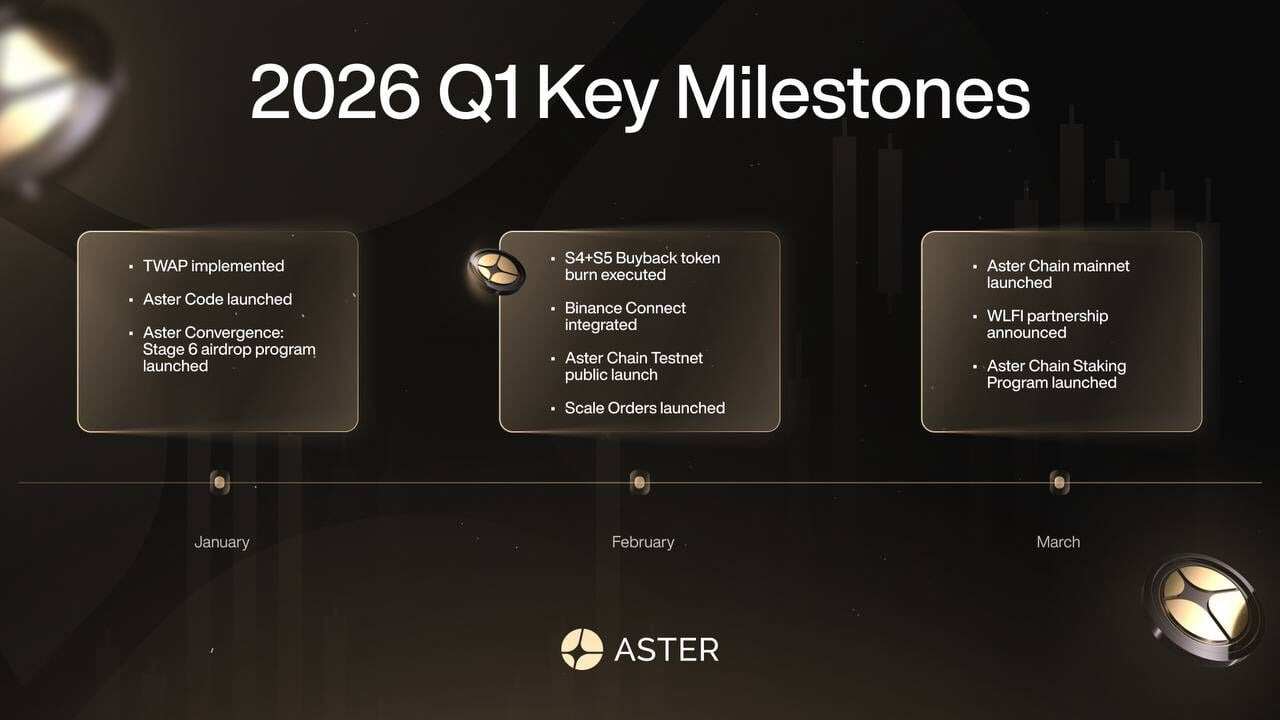
December 2025: Shield Mode Launched
Aster released its H1 2026 Roadmap and began rolling out Shield Mode, TWAP strategy orders, and expanding RWA perpetual markets for stocks, forex, and commodities.
March 2026: Phase 1 of the Aster Chain Mainnet Goes Live, Aster Moves from Perp DEX to Proprietary L1
Focusing on private transactions, it uses ZK proofs and privacy addresses to conceal some transaction information, while emphasizing low latency, high throughput, and a zero-gas user experience.
Aster doesn't just want to be a Perp DEX deployed on multiple chains; it aims to integrate matching, privacy, RWA assets, trading incentives, and future governance into its own on-chain system.
May 2026: Continued Listing of Global Hot Assets and Permissionless Listing Vote
Aster continues to expand its tradable assets. It has started incorporating more stock, Pre-IPO, commodity, and forex markets into its trading system, such as the SpaceX Pre-IPO perpetual contract.
Simultaneously, Aster launched the Permissionless Listing Vote. This mechanism essentially opens up part of the listing authority to the community: eligible validators or ASTER stakers can propose new trading pairs, and the community votes to determine if they go live.
This is somewhat similar to Hyperliquid's HIP-3, both shifting from "the platform decides what to list" to "external participants jointly promote new markets."
Based on current data, some traditional finance-related markets are beginning to show trading activity. For instance,
- Crude Oil (CLU) 24h volume is approximately $8.37 million,
- Silver (XAG) is about $7.48 million, Gold (XAU) is about $3.3 million;
- In the Pre-IPO market, SpaceX contracts have a 24-hour volume of about $1.5 million.
3️⃣ StandX: Turning Perp Margin into Yield-Bearing Assets
Most Perp DEXs compete primarily on matching, leverage, and trading fees. StandX takes a more interesting approach: it attempts to turn otherwise idle or sunk capital during the trading process back into yield-generating assets.
January 2026: StandX Launches Maker Points.
It rewards not the execution itself, but order book liquidity provision. Users earn Maker Points simply by placing limit orders, even if they haven't been filled. Once an order is filled, users further earn Trading Points.
In other words, StandX first turns passive liquidity in the orderbook into an incentivizable asset.
March-April: StandX Consecutively Launches SIP-1 through SIP-4
The product direction becomes clearer: building a Perp trading layer with higher capital efficiency, centered around DUSD, position yields, and large trade execution.
- SIP-1: Block Trade. It separates large derivative trades from the public order book, supporting on-chain matching and StandX settlement to reduce the impact of large orders on the orderbook.
- SIP-2: Position Yield allows eligible perpetual positions to participate in yield distribution.
- SIP-3 further enhances the native yield of DUSD by directing a portion of StandX Perps trading fees to the DUSD yield pool.
- The latest SIP-4 extends Block Trade to TP/SL scenarios. It's not just adding a simple take-profit/stop-loss button; it turns TP/SL into a position-linked execution right, allowing users more flexible arrangements regarding future exit prices, protection prices, and reservation fees.
Looking at the whole picture, StandX's product narrative is quite coherent: DUSD addresses margin yield, Maker Points incentivize order book liquidity, Position Yield improves position capital efficiency, and Block Trade and TP/SL cater to larger, more professional trading needs.
This makes StandX resemble less of a pure Perp DEX and more of a trading system built around "yield-bearing margin." Its differentiation lies not in offering higher leverage but in minimizing idle capital for users before, during, and after trades.
4️⃣ Lighter: Since 2026, Shifted from Airdrop Expectations to Revenue Buybacks, RWA, and ZK Security Narratives
January 2026: Initiates LIT Buyback, Tying Protocol Revenue to the Token
In January 2026, Lighter initiated its LIT buyback program. Unlike many projects that keep revenue in the treasury, Lighter stated it would use fees generated from the DEX and future products to buy back LIT on-chain.
Early reports indicated that at the program's launch, the protocol treasury already held approximately $1.35 million USDC earmarked for market buybacks; subsequent buybacks have been executed multiple times since.
February 2026: Upgrades LLP, Tailoring Liquidity Strategies for RWA
In February 2026, Lighter revamped its Liquidity Provider infrastructure, introducing independent strategies for different market types, including crypto perpetuals, forex, and RWA markets. The goal was to manage the risk, liquidation, and ADL of different assets separately, rather than having all markets share a single liquidity pool.
This step laid the groundwork for subsequent RWA expansion. Since the volatility, trading hours, and liquidity structures of commodities, stocks, and forex differ from crypto assets, a single pool would be inadequate for handling all the risks at scale.
April 2026: Launches Liquidity Partner Program, Focused on Deepening RWA Liquidity
In April 2026, Lighter launched the Liquidity Partner Program, rewarding participants who provide deep liquidity to RWA markets. The program is open to everyone, with rewards distributed via random snapshots of the order book. The weekly reward amount is announced in advance.
The program allocates approximately $250,000 weekly, primarily targeting crude oil, precious metals, and stock markets such as NVDA and Tesla.
5️⃣ edgeX: Since 2026, Moving from Pre-TGE Incentives to EDGE Chain and TradFi Perps
February 2026: Circle Ventures Investment, USDC Native Integration Becomes Key
In February 2026, Circle Ventures invested in edgeX.
With Circle Ventures on board, edgeX can now better utilize USDC for margin, settlement, cross-chain operations, and institutional liquidity access, further smoothing its path toward TradFi Perps.
March 2026: EDGE TGE, Tokenomics Officially Implemented
In March 2026, edgeX first announced the EDGE airdrop terms and opened pre-market trading. The official EDGE TGE was subsequently set for March 31.
April-May 2026: TradFi Perps Expansion, edgeX Bolsters Stock and Commodity Markets
Post-TGE, edgeX continued expanding its TradFi Perps. The platform added numerous stock, commodity, and bulk market products, including assets like NVDA, TSLA, AAPL, Gold, Silver, and Crude Oil.
This step is similar to Hyperliquid's HIP-3 and Aster's RWA expansion, all aiming to extend Perp DEXs from crypto asset trading to traditional financial asset trading.
Based on current trading data, some TradFi markets are beginning to show liquidity. For example:
- Gold (XAUUSDC) 24h volume is approximately $9.49 million
- Crude Oil (BZUSDC) is about $5.89 million
May 2026: Contract V2 Beta Goes Live, edgeX Shifts from Single Perp DEX to EDGE Stack
In May 2026, edgeX opened the V2 Beta for its contracts.
Simply put: V1 was edgeX's earlier trading system, primarily used to get contract trading up and running. V2 is the next-generation system, designed to allow the platform to support more markets, faster matching, and more complex trading products.
This upgrade enables support for perpetuals, spot trading, prediction markets, and traditional financial assets like stocks, ETFs, Gold, and Crude Oil.
V2 is currently in Beta, but the platform already hosts numerous new markets, such as stock and commodity perpetuals.
Final Thoughts
Looking back over the past year, the changes in Perp DEXs are quite clear: they are no longer content with being just on-chain perpetual exchanges.
While they have chosen different paths, the underlying judgment is similar: Perp DEXs cannot remain confined to the crypto perpetual market.
Since the start of the year, strong performance in US stocks, AI-related assets, and traditional financial markets has continuously attracted capital. For on-chain trading platforms, user demand is no longer just trading BTC, ETH, and altcoins. Users want to trade crypto, US stocks, indices, gold, crude oil, and even Pre-IPO assets within a single account.
Therefore, Perp DEXs are competing not just for the crypto perpetual market, but for the much larger demand for global asset trading. This is precisely why, over the past year, several leading Perp DEXs have been aggressively targeting TradFi assets.
The surge in HYPE simply brought Perp DEXs back into the market's spotlight. The truly deeper change is this: the competition among Perp DEXs has evolved from being mere substitutes for CEXs to a race of "who can capture more global asset trading demand."


