






泡沫褪去,谁在统治 AI 时代的注意力?2026 中英 AI KOL 影响力图鉴


- Quan điểm cốt lõi: Trong kỷ nguyên AI, thông tin phổ thông mất giá nhanh chóng, tài nguyên khan hiếm thực sự là "lòng tin" và "năng lực sản xuất có thể kiểm chứng". AI KOL đang chuyển đổi từ người phân phối thông tin thành người hỗ trợ năng suất, giá trị của họ được neo vào năng lực thực hành có thể tái tạo và kết quả xác minh được công bố liên tục.
- Yếu tố then chốt:
- Sự đảo chiều của dòng chảy chú ý: Nhu cầu người dùng chuyển từ "chuyện gì đã xảy ra" sang "có quan trọng không" và "sử dụng thế nào", nội dung thực hành và đánh giá được ưa chuộng hơn. AI KOL thông qua cách xây dựng công khai (Build in Public), biến công nghệ thành các tình huống ứng dụng để xây dựng lòng tin.
- Phân hóa thế hệ KOL: Khu vực tiếng Anh chủ yếu là các chuyên gia kỳ cựu đăng ký năm 2007-2015 (chiếm 62,9%), thiên về nguồn gốc công nghệ và câu chuyện vĩ mô; Khu vực Trung Quốc, các tài khoản mới (đăng ký 2022-2023) chiếm 13%, thiên về ứng dụng thực tế và hướng dẫn thực hành, kết nối cộng đồng chặt chẽ hơn.
- Sở thích sử dụng mô hình lớn: Claude và GPT là "át chủ bài" song ngữ, nhưng tại khu vực Trung Quốc, tỷ lệ đề cập đến công cụ lập trình AI (như Codex) lên tới 80,9%, thể hiện sự cuồng nhiệt với quy trình làm việc thực tế. Các mô hình nội địa DeepSeek (68,1%) và Kimi (58,5%) có sức thâm nhập mạnh mẽ.
- Sự khác biệt về radar năng lực: KOL tiếng Anh tập trung vào đa phương thức (88,3 điểm), mô hình nền tảng và các hiểu biết công nghệ; KOL Trung Quốc dẫn đầu về lập trình AI (88,9 điểm) và tác tử thông minh (87,1 điểm), thiên về năng lực thực hành full-stack ứng dụng.
- Bản chất kiếm tiền khác biệt: Không giống Web3 KOL phụ thuộc vào tin tức và hiệu ứng tài sản, tài sản cốt lõi của AI KOL là "lòng tin" và "phương pháp", thông qua việc phân phối năng lực sản xuất có thể kiểm chứng để kết tụ hệ sinh thái.
Original Author: Alan, Amelia | Biteye Content Team; Denise | XHunt Operations Team
In the summer of 2026, information feeds on social platforms refresh in milliseconds. One second, a major language model releases an update; the next second, tens of thousands of "in-depth interpretations" flood the internet.
An independent developer told us that waking up now, the first thing he does isn't scrolling through his timeline, but quickly scanning a few familiar avatars to see what new Vibe Coding experiments they created the night before.
"I only trust those who have actually done it," he said.
This seemingly paranoid trust points to a truth most people overlook:
In today's era of rapid large model advancement, general information itself is rapidly depreciating.
Traditional tech media accounts that relied on reposting news flashes, translating overseas announcements, or simply stitching together news articles are gradually losing user patience. The truly scarce resource is no longer "who said what first," but "who can tell me if this is actually reliable, and how I should use it."
To uncover the real operational logic of this hidden circle, we leveraged the exclusive data and capability models of the social analytics tool @xhunt_ai to conduct an in-depth analysis of tens of thousands of tweets from nearly 400 top-tier AI KOLs in both the Chinese and English ecosystems.
We found that opinion leaders in the AI era are undergoing a profound transformation from "information intermediaries" to "productivity enablers."
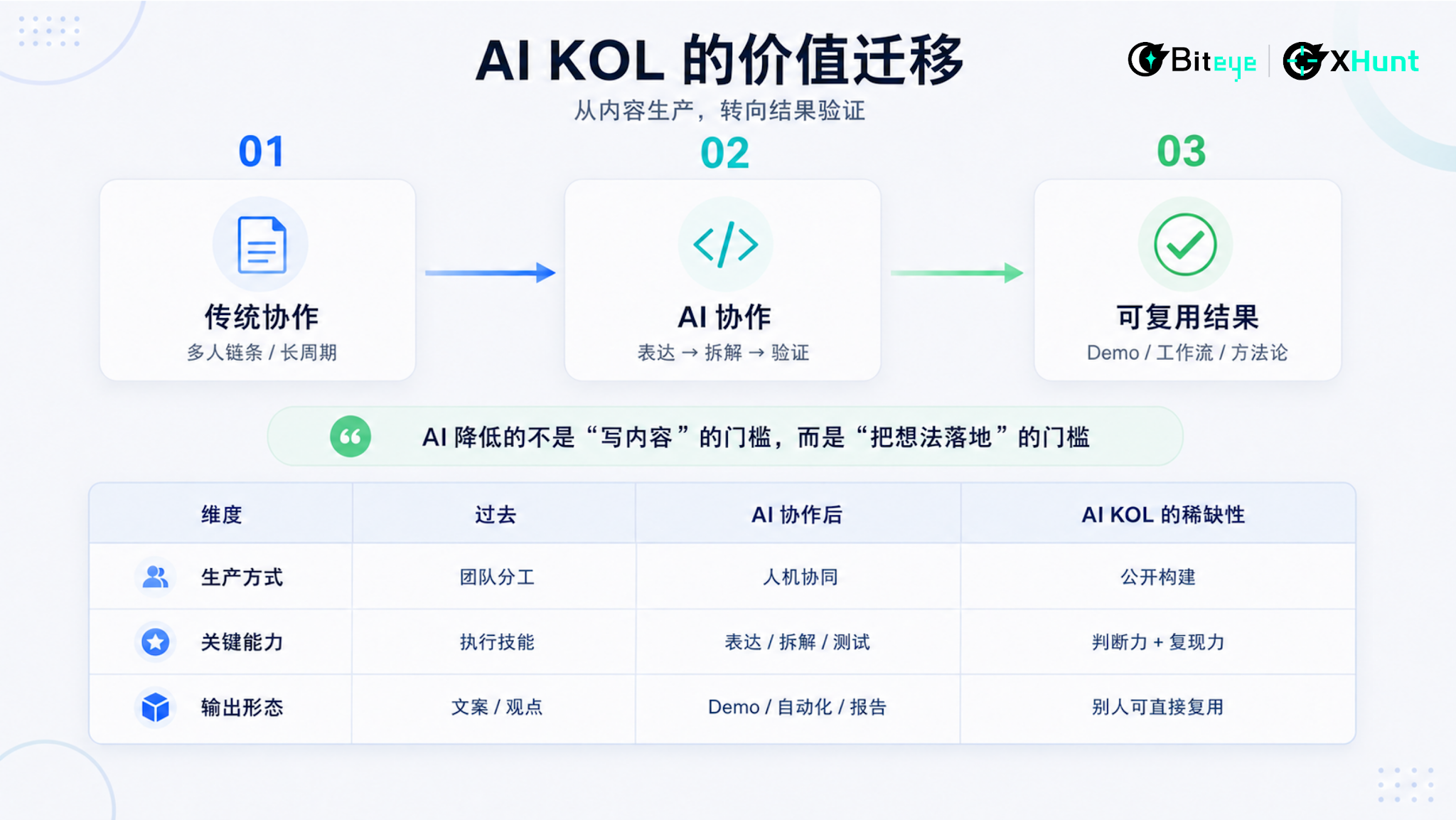
1. Core Finding: From Distributing Opinions to Distributing Productivity
In the traditional internet context, an individual with a brilliant idea needed to mobilize a complex chain of human resources—back-end developers, front-end developers, UI designers, product managers—to bring an idea to fruition. This lengthy collaboration process was enough to dampen most enthusiasm. Today, AI tools are drastically compressing this production chain. Codex, Claude Code, Cursor, and Lovable transform programming barriers into logic and architecture capabilities; Seedance, GPT Image, Kling, and Nano Banana directly remove the barriers to complex image and video production.
However, this has led to a counter-intuitive industry phenomenon: when anyone can mass-produce lengthy articles with AI, high-quality content becomes "cheap" and readily available, making trust unprecedentedly scarce.
The core value of an AI KOL doesn't lie in their ability to make AI churn out a superficial article faster than the average person. Rather, it's that they can, through human-machine collaboration, translate the vague *use of AI* into tangible, demonstrable results that others can see, run, and directly replicate. This is no longer about distributing opinions; it's about distributing productive capability.
For example, when a new model claiming to "beat Claude Opus 4.7" is released, users are tired of formulaic press releases. They desperately want to know from trusted KOLs: "Will it hallucinate in real code development? Is this product, which looks stunning in an official polished video, actually an out-of-the-box productivity tool for ordinary people?"
The compass of attention has reversed: from "what happened," to "is it important," to "how do I use it."
In a noisy field, AI KOLs act as practical pioneers and anchors of trust.
2. Who is Playing This Role: Tech Veterans and a New Generation's Blue Ocean
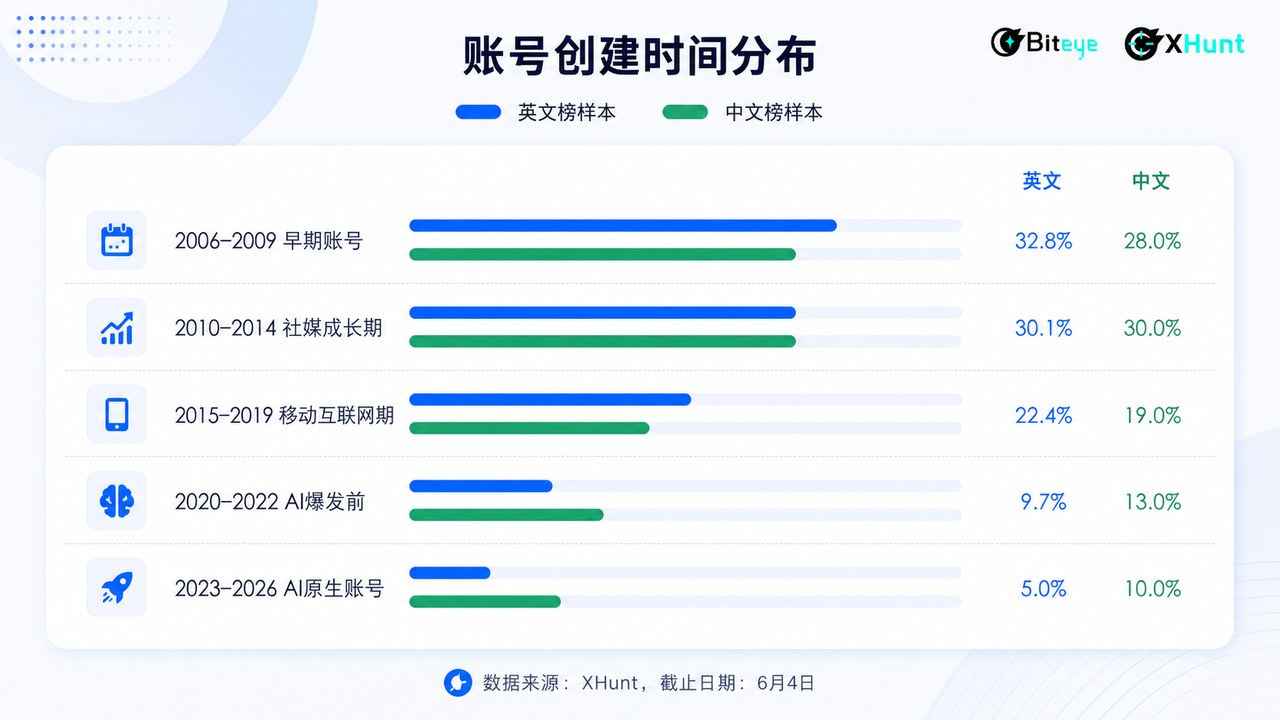
A common industry bias suggests that "most AI KOLs are just marketing accounts that quickly gained traction after the ChatGPT explosion in late 2022." However, XHunt's generational statistics on account registration dates disprove this claim. The generational structure of AI KOLs presents an inverted pyramid distribution.
- Dominance of Veteran Practitioners: In the English rankings, early users registered between 2007 and 2015 account for a high of 62.9%; in the Chinese rankings, this proportion reaches 58%. This means the vast majority of top-tier accounts currently active in the core AI circle are practitioners and entrepreneurs who have weathered the PC, mobile internet, and Web3 cycles. With the advent of the large model wave, they have keenly migrated their productivity tools.
- Rise of the New Generation in the Chinese-speaking World: Notably, during the ChatGPT explosion period of 2022-2023, new AI-native accounts emerging in the Chinese-speaking world accounted for 13.0%, higher than the 9.7% in the English-speaking world. This indicates that the Chinese ecosystem offers a significant traffic bonus for practical, hands-on content. As long as the tools are mastered and tutorials are solid, new accounts can build a competitive advantage through consistent posting.
In contrast, the registration times of Web3 KOLs often show a distinct spindle shape, with a surge in new accounts appearing alongside market hotspots during DeFi Summer, the NFT explosion, and the Meme trend.
3. The Symbiotic Evolution of AI KOLs and OPCs
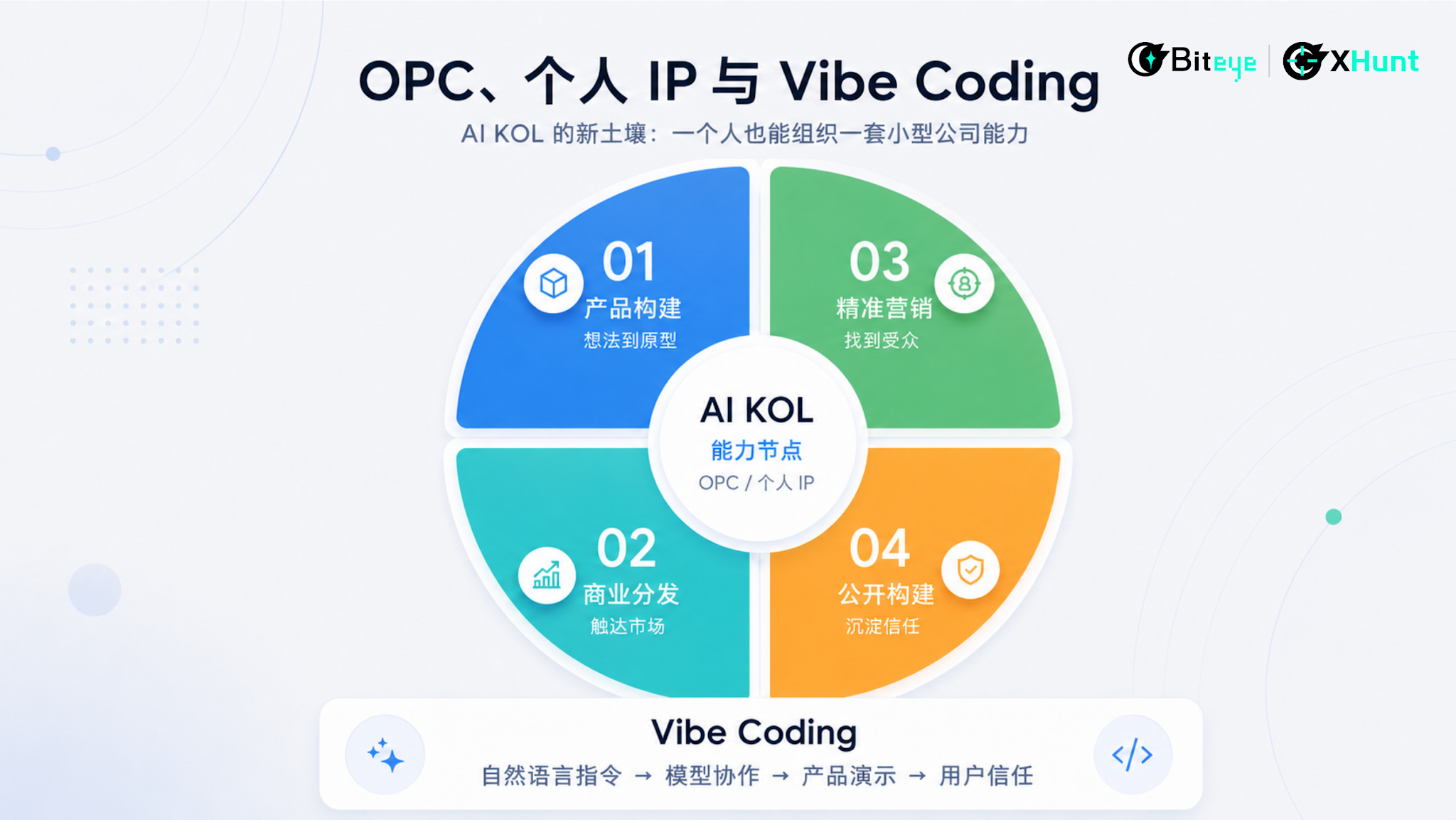
The evolution of AI is turning the One Person Company (OPC) concept from a superhuman idea into a clearly achievable reality. The core essence of OPC is the creator's extreme agility in leveraging various vertical AI Agents, freeing themselves from the burden of going it alone and doing all the grunt work, thereby infinitely amplifying their own ideas to build products, distribute commercially, and market precisely with AI.
In this transformation, "application-distributing" AI KOLs have secured a core ecological niche due to their combined advantages:
- Understands technical boundaries: Most come from AI big tech or are veteran developers with deep technical foundations, understanding the true limitations of tools better than pure marketers.
- Understands market pain points: As long-time content creators facing audiences directly, they possess strong product and marketing awareness, understanding real user needs better than pure R&D personnel.
It is this dual "technology + digital savvy" buff that allows them to transform abstract technology into usable scenarios through "Build in Public," thereby accumulating a steady stream of user trust.
The wildly popular Vibe Coding trend pushes the tension of this personal IP to the extreme: a top AI KOL, when recommending a development framework, no longer writes pale recommendations but directly shows on X how he, using just a natural language instruction in a relaxed atmosphere, collaborates with a model to quickly launch a complete, interactive AI application within 15 minutes.
Traditional KOLs harvest traffic by distributing opinions; AI KOLs consolidate ecosystems by distributing productive capabilities.
4. Data Portrait: The Ecological Divide Between Eastern and Western KOLs
To explore the true operational logic of the AI KOL ecosystem, this report extracted 100 tweet samples from the top 300 English-speaking and top 100 Chinese-speaking AI KOLs on the XHunt influence ranking within the last 3 months, conducting in-depth measurement and comparison of their tweet content and various data points.
We found significant differences between Chinese and English AI KOLs in attention structure and content production models. Below, we unveil the true face of AI KOLs across seven core dimensions, including traffic volume, discussion topics, account creation time, and personal profiles.
1️⃣ Attention Map: English-Speaking World Favors Origins, Chinese-Speaking World Favors Practice
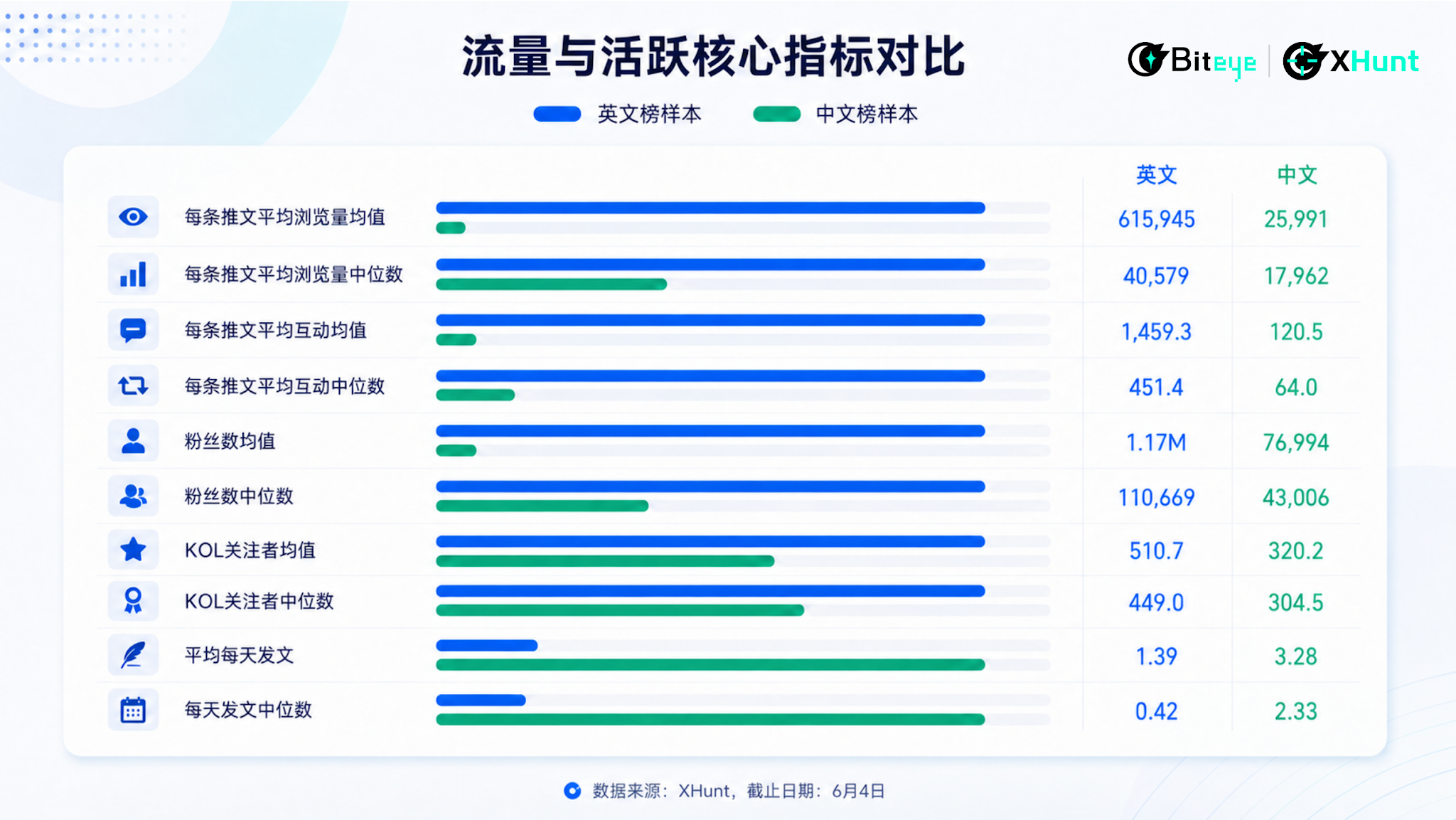
- Traffic Volume Distribution: The total follower base in the English list exceeds 350 million, with an average of 1.17 million and a median of 110,669. The Chinese ecosystem leans towards specialized vertical domains, with an average follower count of approximately 77,000 and a median of 43,006.
- Posting Activity Comparison: In the last 90 days, 100 Chinese accounts produced nearly 30,000 tweets, with a median posting volume of 210. In contrast, 300 English accounts posted only 37,000 tweets total, with a median of just 38. Top English accounts tend to post infrequently, while Chinese accounts form a high-frequency application diffusion network.
- Follower Tier Structure: The English list has a pyramid structure, with accounts having 50,000 to 200,000 followers being the largest group at 41.8%, and accounts with over 1 million followers making up 7.4%. The Chinese list is concentrated in the long-tail application layer, with accounts having 10,000 to 50,000 followers accounting for 53.0%, and those with over 200,000 followers making up only 4.0%.
- KOL Followers: Although the average number of peer followers for English-speaking KOLs (510.7) is higher than that for Chinese-speaking KOLs (320.2), when adjusted for the respective AI KOL base (approximately 1,000 and 5,000), the circle penetration rate for top Chinese KOLs is as high as 32%, far exceeding the 10% in the English-speaking world. This indicates that the Chinese AI KOL circle is a highly dense, tightly connected community.
- Activity Map: A high of 70% of Chinese KOLs share industry dynamics and practical tips frequently every day. In the English-speaking world, low-frequency active accounts uniquely account for 39.8%, while consistently active ones account for 26.4%. The English-speaking world tends towards an industrial source network, while the Chinese-speaking world tends towards a practical network.
Summary: English AI KOLs form an industry source network with first-hand technology and major strategic releases. Chinese AI KOLs form a super-diffusion and practice network that frenetically translates, reviews, tutorials, and pushes cutting-edge technology into mainstream workflows.
2️⃣ Mind Preference: English-Speaking World Leans Macro, Chinese-Speaking World Leans Practical
Peeling back the broad labels, by extracting word frequencies and tags from the overall discussion content, we clearly see the differing focuses of the two major ecosystems:
Whether in the English or Chinese-speaking world, foundational models, AI Agents, AI commercialization, and AI coding are the common axes, but their outward extension paths are entirely different:
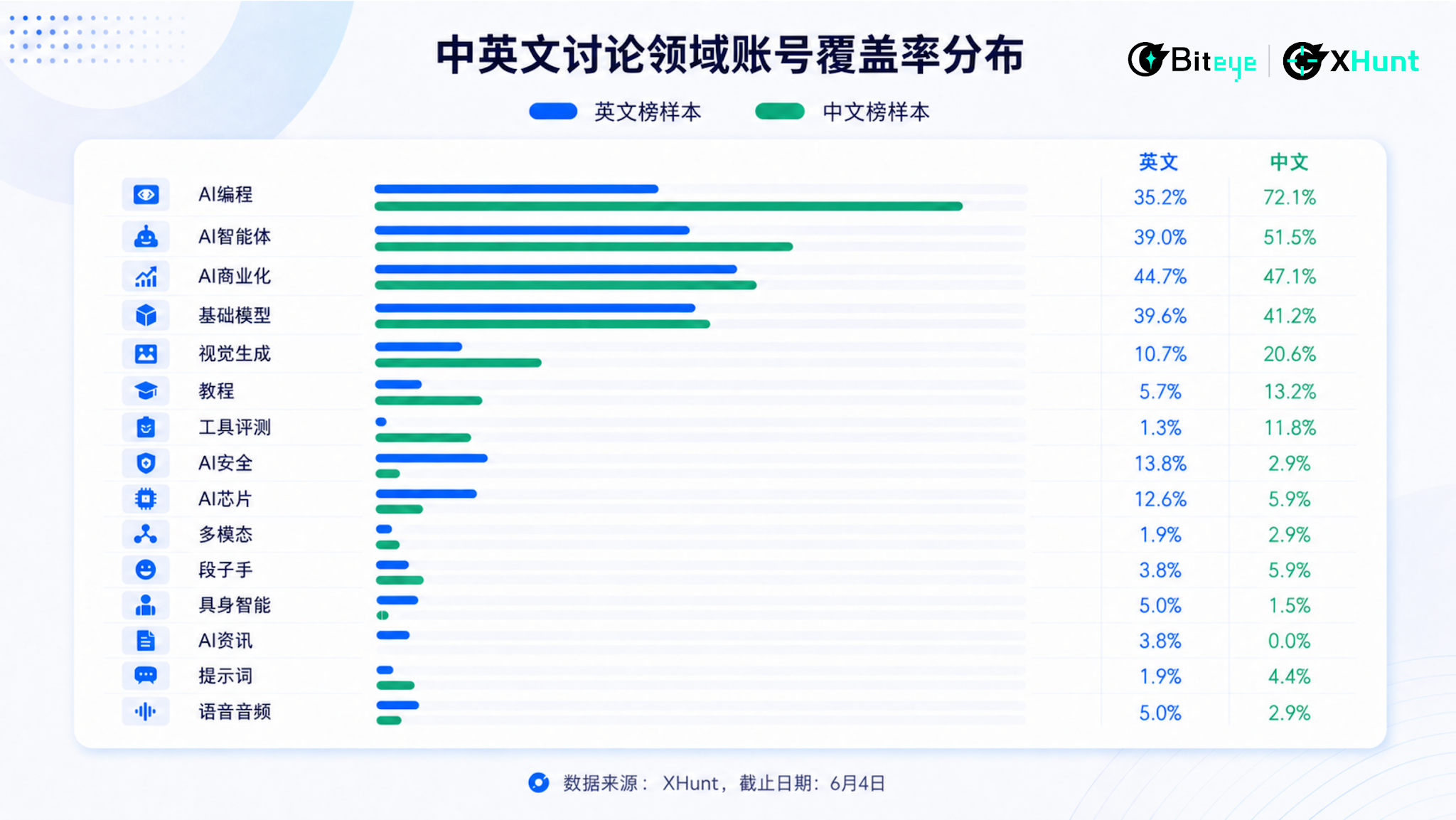
- English-speaking world focuses on underlying technology and macro perspectives: English-speaking KOLs have significantly higher coverage in AI commercialization (44.7%), foundational models (39.6%), AI safety (13.8%), AI chips (12.6%), and embodied intelligence (5%) compared to their Chinese counterparts. They dedicate substantial effort to discussing AGI safety alignment, the supply-demand landscape of computing power, the open-source vs. closed-source debate, and embodied intelligence.
- Chinese-speaking world focuses on application deployment and practical orientation: Chinese-speaking KOLs exhibit strong pragmatism. AI coding constitutes 72.1% of their content, roughly double that of the English-speaking world. AI Agents are at 51.5% vs. 39% in the English-speaking world. In visual generation, 20.6% is again nearly double that of the English-speaking world. Tool reviews are at 11.8%, an astonishing nearly nine times higher. Tutorials and prompt engineering are also significantly higher than in the English-speaking world, indicating Chinese bloggers are more adept at breaking down complex technologies into specific operational guides for coding and agent building.
3️⃣ Capability Radar: English Focuses on Technical Insight, Chinese Focuses on Full-Stack Application
To reduce misjudgment from broad category labels, we utilized XHunt's KOL capability scoring model to comprehensively analyze the quality of content published by AI KOL accounts across multiple dimensions:
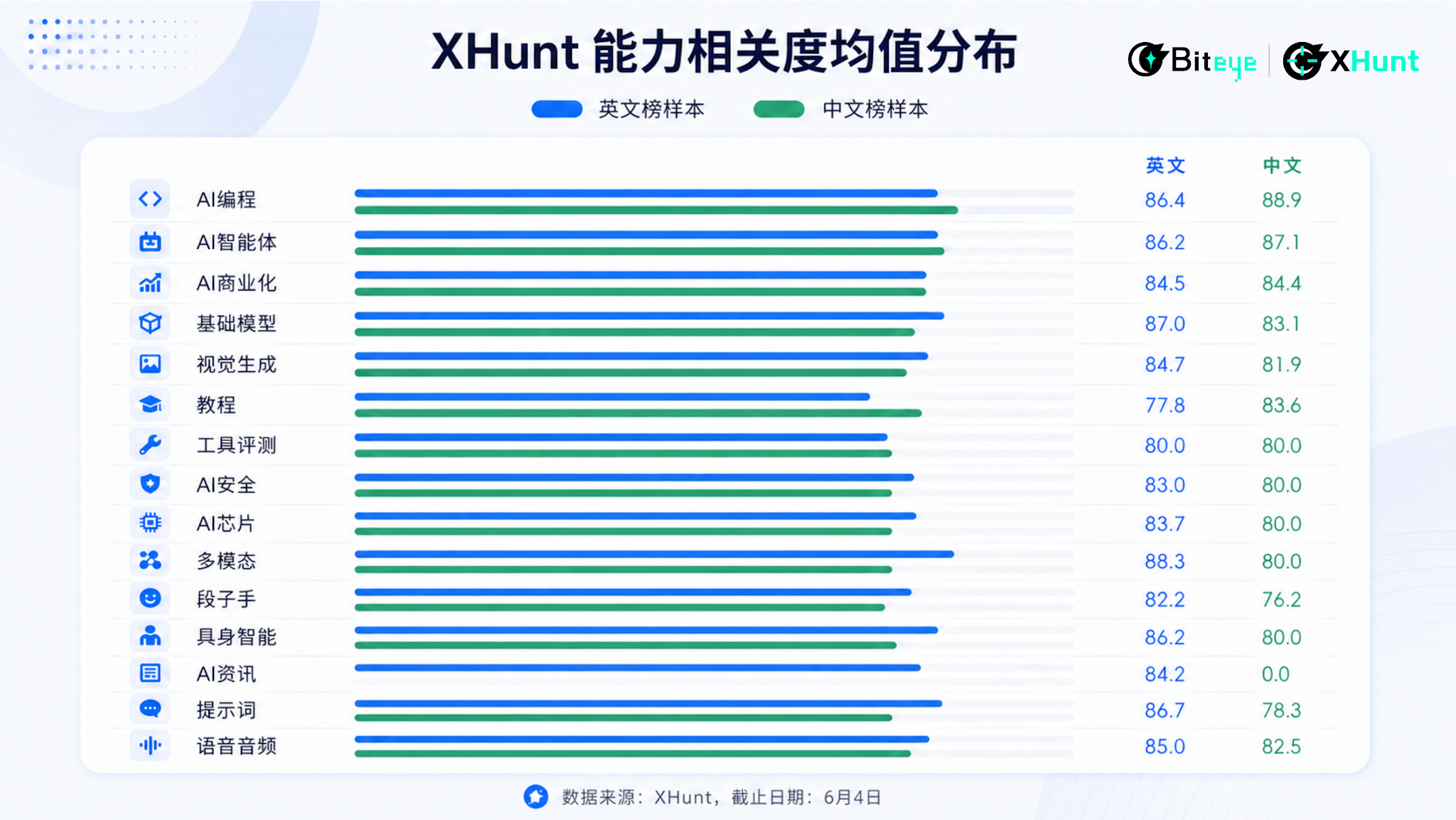
- English List Holds Industry Origins and Underlying Logic: The highest score in the English list is for Multimodal at 88.3, followed by Foundational Models and Prompt Engineering. Their core capabilities lie in insights into model architecture, experience in large-scale engineering tuning, and foresight into cutting-edge trends. In AI safety and chips, the English list has a natural first-mover advantage.
- Chinese List Focuses on Full-Stack Practical Application: In the Chinese sample, the average correlation score for AI coding capabilities reached 88.9, and for AI Agents, it reached 87.1. Chinese Twitter is active with many creators possessing natural language development skills, adept at connecting AI with private domain monetization or light entrepreneurial models.
4️⃣ Large Model Mention Rate: A Workflow Map Voiced by Actions
The large model mention rate (i.e., whether any tweet from an account hit a keyword in 3 months) represents not only the discussion heat of the model within the community but also reflects the KOLs' preferences and sentiments ("voting with their feet") regarding the reliance on and sentiment towards various models in their actual workflows:
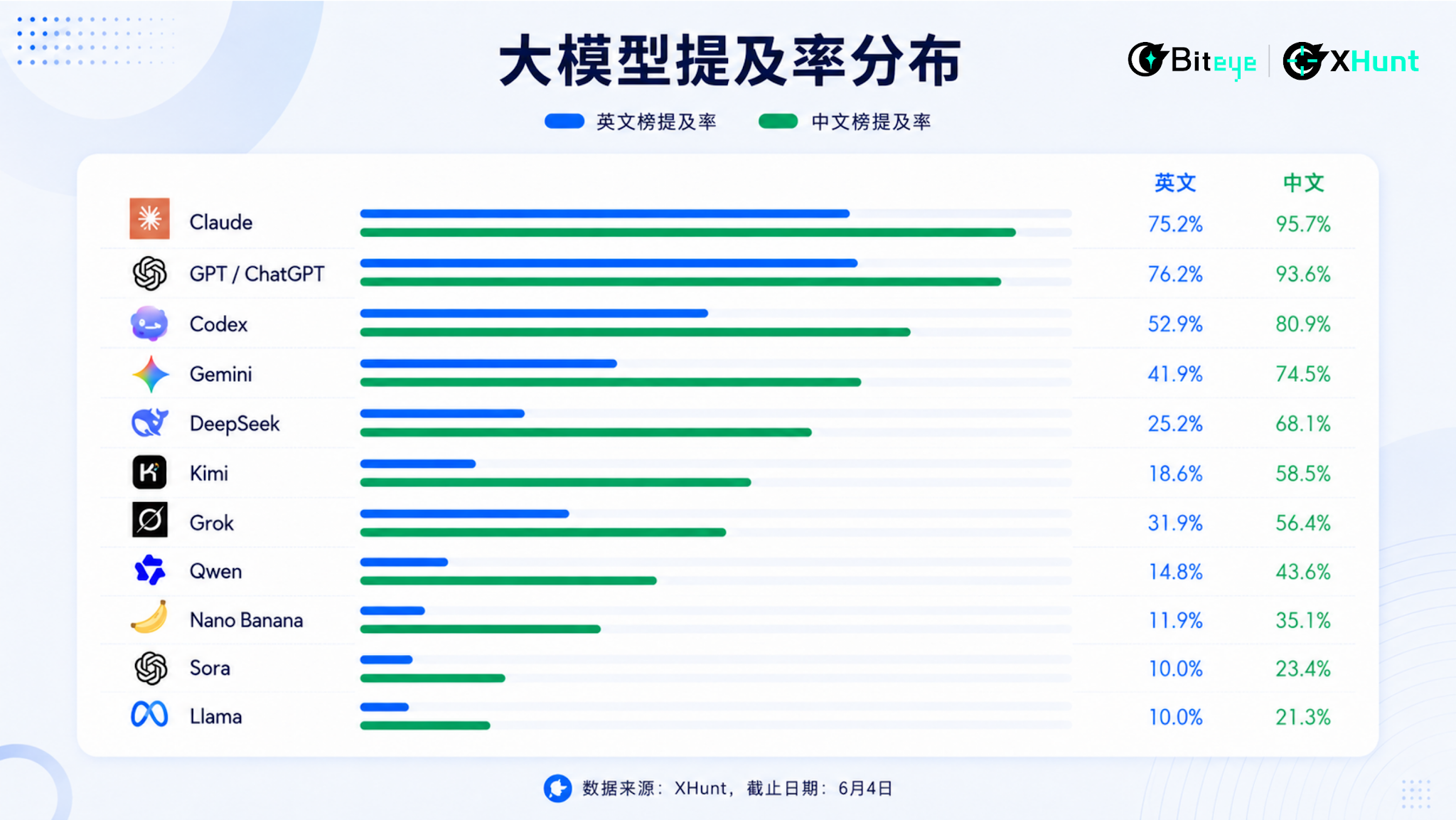
As shown, Claude and GPT form the top pair across both language ecosystems. In the Chinese-speaking world, Claude's mention rate is as high as 95.7%, remaining the top choice for independent developers and Vibe Coders. Notably, with the sustained popularity of AI coding scenarios, Codex's heat has soared recently, securing third place with an ultra-high coverage rate of 80.9%, further confirming the fervent pursuit of deployable workflows among Chinese geeks.
Additionally, domestic Chinese models DeepSeek (68.1%) and Kimi (58.5%) have also shown strong local penetration. In contrast, in the English-speaking world, GPT (76.2%) and Claude (75.2%) are neck and neck. Compared to discussions about a single toolchain, they focus more on multimodal evolution and the overarching narrative of the industry.
5️⃣ MBTI Content Style: Facets of Account Expression
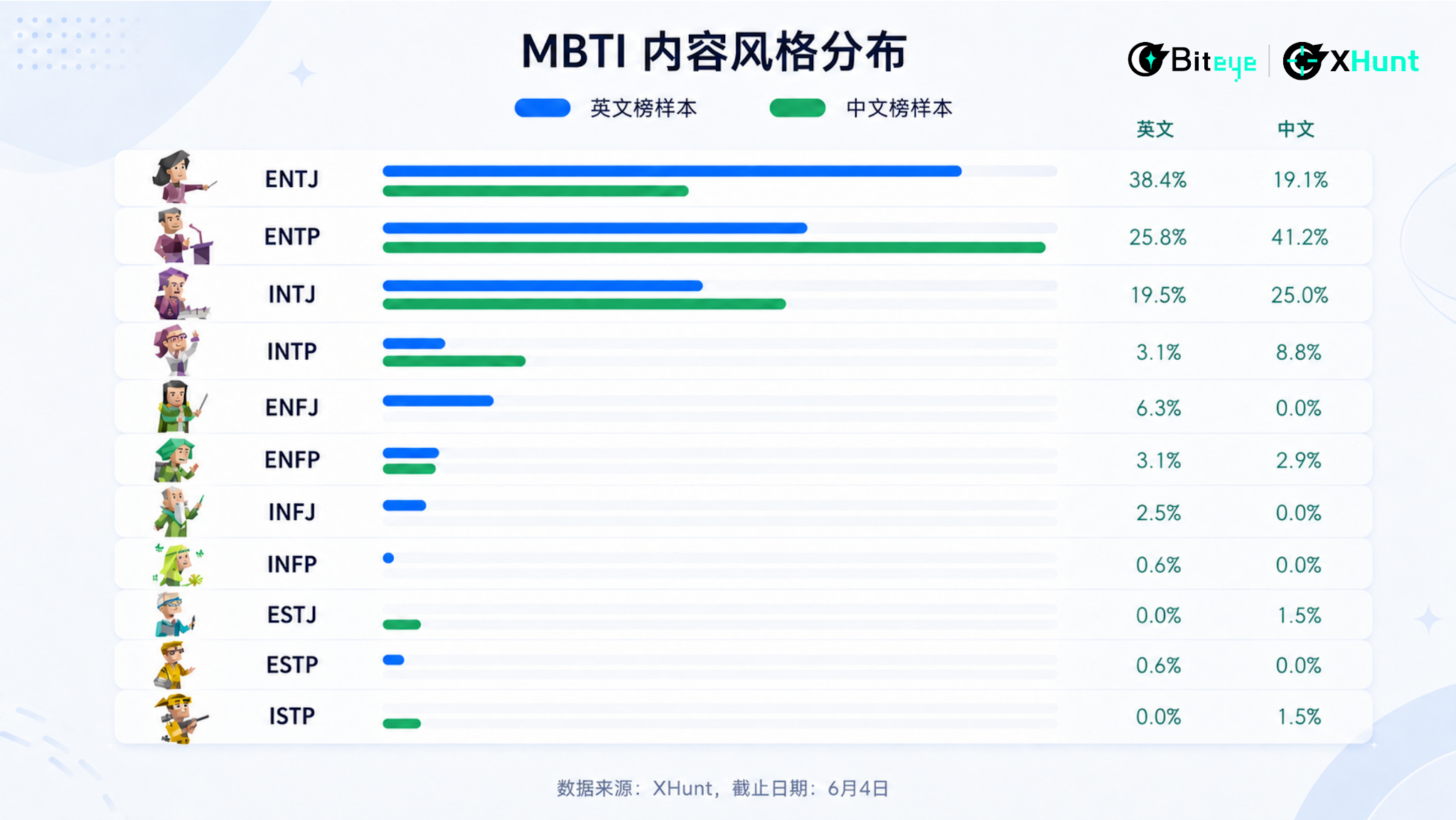
Using a proprietary style inference algorithm, XHunt classified the public personality facets of Chinese and English KOL accounts into MBTI portraits based on their bios, long-form tweet structures, interaction debate logic, and topic preferences:
As shown, regardless of the language ecosystem, accounts with influence predominantly belong to the NT (Rational) camp. In periods of rapid technological iteration, content offering logical analysis and productivity guidance is clearly favored. The English list is dominated by ENTJ (38.4%) and ENTP (25.8%), leaning towards framework building and macro analysis. The Chinese list is led by ENTP (41.2%), echoing the Chinese ecosystem's characteristic enthusiasm for exploring diverse applications of new tools.
6️⃣ Identity Structure: English Leans Frontier, Chinese Leans Practice
By clustering and cross-validating the profile bios and historical tweet self-narratives of the two sample groups, XHunt mapped the profiles of Chinese and English AI KOLs:
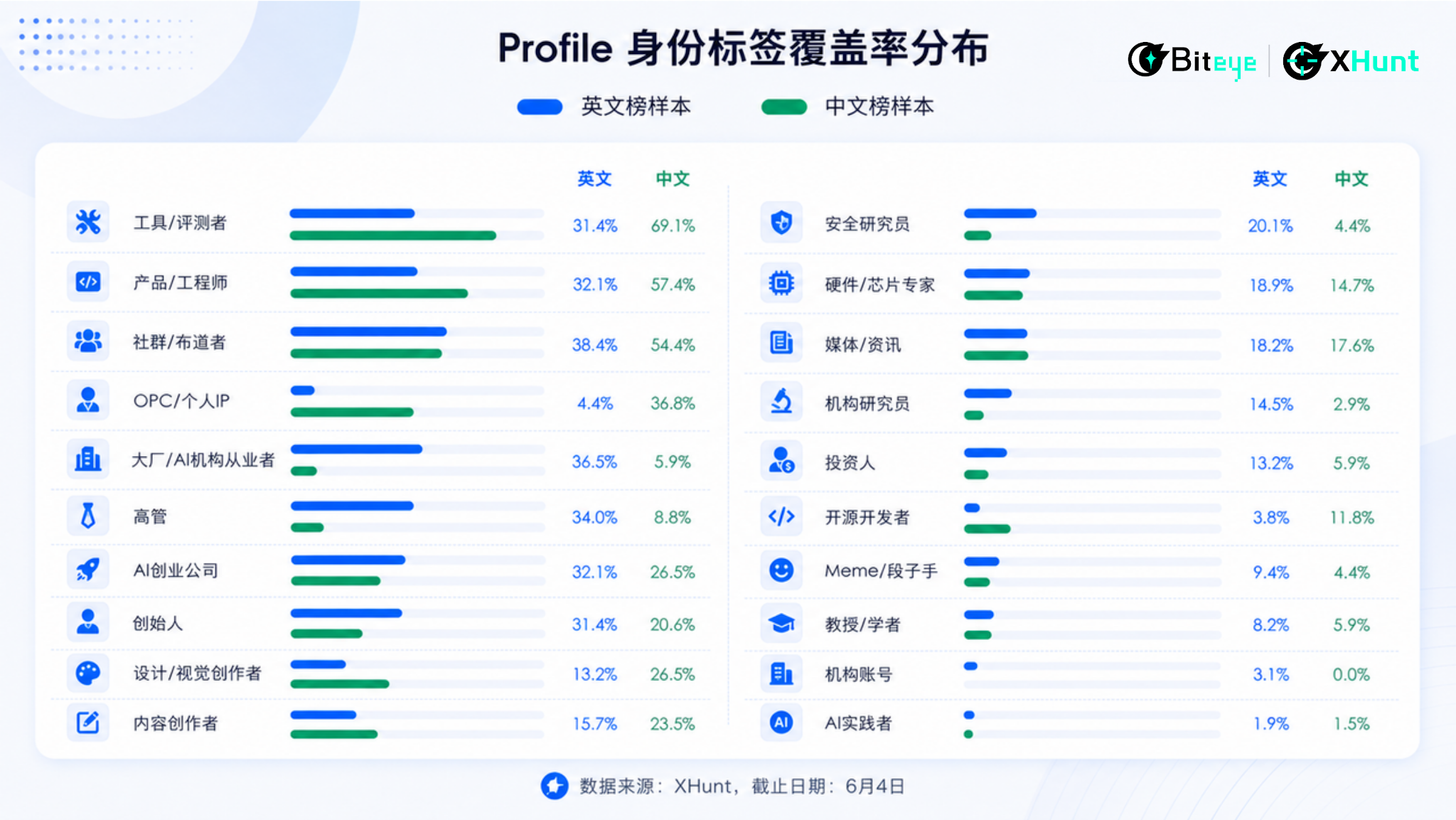
Core Identity Structure:
- Over 65% of KOLs in the English-speaking world are large model founders (31.4%), executives (34%), or scientists. Their content output itself is a form of strategic distribution.
- The top categories in the Chinese-speaking world are Tool/Reviewers (69.1%) and Product Engineers (57.4%). In general, the English ecosystem leans towards a source publication network, while the Chinese ecosystem leans towards a productivity practice network.
Overall:
The English AI KOL network resembles a cutting-edge source technology and paradigm publication network happening at the forefront of Silicon Valley, led by scientists and tech leaders. The Chinese AI KOL network resembles a comprehensive productivity tool and survival practice network erupting in the vast application market, led by full-stack independent geeks and application pioneers.
7️⃣ Tweet Effectiveness Evolution: From Wild Growth to High-Quality Development
Looking at the overall market trends over the past 8 months, the traffic distribution logic in the AI field has shifted from wild growth to high-quality development, with exposure and posting numbers continuously improving, showing three core characteristics:
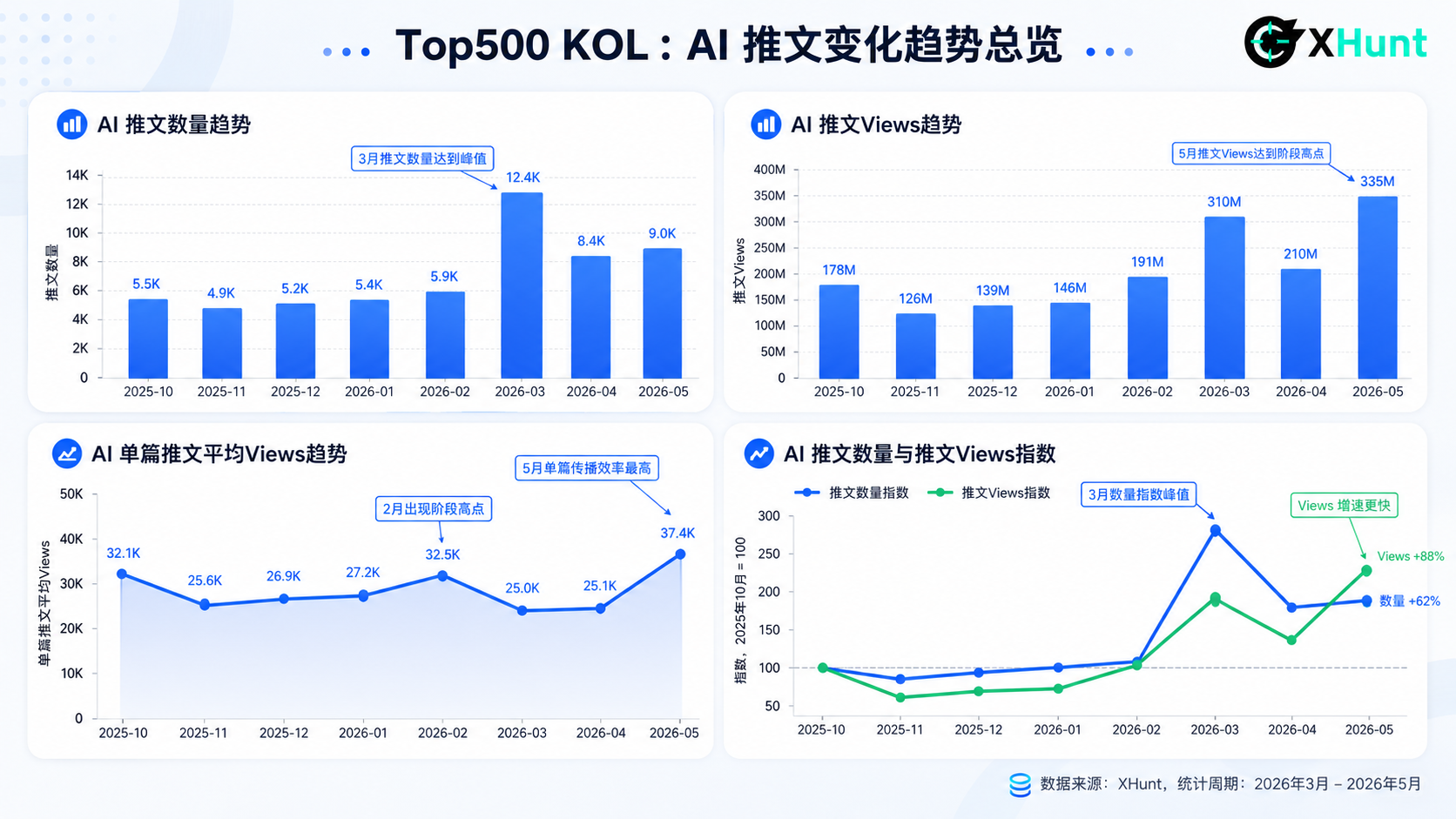
- Attention Dilution in February & March: Influenced by industry hotspots like Openclaw, total tweets surged to 12.4K in March with total Views reaching 310M, but the average Views


