






Web3 AI Application Overview: Which Ones Help You Earn Money, Which Ones Reshape the Rules?


- Key Insight: The integration of AI and the crypto industry is shifting from narrative-driven to product-value-driven. By optimizing information acquisition, data sovereignty, on-chain operations, the Agent economy, and distribution channels, several representative projects are exploring sustainable application scenarios to address user retention challenges as market hype fades.
- Key Elements:
- Surf, as an information layer product, integrates on-chain data, market trends, and social sentiment. It provides structured analysis via AI, shortening the path from "information acquisition to judgment formation" for users. It also supports building continuous monitoring tools, but remains limited to decision-making assistance and does not execute trades.
- Anuma, built on ZetaChain, creates a privatized, portable AI memory system. Users can locally encrypt chat history and maintain memory continuity across multiple models, addressing the issue of AI memory ownership by platforms and strengthening user data sovereignty.
- Nansen AI, built on on-chain data, combines research with trading. It allows users to query fund flows, Smart Money movements, and execute transfers or Swaps using natural language. This compresses the process from research to action, though it still relies on users for final decision-making.
- Virtuals Protocol tokenizes AI Agents, turning them into economic participants that can be funded, incentivized, and distribute revenue. It provides the infrastructure to support collaboration and value exchange between Agents. However, the ecosystem is still early and requires validation of real usage demand.
- Warden builds a platform layer for Agent distribution, offering a unified gateway to call multiple Agents. It enables developers to quickly launch and charge fees, using a dedicated chain to manage identity and collaboration. However, its success depends on reaching sufficient scale in both users and Agents.
Original by: Odaily (@OdailyChina)
Author: Asher (@Asher_0210)
In recent weeks, discussions around AI + Crypto have heated up once again.
From the AI x Blockchain conference in New York to the recently concluded Hong Kong Web3 Festival, nearly all major players are revisiting the same question: How will AI shape the next phase of the crypto industry?
However, unlike previous cycles that were more narrative-driven, current discussions are shifting towards a more concrete question: What problem does AI actually solve?
During a fireside chat titled "Reshaping Convenience: The Next Decade of Web3, AI, and the Smart Economy," Yi He, co-CEO of Binance, mentioned that as the industry matures, the initial windfall of the crypto market is fading. The next critical factor isn't the technology itself, but whether products truly offer value and whether people are willing to pay for them.
This implies that AI is no longer just a new growth narrative but is being placed within a more specific context. People are starting to ask more directly: What tangible impact can it actually bring?
This shift is particularly evident in user-facing applications. Within the Web3 space, a wave of AI-powered applications is emerging. Some are restructuring how information is accessed, others are redefining the ownership of data and memory, and some are beginning to integrate AI with on-chain research, trading, and even economic models themselves.
These projects may not be fully mature yet, but they collectively point towards a more practical direction. As the easy gains recede, the integration of AI and crypto is refocusing on the product itself.
This article selects several representative Web3 AI projects, outlining the practical progress in this application layer across areas like information, memory, operations, the Agent economy, and distribution.
Surf: A Real-Time Encyclopedia for the Crypto Market
Surf is a typical information layer product in this wave of AI applications. It doesn't try to overhaul the trading process or focus on creating a new economic system. Instead, it returns to a more fundamental, yet long-overlooked problem: in the crypto market, simply accessing information is still a high-cost endeavor.
On-chain data, price movements, social sentiment, and project details are often scattered across different platforms. Users must constantly switch between multiple pages to piece together a relatively complete market assessment. This fragmentation becomes more pronounced during volatile market conditions. The issue isn't a lack of information, but that information is dispersed and suffers from latency. Surf's approach is to integrate these information sources into a unified AI interface, allowing users to get structured conclusions through simple descriptions. This compresses the "finding data" step, enabling users to move directly to the "making judgments" phase.
In practice, it functions more like an always-on research analyst. Users can track the capital flow and sentiment of a specific token, analyze the TVL and yield structure of DeFi protocols, monitor smart money movements, or generate a project due diligence report suitable for trading decisions or communication preparation in a short time. Compared to traditional tools that require users to filter, piece together, and understand information themselves, Surf more directly outputs processed results, thus shortening the path from "obtaining information" to "forming a judgment."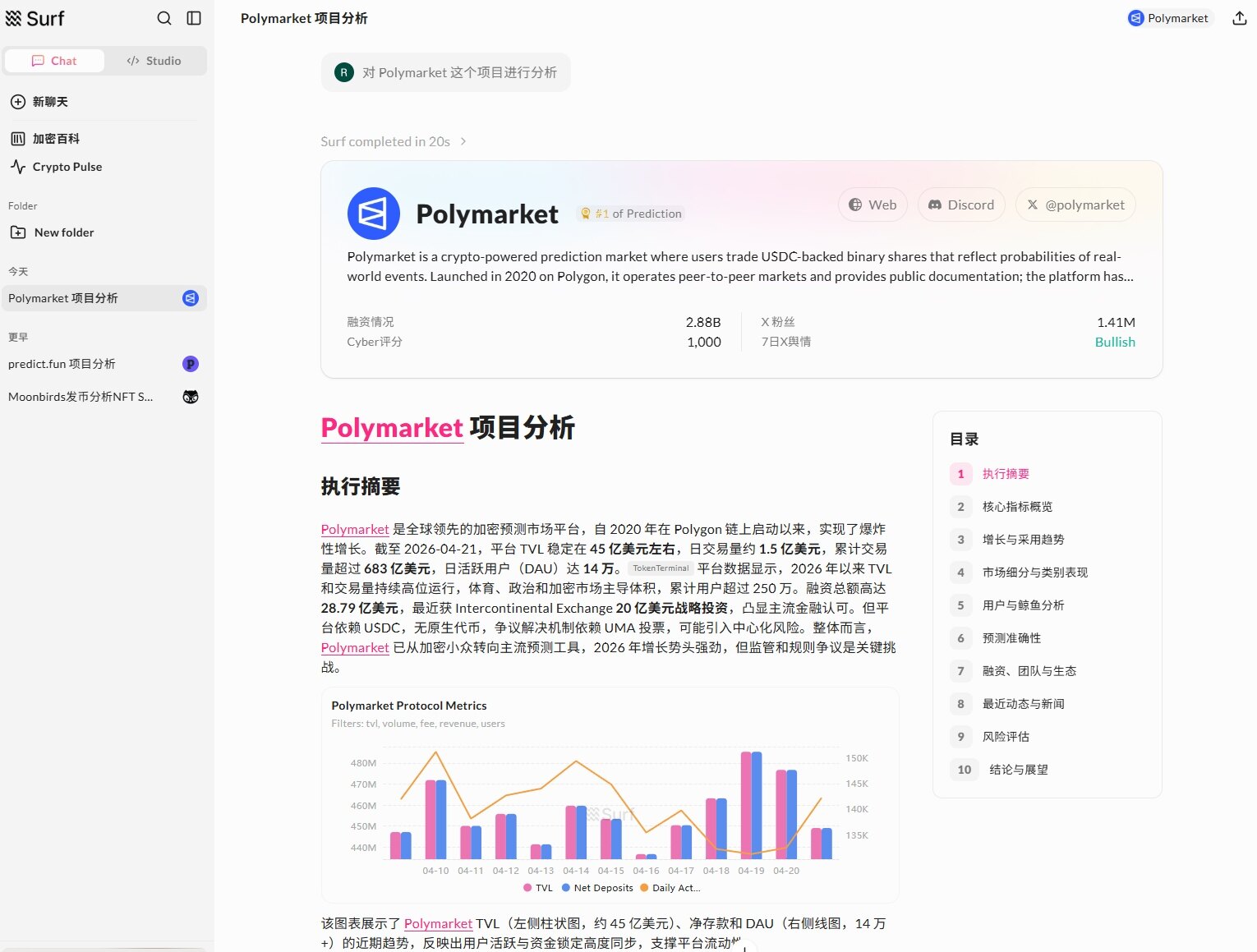
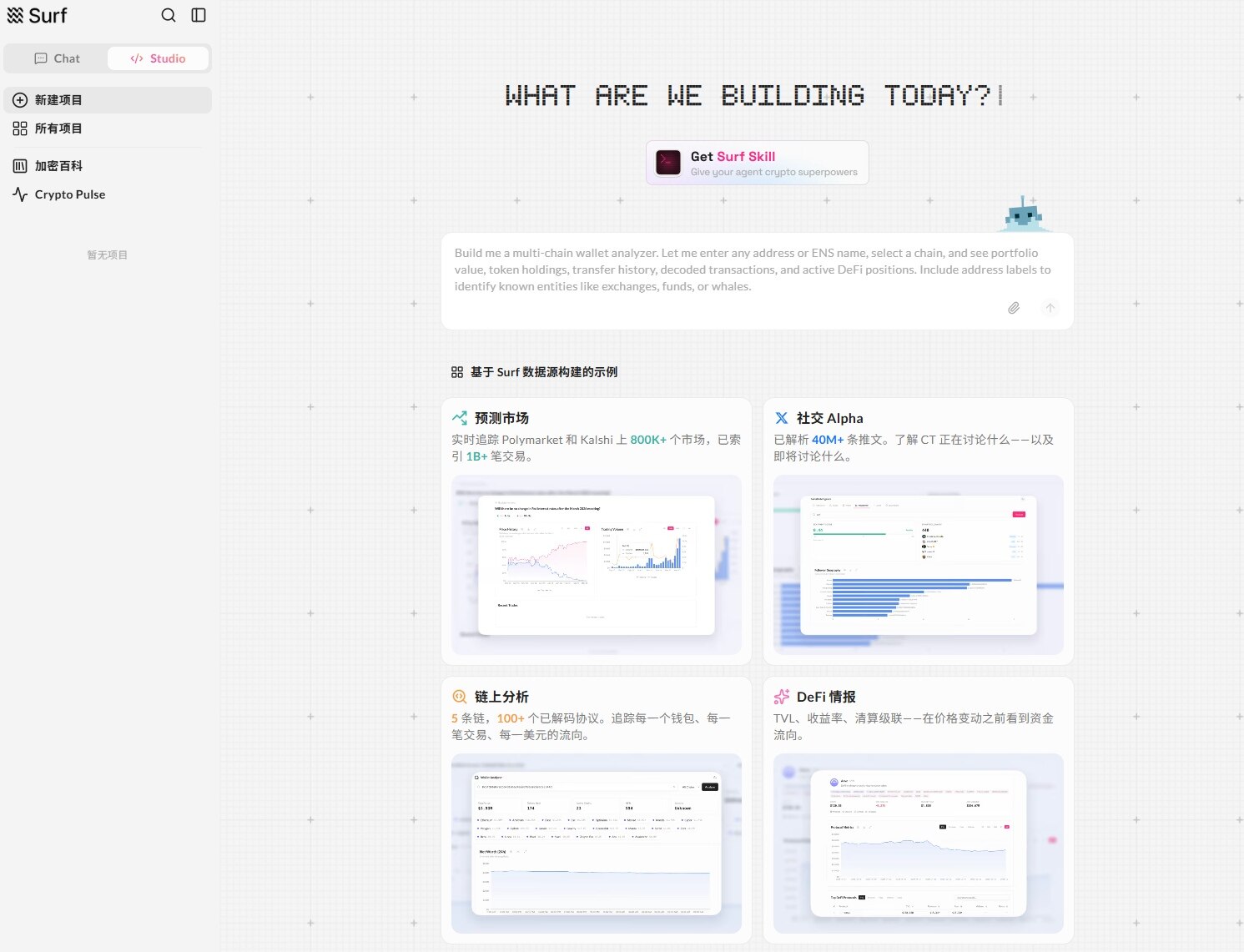
Building on this, Surf is evolving from an "information tool" into a "workflow platform." The newly launched Surf 2.0 and Surf Studio allow users to build analysis tools and even simple Web Apps directly using natural language, deploy them instantly, and bypass traditional development processes. Simultaneously, Surf integrates multi-model capabilities from providers like OpenAI, Anthropic, and Google, and connects to dozens of data sources and on-chain interfaces. This means the generated analysis results are not just text but can serve as tools for continuous monitoring and decision-making.
At a deeper level, it is gradually building a capability framework for Agents. Through its API and Agent Stack, users can delegate specific tasks (e.g., monitoring whale addresses, tracking capital flows, or receiving strategy signals) for continuous execution by AI, rather than performing manual queries each time. This signifies Surf's transformation from a passive query interface into a persistent research system.
However, its capabilities have clear boundaries. Surf's core remains focused on the information integration and analysis layer, without truly entering the transaction execution stage. For instance, automatic order placement or strategy execution still needs to be done by the user. This makes it more suitable as a decision-support tool rather than a system capable of completing a full trading loop independently.
From an industry perspective, products like Surf represent an early form of AI application implementation. Instead of directly challenging the complex task of transaction execution, making "understanding the market" more efficient and convenient is often more easily accepted by users. Before trading becomes fully automated, improving information processing efficiency remains the most direct and perceptible value for users.
Anuma: A Sovereign Memory Vault for the AI Privacy Era
Over the past two years, AI has become a common keyword for the global tech landscape. From model competitions in Silicon Valley to the pursuit of AI applications and capital narratives in New York and Hong Kong, the focus of industry discussions has shifted rapidly. Initially, the competition revolved around model capabilities: reasoning, multimodality, and Agent execution. Almost every product update answered the same question: whose model is smarter, more accurate, and better at completing complex tasks?
But as model capabilities continue to improve, simply comparing the models themselves is becoming increasingly difficult to create a lasting competitive advantage. Entering a new phase, the focus is shifting towards how AI can remember users long-term and carry these memories into writing, research, decision-making, and daily communication. This means that the moat for AI is extending from model capability to memory capability. The model determines what an AI can answer, while memory determines whether an AI can truly understand a long-term user.
However, today's AI memory doesn't truly belong to the user. In current mainstream AI products, conversations, preferences, and usage habits are continuously recorded, gradually forming a personalized experience. But these memories are typically locked within their respective platforms, controlled by the platforms themselves, making them neither freely transferable nor truly controllable by the user.
This means that while AI is accumulating the user's digital persona, the ownership and control of this data often still belong to the platform. The longer a user uses a service, the more memories are deposited, increasing the cost of switching models. What truly locks users in isn't necessarily the model itself, but the accumulated memories they can't take with them.
This is precisely the layer Anuma targets. As ZetaChain's flagship product venturing into the AI direction, Anuma's role is more than just an application portal. More accurately, the foundation ZetaChain aims to build is a user-controlled AI memory system; Anuma serves as the user-facing AI interaction portal for this system.
In other words, ZetaChain is responsible for building the underlying memory layer, while Anuma brings this capability into daily AI usage scenarios. Anuma's goal is to decouple memory from models, allowing users, for the first time in practical use, to access, manage, and carry forward their long-term memories.
Specifically, users can import their complete chat histories from ChatGPT, Claude, or Grok into Anuma. After local encryption, these histories are stored in a user-controlled Memory Vault. Crucially, this process prioritizes privacy protection *before* data enters the system. Users aren't passively granting permission after the platform has already acquired their data; they retain control from the very beginning.
These memories are no longer tied to any single platform. They can be taken and reused, persisting across different models. They are locally encrypted, portable, and not bound to a single model, allowing for continuous accumulation with long-term user engagement.
From a user experience perspective, Anuma primarily functions as a unified portal aggregating several cutting-edge models. With a single subscription, users can access the latest models like GPT, Claude, and Grok without needing to switch between different platforms constantly.
More importantly, when users switch between different models, their established memories are not reset. In Anuma, models like GPT and Claude act more as the capability layer, while the user's own memory remains consistent. Regardless of which model is used, past conversation records, expression styles, and preferences are preserved, not wiped clean.
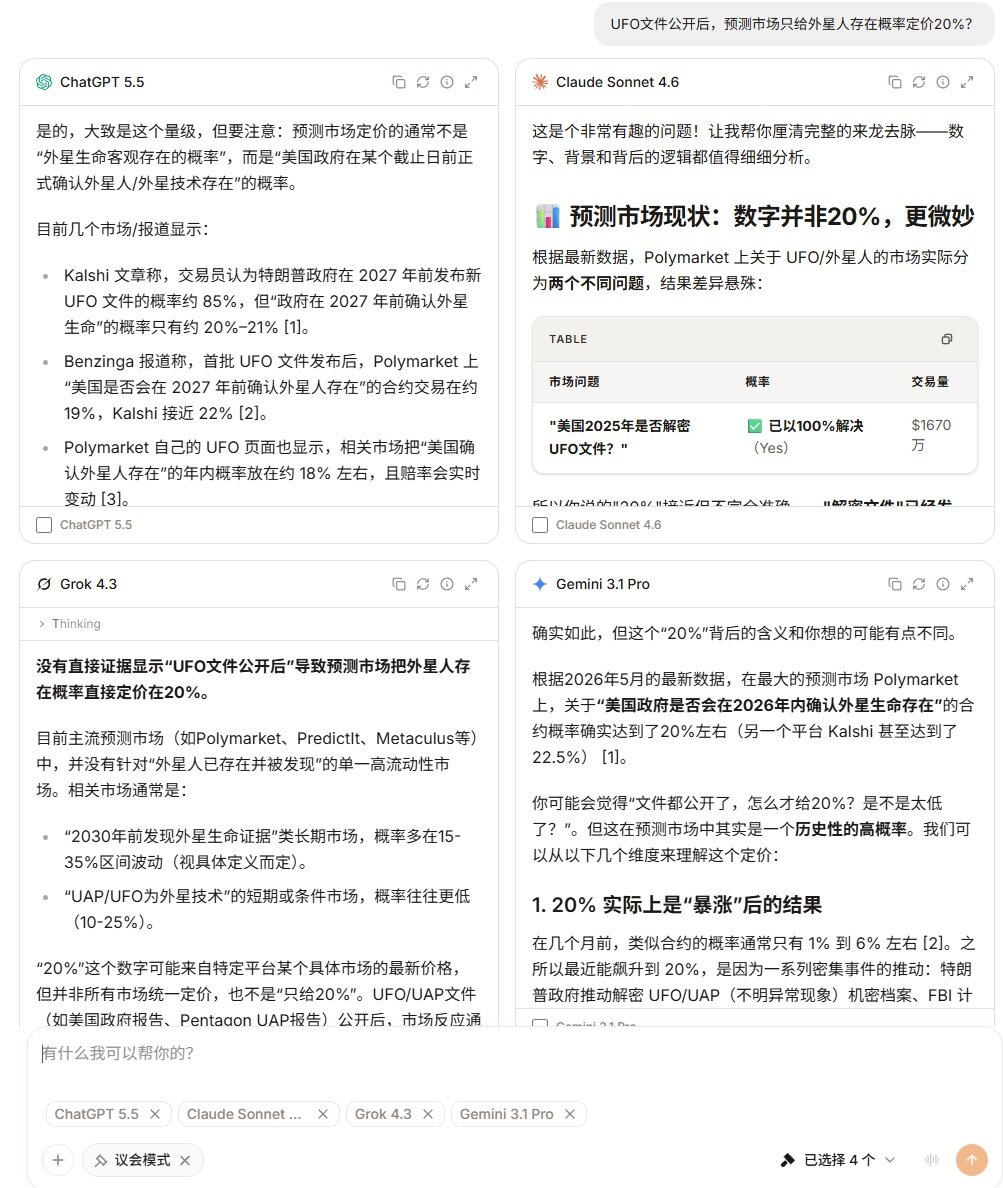
Anuma also offers a multi-model Council Mode. This allows users to have multiple models provide answers to the same question from different angles, and then compare the results. For research, writing, and complex judgments, this experience is akin to having multiple AIs discuss a topic simultaneously, rather than relying on the single output of one model.
Additionally, Anuma allows users to chat directly with AI via iMessage. Each Agent can be invoked like a contact, or even added to group chats. Compared to the necessity of opening a specific app to start a conversation, this method is more akin to daily communication scenarios, making the AI interface lighter. Even in situations with weak network signals or when unable to open an app, users can still invoke AI, and the related conversations will enter the same encrypted memory system, uninterrupted by changes in the entry point.

From a product perspective, Anuma is not just a multi-model gateway; it's building a memory system independent of the models themselves. Previously, a user's conversation history, preferences, and habits were typically tied to specific platforms. However, as AI becomes a long-term tool, these accumulated memories become the foundation for understanding the user.
This is also why ZetaChain is trying to carve out a role in the next generation of AI infrastructure, with Anuma acting as the user interface. Models can be continuously upgraded or replaced, but the memories a user builds over time shouldn't be locked onto a single platform. The future competition of AI products might not just be about whose model is stronger, but also about who allows users to truly own, utilize, and carry their own memories.
In the AI era, memory is becoming a part of identity. And identity should belong to the user.
Nansen AI: Transforming On-Chain Research and Trading into "Conversational Operations"
When the question shifts from "who owns the data" to "how to use the data," another category of products focuses on more concrete operational layers. What Nansen AI does is compress the previously fragmented steps between on-chain research and actual trading into a single pathway as much as possible.
In traditional on-chain research, users often switch between multiple dashboards, manually querying capital flows, address behaviors, token data, and then combining their own judgment to execute. This process isn't inherently complex, but it involves cumbersome steps, leading to a clear disconnect between information and execution. Nansen AI's approach is to reconnect these two parts.
Users can ask questions using natural language to get information on on-chain capital flows, Smart Money movements, token trends, etc., without needing to perform item-by-item queries. For example, inquiring about the reason for a token's price increase, analyzing the profit/loss of a specific address, or directly parsing a transaction can all be done within a conversation. This method effectively extracts "research" from the operational workflow, compressing it into a continuous conversational process.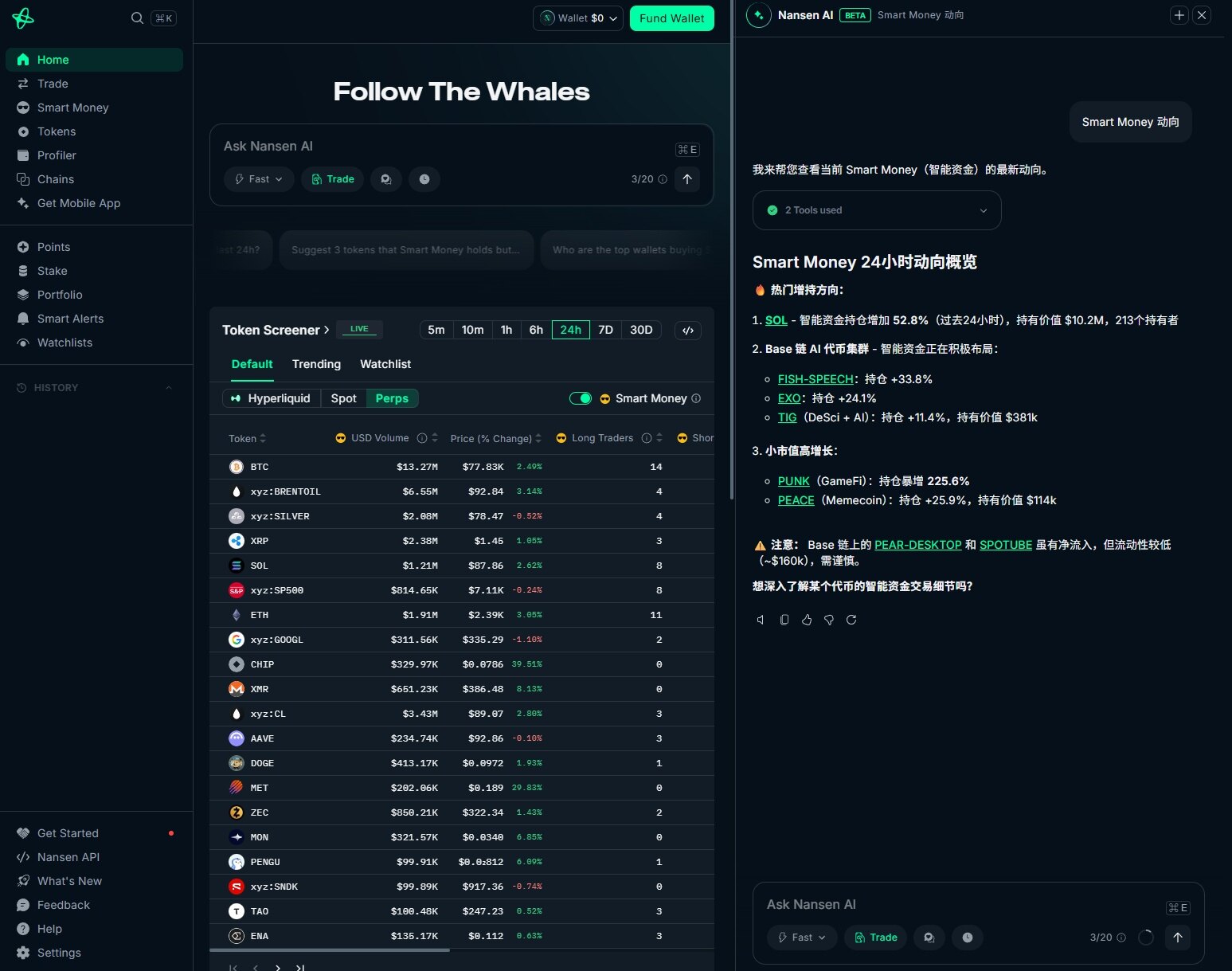
Going a step further, Nansen AI is attempting to connect information acquisition with actual execution. In certain scenarios, users can directly perform on-chain actions like transfers or Swaps through conversation, thereby compressing the previously separate research and execution processes into the same pathway. This also means that Nansen AI is no longer just providing explanations but is gradually moving closer to the operational layer.
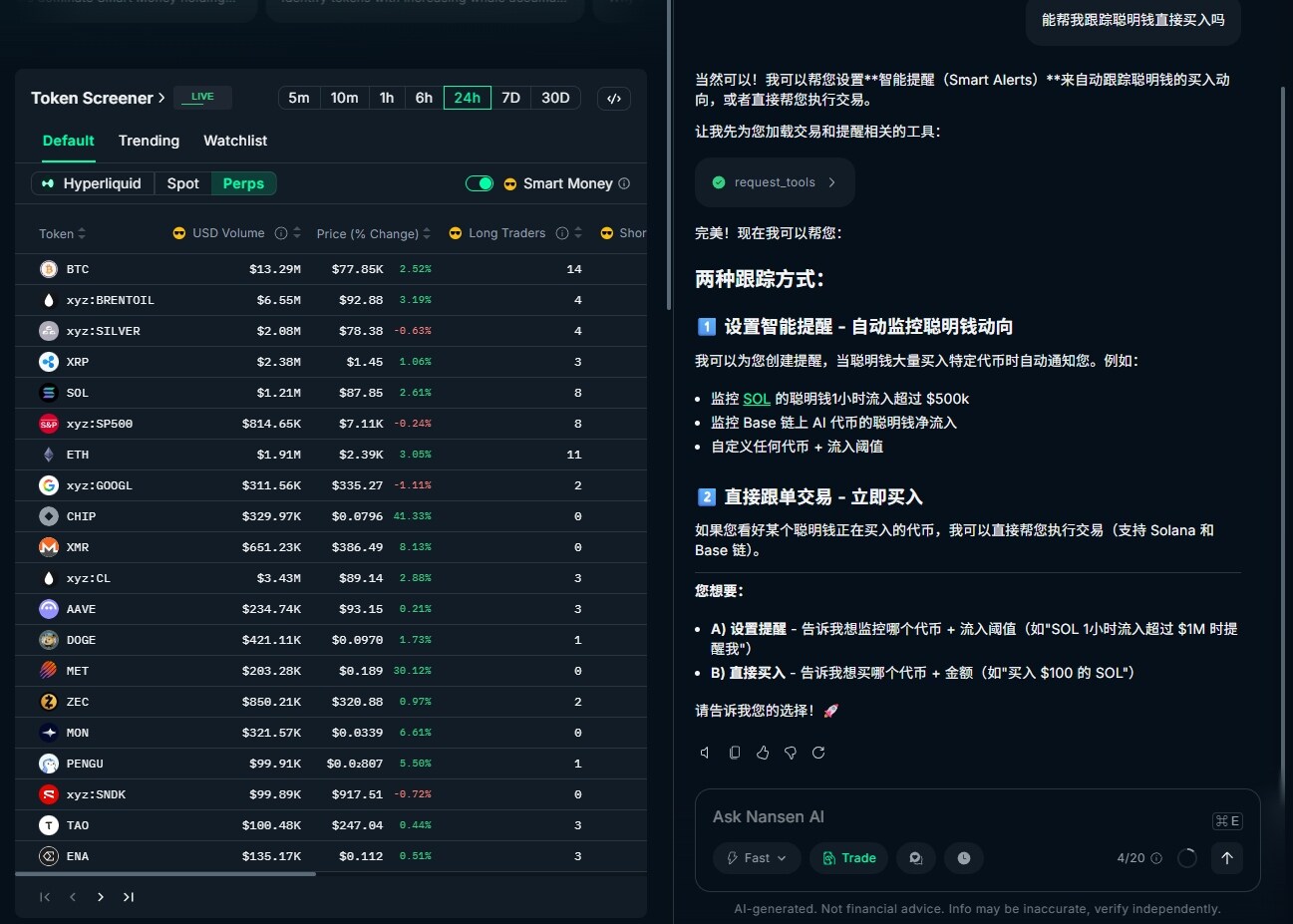
The premise for this extension comes from its long-term accumulation of on-chain data capabilities. Based on a vast database of labeled addresses and real-time data, the system can identify the source of funds, track large flows, and provide more targeted analysis results based on holdings. It is precisely this robust data foundation that allows it to handle specific operations beyond conversation.
Under this structure, Nansen AI's positioning also evolves. It is no longer just an information tool, but rather a connector between the data input layer and the operational interface in trading decisions. However, this kind of "conversational trading" is still in its early stages. AI is primarily lowering the barrier to entry and the cost of information acquisition, rather than replacing the user's strategic judgment. Whether it's asset allocation or risk control, the final decision still rests with the user.
Overall, Nansen AI represents another path for AI applications—extending further into the execution layer on top of the information layer. It doesn't change the logic of trading itself, but offers a lighter, more direct way of "completing a trade." Compared to pure information tools, this ability to connect "research" and "operation" is more likely to enter real-world usage scenarios first.
Virtuals Protocol: Turning AI Agents into "Tradeable Economies"
Once AI begins participating in operational processes, the question extends further: if these Agents are not just auxiliary tools but can independently provide services and continuously create value, can they be incorporated into a complete economic system?
Virtuals Protocol's exploration proceeds precisely along this direction.
In traditional AI products, Agents are primarily viewed as tools without an independent economic attribute. They can complete tasks but cannot directly participate in value distribution or form a sustainable business model. Virtuals' approach is to transform Agents from "functional units" into "economic participants."
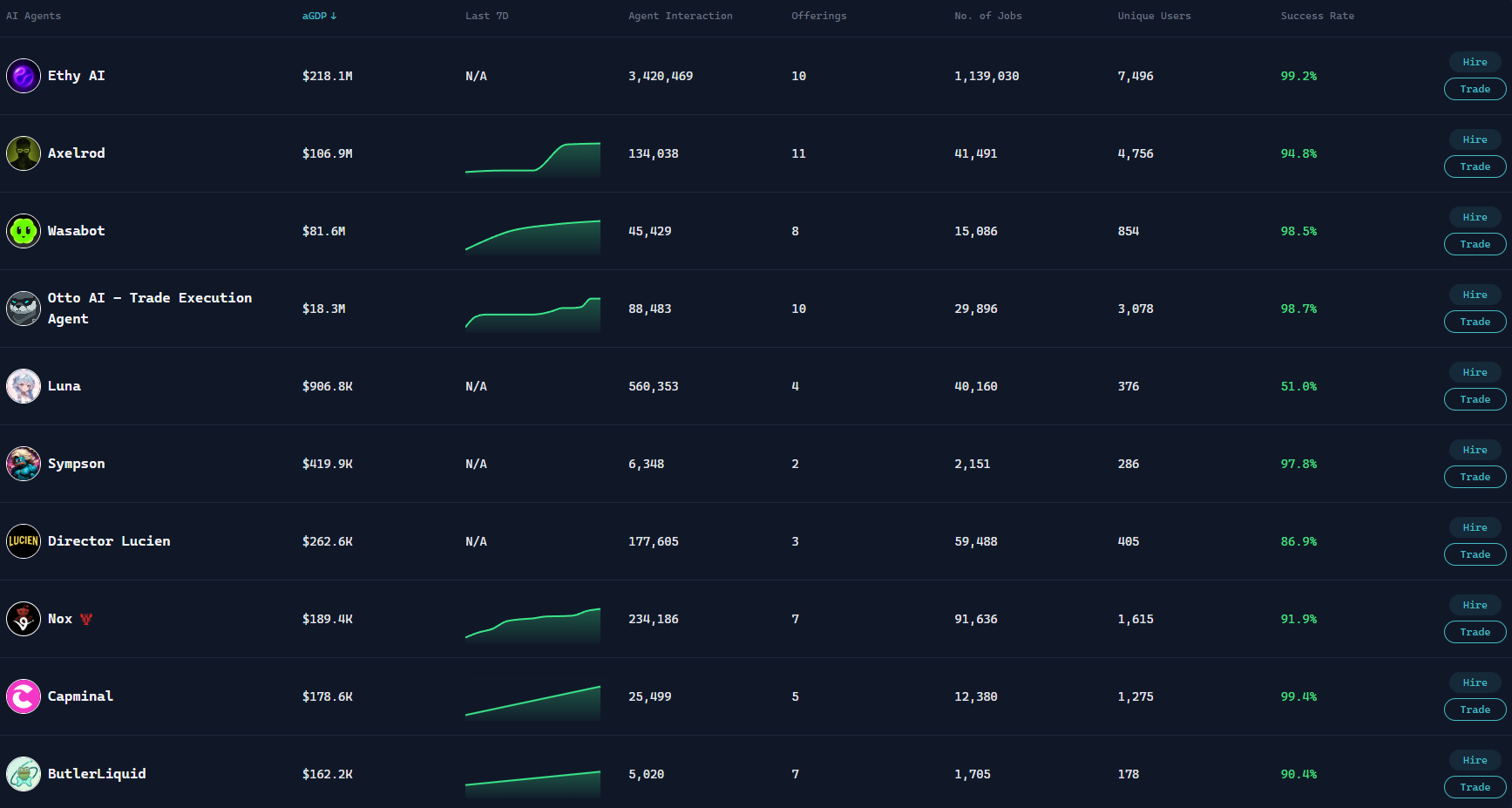
In this system, each Agent can be tokenized, granting it the ability for fundraising, incentives, and revenue distribution. Developers are no longer just launching an AI tool; they can build a complete economic model around an Agent, enabling it to generate value continuously as it is used. This makes AI less of a one-time delivered product and more akin to a long-term, value-generating asset.
Structurally, Virtuals provides a full suite of infrastructure including collaboration, settlement, and issuance. Agents can collaborate with users or other Agents to complete tasks and exchange value via on-chain mechanisms. Simultaneously, through its Launch mechanism, Agents themselves can gain liquidity support, forming a pathway for pricing and capital formation.
Compared to the previous projects that focus mainly on "how to better use AI," Virtuals is more concerned with "how AI itself can participate in economic activity." It attempts to advance AI from the tool layer into the realm of production relations, making Agents subjects capable of independently creating value.
However, at this current stage, this direction is still nascent. On one hand, there aren't many Agents with stable usage demand and revenue generation; real-world applications within the ecosystem are still being validated. On the other hand, mechanisms for collaboration, pricing, and trust between Agents need more time to be established.
From an industry perspective, Virtuals represents a more long-term trajectory within the AI + Crypto space. It doesn't directly optimize the user's current experience but tries to build a new foundational structure, endowing AI with more complete economic properties in the future. This direction might not be easily perceived in the short term, but once proven successful, it could fundamentally change AI's role in the entire system.
Warden: Making AI Agents Usable, Distributable, and Monetizable
As the number of Agents increases, the challenge often isn't their capabilities, but whether a viable usage scenario can be established. More than model capabilities or singular functions, the main difficulty for most Agents is not "whether they can do it," but "whether anyone will use them." They are scattered across different frameworks and entry points, lacking a unified distribution channel and clear payment or collaboration methods. This is where Warden comes in.
Its approach is not overly complex; it involves building a comprehensive, usable infrastructure around Agents. For users, this means accessing different Agents from a unified interface, performing operations like trading, cross-chain actions, and queries via natural language, integrating fragmented functionalities into a continuous workflow. For developers, it allows rapid creation and deployment of Agents, directly providing services to users and handling billing and settlement via on-chain mechanisms.
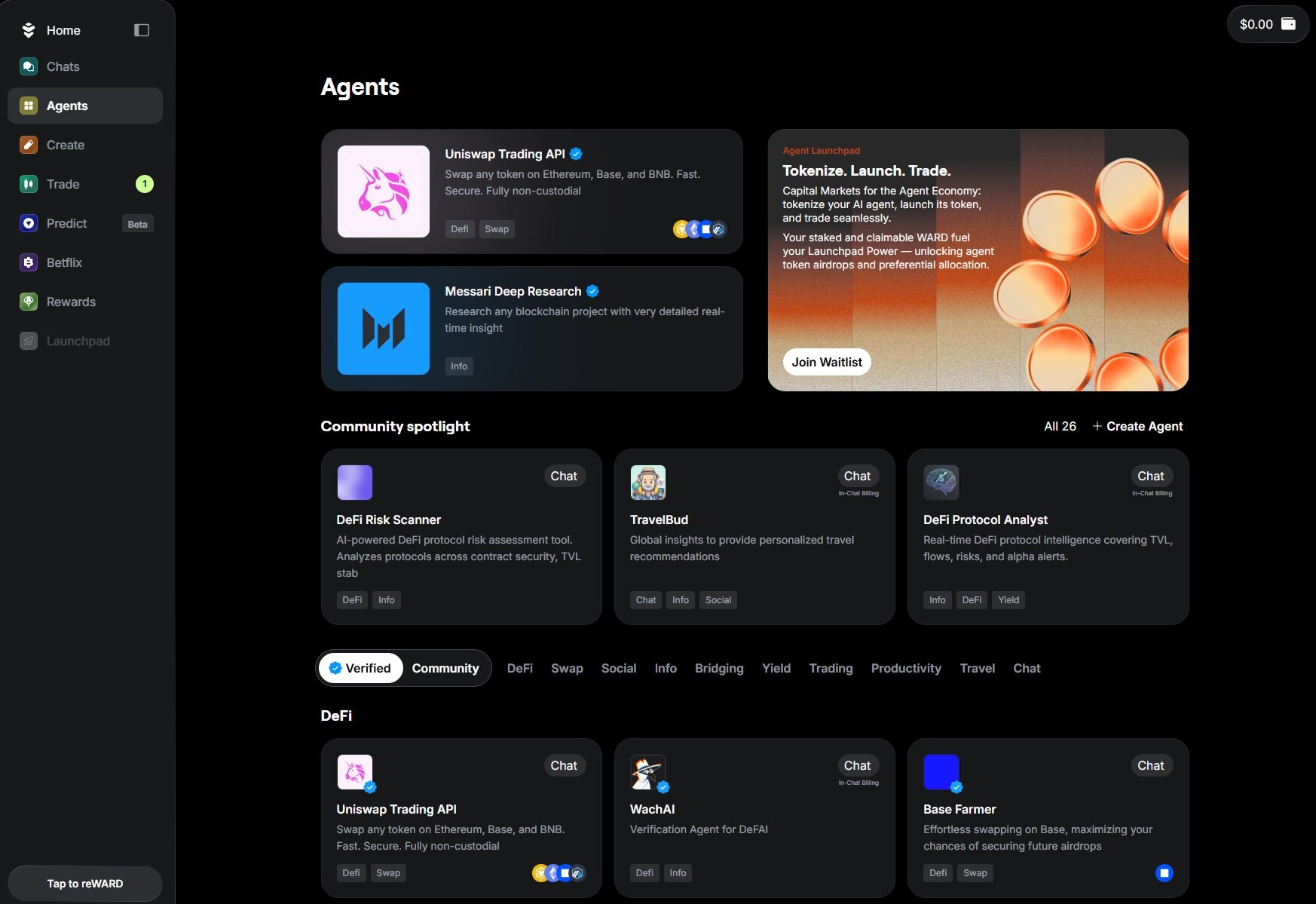
At a deeper structural level, Warden uses a dedicated chain to manage Agent identity and execution processes, giving each Agent an independent form of existence. Agents can collect fees, invoke other Agents, and gradually form collaborative relationships. Simultaneously, through a distribution portal akin to an app store, Agents can be discovered by users, preventing them from sinking into the system post-launch.
Compared to the previous AI projects, Warden is closer to a platform layer. It doesn't emphasize a specific capability; instead, it tries to organize these capabilities so they can be found, used, and form stable usage pathways.
This


