






CZ trong cuộc phỏng vấn mới: Vẫn dành 80% năng lượng cho blockchain, 10 triệu USD là đủ để tự do tài chính


- Quan điểm cốt lõi: Cựu CEO Binance CZ, sau khi ra tù và được ân xá, vẫn dành 80%-90% năng lượng cho blockchain, cho rằng ngành này là đường ray thanh toán không thể thay thế trong kỷ nguyên AI Agent, và quy mô mạng lưới giao dịch tài chính trong tương lai sẽ vượt xa hiện tại. Đồng thời, ông có thái độ thực dụng đối với sự giàu có, gia đình và di sản, nhấn mạnh vào sự đóng góp hơn là hưởng thụ cá nhân.
- Yếu tố chính:
- Trải nghiệm trong tù: CZ bị giam giữ 76 ngày tại Mỹ, trong thời gian đó ông đã sử dụng thiết bị đầu cuối thô sơ để viết sách mới, mỗi ngày 3-4 lần, mỗi lần 15 phút. Ông nhấn mạnh việc vào tù giúp ông nhận ra rõ hơn điều gì là quan trọng nhất (gia đình) và khiến ông trở nên mạnh mẽ hơn.
- Lý do được ân xá: CZ cho biết ông không thực hiện bất kỳ giao dịch nào để được ân xá, bản thân vụ án của ông có tính đặc thù (người đầu tiên vào tù vì một lần vi phạm Đạo luật Bí mật Ngân hàng). Ông đề cập đến việc phải đối mặt với sức ép vận động hành lang từ các sàn giao dịch khác tại Mỹ.
- Suy ngẫm về kinh doanh: Sai lầm lớn nhất là ngay từ ngày đầu tiên đã không tách nền tảng thành phiên bản Mỹ và phiên bản toàn cầu cũng như chặn người dùng Mỹ, dẫn đến rủi ro pháp lý sau này. Tỷ lệ người dùng Mỹ cao nhất trong lịch sử là khoảng 30%, ngay cả khi mất đi cũng không ảnh hưởng đến lợi nhuận.
- Nhận định ngành: CZ cho rằng blockchain là "công nghệ của tiền", khi các AI Agent giao dịch với nhau, tiền điện tử là lựa chọn thanh toán duy nhất. Giá trị vốn hóa thị trường hiện tại 2 nghìn tỷ USD của tài sản tiền điện tử đang bị đánh giá thấp nghiêm trọng.
- Triết lý đầu tư: Tiêu chí đầu tư của YCi Labs tập trung vào năng lực của đội ngũ và động lực theo đuổi sứ mệnh (chứ không phải động cơ kiếm tiền). Ông nói đùa rằng Musk là "người ngoài hành tinh", nhằm mục đích quay trở lại hành tinh mẹ thông qua sao Hỏa.
- Quan điểm về sự giàu có: CZ cho rằng một cá nhân cần khoảng 10 triệu USD để đạt được tự do tài chính, vượt quá 50 triệu USD thì lợi ích biên của tiền bạc đối với hạnh phúc bằng không. Ông không có ý định để lại hàng tỷ USD cho con cái mà sẽ hỗ trợ cuộc sống cơ bản và sự phát triển vừa phải của chúng thông qua quỹ tín thác.
Compiled & Translated by: Odaily TechFlow
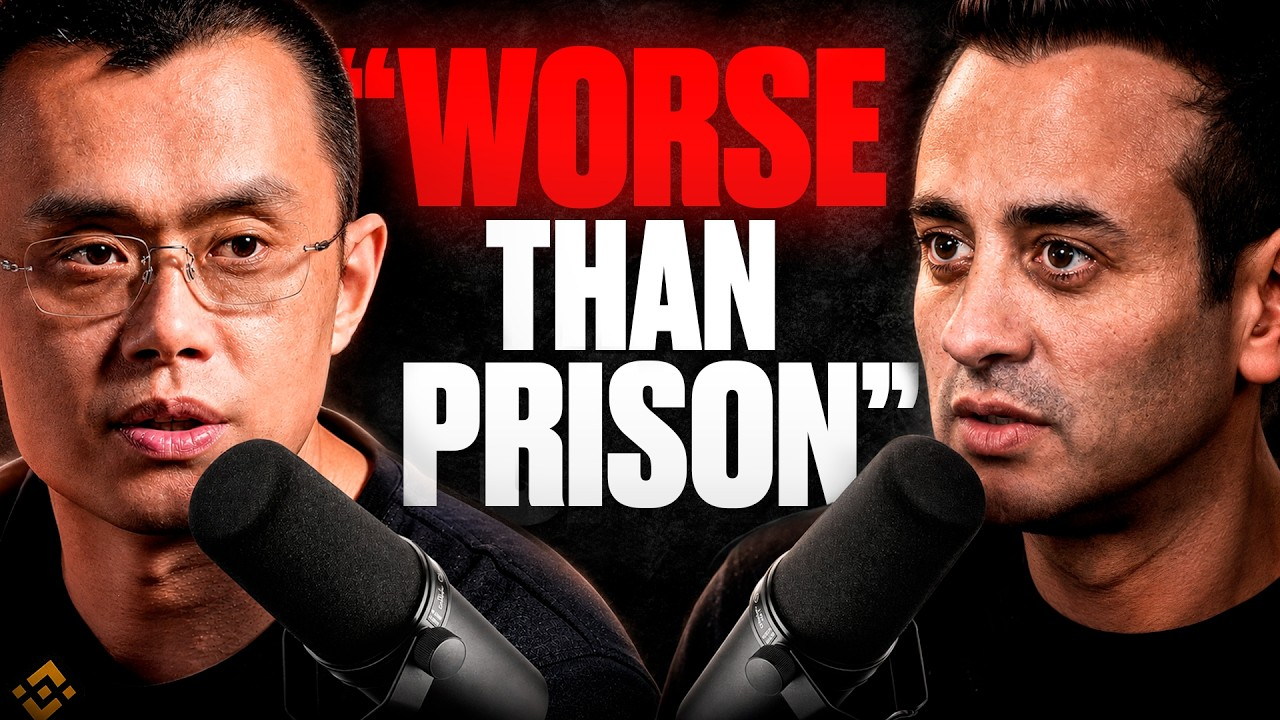
Guest: CZ, Founder of Binance
Host: Ran Neuner, CNBC Crypto Trader
Podcast Source: Crypto Banter & Crypto Insider
Original Title: CZ Life Before and After Prison, Crypto’s Future & The Freedom Of Money
Broadcast Date: May 9, 2026
Key Takeaways
In this exclusive interview, Ran Neuner engages in an in-depth conversation with CZ, the founder of Binance, exploring topics including his new book "Freedom of Money," his prison experience, the pardon process, family relationships, and the future of the crypto industry. CZ recounts writing his book in a U.S. prison, dealing with uncertainty, and reevaluating life's priorities. He also explains why he still dedicates 80% to 90% of his time and energy to blockchain. In his view, the era of AI agents will spawn a financial transaction network far larger than today's, and blockchain is likely to become its irreplaceable settlement rail. Towards the end of the interview, CZ shares his understanding of wealth, children, investment, health, and legacy: money is not the end goal; what truly matters is using one's abilities and resources to improve the world.

Highlights and Key Quotes
On 76 Days in Prison and a Mental Reset
- "I started writing in prison. I had a lot of time, but not much access to the outside world. I had no internet, only a very basic terminal, 15 minutes at a time. Once the time was up, I'd get kicked off. That terminal couldn't copy-paste, so I had to type everything myself."
- "Newspapers wrote I was the richest man to ever enter a US prison, and the only one incarcerated for a single violation of the Bank Secrecy Act. So before going in, my lawyer told me: 'You are the primary target for extortion.'"
- "No one in US history has gone to jail for a single violation of the Bank Secrecy Act, not even today. I am the only one, the first and only. So I was special, and they treated me specially. I didn't know what other 'special treatment' might come."
- "After getting out, I wrote in the book that I don't really care about reputation, or even legacy that much. I don't care what others think of me. What I care about is how I see myself when I grow old."
- "Very clearly, it's people. I miss my family, my children, my loved ones, and my friends. When everything is taken away, you figure out what you miss the most."
On the Pardon, Citizenship, and US Crypto Regulatory Competition
- "To get the pardon, there was absolutely no deal. My lawyer was very clear: you don't want to get into more trouble trying to get a pardon."
- "We did face very strong lobbying, counter-lobbying, and reverse lobbying. Some of our perceived competitors in the US didn't want me to get pardoned. Other American crypto exchanges didn't want me pardoned because they feared Binance returning to the US. That's business competition."
- "Unrelated to the negotiations, I was invited to become a UAE citizen. ... But I didn't use the UAE nationality. I didn't want to use it as a tool to just 'hide here.' Getting it actually motivated me more to go to the US and resolve the issue, rather than rely on it."
- "When you were convicted, one condition was you couldn't run Binance anymore. After the pardon, that's gone for me personally, so I have no restrictions. But for the company, there may or may not be some restrictions remaining."
Business Reflection: CZ’s Biggest Past Mistakes
- "If I could go back now, I would have built two platforms from the start: one Binance US and one Binance Global, and blocked US users from day one. It would have saved a lot of trouble."
- "US users never exceeded 30% of our user base at any point. At different stages, it was maybe 10%, 20%, 30%. ... We were profitable within 3 months, and very profitable. So even losing 30%, we probably would have survived."
- "But what I learned later is that the US looks back many years. They look back at what you did in the past."
- "I'm much more cautious in business now, but I won't have every tweet reviewed by lawyers. ... On the business side, I involve more lawyers now. That's something I learned. Law is my weakness; I don't have a legal background."
Crypto x AI: Why the Crypto Rail is Severely Underestimated
- "Blockchain is about money, it's the technology of money. We will always need money, and we will need more, more efficient, and freer money."
- "I still put 80% to 90% of my time, money, and energy into blockchain. AI and biotech are great, but they aren't my expertise."
- "Based on what I see today, Bitcoin still holds dominance and has the endurance to continue dominating. Nothing can replace Bitcoin yet."
- "It's not just AI-to-AI trading; it's one AI representing a person trading with another AI representing another person on the other side of the world. I don't see a substitute; that money must be crypto."
- "It will definitely far exceed $2 trillion, and it will far exceed our current monetary system. The future monetary system will be much larger than today's."
Wealth, Trusts, and the Hard Numbers of "Financial Freedom"
- "I won't give my children a lot of money. For the adult children, I told them: if you want to live comfortably for the rest of your life, I can support that. But if you want luxury – sports cars, private jets, yachts, big houses – you have to earn it yourself."
- "I won't leave them billions of dollars. I might leave them tens of millions in assets, structured through trusts. They get a certain amount each year when young, less when younger, more when older."
- "I want to use most of my money while I'm alive. I don't really believe in the 'donate to charity at the end of life' approach. I think that's a terrible way to use funds because you can't truly control it anymore."
- "For almost everyone on earth, $90 million is enough... But I think for a normal life, $10 million is enough for financial freedom. What I mean by $100 million is that beyond that, there's really no difference. If you have $100 million and say you're unhappy, thinking $200 million will make you happier – that's crazy, it won't work."
- "Beyond $50 million, the difference is zero. If you obsess over using money to make yourself happy, you will be unhappy."
- "When I'm old and sick in bed, I hope to look back and say: I tried my best to contribute to the world I came into. I want to leave this world a little bit better than I found it."
YZi Labs Screening Logic & Elon Musk's "Alien Theory"
- "I don't look at shiny things, or flashy 'great brands' or 'genius new ideas.' I look at very fundamental things."
- "I look for people who really believe in their mission, who would do it even without money. If you just want to make money, I think you'll stop at a point of relative success, but you won't become a great company in history. So it's these two things: capability and mission."
- "I think Elon doesn't care about money. My theory is that he's an alien, and he wants to go back to his home planet. Mars is just a transit station. That's my theory, half-jokingly, half-seriously."
"The Freedom of Money": CZ’s New Book Launch
Host Ran Neuner: When did you start writing your new book, "The Freedom of Money"?
CZ:
I started writing it in prison. I had a lot of time, but not much access to the outside world. I had no internet, only a very basic terminal, 15 minutes at a time. Once the time was up, I'd get kicked off. The terminal couldn't copy-paste, so I had to type everything myself. I couldn't easily delete either; if I deleted something, I had to retype it. So basically, I just poured out whatever was in my head and emailed it to my assistant and a friend.
After getting out of prison, it took about another year and a half to fully complete. It took me about 6 months to write the book, but there were many rounds of editing after that. Each round of editing was a 400-page document, taking 2 to 3 weeks.
Host Ran Neuner: Before someone writes a book, what goes through their mind? Why do it? You went to prison, likely scared, nervous, anxious. Why was your first reaction to write a book? What were you thinking?
CZ:
There were a few reasons. Firstly, in prison, I wanted to keep myself busy. Writing a book is a good project; you don't need anything else, just to be in your head and write things down. So I was constantly trying to queue up for the computer.
More importantly, people say writing a book is actually writing to yourself. You're having a conversation with yourself, reviewing your life, thinking about what's important, what has meaning, what's not important, what's interesting, and then writing it down.
After getting out, I also felt it was a natural turning point in my life, the closing of a chapter. I originally wanted to publish it immediately upon release, but it took longer. In the following months, I was also applying for a pardon, not knowing when it would come. When the pardon finally came, I was quite surprised, and I thought it would serve as a great ending for the book.
Host Ran Neuner: Tell me about the experience of writing in prison. You mentioned sometimes having computer access. People outside don't really know what it's like inside, we only see it in movies. Did you write with pen and paper? Was there just one computer? Could it access the internet? How did it work exactly?
CZ:
Our unit had 200 inmates and 4 terminals. You had to line up to use the computer. Once on, you had only 15 minutes. The computers had no internet, just a messaging app for contacting pre-approved contacts, up to 30 people. I only had two contacts: my assistant and my friend.
So I'd get on for 15 minutes. After my time ended, I had to wait a few hours before I could use it again and re-queue. I could probably use it 3 to 4 times a day. I also had paper and pen, but I just used a sheet to jot down points for the next writing session. When I got on the computer, I typed as fast as I could. This writing process lasted for a few months.
Host Ran Neuner: You were there for 4 months. Was the writing task solely to keep yourself busy, counting down the days while keeping your mind occupied?
CZ:
Pretty much. Technically, I was in prison for 76 days. Then I went to a halfway house, where I could go out to an office but still with significant restrictions. That lasted about 3 to 4 weeks. For the last 14 days of my sentence, I was re-incarcerated. The book covers this; I couldn't write during those last 14 days because I had no access to anything.
Host Ran Neuner: What was the scariest part of prison? Was it the moment you walked in, or some point during your stay?
CZ:
Before going in, you don't really know what to expect. Newspapers wrote I was the richest man to enter a US prison, and the only one jailed for a single BSA violation. So my lawyer told me beforehand: "You're the prime target for extortion." The question was, how to protect myself from being extorted? I didn't know what form the extortion would take. What if someone put a knife or a metal bar to my neck? How to avoid that? So we did a lot of preparation, which caused a lot of mental anxiety. The book doesn't cover this part much.
But actually going in, the intake process itself was a bit scary. You walk into a unit with 200 strong men all looking at you. In the end, I found most inmates are fairly reasonable people. Some are criminals, some shouldn't be there, some have been there too long.
Then the worry was: would they keep me there forever? Find other charges? Find other reasons? Especially when I got to the halfway house. I was supposed to be transferred to home confinement for the last 9 days. But on the 13th day from the end, police came, handcuffed me, and sent me back to a detention center. The detention center was worse than the prison because it's temporary and has nothing. That's when I started thinking, are they adding new charges? The mental stress was immense.
Even on the day I was supposed to leave, I was very nervous. Even on the plane, I didn't relax. I waited until the plane left US airspace.
Host Ran Neuner: Sounds like you have a lot of PTSD or distrust of the system. I feel that distrust comes from you probably not expecting to go to prison. The whole process seems like the rules can change at any time; there's no fixed rulebook.
CZ:
Exactly right. Any lawyer can tell you that no one in US history has gone to prison for a single BSA violation, not even today. I am the only one. So I was special, and they treated me specially. I didn't know what other "special treatment" might come.
Five days before my sentencing, Senator Elizabeth Warren declared war on crypto. This was during the Biden administration, and there was indeed a war on crypto, so there was a lot of uncertainty. I was a special case, not knowing what to expect. Even my sentencing judge said he couldn't follow precedent because I was a special case.
Host Ran Neuner: You're a special case. When you walk outside, people approach you and you have a lot of respect here. What was it like in prison? When did inmates know who you were? Did they respect you, or were you just another inmate with a number for a crime?


