






太空狗分流再掀骂战:meme币的「正统性」究竟谁说了算?


"Splitting" has always been a contentious topic within the meme coin space, and indeed the entire cryptocurrency market.
Retail investors generally loathe this phenomenon, primarily for the following reasons:
- It’s not easy to establish a sufficiently large narrative, especially in a market with poor liquidity where no meme coin with a market cap over $1 billion has emerged for a long time. Splitting creates more market chaos and makes trading more difficult.
- In most cases, splitting is triggered by influential figures calling for it. In the eyes of retail investors, these influential figures themselves have advantages in terms of capital and trading. They should cooperate and pool their strength to push an already rising asset to higher levels, rather than refusing to "bid it up" simply because the price is already high.
- During the splitting process, influential figures’ rhetoric almost inevitably involves "promoting one while disparaging another." While draining liquidity, this causes even greater harm to the original asset.
Men die for wealth, birds die for food. For a long time, the debate around "splitting" has had its logic, but the final output is often an "emotional output with logical reasoning." Retail investors, who are already in a passive position, experience profit erosion or even losses due to splitting. Cursing is entirely justified and understandable. But when we calm down and think about it, is there a way to overcome the phenomenon of "splitting"? Can this never-ending debate within the crypto circle ever come to an end?
How to Determine "Legitimacy"?
If we hope to one day eliminate "splitting," we first need to address a fundamental question: How exactly is a token deemed "legitimate"?
Let's start with the recent "Space Dog split." This theme was considered the biggest meme coin opportunity recently after Elon Musk agreed to make the "Space Dog" Asteroid the mascot for Space X. The split revolves around two corresponding $ASTEROID meme coins on ETH and SOL:
- $ASTEROID ETH: The $ASTEROID on the ETH mainnet has been operational since September 2024, but after March 2025, its official Twitter account became less active, posting only every few months. The official website linked in its bio is also no longer accessible. They once donated 0.5% of the token supply to St. Jude Children's Research Hospital, the same beneficiary as the proceeds from artist Liv Perrotto's Asteroid Shiba plush toy sales, used to fund childhood cancer treatment. However, that was back in 2024. Nevertheless, their past charitable deeds cannot be erased, and the market recognized the community's past efforts. Even before Musk tweeted about making Asteroid the new Space X mascot, its market cap had already surpassed $160 million.
- $ASTEROID SOL: Liv Perrotto's mother, Rebecca Perrotto, claimed approximately 2013 SOL in fee revenue from the $ASTEROID on SOL. This coin was launched via the Bags platform, and its total fee revenue has now reached 2291 SOL. Rebecca Perrotto has explicitly stated that all revenue from the Bags platform will be used to establish a foundation in memory of Liv Perrotto.
From a trading perspective, both sides have their merits. The $ASTEROID on ETH, in particular, aligns more closely with the unwritten rule long held by crypto natives for determining "legitimacy"—recognize the OGs and the community.
But analyzing it calmly, the root of the "split" lies in Rebecca Perrotto, Liv Perrotto's mother, claiming the fee revenue from SOL $ASTEROID and announcing her intention to use it to establish a foundation in memory of Liv Perrotto. This action provided the angle for the "split."
After Liv Perrotto's passing, Rebecca Perrotto, as the current owner of the IP, her stance is the ceiling for this angle. She has previously expressed her attitude towards the ETH $ASTEROID in a comment under a tweet about Aster listing ETH $ASTEROID:
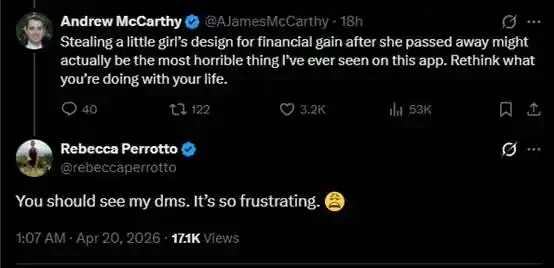
@AJamesMcCarthy stated that profiting from a deceased little girl's creative design is despicable. Rebecca Perrotto replied, "This is just so disheartening."
Here, the author will not make any subjective or emotional judgment about this stance itself. I can only assume that given Rebecca Perrotto's unfamiliarity with cryptocurrency, she might not be fully aware of the charitable deeds previously undertaken by the $ASTEROID on ETH.
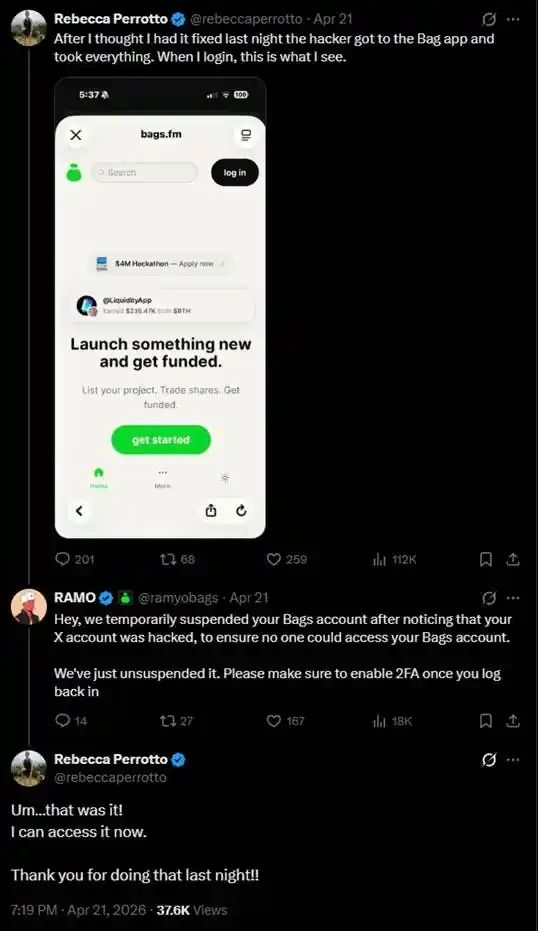
As for the $ASTEROID on SOL, she can directly receive fee revenue from it, and there may have been some communication involved. When her Bags account was hacked, members of the Bags team responded promptly:
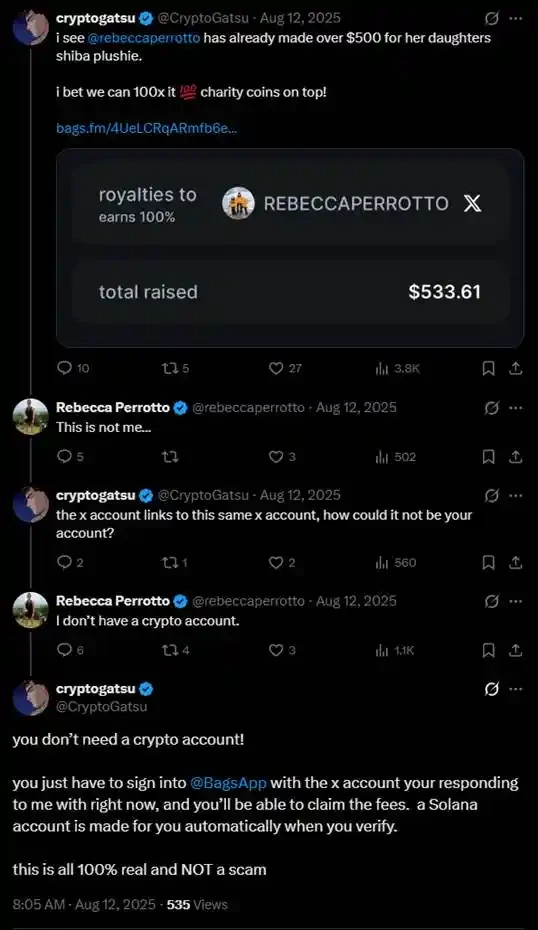
The $ASTEROID on SOL had already caught Rebecca Perrotto's attention when it was launched back in August last year. At that time, her stance was to clarify her relationship with it and did not offer any further response regarding the fees:
You might say, why does Rebecca Perrotto's stance matter? The on-chain capital has already chosen the $ASTEROID on ETH. She can express her opinions all she wants; why can't we unite and avoid splitting?
For short-term price fluctuations, it indeed doesn't matter. If Space X doesn't officially announce Asteroid as its new mascot on social media, neither the $ASTEROID on ETH nor SOL is likely to break through to higher ceilings.
But if it is officially announced, and the coin gets listed on exchanges, who Rebecca Perrotto, as the IP owner, grants authorization to becomes very important.
Let's review the final outcome of the Neiro vs. NEIRO controversy (quoted from @0xVeil):
"In April 2025, the Neiro CTO project reached the most milestone event in its history: it passed a collaboration with OwnTheDoge's decentralized autonomous organization (DAO), officially obtaining the global exclusive IP license for the Neiro name and image from kabosu mama herself, becoming the sole legitimate heir of the legendary Doge meme.
The most direct impact of this was that the legal team for the Neiro CTO project sent copyright infringement notices to major trading platforms, requesting the delisting of all unauthorized 'Neiro' token contracts. The primary target was NEIRO ETH. Although it wasn't listed on Binance spot, it was on various other second-tier exchanges, including Binance futures.
The major trading platforms responded swiftly, successively announcing the delisting of infringing Neiro perpetual futures or spot trading pairs. With that, NEIRO ETH was completely finished."
Whoever holds the copyright can not only rightfully get listed on exchanges but also rightfully prevent other coins with the same name and concept from being listed. Therefore, our discussion on "determining legitimacy" is not an attempt to rank the $ASTEROIDs on ETH and SOL. Because this legitimacy struggle for IP with clear ownership is not merely the current intra-circle shouting match vying for existing capital; it is a "realistic problem that must be faced if the ceiling ever truly opens."
Both $ASTEROID on ETH and SOL should now establish good communication with Rebecca Perrotto as soon as possible, explaining their operational strategies and philosophies. It doesn't necessarily have to be about purchasing a license, but at least establishing a "tacit approval" like $PEPE—yes, $PEPE to this day has not obtained a license from Pepe IP creator Matt Furie, but Matt earned about $600,000 by selling $PEPE tokens gifted to him by the community. He has never publicly commented on $PEPE, but he also hasn't taken any legal action against it. It's worth noting that for other Pepe-related crypto assets, he has successfully used DMCA takedown notices to get OpenSea to delist multiple unauthorized Pepe NFT projects (such as the Sad Frogs District in 2021, which had a trading volume of $4 million).
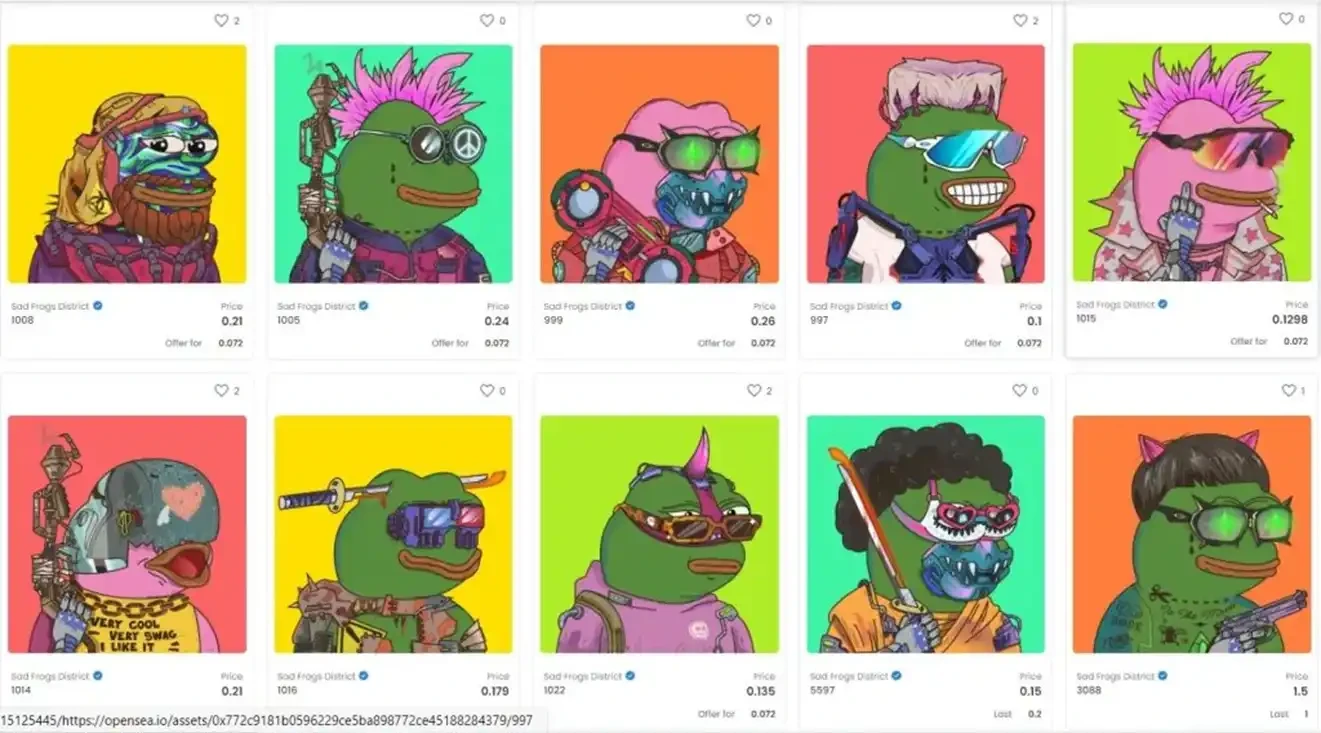
The former Sad Frogs District
Returning to the title of this section, how to determine "legitimacy"? Here, the author's first answer is not so much a definition as it is a piece of advice: For meme coins with clear IP ownership, if there is a genuine determination to build a memecoin that reaches Binance and achieves a market cap of billions of dollars, please urge and assist the token community you support to negotiate IP-related matters.
How to Determine "Legitimacy" for Ownerless IP?
Many memes are, in fact, "ownerless."
For example, Wojak is a classic anonymous internet meme with no single verifiable creator or legal copyright owner. Its origins can be traced back to the Polish imageboard Vichan around 2009, first appearing under the filename "ciepłatwarz.jpg" (warm face.jpg). It became popular on platforms like 4chan after being promoted in 2010 by an anonymous user nicknamed "Wojak" on Krautchan (a now-defunct German imageboard).
Because it was born from the culture of anonymous/pseudonymous imageboards, where images are quickly shared and modified by the community, it has no formal author attribution, copyright registration, or public declaration. Wikipedia, KnowYourMeme, and related analytical articles clearly state that the original author is unknown and difficult to trace, making it essentially a public domain meme, a piece of public cultural heritage resulting from collective internet creation.
Another example is NEET, a typical descriptive term from public policy/sociology. The abbreviation was first coined in 1996 by a senior British Home Office civil servant to replace a previously more controversial term. Copyright laws in various countries explicitly exclude "ideas/facts/short phrases," meaning no individual, company, or institution can claim exclusive intellectual property rights (copyright, trademark, etc.). It is also essentially a public domain meme.
In such cases, just let the market decide who is the "legitimate one." In reality, if we look beyond meme coins, truly powerful crypto assets have never feared "splitting":
- In the blocksize war, the "OG" Bitcoin was the one laughing last.
- Regarding the Ethereum rollback and the transition to PoS, the "OG" Ethereum was the one laughing last.
- Midday not only doesn't restrict derivative series on various chains but even encourages this creativity to "plant flags" on chains outside the ETH mainnet.
This brings us to another question: How do we establish a standard of victory that convinces the market and gains universal recognition?
Only by solving this problem can "splitting" be fundamentally cured.
Exploring a Cure for "Splitting"
Meme coins are not without value. Without delving too deeply into the specific value of meme coins here, we need to consider another question: Why has it always been said that meme coins have no value?
Because, for all these years, we haven't established a value assessment framework for meme coins.
Although retail investors have some unwritten rules—like recognizing OG coins, looking at community activity, and assessing cultural influence—these rules are inherently fragmented. Since pump.fun drastically lowered the cost of launching a meme coin, people have become accustomed to quick trades, and these unwritten rules are on the verge of becoming ineffective.
Murad proposed a compelling "meme coin supercycle" theory, but unfortunately, it currently seems to have become a short-term "narrative angle" rather than a consensus trading logic like P/E ratios or industry outlooks for stocks.
Some launchpads have implemented measures to address the "splitting" problem, such as prohibiting the deployment of new tokens with the same ticker within a certain timeframe. However, this is difficult to promote widely as it doesn't suit the needs of bundlers looking to launch, control supply, pump, and dump new projects, nor is it conducive to the platform's own profitability.
CEXs, as the largest liquidity hubs in the crypto space, are best positioned to lead the market in establishing a value assessment framework for meme coins. We've seen attempts like community voting for listings, but such measures face too many interfering factors.
By establishing a rigorous listing mechanism for meme coins, CEXs have the ability to guide the meme coin market towards a more serious direction, leveraging cultural influence to demonstrate its positive externalities at the consensus level.
Some measures the author can conceive include:
- For meme coins with clear IP ownership, CEXs should consider the resolution of IP ownership as a critical criterion for listing, especially when splitting occurs.
- For meme coins without IP ownership, set a sufficiently long observation period before listing, using multi-dimensional criteria such as thematic culture, social media data, and community activity for long-term tracking and observation.
- For all listed meme coins, publish a complete listing research report.
Cultivating a convincing value assessment framework for meme coins marks the beginning of meme coins evolving into a serious sector within the crypto space, and even a cultural industry.


