






美股下一场风暴,会是美债掀起的吗?未来一周至关重要


- 核心观点:美国长期国债收益率急剧攀升,市场对美联储政策公信力产生质疑,债市波动率飙升并正向股市等风险资产传导压力,未来一周关键事件或加剧市场震荡。
- 关键要素:
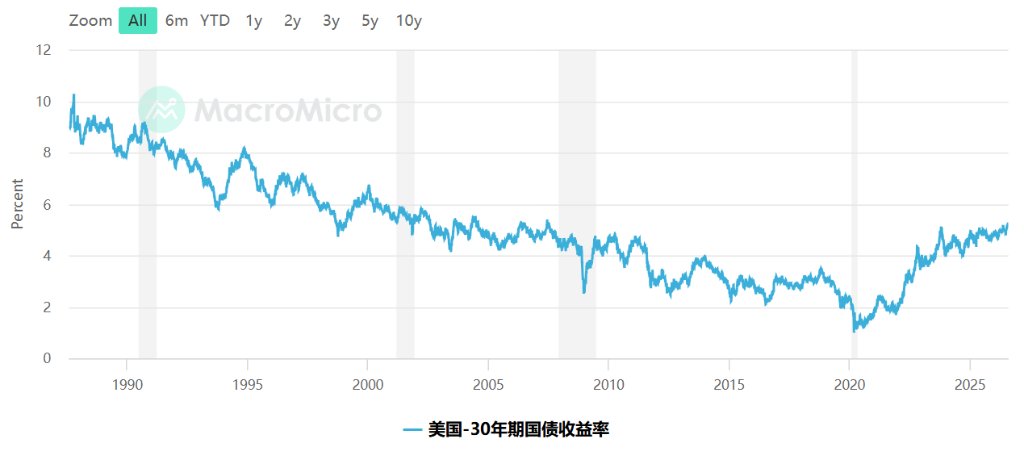
- 30年期美债收益率触及2007年以来最高水平,10年期收益率突破自2023年底以来的交易区间。
- ICE美银MOVE指数升至5月以来最高点,TLT看跌期权偏斜度飙升至2008年金融危机以来最高水平,显示对冲需求急剧扩大。
- 上周美联储利率决策委员会出现罕见分歧,三位地区联储行长投票支持加息,导致收益率曲线急剧压缩。
- 通胀率已连续五年高于2%政策目标,投资者质疑美联储重新加息的意愿,加息概率"显著上升"。
- 长端收益率上行与油价下跌呈现背离走势,相关性减弱加剧市场不确定性。
- 本周美国财政部融资计划细节及7月非农就业报告将发布,可能引发新一轮债市波动。
- 美日当局进行了历史性协调干预以稳定日元,动机或包含防范美债市场再度波动。
Original Author: Xu Chao
Original Source: Wall Street CN
The U.S. Treasury market is sending increasingly intense pressure signals to other asset classes, with equities bearing the brunt.
Long-term Treasury yields surged last week, with the 30-year yield hitting its highest level since 2007, while the 10-year yield broke above the trading range that had held since late 2023.
Meanwhile, the ICE BofA MOVE index, a measure of expected volatility in the Treasury market, rose to its highest level since May. Demand for put options betting on falling bond prices has surged, with Cboe data showing that the one-month put skew tied to the iShares 20+ Year Treasury Bond ETF has spiked to its highest level since the 2008 financial crisis.
In the week ahead, with the release of the U.S. Treasury's quarterly refunding details and the July nonfarm payrolls report, turbulence in the bond market could intensify further.
Bob Elliott of Unlimited Funds recently wrote in a commentary: "It's hard to tell how much longer other asset markets, like equities, can hold up at current interest rate levels without being dragged lower." Gennadiy Goldberg, head of U.S. rates strategy at TD Securities, also warned that uncertainty surrounding the Federal Reserve's policy guidance, compounded by geopolitical and other noise, has left markets fraught with danger.
Fed Credibility Questioned, Long-End Yields Break Higher
The core driver behind this leg of the Treasury yield rally is market skepticism over the Fed's policy credibility.
Since Kevin Warsh took the helm at the Federal Reserve, he has taken a hawkish stance on inflation. But with inflation having run above the Fed's 2% target for five consecutive years, investors are beginning to doubt whether the Fed genuinely has the resolve to resume rate hikes.
Last Wednesday, the Fed's rate-setting committee showed a rare split—three regional Fed presidents voted in favor of a rate hike, diverging from the majority stance. When Warsh wrapped up his press conference last week, long-end yields suddenly jumped while short-end yields fell in tandem, sharply compressing the spread between the two. According to Dow Jones Market Data, this marked the largest "Fed decision day" yield curve flattening since 2023.
Goldberg of TD Securities said: "The market is questioning just how committed the Fed really is to controlling inflation." He also noted that while the base case remains no rate hikes in either this year or next, the probability of hikes has "risen significantly."
Rising Bond Market Volatility, Surging Hedging Demand
The yield moves quickly rippled into the derivatives market, sending hedging demand sharply higher.
The ICE BofA MOVE index hit its highest level since May, signaling that traders are actively hedging against the risk of further upside in rates.
At the same time, the ratio of put volume to call volume on the iShares 20+ Year Treasury Bond ETF (TLT) has risen notably. Cboe analysts noted that the one-month TLT put skew has surged to its highest level since the 2008 financial crisis.
Particularly noteworthy is that this leg of long-end yield increases has diverged from crude oil prices—oil has fallen rather than rising in tandem with yields, further weakening the correlation between yields and oil and adding to market uncertainty.
Spillover Effects Emerging, Equities Face Growing Pressure
Turbulence in the Treasury market has historically been a precursor to equity market risk, and the current situation is no exception, leaving equity investors on edge.
Bob Elliott pointed out in his commentary that whenever Treasury yields reach or approach current levels, pressure tends to spread to other markets, with equities the first to suffer. The 30-year Treasury yield now stands at 5.239%, while the 10-year yield is at 4.693%, both in historically elevated territory.
Goldberg also acknowledged that geopolitical uncertainty stemming from the situation in Iran, ambiguous Fed policy guidance, and a host of other market noise have combined to create a fragile market environment. "All sorts of uncertainties are interwoven," he said.
Multiple Event Windows Ahead, a Key Week of Testing
The coming week will be a critical window for determining whether this bout of Treasury market pressure spills over more broadly.
Later this week, the U.S. Treasury will release the latest details of its government financing plans, and any upside surprises could trigger another round of bond market volatility. Several major economic data releases are also scheduled this week, culminating in Friday's July nonfarm payrolls report, which will significantly influence market expectations regarding the Fed's policy path.
In addition, last week the U.S. Treasury and the Federal Reserve, in coordination with Japanese authorities, conducted a historic coordinated intervention to stabilize the persistently weakening yen. Analysts believe that the U.S. participation in the intervention was partly motivated by a desire to prevent another outbreak of volatility in the Treasury market.
The $30 trillion U.S. Treasury market is the cornerstone of the global financial system—serving as core collateral for short-term institutional liquidity and as the benchmark pricing anchor for trillions of dollars in debt worldwide. Once this "sleeping giant" begins to stir persistently, the tremors will extend far beyond the bond market itself.


