






摩根大通:跌了28%后仍喊12500点,韩国去杠杆完成大半,监管收紧限制反弹弹性


- 核心观点:摩根大通认为韩国KOSPI指数近期约28%的下跌本质是杠杆踩踏和集中持仓调整,而非基本面恶化,因此维持市场超配和12500点目标,但强调波动高企、监管收紧和AI需求持续性仍是关键风险。
- 关键要素:
- 杠杆出清显著:韩国杠杆ETF资产规模从6月底约500亿美元降至260亿美元,去化约75%;对冲基金多空比率已从超5.5倍降至低于4倍,去杠杆进度过半。
- 外资卖压高度集中:年内外资净流出超1100亿美元,其中约90%来自三星电子和SK海力士两大记忆体股,随着权重回落,被迫抛售压力可能缓解。
- 波动率异常高企:韩国波动率指数VKOSPI与美国VIX的比率接近5倍,远高于常态水平(约1倍),显示市场尚未恢复平静。
- 监管收紧限制反弹:韩国金融委员会暂停单一股票杠杆产品上市并提高保证金门槛,限制了杠杆资金快速卷土重来的空间。
- 盈利预期仍在上修:韩国市场2026年EPS过去6个月上调143.4%,科技板块(+215.5%)和工业板块(+91.0%)上调显著,支撑来自AI相关需求。
TL;DR
- J.P. Morgan states KOSPI has dropped approximately 28% from its June high, but maintains an overweight on Korea and a 12,500-point target.
- Leveraged ETF assets are estimated to have fallen from around $50 billion to $26 billion, and hedge funds have also completed more than half of their deleveraging.
- Selling pressure is concentrated on Samsung Electronics and SK Hynix, and tighter regulation of single-stock leveraged products will still limit the rebound's flexibility.
In a July 21 research report, J.P. Morgan estimates that South Korea's KOSPI index has fallen by approximately 28% from its June 22 peak. While leveraged ETF and hedge fund positions have contracted significantly, the bank maintains an overweight rating on the Korean market and keeps its 12-month KOSPI base target at 12,500 points.
The central thesis isn't a simple bet on a rebound but interprets this sharp sell-off in the Korean stock market as a leverage-driven stampede and a concentrated position adjustment. According to J.P. Morgan's data, the size of Korean leveraged ETFs has dropped from about $50 billion at the end of June to the current $26 billion, representing approximately 75% of the required reduction. The deleveraging progress for equity hedge funds is also more than halfway through. Foreign outflows year-to-date exceed $110 billion, with about 90% coming from the two major memory stocks, Samsung Electronics and SK Hynix.
However, a reduction in positions doesn't mean the market has returned to calm. Volatility in the Korean stock market remains elevated, with the VKOSPI/VIX ratio nearing 5x, compared to a typical level of around 1x. Tight swap capacity, tighter regulation of single-stock leveraged products, and whether AI demand can continue to support the memory and industrial chains remain the boundary conditions for determining whether this correction is truly nearing its end.
Deep Decline, but Selling Pressure Resembles a Position Stampede
The magnitude of this decline in the Korean stock market has been severe. KOSPI hit a record closing high of 9,114.55 on June 22 but had already fallen over 20% from its peak by early July. Based on the level around 6,516 points around July 21, the decline from the peak is approximately 28.5%.
J.P. Morgan's premise for maintaining the 12,500-point target is that this decline is not due to a sudden collapse in fundamentals but rather a concentrated unwinding of previously overcrowded trades. The Korean market had been rapidly rising, driven by AI, the memory upcycle, and expectations of corporate governance reform, with some funds amplifying exposure through leveraged ETFs, swaps, and long/short fund positions. When volatility increased, liquidations and redemptions in turn exacerbated the decline.
The four-week retreat in the price momentum factor, close to -26%, points to the same issue: stocks that had risen the most and were most crowded with capital faced the most significant downward pressure.
However, volatility itself hasn't normalized. The VKOSPI/VIX ratio near 5x indicates that domestic Korean market volatility is far higher than in the US market. While position pressure is decreasing, price fluctuations could still amplify in the short term.
Leveraged ETFs Drop from $50 Billion to $26 Billion
The most prominent unwinding has occurred in leveraged ETFs.
J.P. Morgan estimates that the assets under management (AUM) of Korean leveraged ETFs have decreased from about $50 billion at the end of June to the current $26 billion, achieving a reduction rate of about 75%, approaching the more acceptable level of $18 billion they identify.
This figure shouldn't be simply interpreted as massive investor redemptions. Cumulative fund inflows over the period remain positive, with the decline in AUM primarily driven by the underlying market's fall. This means net purchases haven't completely disappeared, but the price decline has passively contracted the leveraged exposure.
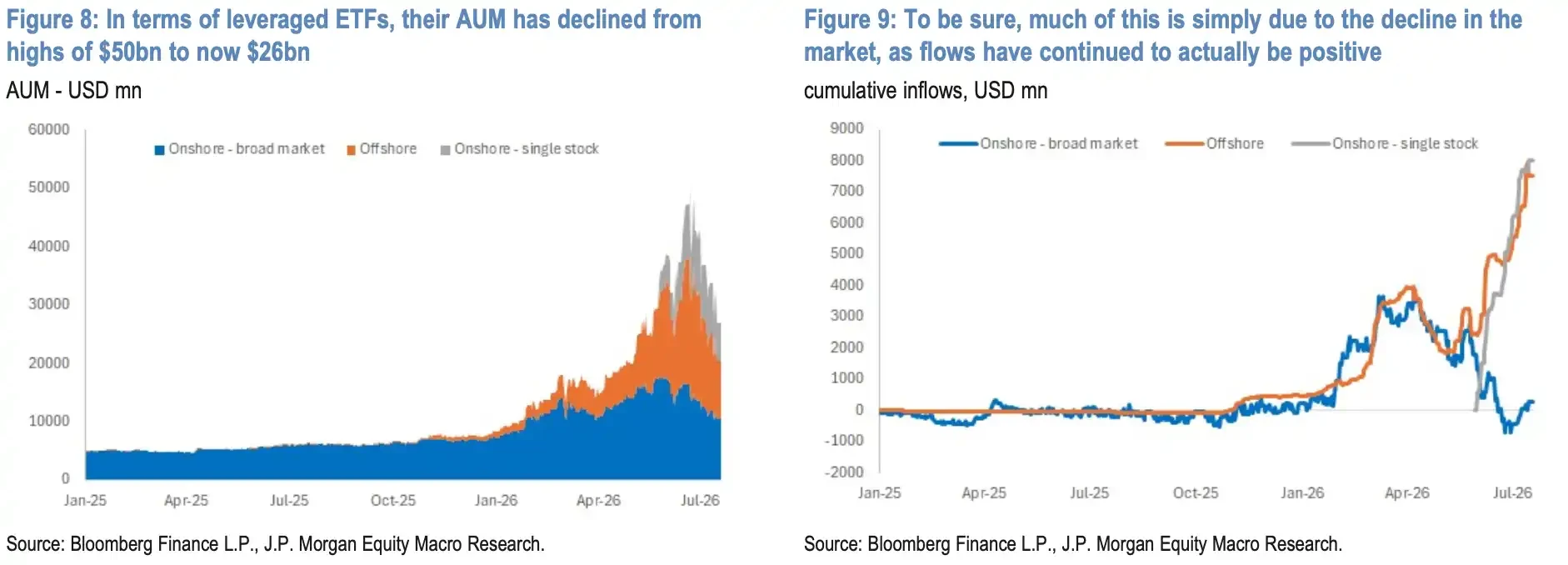
Leveraged ETF AUM decreased from ~$50B to $26B, but cumulative fund flows remain positive.
This is why J.P. Morgan believes substantial progress has been made in deleveraging. If the size of leveraged products remained elevated, every market decline could trigger more passive selling. With the AUM halved, the amplification effect of the same price fluctuation on subsequent selling pressure is weakened.
Horizontally, Korean retail investors' margin debt is not extreme. The research report shows that South Korea's margin balance is approximately $21 billion, representing 0.5% of total stock market capitalization. Leveraged ETFs amount to about $26 billion, or 0.7% of total market cap. In comparison, the US margin balance accounts for about 1.9% of market cap, and leveraged ETFs about 0.3%. China's A-share market margin balance is about 2.8%, with leveraged ETFs accounting for nearly 0%.
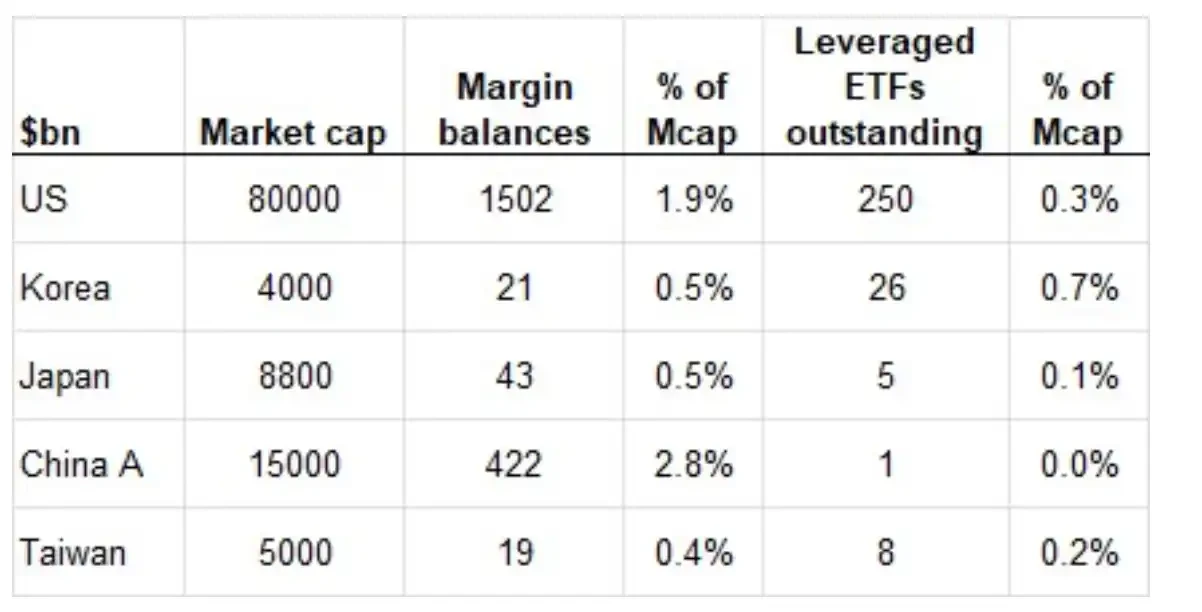
Korea's margin balance stands at $21 billion, or 0.5% of market cap; leveraged ETFs at $26 billion, or 0.7%.
This comparison suggests that Korea's problem isn't abnormally high margin debt, but rather the relatively high presence of leveraged ETFs in the market. Retail investors remain significant buyers in the Korean stock market, with several leveraged products still ranking high in overseas stock purchases since June. Sentiment has not completely cooled; the decline and regulatory expectations have simply reduced the scale of leverage first.
Hedge Fund Selling Pressure Also Declined, But Not Yet Normal
Another key trend in deleveraging comes from hedge funds.
J.P. Morgan's Prime brokerage book shows that equity hedge fund deleveraging has exceeded 50%, with the long/short ratio dropping from a peak of over 5.5x to below 4x. This indicates that funds which increased positions during Korea's rapid rise over the past year have already cut a significant portion of their exposure.
The index drop of ~28% suggests prices have adjusted, while the decline in the long/short ratio indicates that the fuel for "forced selling" is also diminishing. If the long/short ratio continues to fall, the cascading selling pressure caused by overstuffed positions will be lower than it was at the end of June.
However, being below 4x doesn't mean things are completely normal. The deleveraging process still has ground to cover before returning to normal conditions. Tight swap capacity and abnormal volatility haven't fully subsided. In a concentrated market like Korea, once funding channels narrow, the drawdown in popular stocks can be amplified, especially for core holdings previously supported by AI and the memory chain.
A "75% reduction" also cannot be directly equated to a confirmed bottom. The market can retreat from its most crowded state, but as long as volatility remains high and funding tight, remaining positions could still amplify declines on certain trading days.
Foreign Selling Concentrated in Two Major Memory Stocks
The structure of foreign capital flows is more critical than the total amount.
According to J.P. Morgan's July 21 report, year-to-date net foreign outflows from the Korean stock market exceed $110 billion, with about 90% originating from Samsung Electronics and SK Hynix. Public reports from late June cited a similar metric around $95 billion, with subsequent figures likely updated due to market declines and foreign selling.
This type of concentrated outflow is different from a full-scale exodus from Korea. The weighting of these two major memory stocks in the MSCI EM Index has already fallen from 9.5% and 8.3% at the end of June to 7.5% and 5.7%, respectively. As their weighting decreases, the pressure for funds constrained by mandates, benchmark weights, or concentration limits to continue selling will ease.
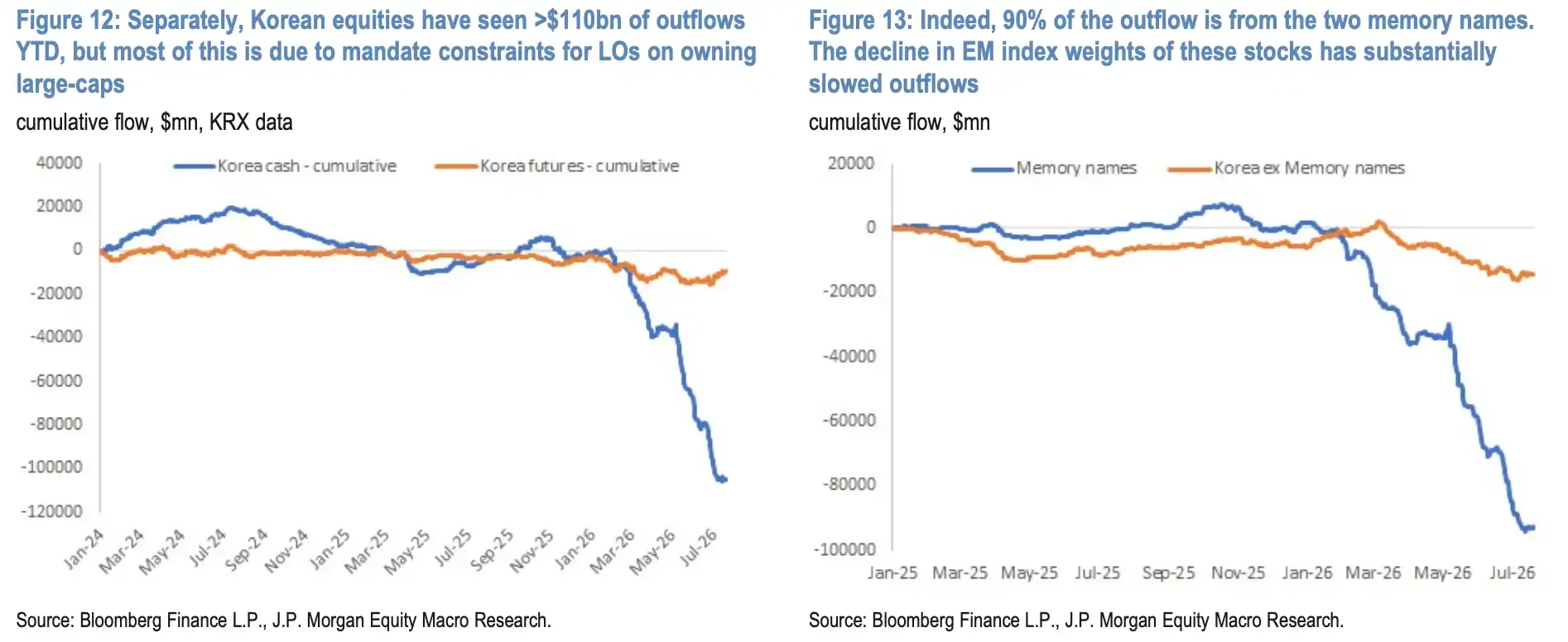
Year-to-date foreign outflows exceed $110 billion, with ~90% coming from the two major memory stocks.
This is also a key reason why J.P. Morgan maintains its overweight on Korea. If foreign capital were selling Korean assets across the board, the problem would be more akin to a systemic decline in confidence. If selling pressure is mainly concentrated on two overweighted memory stocks, as their weights decrease and position limits ease, the market's stress dynamics will be different.
The risk is concentrated here as well. The core support for the Korean market remains tied to AI capital expenditure, data center construction, and high-end memory demand. Should the market begin to question the sustainability of AI computing investment, or anticipate technologies that reduce the need for high-end memory, Samsung Electronics and SK Hynix will once again act as amplifiers for foreign flows and index volatility.
Single-Stock Leveraged Products Tightened, Making a Quick Leverage Comeback Unlikely
South Korean regulators have started to cool down high-leverage trading.
The Korean Financial Services Commission confirmed in a July 16 announcement the suspension of new listings for single-stock leveraged, inverse, and covered call products. The minimum deposit requirement will be raised from KRW 10 million to KRW 30 million, expected to be implemented by August 5. From August 19, only cash will be accepted for initial margin. Starting in November, the minimum trading unit for listed single-stock leveraged products in Korea is planned to be increased from 1 share to 20 shares.
These measures are not aimed at all leveraged ETFs but focus specifically on single-stock leveraged products. The impact is not to immediately push the index higher, but to limit the re-expansion of leveraged products. Even if retail sentiment remains strong, the capacity to rapidly amplify exposure through small trades and non-cash margin will decrease.
This explains why J.P. Morgan, while bullish on Korea, still emphasizes the impact of regulation. If the regulation provides only short-term suppression, leveraged funds might re-accumulate through other products or markets. If the new rules remain in effect, the volatility amplification mechanism in the Korean stock market will weaken.
AI Earnings Upgrades Persist, but So Do AI-Related Risks
Another reason for J.P. Morgan's optimism is that Korean earnings expectations are still being revised upwards.
The report shows that the 2026 EPS for the Korean market has been revised up by 143.4% over the past six months, with the tech sector up 215.5% and the industrial sector up 91.0%. Despite the significant stock price pullback, analysts' revisions to future earnings remain robust, particularly concentrated in AI-related tech and industrial supply chains.
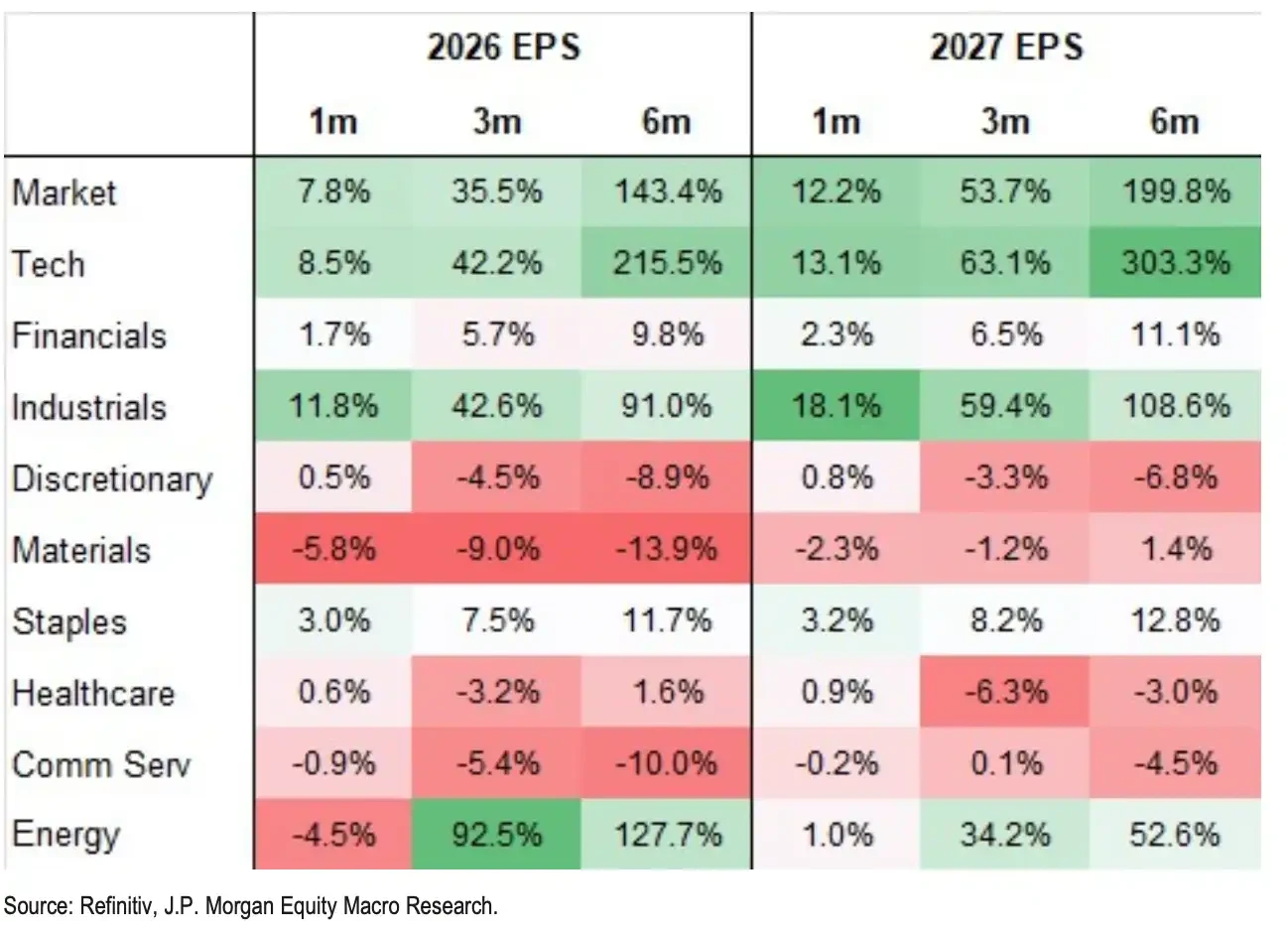
Korea market 2026 EPS revised up 143.4% in six months; tech sector up 215.5%; industrials up 91.0%.
Factors supporting these upgrades include hyperscale computing investment, data center construction, security and resilience spending, and the medium to long-term expectations for Korean corporate governance reform. For the Korean market, memory, servers, industrial equipment, and related supply chains remain the most direct beneficiaries.
The risk also comes from the same direction. The fundamental anchor for this rally in the Korean stock market is highly dependent on the AI cycle. If AI capital expenditure slows down, or new technologies reduce the demand for high-end memory and related hardware, the earnings upgrades could be re-evaluated. The relative weakness in sectors like materials and consumer goods also indicates that the Korean market's improvement is not synchronized across all industries.
J.P. Morgan's 12,500-point target rests on a combination of conditions: continued progress in deleveraging, AI demand not being invalidated, and easing concentrated foreign selling pressure. What can be said currently is that the most crowded positions in the Korean market have notably loosened. What cannot yet be said is that volatility has returned to normal, foreign capital has turned consistently to net inflows, or that earnings upgrades for the AI chain are fully locked in.


