






花ิตี้: ปรับเพิ่มน้ำหนักจีนเป็น Overweight ปรับลดเกาหลีใต้เป็นการชั่วคราว


- มุมมองหลัก: ฝ่ายวิจัยของซิตี้ชี้ว่าการปรับตัวขึ้นของตลาดเกิดใหม่ในปี 2028 มีการกระจุกตัวสูงในเกาหลีใต้และไต้หวันของจีน ซึ่งเป็นระดับสูงสุดในรอบ 25 ปี คำถามหลักในช่วงครึ่งปีหลังคือแนวโน้มขาขึ้นจะกระจายตัวในวงกว้างหรือไม่ จากเหตุผลดังกล่าว จึงปรับเพิ่มน้ำหนักจีนเป็น Overweight และปรับลดเกาหลีใต้เป็น Neutral ในการดำเนินกลยุทธ์
- ปัจจัยสำคัญ:
- การปรับตัวขึ้นของดัชนี MSCI Emerging Markets กระจุกตัวอย่างมาก โดยเกาหลีใต้และไต้หวันของจีนเป็นตัวขับเคลื่อนการปรับขึ้นเกือบทั้งหมด ค่าความแตกต่างของผลตอบแทน (return dispersion) พุ่งสูงขึ้นสู่ระดับสูงสุดในรอบ 25 ปี
- ภาวะตลาดขาขึ้นที่กระจายตัวในวงกว้างจำเป็นต้องมีเงื่อนไขสองประการพร้อมกัน: ข้อมูลเศรษฐกิจมหภาคที่ดีขึ้นและการปรับเพิ่มประมาณการกำไรในวงกว้าง รวมถึงการชะลอตัวชั่วคราวของแนวโน้มขาขึ้นในกลุ่มเทคโนโลยี/AI
- ประมาณ 85% ของการปรับเพิ่มประมาณการกำไรต่อหุ้น (EPS) ของ MSCI Emerging Markets สำหรับปี 2569 มาจากกลุ่มเทคโนโลยีสารสนเทศ (IT) ซึ่งบ่งชี้ว่าการปรับเพิ่มประมาณการกำไรยังไม่กระจายตัวอย่างกว้างขวาง
- ซิตี้ปรับลดน้ำหนักเกาหลีใต้จาก Overweight เป็น Neutral เนื่องจากแรงกดดันสามประการ ได้แก่ ข้อกังวลเกี่ยวกับการใช้จ่ายด้าน AI การใช้มาร์จิ้นของนักลงทุนรายย่อยที่เพิ่มความผันผวน และปัจจัยอื่นๆ
- ซิตี้ปรับเพิ่มน้ำหนักจีนจาก Neutral เป็น Overweight ด้วยเหตุผลว่ามีสถานะการลงทุนเบา สภาพแวดล้อมเศรษฐกิจมหภาคที่ดีขึ้น และ valuation ที่น่าสนใจ พร้อมตั้งเป้าหมายดัชนี Hang Seng สิ้นปี 2569 ที่ 29,600 จุด
- ซิตี้คงเป้าหมายดัชนี MSCI Emerging Markets สิ้นปีที่ 1,870 จุด ( upside ประมาณ 12%) และคงน้ำหนักการลงทุนโดยรวมต่อ EM ไว้ที่ Neutral
Original Author: Long Yue
Original Source: Wall Street CN
The performance of emerging markets this year has been a feast for a select few – and Citi believes the core question for the second half of the year is whether this feast can broaden out.
The MSCI Emerging Markets Index has risen approximately 20% year-to-date, marking one of its best starts to a year on record. However, according to *Flow of Funds*, Citi Research stated in its *Emerging Market Equity Strategy 2026 H2 Outlook* released on July 19th that this rally is "extremely concentrated," with South Korea and Taiwan contributing virtually all of the index-level gains. This level of concentration is historically very rare. The bank's data shows that the cross-sectional dispersion of returns among major emerging market (EM) countries has soared to its highest level in 25 years.
Citi believes that rising AI volatility has exposed concentration risks, while China, with light positioning and an improving macroeconomic environment, is well-positioned for a "rally broadening." The bank sets a Hang Seng Index target of 29,600 points and a CSI 300 target of 5,600 points by the end of 2026.
Rally Concentration Hits 25-Year High, "Broadening" Becomes Core H2 Theme
The bank's analysts pointed out that a genuine "broadening rally" requires two conditions to be met simultaneously:
First, evidence of a cyclical recovery – improving macro data and earnings upgrades spreading to a wider range of sectors and regions.
Second, a temporary pause in the Tech/AI leadership momentum – allowing room for other sectors to catch up in relative performance.
Currently, both conditions are "partially met."
On the macro front, the bank's Economic Data Change Index has been trending upward overall since May, and the Citi Economic Surprise Index (CESI) remains positive, but the magnitude of improvement is significantly weaker than in developed markets. The Iran conflict previously brought stagflationary shocks, lowering growth expectations and raising inflation expectations, particularly impacting energy-importing countries like ASEAN. The bank's commodity strategists maintain a baseline forecast of Brent crude oil averaging $75/barrel in Q3 and falling to $65/barrel early next year. If oil prices decline as expected, it would benefit the stock markets of South Korea, Taiwan, and India.
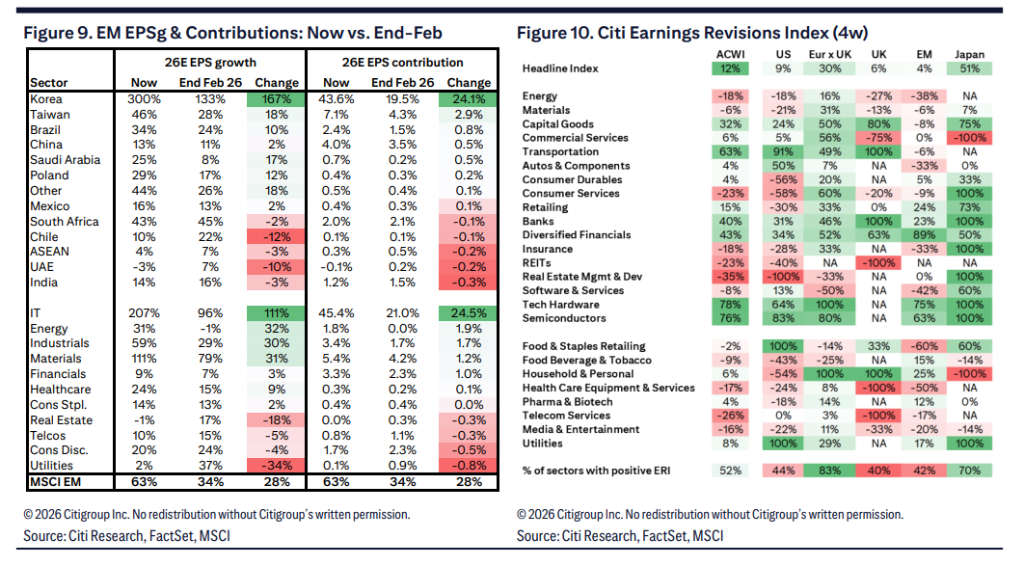
On the earnings front, the issue is more pronounced. The expected EPS growth rate for MSCI Emerging Markets in 2026 has been raised by 28 percentage points since the end of February, but approximately 85% of that comes from the IT sector. Currently, the overall EM EPS growth expectation is +63%, with the IT sector contributing about two-thirds. In Citi's tracked EM Earnings Revision Index (ERI), only 42% of sectors show net upward revisions, with clear positive direction only in Technology and Financials. In contrast, earnings upgrades in Japan and Europe are already showing a broader broadening trend.
Tactical Downgrade of South Korea, Upgrade China to Overweight
Based on the above judgment, Citi has made three key adjustments to its EM country allocations:
South Korea: Overweight → Neutral (Tactical)
The bank has held an Overweight position on South Korea since July 2025. However, recent South Korean market volatility has been severe, with KOSPI implied volatility far exceeding comparable global markets.
Analysts point to three pressures underlying the volatility: uncertainty over the sustainability of AI capital expenditure, local resistance to data center construction, and the rising threat of open-source models to frontier AI labs. Furthermore, the influx of retail investors and the use of leveraged products have further amplified volatility.
The bank's quantitative data shows that KOSPI long positioning has reverted from extremely overweight to neutral, but has not yet turned into net short. Analysts stated, "Although South Korea still performs exceptionally well in our fundamental models, given the volatility in current trading conditions, we are tactically downgrading to Neutral."
South Korean local strategists maintain their year-end target for the KOSPI at 10,000 points (approximately 47% upside from current levels) and expect the memory shortage to intensify further in 2027. They anticipate the memory upcycle will continue, with operating profit forecasts for memory manufacturers in 26/27 reaching 58.53 trillion KRW and 76.36 trillion KRW, respectively, accounting for 65% of total KOSPI 200 operating profits.
China: Neutral → Overweight
Citi has been cautious on Chinese equities this year, primarily due to weak relative EPS momentum. The logic for this upgrade, however, lies in China being a strong candidate for a "broadening rally" – light positioning, favorable macro conditions from lower oil prices and improving global growth, along with still-attractive valuations.
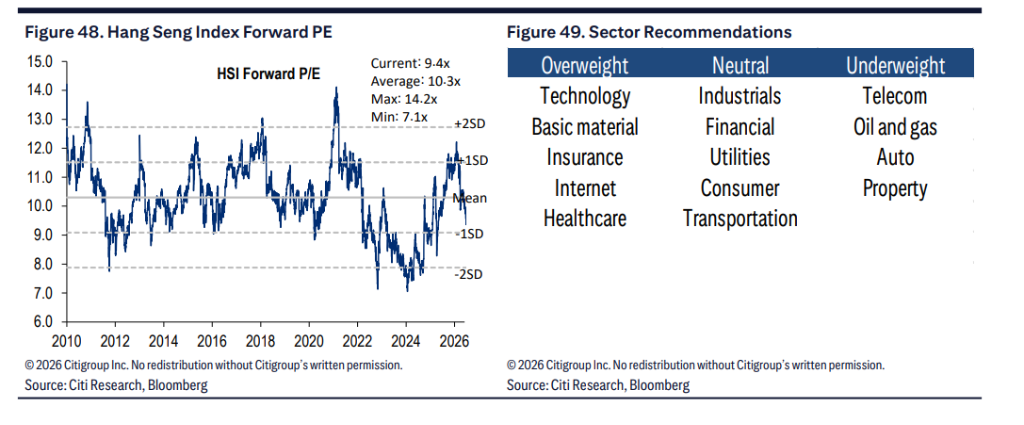
The bank's China strategist, Pierre Lau, pointed out that the Hang Seng Index is currently trading at 9.4 times 2026 forward P/E and 1.1 times P/B, both below historical averages (10.3 times P/E, 1.2 times P/B). The bank's China economists expect room for PBoC rate cuts and accelerated fiscal policy deployment, with these marginal positives likely to support the market.
Analysts set a year-end 2026 target of 29,600 points for the Hang Seng Index and a mid-2027 target of 30,500 points; CSI 300 targets are 5,600 points and 5,700 points, respectively; MSCI China targets are $92 (year-end 2026) and $97 (mid-2027), implying approximately 31% upside from current levels.
Mexico: Underweight → Neutral
Mexico has continuously underperformed this year, weighed down by uncertainty over the USMCA renegotiation outlook and expectations of tighter policy. However, similar to China, Mexico performs well in Citi's "broadening candidate" framework and has the lightest positioning among EMs. The bank sets a year-end 2026 target of 70,000 points for the Mexico IPC Index and a mid-2027 target of 73,000 points.
AI Theme: Structurally Bullish, But Short-Term Volatility Inevitable
Citi clearly states that it will not fully exit Tech/AI exposure due to short-term volatility.
Three reasons are given:
First, free cash flow for Asian memory manufacturers is projected to rise sharply in 2026-27, a stark contrast to US hyperscalers' FCF nearing zero, indicating that the global tech profit pool is still expanding.
Second, Citi's South Korean local strategists believe that memory shortage signals will further strengthen in 2027, with the trend of memory customization and growth in AI tokens driving the upcycle's continuation.
Third, the fundamentals of the EM tech sector remain solid: the EPS growth rate in the IT sector far outpaces global peers, earnings upgrades are sustained, and valuations are attractive relative to peers.
The bank also notes that for investors looking to hedge AI exposure, Saudi Arabia, India, and Mexico have lower correlations with the Bloomberg AI Index and could serve as effective hedging tools.
Target Prices and Overall Allocation Framework
Citi maintains its MSCI Emerging Markets year-end target of 1,870 points, implying approximately 12% upside from current levels, and introduces a first-time mid-2027 target of 2,050 points (approximately 20% upside). The target is based on conservative EPS growth assumptions (approximately 40-45%, below consensus) and a slight contraction in valuation multiples.
Among the bank's local strategists, the most optimistic views are on South Korea and China, with targets for both implying approximately 40% upside.
At the global allocation level, the bank currently maintains a Neutral stance on EM (relative to Global), citing that EM still faces AI volatility risks and macro complexities (geopolitics, Fed, El Niño). A return to Overweight would require seeing a genuine inflection point in EPS across the broader market.
The bank's global Bear Market Checklist (BMC) is currently at its highest level since the financial crisis, but has not yet triggered an "excessive euphoria" signal. Historical patterns show that in the late stages of a bull market, market-cap-weighted indices tend to persistently outperform equal-weight indices – suggesting that Tech-led leadership may continue until market euphoria ends.
Quantitative Perspective: EM Valuations Cheapest, Fund Inflows Slow
Citi's quantitative strategists note that in the global "World Radar" model, EMs have the cheapest relative valuations globally and rank the highest overall.
However, fund flows are not encouraging: Global and US fund inflows continue to surpass EM funds, and inflows to EM funds (excluding China) have nearly stalled. China funds have seen net redemptions year-to-date, but have started seeing minor inflows in recent weeks.
South Korea experienced continuous net foreign outflows in Q2, with cumulative net outflows from South Korea reaching approximately $97 billion. Congestion in the Tech sector has further increased, making it the most crowded sector in Asia, with the Information Technology sector's crowding score reaching 60%.


