对话Bitget CEO:rToken上线一个月AUM破亿,下一阶段做什么?


- ประเด็นหลัก: rToken หุ้นสหรัฐฯ ของ Bitget มี AUM ทะลุ 100 ล้านดอลลาร์อย่างรวดเร็ว ซึ่งยืนยันถึงความต้องการของผู้ใช้คริปโตที่มีต่อสินทรัพย์ทางการเงินแบบดั้งเดิม แต่จุดแข่งขันในระยะต่อไปจะเปลี่ยนจากปริมาณสินทรัพย์ไปสู่บัญชีรวมข้ามสินทรัพย์และการเพิ่มประสิทธิภาพของเงินทุน
- ปัจจัยสำคัญ:
- AUM ของ rToken อยู่ที่ 114 ล้านดอลลาร์ ปริมาณการซื้อขายสะสม 670 ล้านดอลลาร์ ปริมาณการซื้อขายพุ่งสูงในช่วงที่ตลาดผันผวนในวันหยุดสุดสัปดาห์ ซึ่งเน้นย้ำถึงคุณค่าของการซื้อขายตลอด 24 ชั่วโมง 7 วัน
- ผู้ใช้แบ่งเป็น 3 ประเภท: ผู้ใช้ที่เกิดในระบบคริปโตให้ความสำคัญกับประสบการณ์การซื้อขาย; นักเทรดข้ามสินทรัพย์ให้ความสำคัญกับคุณภาพการดำเนินการและการเชื่อมต่อตลาด; ผู้ใช้สถาบันให้ความสำคัญกับ API, หลักประกันแบบรวม และการจัดการความเสี่ยง
- ความแตกต่างของผลิตภัณฑ์คือการเชื่อมต่อโดยตรงกับสภาพคล่องของ Nasdaq และ NYSE (ความลึกของคำสั่งซื้อดีกว่าคู่แข่ง 50-100 เท่า) และใช้วิธีการจัดการเงินปันผลแบบเดียวกับโบรกเกอร์แบบดั้งเดิม ซึ่งช่วยลดต้นทุนในการทำความเข้าใจของผู้ใช้
- ระยะต่อไปจะเน้นการสร้าง "บัญชีรวมข้ามสินทรัพย์" เพื่อให้สามารถใช้ rToken เป็นหลักประกัน, การกู้ยืมแบบมีหลักประกัน และฟังก์ชันขั้นสูงอื่นๆ เพื่อเพิ่มประสิทธิภาพของเงินทุน
- ในอนาคตจะระมัดระวังในการเปิดตัวหุ้นนอกสหรัฐฯ (เช่น หุ้น A, หุ้นฮ่องกง) ซึ่งมีข้อจำกัดหลักมาจากกฎระเบียบในท้องถิ่นที่ไม่ชัดเจนและความเสี่ยงด้านความเป็นไปได้ของผลิตภัณฑ์
- อัตราส่วนสำรองของ rToken จะคงไว้ที่ 100% อย่างเคร่งครัด และมีรายงาน POR รายวันจากผู้ตรวจสอบบัญชีบุคคลที่สามเพื่อรับประกันความโปร่งใสของสินทรัพย์
- จากมุมมองเชิงกลยุทธ์ rToken คือการตรวจสอบที่สำคัญของ Bitget ในการผลักดัน "UEX" (Universal Exchange) ซึ่งมีเป้าหมายเพื่อเชื่อมช่องว่างการจัดการระหว่างสินทรัพย์คริปโตและสินทรัพย์แบบดั้งเดิม
After US Stock Token rToken's AUM Surpasses $100 Million, What's the Next Focus?
Gracy: The US stock token rToken launched in early June, and its AUM surpassed $100 million within about a month. As of July 6th, the AUM reached $114 million, with a cumulative trading volume of $670 million. The growth rate exceeded our expectations and also validated the genuine demand among crypto users for traditional financial assets like US stocks.
This demand is reflected not only in the size of holdings but also in trading activity. During a weekend when the Middle East situation changed and the US stock market was closed, rToken's weekend trading volume was 10 times that of the previous week, and about 2.2 times higher than the average weekend level in June. We see that more and more users are starting to use rToken as a tool for allocating global assets during periods of market volatility, not just for long-term holding. Although the absolute trading volume of US stock tokens on weekends is still in its early stages, the moments of market fluctuation have already highlighted the importance of 24/7 trading.
However, surpassing $100 million in AUM at least validates that users are indeed willing to trade this type of asset. But for us, this is just the first step. What's more important next is finding actual use cases for the assets beyond just listing them. Since we proposed the concept of the Universal Exchange (UEX) in September last year, we have successively covered US stocks, forex, commodities, and Pre-IPO products. Now that most core asset classes are in place, we believe that simply increasing the number of assets in the future will hardly create a long-term differentiation.
The focus for the next phase is to truly integrate different assets into a unified account to improve capital efficiency. For example, using rToken as unified collateral, different assets share capital, supporting cross-asset strategies, lending, APIs, and quantitative trading. In terms of unified accounts and institutional products, Bitget is indeed one to two years behind some leading platforms. What needs to be built now is not just an account feature, but a complete product capability centered around professional traders and institutional users. Institutions are more concerned about whether they can manage stocks and crypto assets in the same account, share margin, and efficiently allocate capital between different markets. What users need in the next phase is not just a "unified account," but a "cross-asset unified account". This is the direction we are focusing on building. The metrics we will focus on going forward won't only be AUM and trading volume, but also transaction friction, capital utilization, and cross-product experience.
Will you consider listing Korean, Japanese, Hong Kong, and A-shares in the future?
Gracy: User demand does exist, but for stock markets outside the US, we will be more cautious at this stage, primarily due to regulatory and product feasibility concerns. Currently, the platform covers 10 Hong Kong stock-related underlying assets through perpetual contracts, including AI concept stocks like Zhipu AI, but this does not equate to establishing a complete Hong Kong stock spot or tokenized stock product.
Outside of the US, most regions still lack a sufficiently clear and mature regulatory framework for RWA and stock tokenization. At the same time, global stock market capitalization and liquidity remain highly concentrated in US stocks, making the US market more suitable to prioritize in terms of asset supply, institutional participation, and liquidity. The regulatory sensitivity for A-shares and Hong Kong stocks is particularly high. Regulators generally do not want local stocks to be repackaged and traded on overseas or crypto platforms, detached from their original exchanges and securities regulatory systems, as this involves investor protection, market supervision, and cross-border capital flows.
Therefore, whether to list stocks from other countries and regions depends not only on user demand but also on whether local regulations are clear and whether the platform can find a compliant product structure. For example, many users leave comments on my Twitter, hoping the platform will list a specific stock. But users "ordering dishes" doesn't mean the "chef" can serve them immediately. We certainly take these demands into consideration, but ultimately, decisions must be based on a comprehensive evaluation of regulations, product feasibility, and market maturity.
The Three Main Types of Users for the US Stock Token rToken, and What They Trade
Maodi: rToken's AUM has surpassed $100 million. What types of users are primarily using it? How do the needs of different users differ?
Gracy: Currently, they can be roughly divided into three categories: crypto-native users, cross-asset traders, and institutions/professional traders.
The first category is crypto-native users. They already hold stablecoins like USDT and USDC, are accustomed to using crypto platforms, and want direct exposure to US stock prices without needing to open new accounts, perform fiat on/off ramps, or transfer assets between platforms. What matters most to these users is trading hours, liquidity, slippage, and whether corporate actions are handled accurately. Whether the asset is "on-chain" is not the most important thing; what's key is whether it is truly tradable.
The second category is cross-asset traders. They hold Bitcoin, Ethereum, US stocks, and ETFs simultaneously and want to reduce account switching while managing multiple asset types within the same capital system. These users are more concerned with the stability of the connection between the tokenized asset and the real securities market, including whether the quotes closely track the underlying stock, whether order execution is close to that of traditional brokers, and whether prices deviate significantly during extreme market conditions.
The third category is institutions and professional traders. They are less concerned with manually buying and selling individual stocks, but focus on whether rToken can integrate with their existing APIs, quantitative trading, and risk management systems, and be used for unified margin, lending, and cross-asset hedging. For example, an institution might want to hold both rToken and crypto contracts simultaneously, allowing different positions to share margin. In this case, API stability, trading latency, liquidation rules, and liquidity management are more important than the number of assets covered.
All three user types care about price, liquidity, and trading experience, but their focus differs: crypto-native users value the convenience of stablecoins and crypto accounts; cross-asset traders value execution quality close to traditional brokers; institutions focus more on APIs, margin, lending, and risk control.
How Should Regular Users Understand the US Stock Token rToken? How is it Different from Other Stock Tokenization Products?
Gracy: rToken is a tokenized asset issued by Reality, a licensed RWA protocol launched by Bitget. It currently supports over 500 mainstream US stocks and ETFs, and may be extended to other asset types in the future. Compared to other stock tokenization products on the market, we have made improvements primarily in three areas: liquidity, dividend distribution, and capital efficiency.
Bitget started supporting US stock tokens from other RWA issuers as early as the latter part of last year. We found that the most common issue users reported in the past was liquidity. Typically, slippage was controllable for orders of a few hundred dollars, but larger orders might fail to execute or incur excessive slippage. Therefore, rToken planned from the outset to incorporate liquidity from Nasdaq and the New York Stock Exchange. As far as we know, there are currently few platforms capable of this. We have done some internal comparisons, and in terms of order book depth for mainstream US stock tokens, rToken is 50-100 times ahead of similar products. After all, it's hard to find a market with stronger liquidity than Nasdaq and the NYSE.
Another issue frequently reported by users involves corporate actions like dividends, stock splits, etc. In this regard, rToken's presentation is closer to that of traditional brokerages. If the underlying stock pays a cash dividend, the user receives the net dividend settled in USDT. If it's a stock dividend or stock split, the number and cost basis of the user's rToken holdings are adjusted accordingly.
Some other tokenized stock products might retain cash dividends within the underlying asset pool, reflecting them in the token's net asset value through reinvestment or buybacks. This model may not necessarily reduce the user's economic returns, but it can cause the token price to gradually deviate from the stock price displayed on traditional market data software. For example, if a stock is priced at $200 and generates a $2 cash dividend per share, rToken would treat the stock position and cash return separately. The user continues to hold the corresponding asset and receives the equivalent of $2 in USDT. Another type of product might add that $2 back into the asset pool, increasing the token's net asset value.
The economic results of different models may be similar, but the user experience differs. rToken places greater emphasis on keeping the price, holdings structure, and income structure as consistent as possible with traditional securities accounts, reducing the learning curve for average users. Therefore, our goal is to maintain alignment with traditional brokerages as much as possible. The difference between rToken and other products lies not only in whether there is real underlying asset backing, but also in how corporate actions like dividends, stock splits, and reverse stock splits are presented.
Furthermore, due to the deep integration between Reality and the Bitget platform, we can integrate rToken into various aspects of the Bitget exchange ecosystem. For example, within a cross-asset unified account, rToken can be used as margin. This means after buying Nvidia stock tokens, users don't have to sell them; they can use them as margin to open a BTC contract. We have also seen some strategies, like using the Bitget lending feature to borrow Apple stock tokens. If the dividend can cover the borrowing cost, it could theoretically create an arbitrage opportunity. Giving stock tokens the flexibility and utility of crypto assets will enable new possibilities for users' operations and significantly enhance capital efficiency. These are things that many other US stock tokens find difficult to achieve currently.
Is Using the US Stock Token rToken as Contract Margin Still Primarily for Institutions and Professional Traders?
Gracy: To answer this question, we need to start with our cross-asset unified account. Simply put, it allows one unit of rToken to do three jobs simultaneously: earn yield while holding, act as margin, and serve as collateral for loans.
For most regular users, the simplest is the first: earning yield while holding. Buying and holding rToken gives you price exposure to the corresponding US stock and related rights, an experience closer to owning the stock itself.
The latter two uses, acting as margin and collateral for loans, are more advanced applications, better suited for institutions and professional users with risk management capabilities.
For example, if you use rNVDA as margin to open a BTC contract. Ideally, if Nvidia's price is stable and the BTC position goes in the right direction, you achieve higher capital efficiency and an additional return without selling the stock. However, if Nvidia's price drops simultaneously with a loss on the contract, collateral shrinkage and position loss would occur concurrently, leading to a faster liquidation risk.
Regarding collateralized lending, users can pledge rToken as collateral to obtain stablecoin liquidity. Different assets have different borrowing limits and risk control requirements. For a large-cap stock like Apple, the borrowing limit per user might be around $1.2 million, whereas for a small-cap stock like SanDisk (SNDK), it might be only $80,000. Generally, the more niche, volatile, and illiquid the asset, the more cautious the limits will be.
How Do US Stock Orders Ultimately Flow into the Real Market?
Gracy: To connect rToken's liquidity directly to Nasdaq and the NYSE, we established a technical link between the following three parties:
- Trading Platform: Bitget
- Issuer: Reality
- Partner Broker: Alpaca
For example, when a user submits a buy order for rToken, the order is sent to Alpaca, which then accesses the US securities market for execution. Following this, the underlying broker and clearing system complete the securities settlement, and the stock is held by the custodian. Simultaneously, the system generates the corresponding quantity of rToken and credits it to the user's account. Therefore, each newly created rToken theoretically corresponds to an equivalent quantity or value of underlying securities as backing. What the user sees as a token relies on brokers, exchanges, clearing houses, and custodians in the background to complete the real securities transaction.
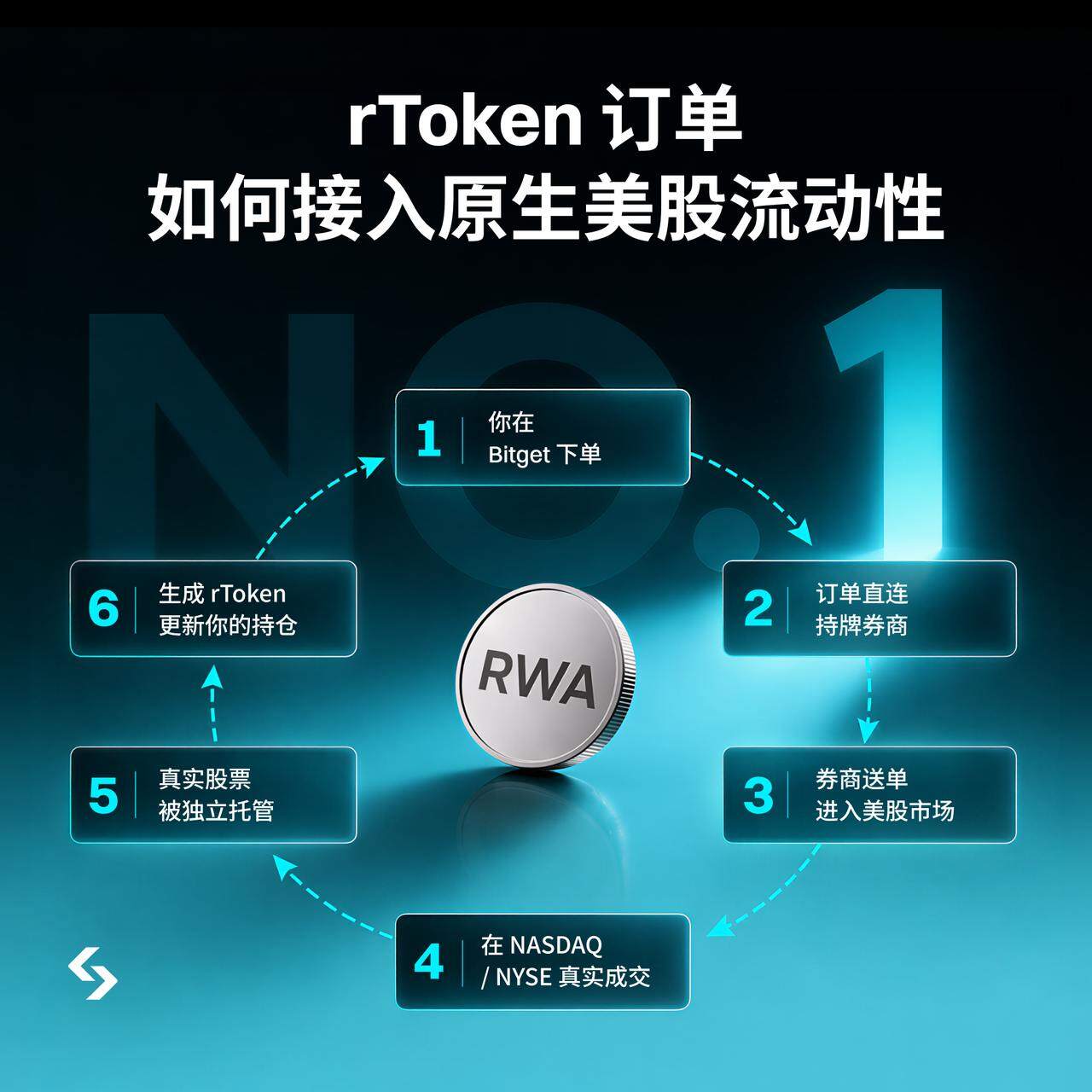
The sell process is essentially the reverse. After a user sells rToken, the corresponding tokens are burned, the underlying service provider sells the equivalent stock, and once settlement is complete, the proceeds are returned to the user's account in stablecoins or the platform's supported settlement assets. Thus, rToken does not operate independently of the traditional financial system. Instead, it connects the front-end crypto account and token format to the back-end traditional securities market. The user experience can be similar to crypto spot trading, but the underlying process relies on real securities trading, clearing, and custody systems.
How Does rToken Maintain Trading When the US Stock Market is Closed?
Maodi: rToken aims to offer extended trading hours, but the US stock market itself is not open 24/7. How does the platform maintain liquidity and price stability when the underlying market is closed?
Gracy: Extending trading hours means users don't have to be entirely constrained by the US stock market's opening hours, and the market can react to events sooner. However, when the US stock market closes, rToken's primary source of liquidity temporarily disappears. At this stage, trading during closed hours is primarily handled by market makers. Partnering market makers build up stock inventory before the US market closes. When users buy or sell rToken over the weekend, these trades are mainly matched using this inventory.
However, this doesn't mean that market depth during closed hours is the same as during regular trading. When significant events occur, market makers need to assess risk without the main market price. They typically reduce their order book size and widen bid-ask spreads. While they can use overnight market quotes (e.g., from Blue Ocean) for partial hedging, liquidity in these markets is far lower than during regular hours and cannot fully replace the NYSE and Nasdaq.
Therefore, prices during closed hours reflect market makers' quotes based on their inventory and risk tolerance, rather than a fully traded market price. Users need to accept the risks of lower liquidity, wider slippage, and the fact that the execution price may deviate from the opening price of the next regular trading session. Extended trading hours solve the problem of "whether you can trade," not "whether you can always trade with normal market depth."
How is rToken Priced and Liquidated During Trading Halts, Circuit Breakers, or Major Events?
Gracy: First, we need to distinguish between two issues: how the stock token is priced and whether the unified account triggers liquidation. If a user is using rToken as margin during a US market holiday, the platform uses the index price from the end of the most recent regular trading day's extended hours session for valuation. This prevents the collateral value from being distorted by sporadic trades when the underlying market lacks a continuous quote. However, this is a temporary freeze of the valuation benchmark and does not mean the risk has disappeared. If a major event occurs over the weekend, the stock could still gap significantly on the next trading day.
At the same time, other assets within the unified account will continue to fluctuate normally. For example, if a user holds a crypto contract using rToken as margin, even if rToken is temporarily priced at the previous day's value, liquidation will still be triggered if the overall account risk rate hits the liquidation line due to other positions. The unified account always performs risk control based on the total collateral, liabilities, and unrealized P&L of the entire account, not by evaluating a single margin item in isolation.
If the underlying stock is halted, circuit-breaked, or affected by a major event making reliable pricing impossible, the platform will implement temporary risk control measures based on the nature of the event, the duration of the halt, and market liquidity. These measures could include adjusting loan-to-value ratios, restricting new margin deposits, limiting trading, or suspending the relevant product. It will not apply a fixed rule. For example, during a prolonged halt with clearly increased risk, the platform might reduce the collateral value preemptively. If it's just a brief circuit breaker, the platform will typically wait for the underlying market to resume trading before updating the price. Therefore, a trading halt or market closure does not mean the risk is paused. So, when using rToken as margin, besides price volatility, one must also be aware of risks such as price gaps, trading halts, reduced liquidity, and potential changes in the platform's risk control parameters.
Why is the Reserve Ratio for Stock Assets Exactly 100%? Can rToken Be Redeemed for the Underlying Stock?
Maodi: Reality's reported reserve ratio for stock assets is basically maintained at 100%. Why is there not a certain percentage of excess reserves like in crypto?
Gracy: The stock asset part uses a one-to-one matching structure. For every rToken Reality issues, Alpaca holds a corresponding quantity or value of stock in the underlying. Currently, there is no additional purchase of stock inventory beyond what is needed to back the tokens in circulation.
Therefore, as long as the token supply perfectly corresponds to the underlying holdings, the reserve ratio is naturally 100%. For this ratio to be above 100%, Bitget, Reality, or other participants would need to inject extra capital to buy a batch of stocks that do not correspond to any existing user holdings. In our view, the necessity of doing this is currently quite low.
Additionally, rToken is currently the only RWA asset on the market that provides daily third-party PoR audit results. Other RWA issuers also disclose reserves, but more often in a self-reported format, which carries the risk of "acting as both referee and player." Reality currently cooperates with the US audit firm The Network Firm to provide daily PoR data. The Network Firm is a familiar partner for crypto enterprises; compliant exchanges like Kraken and Gemini also cooperate with them for asset audits.
Maodi: Stock investors sometimes plan to