






华尔街之狼们,别再猛冲2x、3x海力士了


- 核心观点:单股杠杆ETF通过衍生品放大单一股票每日涨跌幅,在AI热潮中增长迅速,但其风险在极端行情下可能导致基金直接爆仓退市,投资者无法等待后续反弹,已引发监管对系统性风险的担忧。
- 关键要素:
- 单股杠杆ETF通过掉期、期货等衍生品将单一股票日涨跌幅放大至2-3倍,若股票上涨10%,对应杠杆ETF可上涨约20%;反之亦然。
- 美国电动车公司Lucid股价盘中暴跌57%后反弹,但其2倍做多ETF(LCDL)因净值跌为负数爆仓,被强制平仓并启动退市程序,投资者无法参与后续上涨。
- 韩国四大金融部门已召开会议讨论对单股杠杆ETF的监管,方向包括提高保证金、限制日波动及降低杠杆倍数,以防范系统性风险。
- 韩国散户大量涌入AI热门股(如三星、SK海力士)的杠杆ETF,加剧市场波动;近期已出现因投资失败引发的自杀传闻和暴力袭击事件,风险可能外溢为社会问题。
- 在AI存储热潮下,该类产品规模快速扩张,但投资者常忽视其“触发死亡机制”的风险,即在极端单边行情下可能永久损失本金。
Original by Odaily Planet Daily (@OdailyChina)
Author: Azuma (@azuma_eth)

If you had to choose the most talked-about concept in global capital markets this year, the answer would undoubtedly be storage.
With the continuous progress of AI infrastructure construction, the supply of HBM (High Bandwidth Memory) has fallen short of demand. The three major memory manufacturers – SK Hynix, Samsung, and Micron – have become the focus of market heat. The influx of capital has driven their stock prices to soar rapidly. Even after a significant recent pullback, their gains for the year remain quite substantial.
When a stock keeps rising, there are always some in the market who feel it "isn't rising fast enough." Thus, a once relatively niche product category has quickly entered investors' sight — Single Stock Leveraged ETFs. Unlike traditional ETFs that track a basket of stocks or an index, these products track only a single stock. Through financial derivatives like swaps and futures, they amplify the daily price movement of the stock by 2x or even 3x. In other words, if the underlying stock rises 10% on a given day, the corresponding 2x leveraged ETF would theoretically rise about 20%; conversely, if the stock falls 10%, the product would also lose about 20%.
For this reason, Single Stock Leveraged ETFs are becoming a new tool for an increasing number of aggressive investors to bet on popular AI stocks. This year, as hot money looking to leverage gains from AI and storage themes continues to pour in, the scale of Single Stock Leveraged ETFs launched around popular AI concept companies like SK Hynix has also been expanding.
However, what many investors overlook is that on the flip side of amplified returns, risks are also amplified by the same multiple — in extreme market conditions, the underlying stock might still rebound, but a Single Stock Leveraged ETF might not even get a chance to wait for that rebound.
Real-life Case: The Delisting Path of a 2x Leveraged ETF
Don't think this is alarmist. A case that occurred during US stock market trading the night before last is enough to reveal how dangerous Single Stock Leveraged ETFs can be.
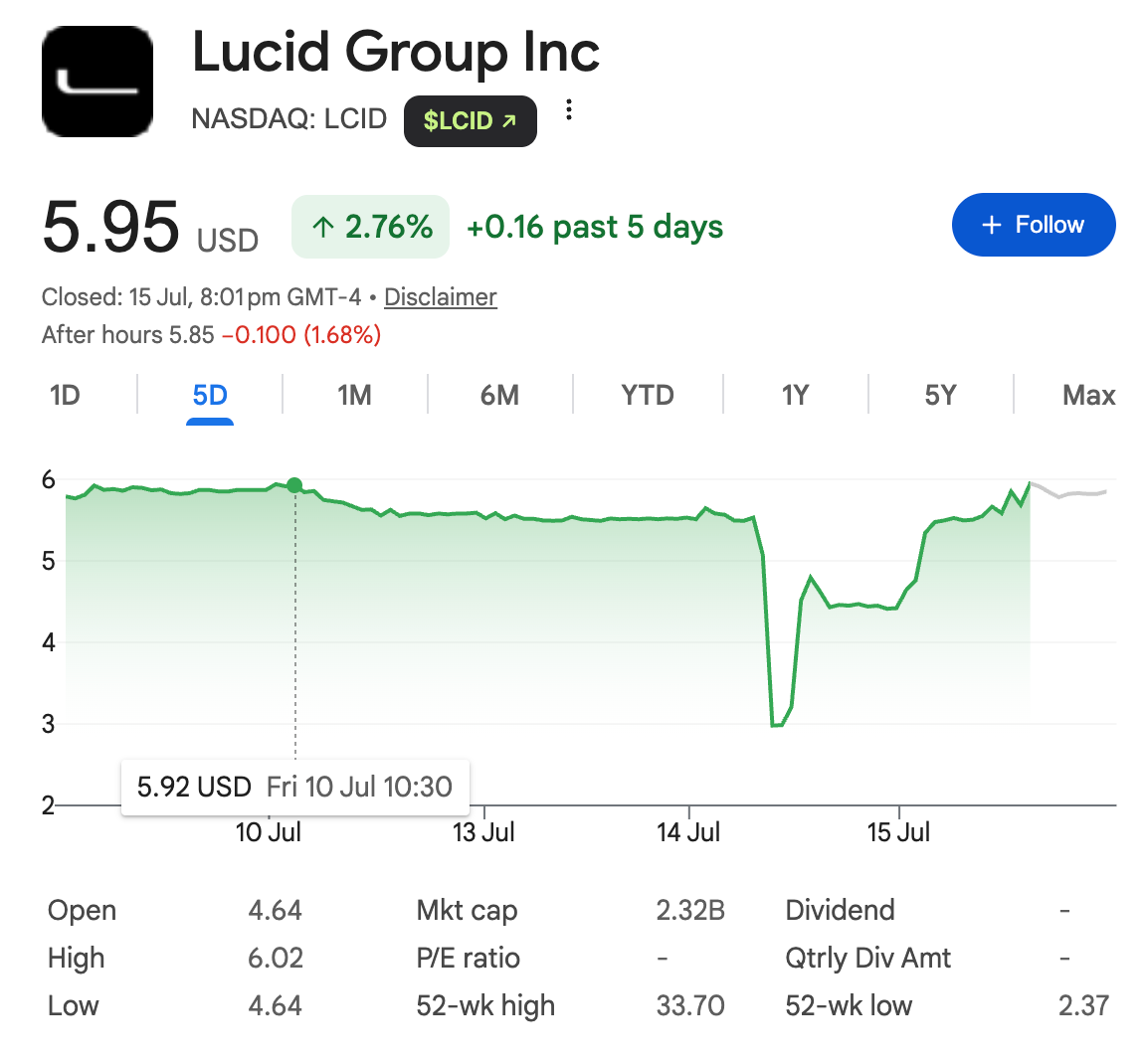
The above shows the recent stock price trend of US electric vehicle manufacturer Lucid (LCID). On July 14, local time, rumors suddenly circulated during US trading hours that Lucid was considering filing for bankruptcy protection. Under this negative news, LCID's stock price once plummeted 57%, triggering multiple trading halts during the session, marking its biggest intraday drop since listing.
However, the plot soon reversed. Lucid subsequently issued a statement saying that the company had indeed hired consulting firm AlixPartners to conduct a comprehensive review of its operations to optimize operations, cut costs, and advance new model development. It stated that the rumors about filing for bankruptcy were "completely false." Lucid also emphasized that it currently has sufficient liquidity to support operations until next year, and AlixPartners is only responsible for operational optimization work, without providing any bankruptcy advice to management or the board.
As Lucid quickly refuted the rumors, market sentiment swiftly recovered. Lucid's stock price rebounded from its intraday low, eventually closing with a narrowed loss of approximately 16%. For investors holding Lucid stock, this felt more like a thrilling "roller coaster ride."
However, for another group of investors, the story ended at the moment the crash occurred.
During Lucid's plunge, the 2x Long ETF tracking its stock performance — the GraniteShares 2x Long LCID Daily ETF (LCDL) — was directly liquidated. Fund manager GraniteShares subsequently issued a notice confirming that the fund had closed all its LCID positions that day. As its net asset value turned negative, it would formally initiate the delisting process.
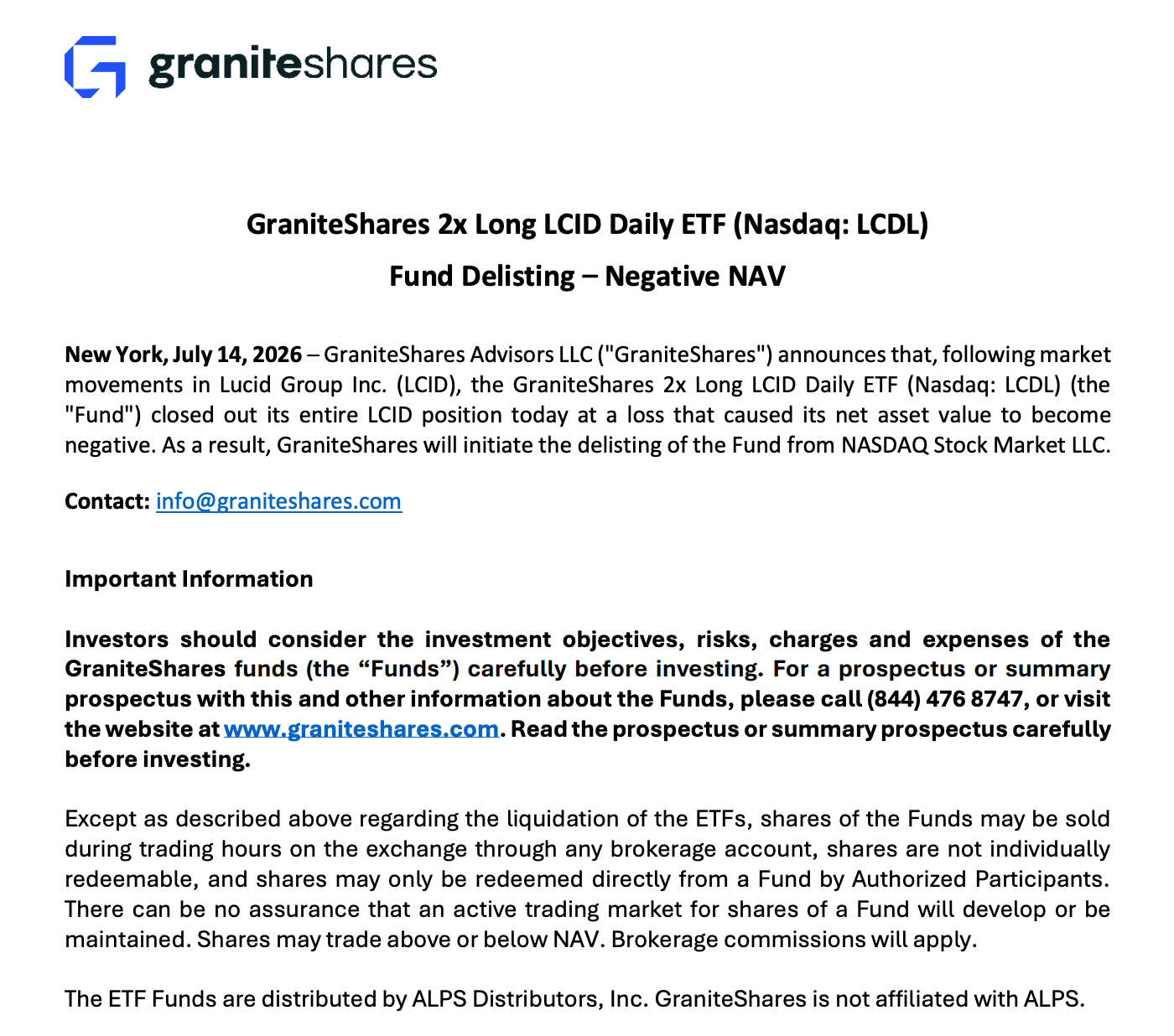
That is, when Lucid's stock price rapidly rebounded later, this ETF had no remaining positions to recover its net asset value. For all users holding LCDL, there was no longer any opportunity to participate in LCID's subsequent upside.
This is precisely the biggest difference between Single Stock Leveraged ETFs and regular stocks. Even if a stock suffers a drastic drop, as long as the company still exists, investors have a chance to wait for a rebound. But once a Single Stock Leveraged ETF "triggers its death mechanism" during extreme volatility, even if the underlying stock recovers its losses later, investors may never get to see that day.
Social Issues Emerge, South Korean Government Begins to Fear
The delisting of LCDL is by no means an isolated case. In fact, with the rapid proliferation of Single Stock Leveraged ETFs in popular AI stocks, regulators have begun to re-evaluate the systemic risks these products may pose.
South Korea's stance is particularly representative in this regard.
In mid-July, according to reports from The Korea Times, South Korea's four major financial authorities — the Ministry of Economy and Finance, the Financial Services Commission, the Financial Supervisory Service, and the Bank of Korea — will convene a special meeting under the government's macroeconomic and financial issues coordination mechanism (F4) to discuss the risks of Single Stock Leveraged ETFs and regulatory measures. Discussed directions include raising margin requirements, limiting daily price fluctuation ranges, and lowering leverage multiples.
In recent years, as South Korean retail investors have continuously poured into the stock market, the AI theme has almost evolved into a nationwide investment craze in South Korea. Heavyweight stocks like Samsung Electronics and SK Hynix have become the focus of capital, while leveraged ETFs launched around these individual stocks have further amplified market sentiment and stock price volatility. Regulators are concerned that as more investors begin using high-leverage products to chase popular stocks, the impact of a sharp fluctuation is no longer just a change in numbers on investment accounts, but could potentially evolve into a social issue.
As storage concept stocks faced downward pressure, extreme incidents have occurred repeatedly in South Korea's capital market. On one hand, rumors have emerged on social media about suicide incidents stemming from failed stock investments. The Chosun Ilbo also reported yesterday that a YouTuber operating a stock investment channel in Busan was repeatedly stabbed on the street by a man in his 20s. Preliminary police investigations indicate that the suspect was a subscriber to the channel, who attacked out of resentment after suffering significant losses from following the blogger's stock recommendations.
Although the above incidents were not directly caused by Single Stock Leveraged ETFs, they send a highly consistent signal to regulators — when high-risk investment tools continuously lower the barrier to participation, and overlap with communication channels like social media and live-streamed stock recommendations, financial risks may ultimately spill over into social risks.
For the South Korean government, this is the most frightening prospect.


