






突破900亿美元,波场TRON链上USDT发行量再创历史新高


- 核心观点:波场TRON网络上的TRC20-USDT发行量突破900亿美元,创历史新高,这反映了全球稳定币需求的持续增长,并推动波场TRON从链上转账向AI支付、跨境结算及机构化合规市场等更广泛的金融场景拓展。
- 关键要素:
- TRC20-USDT发行量于7月9日突破900亿美元,年内增发超80亿枚,持有账户超7490万,累计转账超35亿笔。
- 波场TRON网络长期承载全球USDT发行量近半份额(约48%),2026年Q1稳定币结算规模接近2万亿美元。
- 波场TRON已加入万事达卡加密计划,加密卡交易市场占比达32%,正从链上延伸至传统商业支付场景。
- 生态项目B.AI已接入波场网络,用户规模突破200万,专为AI Agent经济提供低成本、可自动执行的高频小额支付基础设施。
- 波场TRON已在测试网开启后量子签名功能(FN_DSA_512),并联合成立T3小组冻结超4.5亿美元非法资金,强化安全与合规能力。
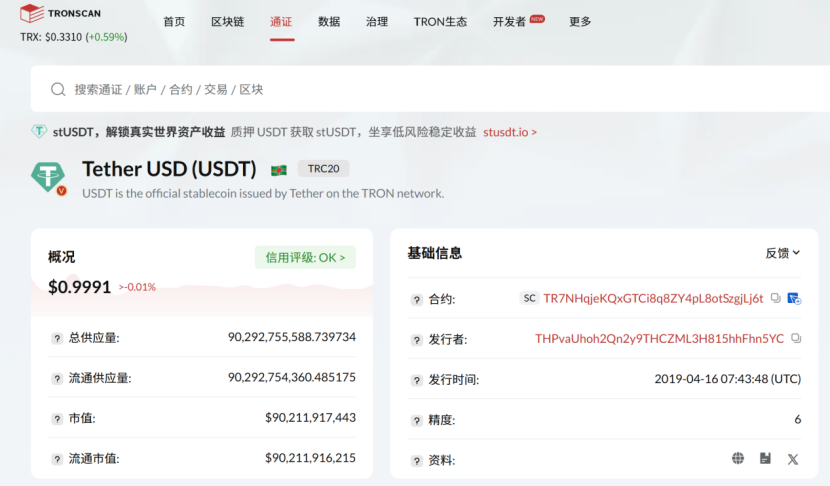
On July 9, data from TRONSCAN and Tether on-chain data showed that the issuance of TRC20-USDT on the TRON network officially exceeded 90 billion US dollars, setting a new historical record.
Since the beginning of this year, TRC20-USDT has continued its growth trend. In January this year, the issuance of USDT on the TRON chain was approximately 82.4 billion tokens; in just over six months, this figure has climbed to 90 billion tokens, with a cumulative additional issuance of about 8 billion tokens this year. From 80 billion to 90 billion, TRON has once again steadily crossed a new ten-billion-level milestone, continuously solidifying its important position in the global stablecoin issuance and on-chain settlement network.
Stablecoin Demand Drives TRON's Continued Expansion
Stablecoins have always been the largest application scenario for TRON. Since TRON partnered with Tether to issue TRC20-USDT in 2019, the TRON network has gradually become an important network for global USDT transfers and value settlement, leveraging its fast transfer speeds, low transaction fees, and stable operation. Currently, TRON consistently carries nearly half of the global USDT issuance share, accounting for approximately 48%.
Entering 2026, stablecoin activity on the TRON chain continues to expand. As of now, the additional issuance of TRC20-USDT this year has exceeded 8 billion tokens, the number of holding accounts has surpassed 74.9 million, and cumulative transfers have exceeded 3.5 billion; TRON's total network accounts have exceeded 390 million, with cumulative transaction numbers exceeding 14.6 billion.
Messari data shows that in the first quarter of 2026, the stablecoin settlement scale on the TRON network approached $2 trillion; for the full year of 2025, the transfer volume of USDT on the TRON chain was approximately $7.9 trillion. These figures indicate that the growth of TRC20-USDT is not solely driven by the expansion of issuance scale but also stems from sustained demand for on-chain transfers, cross-border settlements, and peer-to-peer payments.
This demand is particularly concentrated in emerging markets. For small-value cross-border transfers, high-frequency payments and collections, and dollarized settlements between individuals, users are more sensitive to transaction fees and confirmation times. Based on its DPoS consensus mechanism, TRON can support approximately 2000 transactions per second, offers block confirmation in seconds, and has low per-transfer costs. For users who cannot afford high transaction fees, TRC20-USDT provides a more accessible digital dollar transfer method.
Beyond native on-chain scenarios, TRON is also accelerating its entry into traditional financial and real-world payment networks. In March this year, TRON announced its participation in the Mastercard Crypto Partner Program, exploring areas such as cross-border settlement and B2B transfers. According to data from the crypto card data analytics platform PaymentScan, TRON's share of the crypto card transaction market has reached 32%, with a transaction volume exceeding that of Ethereum and BNB Chain combined. Additionally, the decentralized prediction market Polymarket has natively integrated support for the TRON TVM network deposit channel. These developments show that TRON is extending from an on-chain transfer network to broader payment and commercial scenarios.
AI Payments and Institutional Markets Open New Avenues
With USDT issuance reaching the $90 billion milestone, TRON is also strengthening its布局 in AI payment scenarios. With the development of the AI Agent economy, the market requires payment networks that are low-cost, automatically executable, and globally settled. TRON's high throughput and low-cost characteristics make it suitable for high-frequency scenarios such as machine-to-machine payments, model call fees, and on-chain automatic settlements.
The TRON AI Development Fund has been expanded to $1 billion this year, focusing on supporting AI infrastructure, on-chain payments, and open financial innovation. In this direction, B.AI, designed as the underlying financial infrastructure for the AI Agent era, has become a key entry point for the TRON ecosystem to explore the AI Agent economy. As the underlying financial infrastructure for AI agents, B.AI has been integrated with the TRON network and aggregates leading domestic and international large language models including Claude, ChatGPT, Gemini, as well as MiniMax, Kimi, and others.
Through B.AI, an AI agent can use a single on-chain wallet address for identity verification, model invocation, and on-chain payment. For developers, this means they can access multi-model capabilities at a lower cost and directly embed payment, settlement, and account systems into application workflows. For users, B.AI lowers the barrier to using AI services and on-chain payments, transforming wallets from mere asset storage tools into account portals for AI Agents to call services, execute tasks, and complete transactions.
Currently, the number of B.AI users has exceeded 2 million. As more AI applications evolve from "conversational tools" to "agents that automatically execute tasks," high-frequency micro-payment demands may arise from model calls, data services, plugin usage, on-chain transactions, and cross-border settlements.
The integration of B.AI with the TRON network provides a scalable payment and settlement foundation precisely for this scenario: AI handles task execution, while TRON offers a low-cost, high-efficiency channel for value transfer.
This strategic layout also provides a new growth narrative for TRON's stablecoin network. In the past, TRC20-USDT's core scenarios were mainly focused on personal transfers, cross-border payments, exchange circulation, and dollarization needs in emerging markets. In the future, as the AI Agent economy expands, stablecoins could also become important payment mediums for settlement services between agents, purchasing computing power, invoking models, and completing automated transactions. B.AI's integration allows TRON to participate earlier in this emerging payment scenario and extend its stablecoin settlement capabilities to the AI application layer.
On the security front, TRON is accelerating its upgrade towards quantum-era network security. On July 2, 2026, the TRON Nile testnet officially activated post-quantum signature functionality through Committee Proposal No. 20628, pioneering the use of the FN_DSA_512 signature algorithm. This signifies that TRON's quantum-resistant capabilities have entered the testnet verification phase, providing longer-term security assurance for future, larger-scale on-chain assets, stablecoin settlements, and automated payment scenarios.
In terms of compliance, TRON is also making continuous investments. The T3 Financial Crime Unit, jointly established by TRON, Tether, and TRM Labs, has assisted global law enforcement agencies in freezing over $450 million in illicit funds. With the Nasdaq-listed TRON.Inc continuously implementing the TRX treasury strategy and the advancement of the TRX spot ETF application, TRON is simultaneously expanding towards decentralized innovation and institutional-grade compliant markets.
The TRC20-USDT issuance surpassing $90 billion marks a new milestone for the TRON stablecoin ecosystem and reflects the still-expanding global demand for stablecoins. As the regulatory framework gradually becomes clearer, traditional financial institutions accelerate their entry, and the AI agent economy requires more efficient payment layers, competition among stablecoin networks will increasingly revert to four fundamental capabilities: efficiency, cost, security, and compliance.
For TRON, the $90 billion mark is not an end point. Stablecoins have become the core fulcrum connecting it to on-chain finance, cross-border payments, AI payments, and institutional markets. As issuance scale, settlement volume, and real-world application scenarios continue to expand, TRON is steadily advancing towards its goal of becoming the core settlement layer for global financial transactions.


