






CARDS The Brutal Truth Behind a $535 Million FDV: Net Revenue of Only $43 Million, Profit Margins Halved


- Core Thesis: CollectorCrypt (CC) is an on-chain blind box platform combining physical trading cards with NFTs. While its cumulative revenue reached $635 million, 90.6% was returned to users via instant card buybacks, resulting in a net revenue of only $43 million. The platform relies on a small number of high-frequency players for operations. Token value capture (buyback + burn) accounts for just 3.4% of net revenue, while a genuine collector market has yet to form, with secondary trading volume being virtually zero.
- Key Elements:
- CC's cumulative gross revenue is $635 million, but 90.6% is returned via card buybacks, resulting in a net retention rate of only 6.7%. Daily active users are approximately 420, and revenue is highly concentrated among a few dozen wallets.
- Total secondary trading volume across all channels is less than $5 million. eBay's share has continuously declined from 1.23% in Q1 2025 to 0.10% in Q2 2026, indicating user behavior contradicts the collector model.
- As trading volume shifts towards higher-tier card packs, the net profit margin has halved from 11.2% to 5.8%, leading to diminishing marginal returns on growth due to structural margin compression.
- Total token value capture (burn + buyback) is only $1.4 million, representing 3.4% of net revenue. Meanwhile, operational wallets on the same channel have withdrawn $45.7 million in USDC, revealing a significant imbalance in value flow.
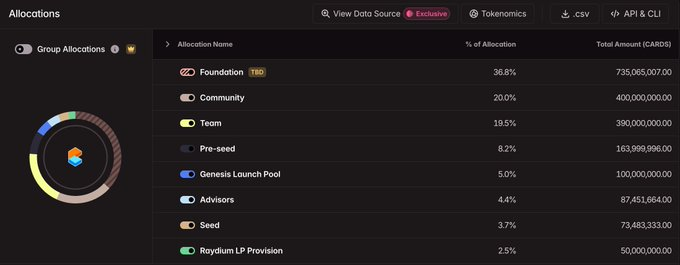
- The FDV of approximately $535 million corresponds to 7.3x net revenue. 72% of insider supply is locked until November 2027, with a circulating market cap of only $110 million (20.5% float). The tokenomics face significant unlock pressure.
Original Author: Four Pillars (@FourPillarsFP)
Original Compilation: AididiaoJP, Foresight News
Key Takeaways
- Collector Crypt (CC) has generated $635 million in total cumulative revenue, with 90.6% returned to users via instant card buybacks, resulting in a net revenue of only $43 million and a retention rate of 6.7%.
- Total secondary trading volume across all channels is under $5 million, with eBay's share dropping from 1.23% to 0.10% (declining for six consecutive quarters).
- Total token value capture (burn + buyback) amounts to just $1.4 million, representing 3.4% of net revenue, while operational wallets have off-ramped $45.7 million in USDC.
- As volume tripled and shifted towards higher-tier card packs, the net profit margin was halved from 11.2% to 5.8%. With each step up in denomination, the blended margin is further compressed.
- At the current FDV of approximately $535 million, this implies a 7.3x multiple on net revenue for a "casino" with continuously compressing margins, roughly 420 daily active users, a float ratio of 20.5%, and 72% insider supply locked until November 2027.
Introduction
You deposit $1,000 into Collector Crypt, open a Grail pack, and receive a tokenized Pokémon card valued by the platform at $1,015. It looks like you made a profit. Turbo mode activates automatically, selling the card back to the protocol at a 93% buyback rate, and $944 hits your account instantly. The entire cycle takes just seconds.
This cycle, repeated rapidly by hundreds of wallets, has generated $635 million in volume and an FDV of approximately $535 million for the CARDS token. This article will deconstruct the composition of this volume, whether the collector economy priced into the token is materializing, and what share of the revenue is actually captured by the token.
Note: Collector Crypt (CC) is an on-chain gacha (blind box) platform combining physical collectible cards (primarily graded Pokémon and sports cards) with NFTs. Users deposit USDC to purchase random card packs at various price points ($25 ~ $2500+). Upon opening, they receive an NFT card backed by a physical graded card. The platform offers an 85%-93% instant buyback (Turbo mode is default), allowing users to sell the card back to the platform for USDC within seconds, creating a rapid cycle.
Decoding the $635 Million Figure
90.6% of the cumulative volume was returned to users within seconds
CC's core product is a gacha machine. Users deposit USDC, purchase a random card pack ($25 to $2500, with a $5000 tier in the API but not yet publicly available), and receive an NFT card backed by a physical graded card. Each card has an "insured value," and the platform offers an 85%–93% instant buyback.
The buyback is the default behavior, not an exception. All 33 machine configurations in the CC API have turboMode: true enabled. Cards are automatically sold back to the protocol, and users receive USDC in seconds, net of the spread.
According to Blockworks data as of June 13th, cumulative revenue stands at $635 million. Of this, $576 million was returned to users via card buybacks, leaving a net revenue of $43 million and a retention rate of 6.7%. This "buyback" is not a token buyback; it's the platform repurchasing the card it just sold, cycling the same deposit back into the next pull.
On the all-time high day of June 11th, the machines processed $10.6 million in volume, retaining $881,000, for an 8.3% retention rate.
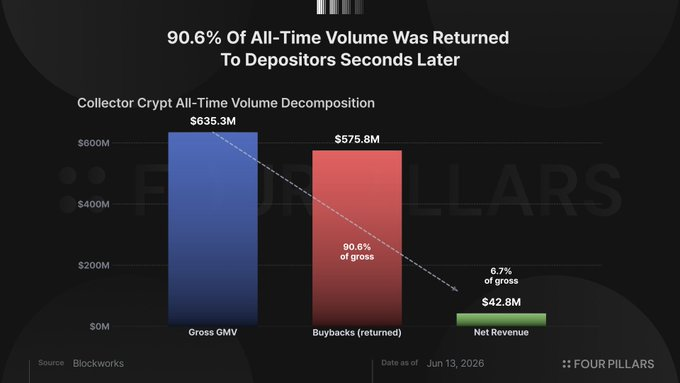
The DeFiLlama adapter source code confirms this decomposition: dailyFees = pack_purchases + royalties - buybacks. This means the ~$52 million annualized fees on the dashboard are already net of buybacks. dailyVolume = pack_purchases, representing gross spending before the cycle is removed, which is also the figure shown on protocol volume ranking lists.
Volume is highly concentrated among a few dozen wallets
Blockworks reports a cumulative user count of 23,333. In May 2026, the platform had roughly 420 daily active users, processing $3.3 million in daily volume, averaging about $7,800 per person per day. Even if 400 of those 420 users each spent $1,000 per day, the remaining 20 wallets would still contribute $2.9 million, accounting for 87% of the total. Extreme concentration is a mathematical certainty given the averages.
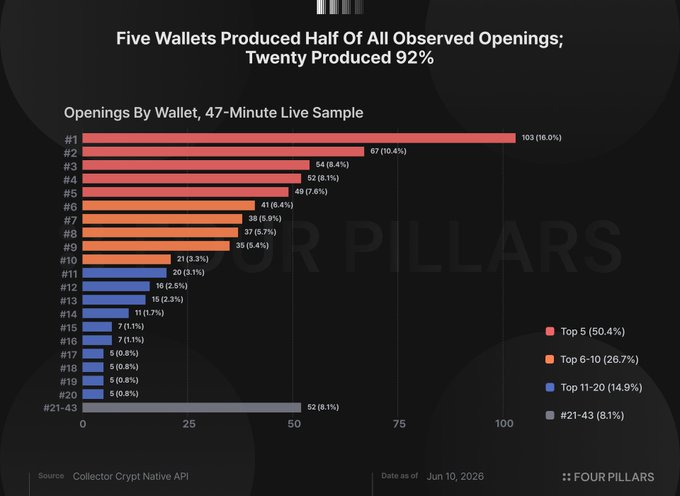
Live activity confirms this. We polled CC's public win count 20 times within a 47-minute window on June 10th, deduplicating by NFT address. The sample included 645 pack openings from 43 wallets. The top 5 wallets contributed 50.4% of openings, the top 10 contributed 77.1%, and the top 20 contributed 91.9%. The single most active wallet contributed 103 openings, accounting for 16% of the total.
This was just a 47-minute window, not a full-time distribution. But both the averages and the sample point in the same direction: this $635 million is a casino with a 6.7% retention rate, fed at industrial speed by a few dozen high-frequency players.
The Collector Market Has Not Yet Arrived
The Bull Case
The strongest bull case is worth stating: the buyback cycle is the product itself. The pull is entertainment, the 85%-93% return rate means users lose money slowly, and the instant liquidity of physical vault cards is a product innovation. As a consumption design, it is defensible.
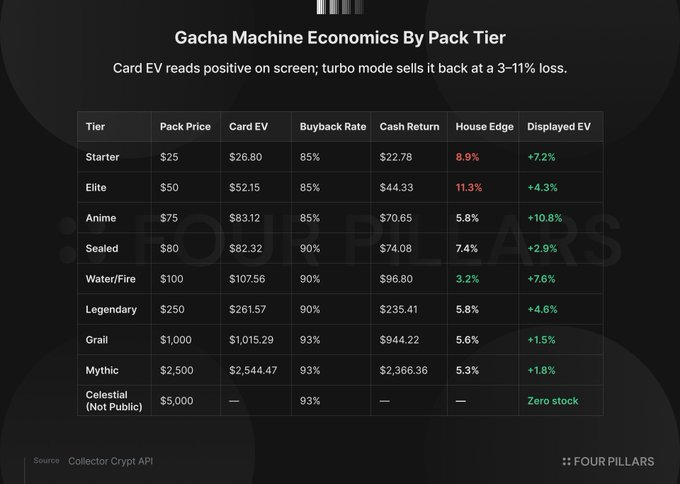
But the machine configurations reveal the direction of design optimization. CC independently controls two variables: the insured value assigned to a card and the buyback rate for Turbo mode's automatic resale. The tier ranges and vault inventory are configured so the probability-weighted expected card value is higher than the pack price. The buyback rate then discounts this value below the price.
For example, a $1,000 Grail pack shows an expected card value of $1,015, presenting the user with a +1.5% proposition. Turbo mode activates at a 93% buyback rate, returning $944 in cash. The card EV is above the pack price, the pack price is above the cash return. The user sees the former comparison, while the platform profits from the latter. The structure is identical across all tiers, with the edge ranging from 3.2% to 11.2%.
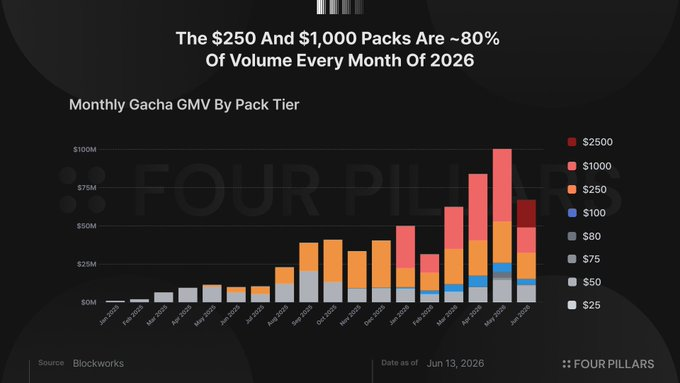
Spending patterns confirm the user type. Monthly in 2026, the $250 and $1000 tiers account for roughly 80% of volume (79.4% in Jan, 80.6% in Mar, 79.4% in Apr). Collectors would buy specific cards at specific prices to complete a particular set. A distribution dominated by random $1,000 packs is a whale distribution.
Secondary Trading Below 1%, eBay Share Declined 12x
If collectors were using this platform, they would trade with each other, and cards would flow into the broader market. CC data tracks both, and both are near zero.
On-platform, cumulative marketplace royalties total $133,000. Of the $6.9 million in lifetime marketplace volume, only $823,000 represents genuine peer-to-peer trades; the rest is buyback flows and legacy V1 volume.
Off-platform, Blockworks tracks eBay sales of CC vault cards. The cumulative total is $3.4 million, but the trend is the key finding. As a share of gacha flow, eBay was at 1.23% in Q1 2025, 0.46% in Q2, 0.89% in Q3, 0.30% in Q4, 0.17% in Q1 2026, and 0.10% in Q2 2026. Over the same period, gacha volume grew roughly 25x. The absolute value of the collector channel has barely moved, while its share has plummeted 12x.
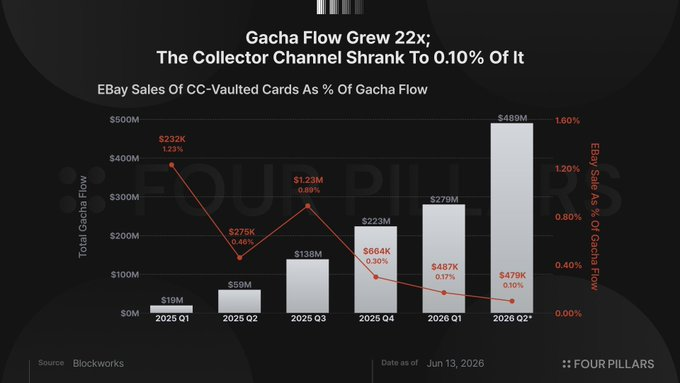
Of the $635 million in card value generated by the platform, only $18.5 million (2.9%) has been redeemed for physical cards. The remaining 97% was sold back to the protocol via auto-buyback, most of it within seconds.
Combining all channels (eBay + peer-to-peer marketplace trading), real secondary activity totals under $5 million, against a gacha throughput of $635 million. The standard bull rebuttal is "it's early," but the quarterly eBay sequence answers that. The platform is not on an early path towards collector behavior; it has been demonstrably moving away from this behavior for six quarters.
Turbo mode eliminates the dwell time—browsing, comparing, collecting—that a collector platform relies on to monetize, which builds the secondary market. The design optimizes for cycle speed, not discovery. These are two different products.
Token Utility
CC's revenue flows through three layers. Users deposit USDC to buy gacha packs, receive random card NFTs, and in almost all cases, automatically sell them back at an 85%-93% buyback rate. The platform retains the 7%-15% spread as net revenue. Secondary revenue lines include a 2% royalty on marketplace trades and a 2% fee when users redeem NFTs for physical cards. All net revenue flows into an operational treasury used for card inventory procurement, USDC off-ramping, and, since June 2026, a small token buyback program.
Volume Tripled, Profit Margin Halved
According to Blockworks daily data, gross volume in Q3 2025 was $75 million with an 11.2% net margin; Q4 was $116.3 million with a 5.7% margin; Q1 2026 was $145.9 million with a 5.9% margin; and Q2 (up to June 13th) was $256 million with a 5.8% margin.
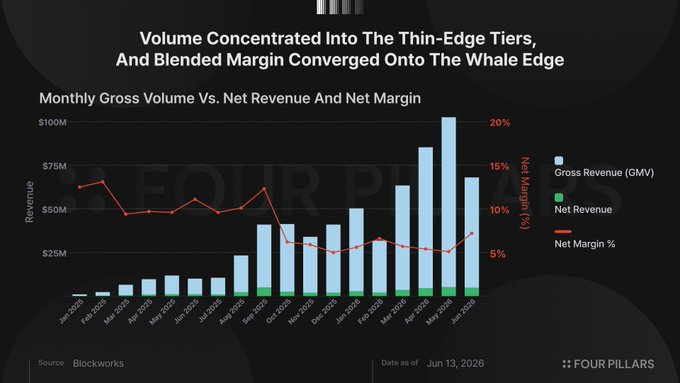
The compression is structural. The thinnest margins are where the volume is highest—around 5% for the $250 and $1000 packs, compared to 9%-11% for the $25 and $50 tiers, because high-volume players don't cycle six-figure sums at an 11% spread. As volume concentrates in higher tiers, the blended margin converges to the higher-tier edge. The marginal dollar of growth comes from the players the platform retains the least.
The $2,500 Mythic pack launched on June 10th has a 6.4% margin. The API already contains a $5,000 Celestial pack (with zero inventory). With each step up in denomination, gross volume continues to grow, pulling the blended margin down towards the higher-tier floor.
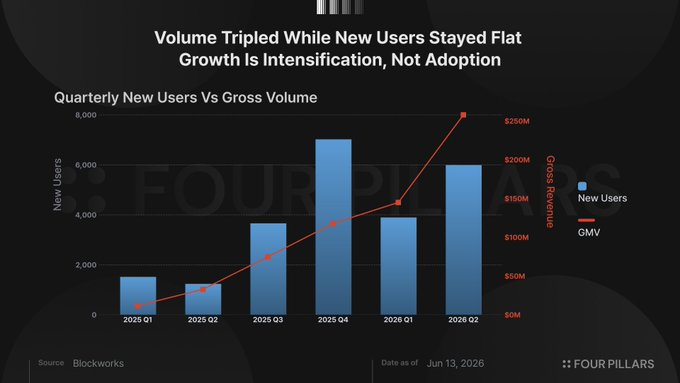
User data confirms growth is intensification, not adoption expansion. New users over the past four quarters were 3,668, 7,013, 3,886, and 5,982 (Q2 up to June 13th), roughly flat, while volume more than tripled. May 2026 saw 2,593 new users, but DAU rose from ~280 in April to 420 in May. Most new users churn within days.
Token Value Capture: $55.9k Burn + $887k Buyback
Since launch, 294,203 CARDS tokens have been burned, representing 0.015% of the supply, valued at approximately $55,900 over 9.5 months. The CC documentation does not specify the mechanism triggering the burn, but the downward trend is consistent with a collapse in market activity. In May 2026, 372 tokens were burned; in June, only 21 (worth $4).
On June 13th, Maelstrom's Lukas Ruppert published on-chain evidence linking wallets associated with token purchases to CC's operational infrastructure. Ruppert traced activity from DFEst, a known CC operational hub, through Kraken to a DCA bot and identified related wallets with a history of pack openings. He didn't fully confirm team control but wrote, "if these wallets are indeed controlled by the team, the implications go far beyond the purchases themselves." The circumstantial evidence is strong.
The on-chain trajectory reveals two events. On May 12th, the CARDS Aggregator wallet, via Fireblocks custody, paid $500,000 to pre-seed investor GSR for 4,045,013 CARDS at ~$0.124 each. Subsequently, on June 10th and 11th, a newly created wallet funded via Kraken began market-buying CARDS through a DCA bot, with two parallel streams executing approximately $625 and $587 every 2-6 minutes. By June 12th, the bot had deployed $159,000 to accumulate 599,104 CARDS, with a remaining budget of $728,000.
Calculating all forms of token value capture: burns ($55,900), GSR settlement ($500k), and the full DCA budget including undeployed funds ($887k), totals $1.4 million. This represents 3.4% of the platform's cumulative $43 million in net revenue. At the current Q2 annualized rate of roughly $73 million, the entire DCA budget is equivalent to 1.2% of one year's net revenue.
Wallets identified by Ruppert as CC operational hubs have withdrawn $45.7 million in USDC, $8.5 million of which occurred since May 2026. Whether these wallets are controlled by the team or not, the disproportion is noteworthy: $1.4 million flowed towards the token, while $45.7 million flowed away from it. The buyback program might be the beginning of sustained value capture, but simultaneously, it has no on-chain automation or commitment and could stop tomorrow.
With a 5.8% net margin, significantly increasing token buybacks is a zero-sum game against operational treasury income. The buyback rate (85%-93%) determines the player's cost per cycle; lowering it destroys volume, so the total margin is determined by player tolerance. Within this margin, token buybacks and operational withdrawals compete for the same funds.
Even at face value, at an annualized rate of ~$73 million based on Q2 pace, the ~$535 million FDV implies a 7.3x multiple on net revenue. This is a casino with continuously compressing margins, roughly 420 daily active players, and a highly concentrated revenue base (a single wallet exiting could move daily volume by double-digit percentages).
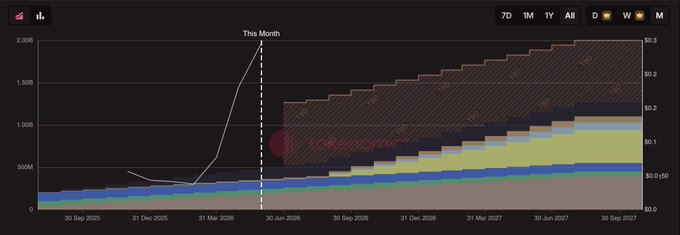
The ~$110 million circulating market cap reflects a 20.5% float ratio, with 410 million tokens in circulation out of a 2 billion total supply. The remaining 79.5% is locked per a public schedule until November 2027. The next unlock on June 29th releases 28.84 million tokens distributed across four allocations. Insider allocations account for 72% of the supply (Foundation 36.75%, Team 19.5%, Pre-Seed 8.2%, Advisors 4.37%, Seed 3.67%), Community 20%, Genesis Launch Pool 5%, and Raydium LP 2.5%.
Conclusion
CC has built a product that puts physical cards in a vault and found product-market fit with a small cohort of high-speed gamblers. Our view would change if marketplace royalties shifted towards genuine peer-to-peer trading, if the eBay share reversed its six-quarter decline, or if the buyback program scaled significantly beyond 3.4% of net revenue. None of this is currently visible.
What is currently visible is this: token value capture totaling $1.4 million, representing 3.4% of cumulative net revenue, against a $110 million market cap ($535 million FDV); operational wallets within the same infrastructure have off-ramped $45.7 million concurrently with an $887k buyback; the collector channel has shrunk every quarter since launch; and on top of a 20.5% float ratio, insider allocations account for 72% of the supply, locked until November 2027.


