The World Cup has only been going for a few days, and AI predictions already have some models achieving legendary status while others have crashed and burned.


- Key Insight: Several major AI models (Qwen, Copilot, ChatGPT, etc.) have been used to predict World Cup match outcomes, with varying degrees of accuracy. Qwen impressed by correctly predicting the score and red card risk on the first day. Copilot and ChatGPT had their highlights, but they were overly conservative in identifying upsets and draws, proving that AI can serve as a helpful reference, but is still far from providing a definitive answer.
- Key Elements:
- Qwen accurately predicted the opening match score of Mexico 2:0 South Africa, as well as the red card risk, and precisely forecasted South Korea's comeback victory over Czech Republic 2:1. This "script-like" accuracy significantly raised attention around AI predictions.
- Copilot's full tournament predictions had some high points (e.g., Brazil 1:1 Morocco), but clearly overturned in cold cases like Australia defeating Turkey and Japan drawing with the Netherlands, exposing its overly conservative assessment of underdog teams.
- ChatGPT provided a comprehensive analytical logic, offering well-reasoned predictions for the opening match, but it also failed to correctly identify matches that deviated from paper strength, such as Qatar's draw with Switzerland and the Netherlands' tie with Japan.
- Models like Gemini, Grok, and Claude showed mixed results in single-match predictions. For instance, Gemini correctly predicted the opening match score, while Grok and Claude did not hit exact scores. However, with such a limited sample size, it's difficult to rank them reliably.
Original: Odaily Planet Daily (@OdailyChina)
Author: Asher (@Asher_0210)

In this World Cup, the most exciting action isn't just on the pitch.
As buzz around World Cup prediction events heats up, more users are beginning to participate with real money. Who will win, the exact score, will there be an upset, will there be a red card, which player will score – these topics, once casual pre-match banter among fans, have been broken down into tradable prediction events.
When predictions become trades, users need more than just emotion and intuition: odds fluctuations, team form, injury news, historical head-to-heads, and market sentiment all become pre-trade references. In this process, AI models have started being frequently brought into World Cup prediction scenarios.
Large models like Qwen, ChatGPT, Gemini, Claude, DeepSeek, and Copilot can not only answer "which team is more likely to win" but also provide score predictions, upset probabilities, red card risks, key player performance, and match trend analysis. For prediction market participants, AI's pre-match reasoning is becoming another layer of reference alongside odds, news, team data, and market sentiment.
However, predictions ultimately must return to the game itself.
With the World Cup officially underway, results from the first few matches have already come in. The AI analyses that users relied on for pre-match assistance now have verifiable answers: Were the scores predicted correctly? Were upsets foreseen? How many details like red cards, last-minute goals, and match trends did the models actually capture?
Qwen Steals the Spotlight First
The most entertaining story on the World Cup's opening day was undoubtedly Qwen.
In the opening match between Mexico and South Africa, Qwen's pre-match prediction was Mexico 2:0 South Africa. After the match, the score indeed ended 2:0. Even more noteworthy, the match saw a total of three red cards, closely aligning with Qwen's pre-match assessment that "South Africa's aggressive defending could lead to an early man-disadvantage situation."
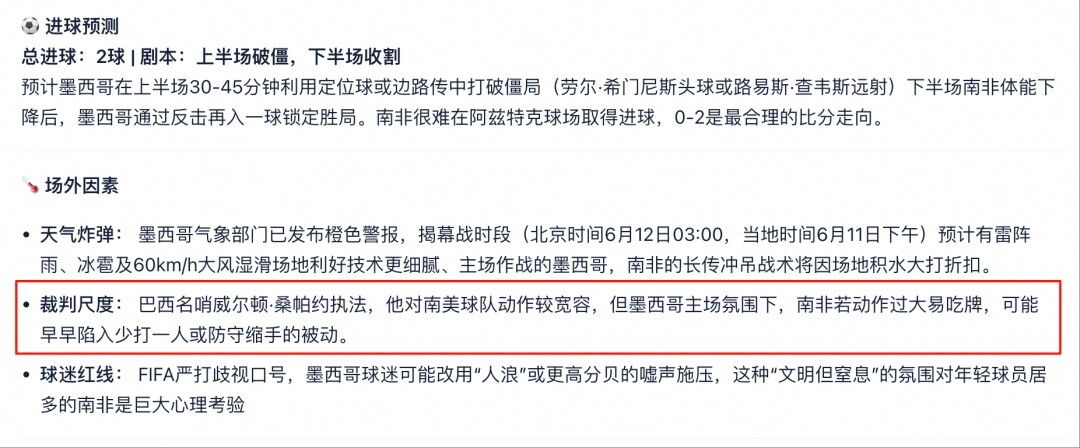
Predicting a Mexico win wasn't particularly surprising, as Mexico, being one of the co-hosts, was the favorite. But Qwen's achievement was in predicting more specific match details: the 2:0 scoreline, South Africa's red card risk, and the gradual widening of the gap in the latter stages of the game.
Next, for the match between South Korea and the Czech Republic, Qwen predicted a 2:1 victory for South Korea.
This pre-match prediction wasn't easy. The Czech Republic had physical strength, set-piece threats, and the typical tournament experience of a European team. The match process wasn't one-sided either; the Czech Republic took the lead first, South Korea equalized, and the game was locked at 1:1 for a long time. It was only in the final stages that South Korea scored the winner, making the final score 2:1.
This gave Qwen's prediction a much stronger "scripted" feel. Predicting the winner could rely on paper strength, predicting the score might involve luck, but details like red cards, comebacks, and late winners are what truly make people think "there's something here." After two successful predictions on opening day, Qwen quickly captured attention for AI-powered World Cup predictions.
Copilot: Brilliant Insights, Obvious Mistakes
Before the tournament, USA Today asked Copilot to predict all 104 matches of this World Cup. Looking at the matches that have ended, this prediction had both highlights and clear failures.
Three predictions were particularly impressive.
For the opening match, Mexico vs. South Africa, Copilot predicted Mexico 2:0 – the exact score. For South Korea vs. Czech Republic, it predicted South Korea 2:1, matching the result. For Brazil vs. Morocco, Copilot predicted a 1:1 draw, and Brazil was indeed held by Morocco.
Especially the Brazil 1:1 Morocco prediction, which carried significant weight. Brazil is a traditional powerhouse with top-tier squad depth and attention. Although Morocco reached the semi-finals last World Cup, predicting a draw against Brazil was not a particularly safe choice before the match. As it turned out, Brazil failed to secure an opening win, and Morocco continued its tournament resilience. This Copilot prediction was indeed a stroke of genius.
But Copilot's flaws quickly emerged.
It predicted Canada would beat Bosnia 2:1, but the match ended 1:1. It predicted Switzerland 1:0 over Qatar, but Switzerland was also held to a draw. It predicted USA 2:0 over Paraguay – the direction was correct, but the actual score was 4:1, significantly underestimating the offensive strength.
A more obvious failure occurred in several upset matches or games where strong teams struggled.
In Turkey vs. Australia, Copilot predicted Turkey 2:1, but Australia won 2:0 in an upset. In Ecuador vs. Ivory Coast, it predicted Ecuador 2:1, but Ivory Coast won 1:0. In Netherlands vs. Japan, it predicted Netherlands 2:1, but Japan equalized twice for a 2:2 draw. In Sweden vs. Tunisia, it predicted 1:1, but Sweden won 5:1.
Copilot's accurate predictions for specific scores in Mexico, South Korea, and Brazil matches show it doesn't just blindly favor favorites. However, Australia's victory over Turkey, Qatar's draw with Switzerland, and Japan's draw with Netherlands reveal its judgment on upsets and draws remains overly conservative.
ChatGPT: Thorough Analysis, Less Accurate on Upsets
Compared to Copilot's full tournament prediction, ChatGPT is more of a "pre-match analyst."
In the opening match prediction, ChatGPT predicted Mexico 2:0 South Africa, matching the final score. Its reasoning was quite comprehensive, citing Mexico's home advantage, recent form, South Africa's lackluster attack, and factors like Mexico City's high altitude and home crowd support. In this prediction, ChatGPT didn't just provide the result; its underlying logic aligned with the match outcome.
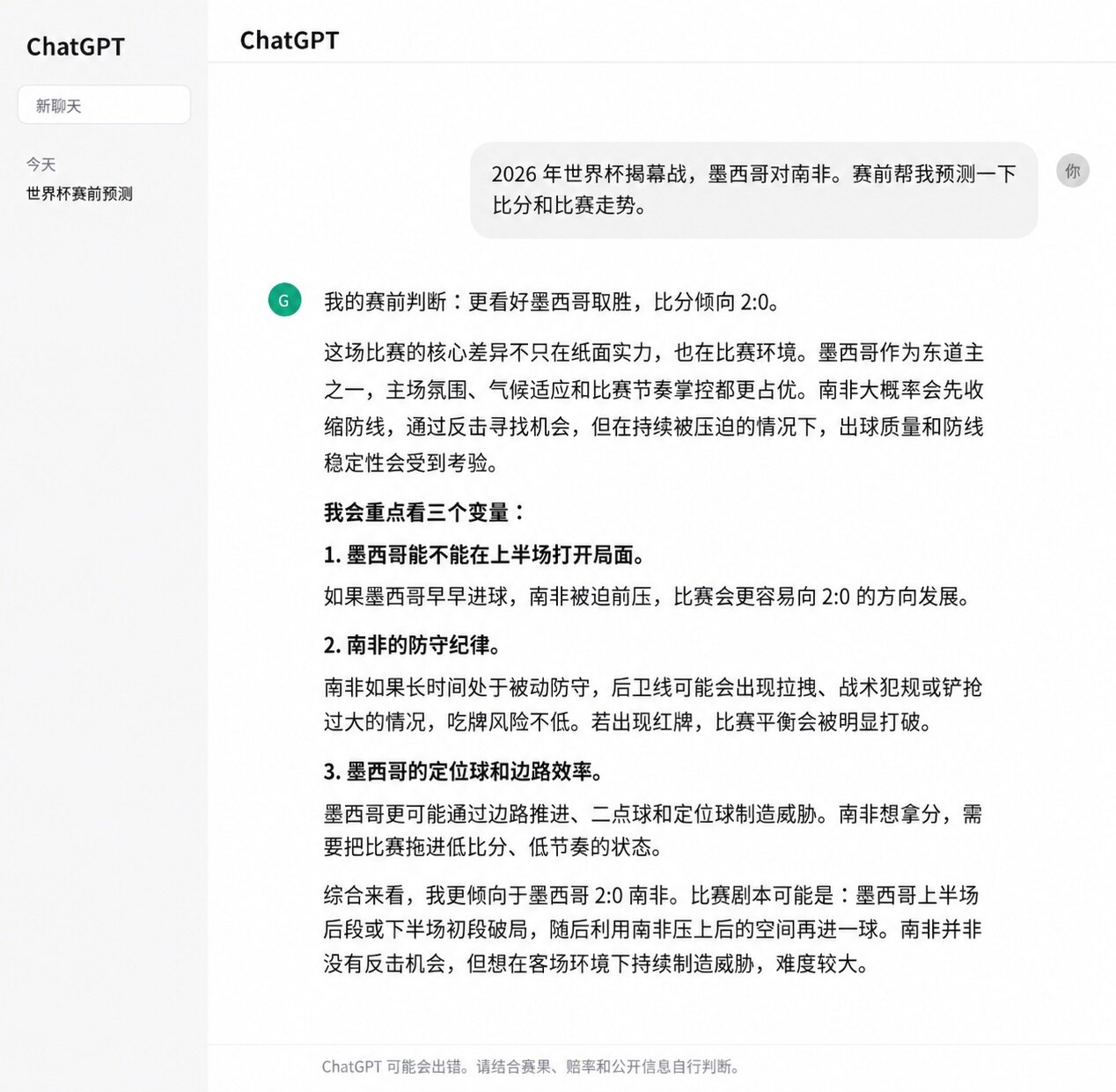
However, regarding full tournament predictions, ChatGPT's consistency wavered. It correctly predicted Mexico 2:0 South Africa and Brazil 1:1 Morocco, and accurately predicted the winners for matches involving Scotland, Germany, and Sweden. But for matches like South Korea 2:1 Czech Republic, Qatar 1:1 Switzerland, Australia 2:0 Turkey, and Japan 2:2 Netherlands, ChatGPT's judgments favored the team with stronger paper strength. For instance, it predicted Switzerland should beat Qatar, Turkey should beat Australia, and Netherlands should narrowly defeat Japan.
ChatGPT is not incapable of prediction. It can clearly break down team strength, home environment, and recent form, and accurately predict scores in some matches. But based on current results, it excels at explaining "why the favorite is more reasonable" rather than identifying which matches might deviate from the expected script.
Gemini, Grok, Claude: Same Match, Different Scripts from Different Models
Besides Qwen, Copilot, and ChatGPT, some social media users fed the same match into multiple models for pre-match predictions.
Taking the opening match Mexico vs. South Africa as an example, one blogger tested four AI models – ChatGPT, Gemini, Grok, and Claude – for pre-match predictions. The results showed ChatGPT and Gemini both predicted Mexico 2:0 South Africa, the exact final score. Grok predicted Mexico 2:1, Claude predicted Mexico 3:1 – while both correctly predicted a Mexico win, they didn't hit the exact score.
For this opening match prediction, different models produced three different "scripts." ChatGPT Go and Gemini Pro were closer to the actual game: Mexico dominant, South Africa's attack ineffective, ultimately kept scoreless. Grok predicted a more open scoreline, suggesting South Africa would have some counter-attacking success. Claude Sonnet projected Mexico's offensive prowess higher, predicting a more open 3:1 result.
Summary
Given the limited sample of verifiable AI predictions so far, it's too early to definitively determine which model "knows football" best.
But just from the few concluded matches, differences are already apparent. Qwen is currently the most memorable, hitting consecutive exact scores for Mexico 2:0 South Africa and South Korea 2:1 Czech Republic on opening day, while also correctly identifying red card risks and match trends – a standout performance in a small sample. However, sustained accuracy requires verification over more games.
Both Copilot and ChatGPT had moments of hitting exact scores but share a common weakness – their judgment remains insensitive to matches deviating from paper strength, such as Australia defeating Turkey, Qatar drawing with Switzerland, and Japan holding Netherlands to a draw.
As for models like Gemini, Grok, and Claude, currently available public samples are mostly limited to single matches or social media comparisons. Their insights are valuable but insufficient for direct rankings.
AI can serve as a reference layer for users in the World Cup prediction market, but it is far from being a standard answer. Moving forward, Odaily Planet Daily will continue collecting pre-match predictions from various models and track their performance as the tournament progresses: which models are merely lucky early on, and which ones can withstand the test of match results across more games.