






从社区「硬件宅」到AI圈「浑水」:年入近亿美元的SemiAnalysis如何搅动半导体市场?


- ประเด็นหลัก: บทความนี้เจาะลึก SemiAnalysis ซึ่งเป็นสถาบันวิจัยด้านเซมิคอนดักเตอร์และโครงสร้างพื้นฐาน AI โดยเผยให้เห็นว่าด้วยการวิเคราะห์เชิงลึก วิธีการรวบรวม情报 ที่ไม่เหมือนใคร และความสัมพันธ์ระดับสูงในอุตสาหกรรม พวกเขาได้เติบโตจากกลุ่มผู้ชื่นชอบฮาร์ดแวร์นิรนาม กลายเป็นกำลังสำคัญที่ส่งผลต่อการกำหนดราคาในตลาด AI รายงานเชิงลบเกี่ยวกับ CPO (Co-Packaged Optics) ของโมดูลออปติกเมื่อเร็วๆ นี้ ทำให้เกิดความปั่นป่วนอย่างรุนแรงในตลาด สถาบันวิจัยแบบสั้นหรือ情报 ลักษณะคล้าย ‘浑水’ (Muddy Waters) กำลังมีอิทธิพลมากขึ้นในยุค AI
- องค์ประกอบสำคัญ:
- SemiAnalysis สร้างชื่อเสียงจากการคำนวณต้นทุนที่แท้จริงของ DeepSeek (ประมาณ 1.6 พันล้านดอลลาร์ ไม่ใช่ 6 ล้านดอลลาร์) และการชี้ให้เห็นจุดอ่อนของซอฟต์แวร์ AMD โดยการทดสอบ MI300X จริง การวิเคราะห์ของพวกเขาส่งผลโดยตรงต่อความเชื่อมั่นของตลาดในการลงทุนด้านพลังประมวลผล AI
- SemiAnalysis ถูกอ้างถึงโดย Jensen Huang ซีอีโอของ Nvidia ในงาน GTC ปี 2026 และอันดับประสิทธิภาพชิปของพวกเขาถูกนำไปใช้ในปาฐกถา ซึ่งบ่งชี้ว่าอำนาจของพวกเขาได้รับการยอมรับในระดับสูงสุดของอุตสาหกรรม
- โมเดลธุรกิจของพวกเขาอาศัยความสามารถในการรวบรวมข้อมูลเชิงลึกและไม่เปิดเผยต่อสาธารณะ รวมถึงภาพถ่ายดาวเทียม การสัมภาษณ์ห่วงโซ่อุปทาน เอกสารของรัฐบาล และข้อมูลวงในจาก Discord และยังเคยถูกอดีตพนักงานกล่าวหาว่าใช้การลงทุนส่วนตัวเพื่อรับข้อมูลลับที่ไม่เปิดเผย
- รายได้ของ SemiAnalysis คาดว่าจะพุ่งทะยานจากประมาณ 20 ล้านดอลลาร์เมื่อปีที่แล้ว สู่ 100 ล้านดอลลาร์ โดยลูกค้าประกอบด้วยผู้ให้บริการคลาวด์รายใหญ่และสถาบันการลงทุนชั้นนำ ซึ่งสะท้อนถึงความต้องการ情报 มูลค่าสูงในตลาดอย่างมาก
- Dylan Patel ผู้ก่อตั้ง มีความสัมพันธ์ใกล้ชิดกับกลุ่มแกนกลางของ AI (เช่น นักวิจัยเดิมของ Anthropic, OpenAI และ Sequoia Capital) และใช้พื้นที่ทำงานร่วมกัน ซึ่ง ‘วงใน’ นี้ยิ่งเสริมความได้เปรียบด้านข้อมูลและอำนาจในการกำหนดวาทกรรมของเขา
Over the past month, the hottest sub-sector in the US AI stock market has been optical modules.
An AI data center isn't just about stacking rows of GPUs. Massive amounts of data also need to be exchanged between GPUs and between servers. The larger the model and the cluster, the more easily the "data transfer" between machines becomes a bottleneck. Consequently, the market has turned its attention to the optical communication chain, with the hottest concept being CPO (Co-packaged Optics). CPO can be roughly understood as placing optical communication components closer to the core chip. Shorter distances mean faster data transfer and lower power consumption. In the context of increasingly massive AI data centers, this narrative sounds almost perfect.
The true ignition of this narrative is credited to Jensen Huang. As Nvidia continues to push the AI infrastructure story, optical communication chain companies like Marvell, Coherent, Lumentum, Corning, and AAOI have either been rumored to have landed large orders or have seen their stock prices run up significantly.
However, a highly controversial research report a couple of days ago suddenly poured cold water on this red-hot sector. Stocks across the optical communication chain corrected collectively, with many experiencing high single-digit or even double-digit percentage drops.
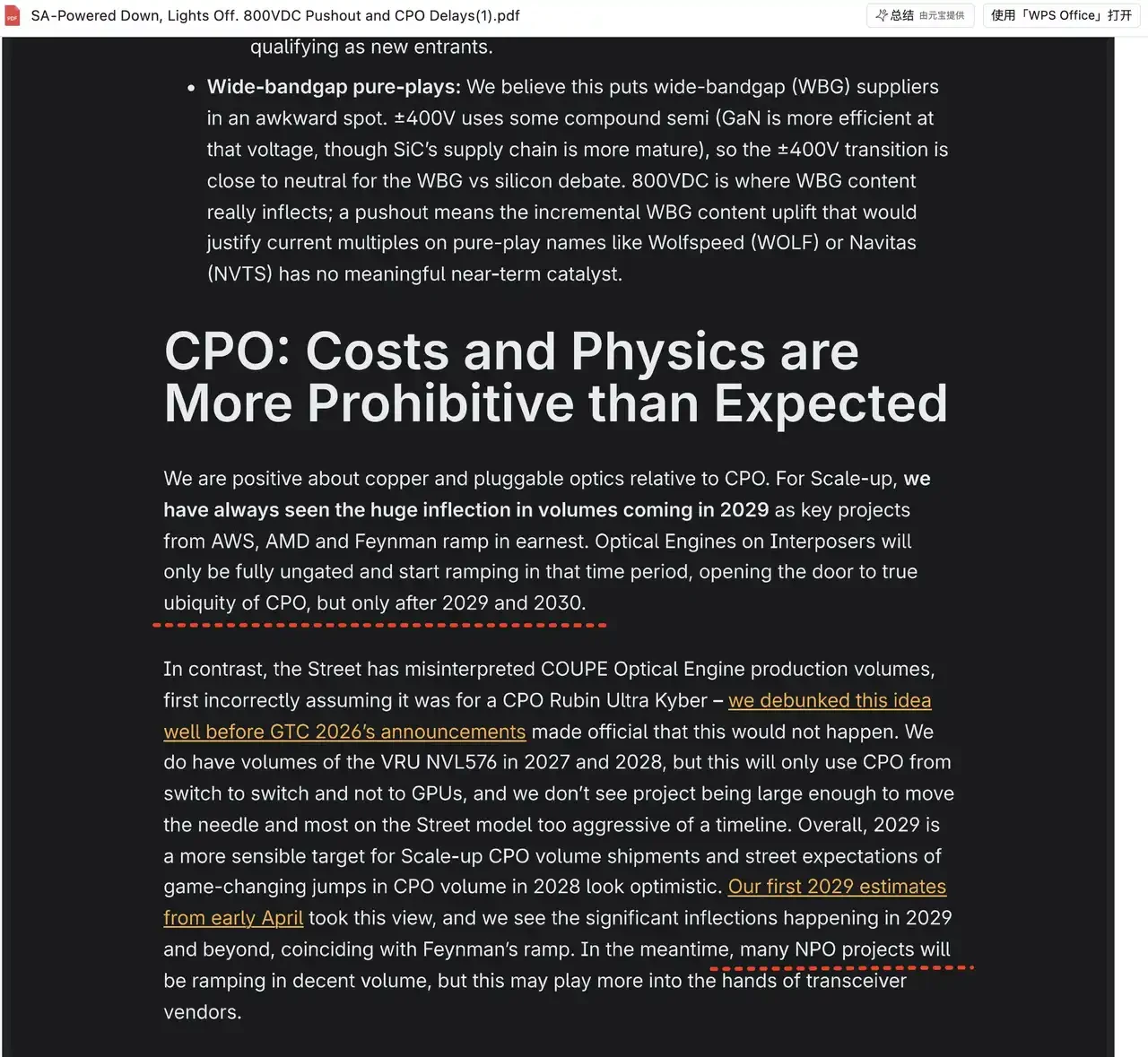
This raises the question: What exactly did this report say? Who is SemiAnalysis, the firm that published it? And why could one report from them cause the market to reprice the entire AI optical module chain?
This article from BlockBeats will delve into this institution.
Why is SemiAnalysis Treated Like an "Industry Bible"?
In the eyes of many institutions in the AI and investment circles, SemiAnalysis is far from an unfamiliar name. But for ordinary retail investors, it still retains some mystery.
SemiAnalysis is one of the fastest-rising star institutions in semiconductor and AI infrastructure research in recent years. Although still a relatively new player, it has rapidly gained prominence in AI and investment circles thanks to its in-depth analysis and sharp insights. Currently employing around 85 people, it focuses on providing in-depth reports and data models for the AI ecosystem, covering various aspects such as data center construction, supply chain economics, chip deployment, networking, power, packaging, and equipment.
SemiAnalysis's official website introduction
SemiAnalysis's classic battle that earned the industry's respect was likely its recalculation of DeepSeek's costs.
In early 2025, DeepSeek exploded globally with a highly viral narrative: "Delivering a model comparable to OpenAI o1 for only $6 million." This figure directly challenged the investment logic behind AI computing power. The market began to doubt whether the multibillion-dollar capital expenditures on GPUs were all for nothing if models could be trained so cheaply.
In a panic, Nvidia's market cap once evaporated by about $600 billion in a single day, setting a record for the largest single-day value destruction in US stock market history.
While the world debated the truth behind the $6 million figure, SemiAnalysis recalculated DeepSeek's hardware costs in a research report. It didn't simply deny DeepSeek's technological progress but dissected the "low-cost myth": What exactly did the $6 million cover? And, more importantly, what did it not cover?
SemiAnalysis concluded that the $6 million only covered the narrow cost of GPU pre-training, excluding R&D, infrastructure, cluster construction, and ongoing operations. It estimated DeepSeek's real server capital expenditure to be around $1.6 billion, with cluster operating costs approaching $944 million.
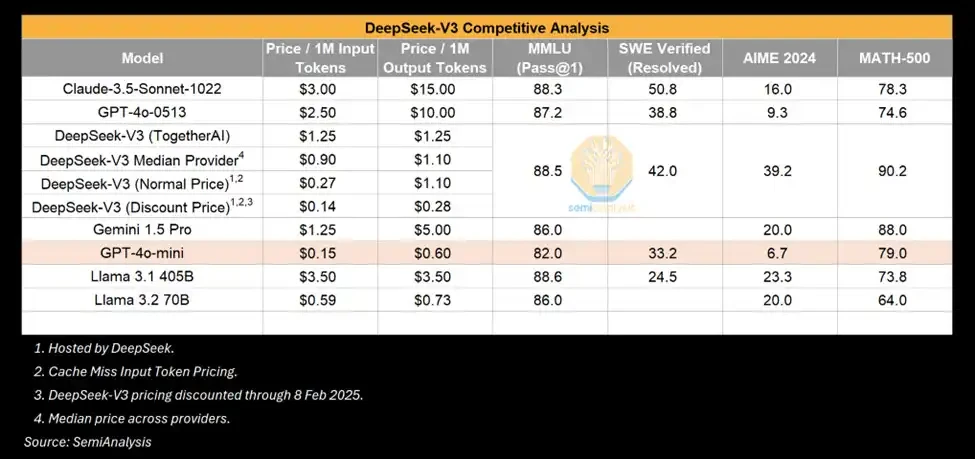
SemiAnalysis's cost calculation data for DeepSeek
More critically, it broke down DeepSeek's computing power inventory. SemiAnalysis determined that DeepSeek likely possessed around 50,000 Hopper GPUs. However, this wasn't 50,000 H100s but a mix of H800, H100, and the China-specific H20. Moreover, these cards were shared with the quantitative hedge fund High-Flyer, distributed across multiple locations for tasks like trading, inference, training, and research.
Beyond DeepSeek, another frequently cited case is SemiAnalysis's "bearish" report on AMD.
At the time, a hot topic in the market was AMD's potential to catch up with Nvidia. Most were comparing the paper specs of AMD and Nvidia GPUs. SemiAnalysis, however, repeatedly emphasized that Nvidia's true moat was never just the chip, but the entire ecosystem: CUDA software, networking, system design, supply chain capabilities, and the deployment experience accumulated by customers over years. These elements, they argued, are Nvidia's real competitive advantage.
In December 2024, SemiAnalysis published a report based on five months of practical testing of the AMD MI300X. The report bluntly stated: "We had hoped AMD could be a strong competitor to Nvidia on the training side, but that day has not yet arrived." Its core conclusion was that while the MI300X should have had a clear advantage over Nvidia's H100 and H200 on paper specs and total cost of ownership, its actual performance didn't fully deliver, primarily due to issues on the software side.
Just one day after the report was released, AMD CEO Lisa Su proactively contacted SemiAnalysis founder Dylan Patel. A scheduled 30-minute call ended up lasting a full 90 minutes.
Of course, this also led to community suspicions that SemiAnalysis might be a front or supported by Nvidia.
SemiAnalysis's influence has also spilled over from its reports into the industry itself.
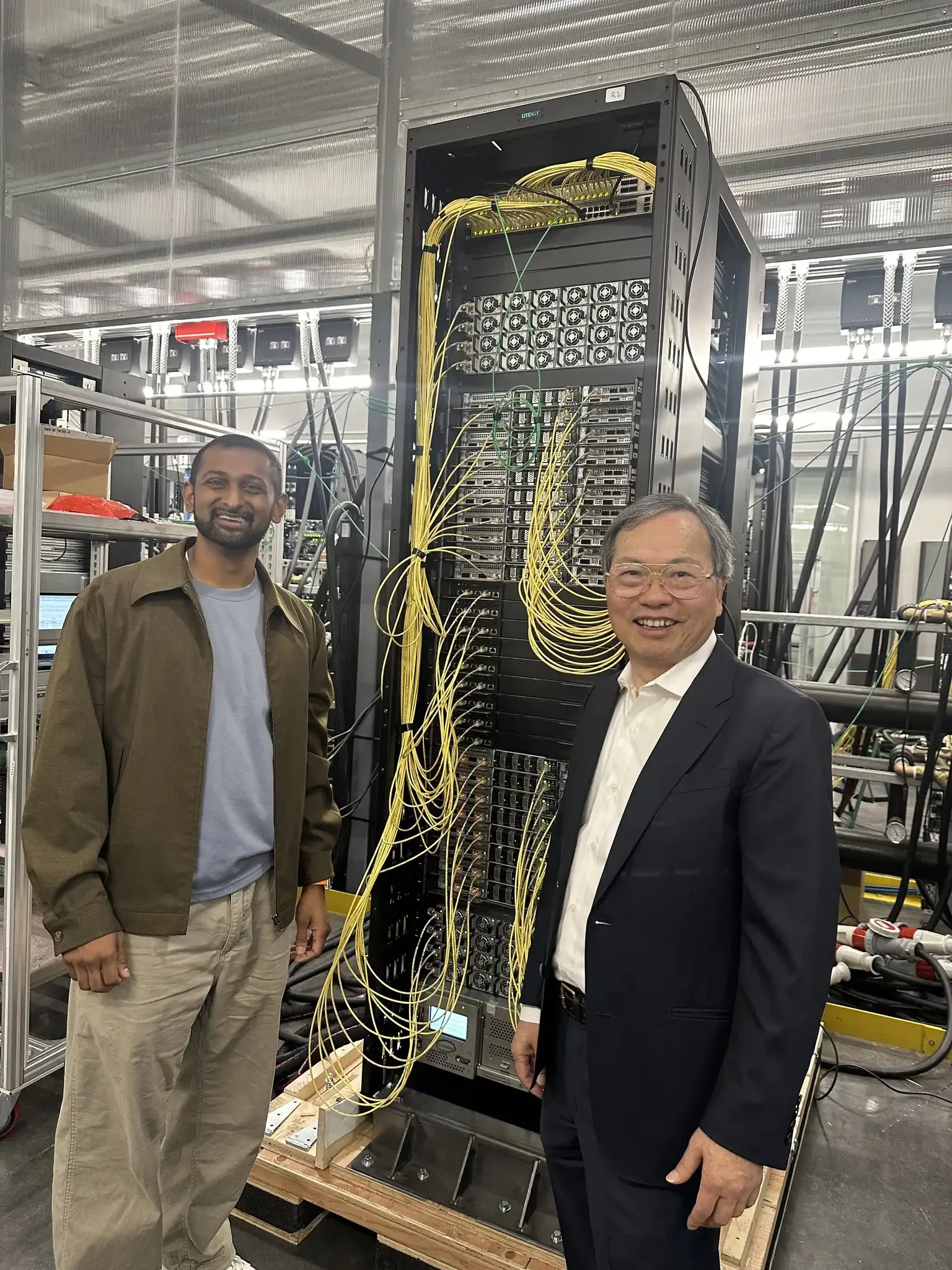
Dylan (left) with SuperMicro founder and CEO Charles Liang (right)
Last year, Dylan was invited to tour the Supermicro factory, personally guided by CEO Charles Liang. According to a reporter from The Information, when visiting Dylan's San Francisco office for an interview, he almost bumped into Dylan's next visitor in the lobby: Sequoia Capital partner Shaun Maguire was sitting there waiting to see him.
The pinnacle moment came at GTC in March 2026.
During Jensen Huang's keynote speech lasting over two hours, he only mentioned two people by name, one of whom was Dylan Patel. He not only cited SemiAnalysis's newly released chip performance ranking list, InferenceX, but also displayed SemiAnalysis's logo prominently on the big screen, spending a full 5 minutes explaining it. During the speech, Huang even publicly acknowledged Dylan's analysis: "Dylan Patel (SemiAnalysis founder) said I was hiding our strength, saying the real performance is 50 times. He wasn't wrong."
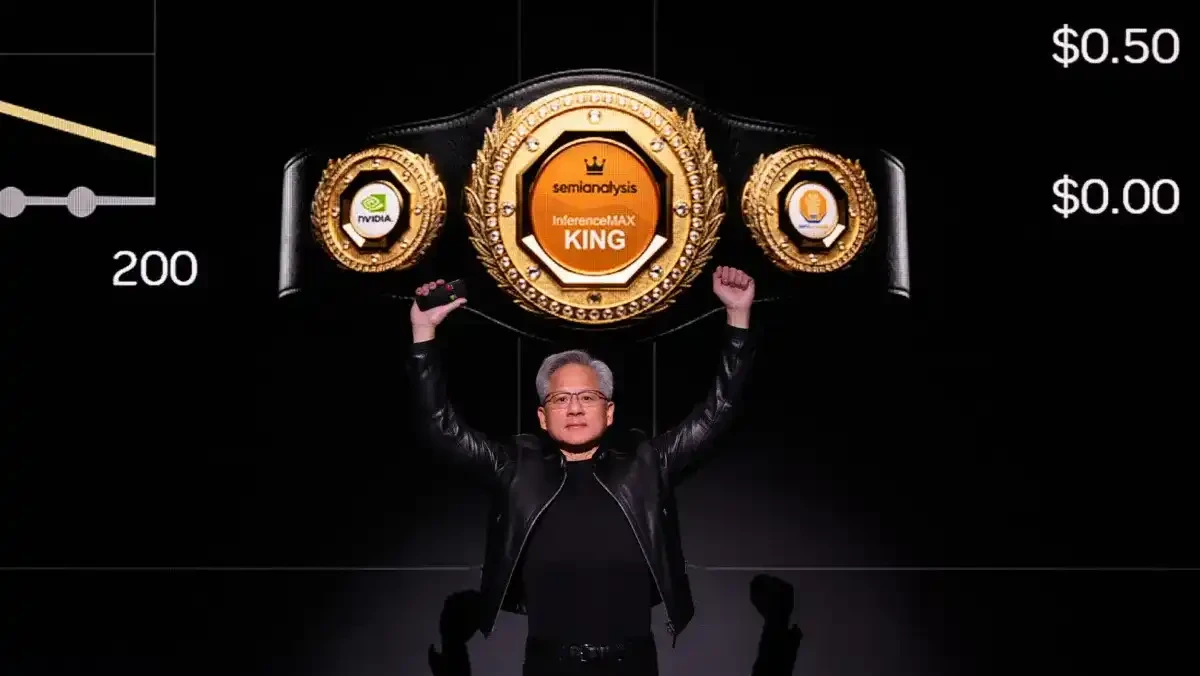
Nvidia CEO Jensen Huang celebrates with raised hands at the latest GTC developer conference, mentioning SemiAnalysis and its recent evaluation report on Nvidia chips
This status is directly reflected in its commercial revenue.
SemiAnalysis's revenue is projected to approach $100 million this year, up from just about $20 million a year ago. Its clientele spans tech giants and top-tier investment institutions. It doesn't publicly display client logos, but the disclosed client categories are telling enough: hyperscale cloud providers, major chip companies, large mutual funds, and private investors.
In other words, SemiAnalysis's main revenue doesn't come from regular newsletter subscribers. Instead, it sells these reports to the startups, investors, institutions, and traders who make decisions on billions of dollars in AI infrastructure spending.
From Anonymous Hardware Enthusiast to Top-Tier AI Institution
Much like the recently discussed "White-Haired Stock God," the background of SemiAnalysis founder Dylan Patel also has a distinctly internet flavor.

Dylan Patel
According to BlockBeats' findings, Dylan Patel's friend, Dr. Ian Cutress, once recalled in an article that before founding SemiAnalysis, Dylan was a moderator on a popular hardware forum.
Dylan himself recalled in a podcast that before starting the company, he ran an anonymous blog for many years within the "Silicon Valley Twitter circle." It was a niche community unfamiliar to the average tech Twitter user but densely populated with hardware, chip, and supply chain professionals.
Reddit community users also mentioned that early on, Dylan Patel was just a "nobody" on Reddit. Public Reddit archives we found show the username u/dylan522p and u/SemiAnalysis appearing in r/hardware moderation discussions.
These clues paint a consistent picture: Dylan was an active hardware enthusiast in the early days, participating in Reddit and WordPress communities. He wasn't treating writing as a serious business yet. He worked as a consultant while maintaining an independent blog called "A thousand million," with the consulting work itself being related to the blog's content and industry connections.
Besides Dylan, his partner Doug O'Laughlin is also a key figure at SemiAnalysis and a pivotal turning point in the blog's commercialization.
After Doug also started posting on forums, Dylan found him "interesting," and their interactions increased. Later, Doug repeatedly urged him: You should use your real name, move to Substack, and start charging. A few years later, Doug joined the company full-time.
Today, SemiAnalysis is the largest paid technology newsletter on Substack, with over 285,000 subscribers. In addition to Substack posts, it also has a podcast called Transistor Radio.
According to Dylan, the podcast serves as a vehicle for industry perspectives that don't fit into formal articles. Articles handle complete, in-depth stories, while the podcast handles fragmented news commentary, impromptu judgments on the broader market, and weekly real-time industry discussions. It's roughly bi-weekly, featuring casual conversations about the last two weeks' semiconductor news.
As it has grown, the podcast has become a regular operation, no longer relying solely on the two founders. Team members now take turns participating. For example, an episode in March 2026 featured Sravan Kundojjala, Ivan Chiam, and Jordan Nanos dissecting AI chip shortages, covering everything from TSMC and Nvidia CPO to how the memory crisis affects GPU pricing and next-generation smartphones.
Beyond their own channels, Dylan himself is a frequent guest on various tech and investment podcasts, almost becoming a default guest for AI hardware topics. He has appeared on No Priors, Invest Like the Best, Unsupervised Learning, and Dwarkesh Patel's podcast. He has also had in-depth conversations with Jon Y from Asianometry, which many viewers consider one of the best YouTube channels covering semiconductors and business history.
Like an "Intelligence" Agency, but More Like Muddy Waters Capital
A detail in The Information's report reveals a lot about Dylan Patel's modus operandi.
In the early days of his startup, to supplement his semiconductor knowledge, Dylan attended virtually every industry conference he could. Once there, he would grab people and ask questions. Not just brief pleasantries, but a relentless pursuit of information, turning engineers, supply chain personnel, and company executives into his sources one by one.
Even as SemiAnalysis grew larger, this methodology remained, only becoming more industrialized.
According to The Information, the company now has 85 employees spread across 11 countries. Every Monday, Dylan reviews the weekly briefs submitted by team managers. Each team monitors a segment of the AI economy, compressing the news, leads, anomalies, and inferences from the past week into a single document.
Think of it as a weekly AI infrastructure intelligence report. Someone tracks each line: GPU, HBM, packaging, data centers, power, cloud providers, optical modules, and chip manufacturing equipment. This includes former ASML engineer Jeffrey Koch, who specializes in the semiconductor equipment chain. When he looks at bottlenecks in the AI supply chain, his focus extends beyond just power to whether chip manufacturing equipment might become the primary constraint.
SemiAnalysis is also adept at digging for information in gray areas.
The article mentions that Dylan once saw a leaked Google internal memo circulating on Discord. He downloaded it and then verified its authenticity with Google insiders.
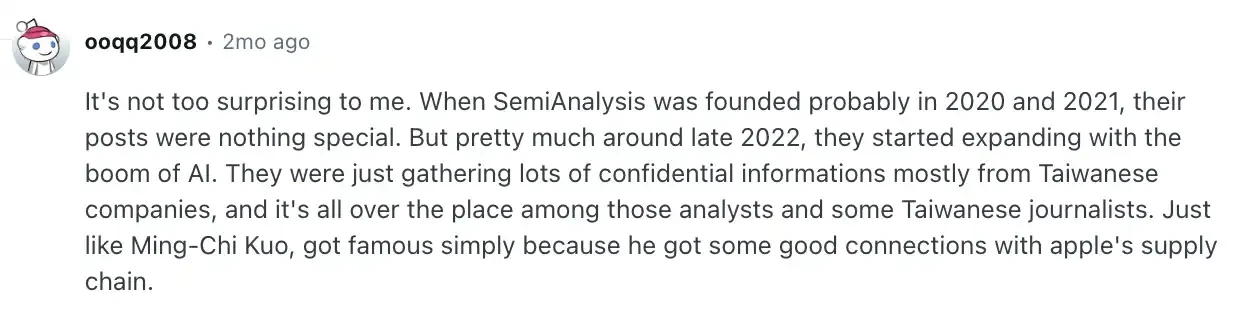
Reddit communities also pointed out: when SemiAnalysis was founded around 2020 or 2021, its content wasn't particularly special. But around the end of 2022, as the AI boom began, it started expanding rapidly. The user suggested that SemiAnalysis collected a large amount of non-public or semi-public information, mainly from Taiwanese companies, which circulates among analysts and some Taiwanese journalists.
"In a way, SemiAnalysis is like Ming-Chi Kuo, famous simply because he built excellent relationships with the Apple supply chain."
A recent lawsuit between SemiAnalysis and a former employee has also brought this "gray area information-gathering ability" into the spotlight.
According to documents filed in the San Francisco County Superior Court, former SemiAnalysis employee Wei Zhou alleges that Dylan Patel operated SemiAnalysis while personally investing in Fluidstack, using non-public information obtained through this investment for research. When Zhou refused to incorporate this information into SemiAnalysis products, he allegedly faced retaliation and was terminated. (It should be noted that these are currently allegations from one party in the lawsuit and have not been finally determined by the court.)
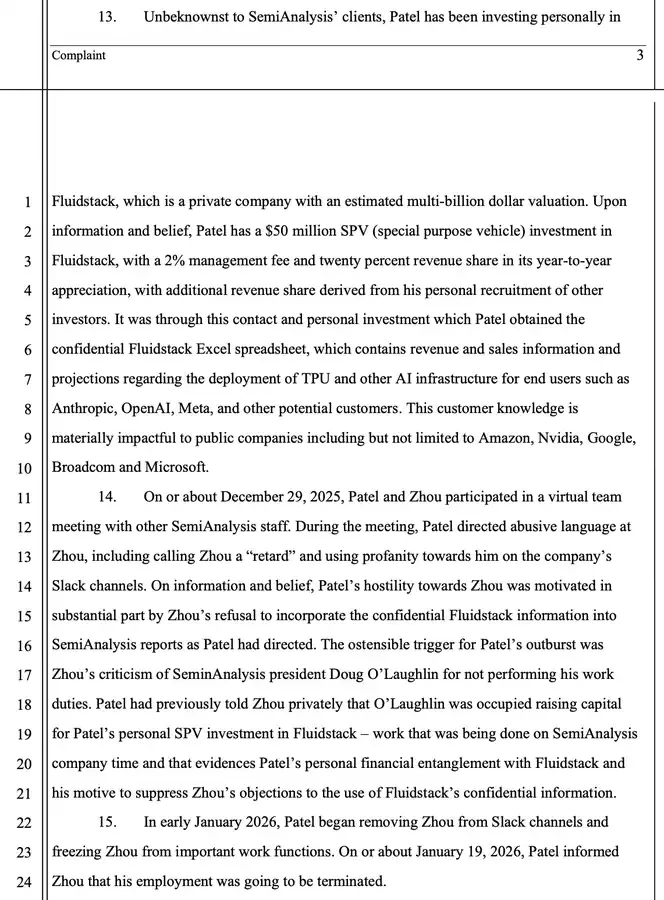
Former SemiAnalysis employee accuses Dylan Patel of improperly obtaining information
The complaint states that SemiAnalysis clients were unaware that Patel was personally investing in Fluidstack. Fluidstack is a private cloud service company reportedly valued at several billion dollars. Zhou alleges that Patel invested in Fluidstack through a $50 million SPV (Special Purpose Vehicle). Patel could also collect a 2% management fee from this SPV, share in the investment's appreciation, and potentially earn additional fees for introducing other investors.
More critically, the complaint alleges that Patel, through this personal investment relationship, obtained a confidential Excel spreadsheet from Fluidstack. The spreadsheet contained Fluidstack's revenue, sales data, and forecasts for deployments around TPUs and other AI infrastructure, with end customers including Anthropic, OpenAI, Meta, and other potential clients.
Zhou's implication is that this customer demand and deployment information is not just Fluidstack's trade secrets but could also influence the valuations of a range of public companies such as Amazon, Nvidia, Google, Broadcom, and Microsoft, as they are all part of the AI cloud, GPU/TPU, networking, and data center infrastructure value chain.
From a small sample, we can infer SemiAnalysis's research approach: it's backed by a complete intelligence-gathering machine involving forums, Discord, industry conferences, networks, shipping records, government documents, supply chain data, data center site photos, benchmarks, models, and weekly internal briefs.
According to Dr. Ian Cutress, institutions like SemiAnalysis rely on data sources far more complex than the average person imagines. This includes filing public information requests, sifting through public shipping manifests, and combing through supply chain and government documents. For data centers, they sometimes apply for permits to fly drones over construction sites to take high-resolution photos of the equipment being installed.
SemiAnalysis's own product page is also quite explicit. Its AI data center model tracks over 5,000 data centers globally, sourcing data from property records, construction permits, electricity usage, FOIA requests, and satellite imagery. To process the massive volume of satellite photos, they have specifically trained computer vision models (CNNs) to automatically identify the size, capacity, and construction progress of each data center. The goal is to extend coverage to every data center in every country.
This approach resembles less of a traditional analysis firm and more of an open-source intelligence (OSINT) company.
Interestingly, this reminds us of the famous short-selling research firm Muddy Waters' investigative methods. Muddy Waters made its name with reports on certain Chinese companies.
For example, Muddy Waters' investigation of Orient Paper included on-site factory visits, observing the factory environment, machinery, and inventory, chatting with workers and nearby residents, and even secretly squatting outside the plant to record the cargo carried by entering and exiting vehicles for photographic evidence. They concluded that the so-called inventory was essentially a pile of waste paper.
Another case was their investigation of China MediaExpress (CME). Muddy Waters physically inspected the advertising terminals on over 50 buses, finding that drivers preferred playing their own DVDs, indicating CME had weak control over its terminals. When investigating Multi-Pure International (MCF), they found one office location was practically non-functional, with employees showing no signs of working, which they jokingly called an "adult daycare center."
The most recent high-profile short attack was against Luckin Coffee, a company we drink daily. Muddy Waters mobilized 92 full-time and 1,418 part-time investigators to stake out over 620 stores in 38 cities across China. They recorded


