






AI 正在制造新的"信息穷人"?


The cruelest thing about AI is not that it denies answers to the poor.
On the contrary, it gives answers to everyone.
It provides essay frameworks to students, email templates to employees, business plans to entrepreneurs, and legal explanations, investment advice, and career guidance to ordinary people. For the first time, answers are so cheap, so abundant, and so convincing.
But herein lies the problem: when answers are accessible to all, what becomes truly scarce is no longer the answer itself, but the ability to judge those answers.
The new information-poor are not those locked out of AI, but those who have already received answers yet lack the ability to evaluate them and lack the means to translate those answers into real opportunities.

1. The Information Gap in the AI Era
In the internet era, the information-poor were those excluded from the network. The solution seemed clear: connect the cable, popularize devices, and improve literacy. The search engine era was slightly more complex, requiring you to master keyword extraction, source filtering, credibility assessment, and preferably some English. But the barriers were visible and quantifiable.
The information gap in the AI era has a fundamentally different structure.
Large language models are not search engines; they generate conclusions for you directly. You no longer need to "find" the answer—the answer is actively delivered to you in fluent paragraphs, clear steps, and confident tones. On the surface, the barriers have been drastically lowered. But hidden here is a harsh structure: when answers become cheap, errors become equally cheap; and the ability to discern "whether this answer is trustworthy" has become more scarce and more valuable than ever before.
Every historical diffusion of a general-purpose technology follows the same logic: new technology first rewards those who already possess complementary capital. The printing press benefited the literate first; computers benefited those who knew office software and programming first; the internet benefited those with strong English skills and proficient search techniques first. AI's complementary capital includes educational background, professional knowledge, critical thinking, organizational authorization, purchasing power, and the hardest-to-quantify trait of all: judgment.
New technology rarely rewards those who need it most first. It usually rewards those who can best utilize it first.
2. The First Divide: The Path to AI
The first crack of inequality appears before you even open the application.
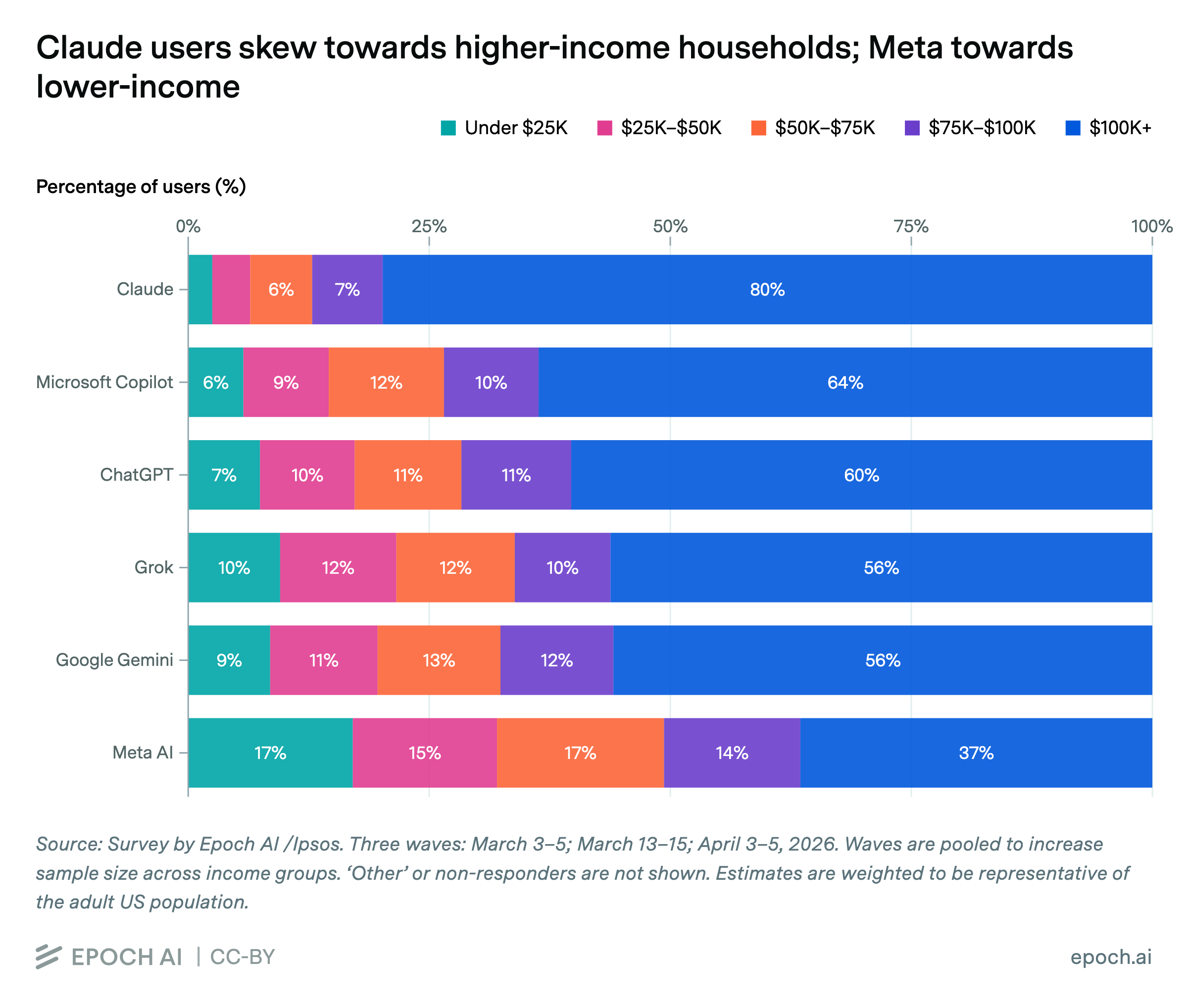
In April 2026, AI research institute Epoch AI, in collaboration with polling firm Ipsos, released a survey of approximately 5,000 American adults. Three rounds of questions asked a seemingly simple question: Which AI services have you used in the past week? But the answers revealed not just simple product preferences, but a map woven together by income, access points, and distribution.
Approximately 80% of Claude's weekly active users come from households earning over $100,000 annually; for Meta AI users, this proportion is only 37%. Conversely, about 32% of Meta AI users come from households earning under $50,000 annually, while for Claude users, this proportion is only 7%.
These numbers matter not because they prove "the rich use advanced AI, the poor use free AI." That is the most superficial reading. What is more worth investigating is: Why do different people encounter different AIs in their daily lives?
One person asks AI to pair leftover ingredients in the fridge for dinner, brighten the background of a photo, or polish a text message. Another asks AI to organize client interviews, compare supplier quotes, or identify weak assumptions in a report. Both are invoking the same technology. But one invocation ends at convenience; the other enters a cycle of income, position, and bargaining power.
The difference lies not only in the users but also in the access points. Using Claude requires actively searching, comparing products, understanding capability differences, choosing a payment plan, and embedding the tool into a workflow—each step filters users out. Meta AI's path is almost the opposite: it is built into a social platform, free, low-friction, and users often encounter it passively while browsing feeds, sending messages, or viewing photos.
This is not a market of taste, but a market of distribution. While users appear to be choosing tools, the tools' prices and access points are also choosing their users.
Source: epoch.ai
3. Then Comes the Divide: How AI is Used
Even if you find a good AI tool, the second divide awaits you inside the company.
In ordinary offices, AI rarely arrives in the form of a "layoff notice." It first takes over meeting minutes, email drafts, spreadsheet organization, client categorization, and report drafts. For managers, this automation frees up time for judgment calls; for newcomers and junior employees, this automation takes away precisely the entry point for proving themselves, practicing judgment, and reaching higher-level work.
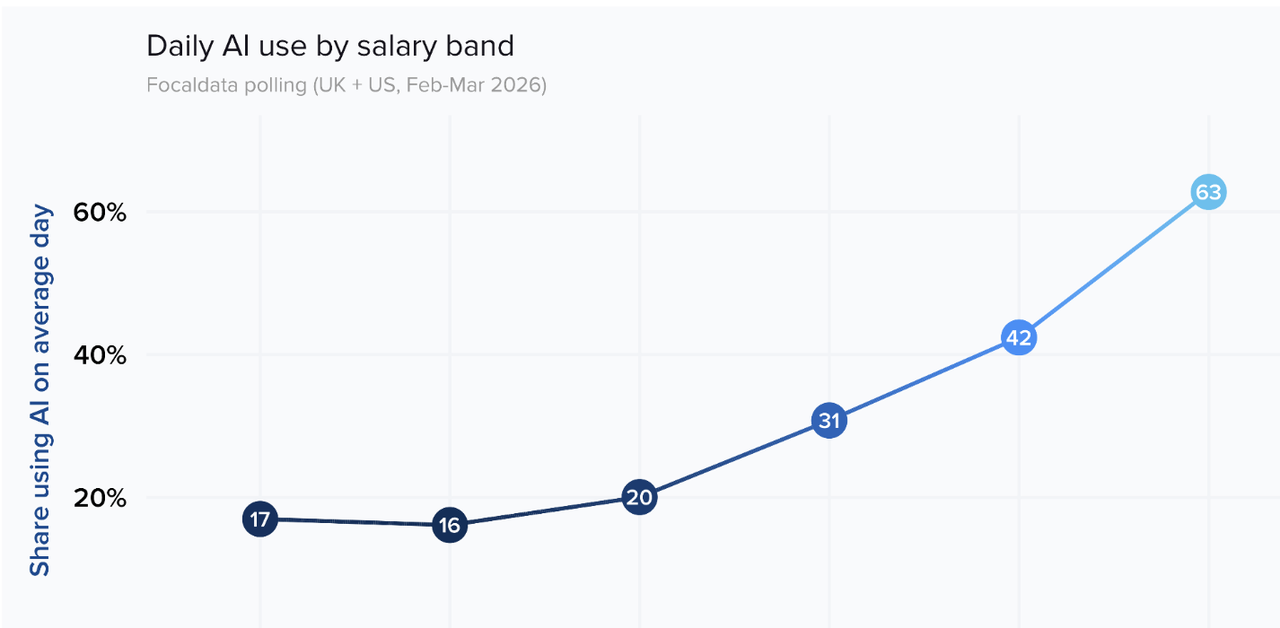
The data is even colder: an Anglo-American workforce AI tracking survey conducted by the Financial Times and a research institute (Feb-Mar 2026, covering over 4,000 respondents in the UK and US) shows that 63% of workers in the highest salary bracket use AI on a typical workday, while the proportions for the two lowest brackets are only 17% and 16%. This is not a gentle slope; it is a cliff.
More critical is the driving factor. The regression analysis of this workplace survey revealed that the influence of salary on AI usage nearly disappears after controlling for other variables. What truly matters are four factors: age, seniority, industry, and training. Training has the largest effect: in companies that provided formal AI training, employees' daily AI usage rate was 37 percentage points higher than in comparable companies without training. Even just informal guidance led to a 24 percentage point increase.
However, the reality is: as of early 2026, only 14% of employees reported receiving formal AI training from their employers, and two-thirds received no training at all.
AI training is not a technical issue; it is an allocation issue. Who gets chosen for training gets permitted onto the track of productivity growth; for those who don't, the tool is just an unapproved icon on the screen.
On the consumer side, AI is an application. On the workplace side, it is a permission. And permissions are never distributed equally.
Source: Focaldata
4. The Final Divide: The Ability to Judge AI
This is the most hidden divide, and also the most fundamental one.
Imagine a new graduate who just joined a consulting firm. They use AI to generate a draft of an industry analysis report, complete with a solid structure, ample data, and a confident tone. Their manager—someone with a decade of experience in the industry—glances at it and points out that two of the data sources cited have methodological flaws in their original research, and the third conclusion relies on a flawed causal inference. The manager didn't get there by trying harder, but by possessing that foundational layer—knowing where errors are likely, knowing which fluency reflects true understanding and which is just the machine filling in blanks.
This is the true meaning behind the counter-intuitive finding in the workplace survey: the heaviest users of AI at work are not the youngest employees, but those who have been in their current role for 2 to 10 years. The relationship between AI usage and seniority remains significant even after controlling for age. This is not because young people don't want to use it, but because the value of AI is highly dependent on the user's pre-existing judgment.
Experience is AI's most important complementary capital, and experience cannot be subscribed to.
AI lowers the cost of "sounding knowledgeable" without equally lowering the cost of "being truly knowledgeable." There is even a more dangerous consequence: the more a user lacks a solid foundation, the more likely they are to accept AI's output unquestioningly. And the more they accept it, the harder it becomes for their judgment to grow. When an agent judges for you, you are consuming intelligence, not accumulating it.
Nobel Prize-winning economist and MIT professor Daron Acemoglu is blunt about this: using AI tools requires a certain level of education, abstract thinking, quantitative skills, and familiarity with technology. "It is almost certain that AI will increase inequality," he said.
The new information-poor take shape here: they are not those without AI, but those who have AI, have access, have answers, yet lack the training to judge those answers; they have the tools and the context but lack the permission to turn the tool's output into opportunity; they consume intelligence daily, but have never accumulated it.
5. The Limits of the Equalizing Effect
However, the relationship between AI and inequality is not solely about widening the gap.
Multiple experimental studies have found that, under controlled conditions, AI often yields larger improvements for lower-skilled workers—whether they are call center employees, junior writers, or entry-level consultants. This is understandable: top experts gain limited marginal benefits from AI; but for someone who could never afford professional services, using AI for the first time to understand a contract is a qualitative leap.
But a crucial distinction must be made here: experimental studies measure "improvement after use," while real-world data measures "who actually uses it," "who is allowed to use it," and "who can turn the results into opportunities after using it." Both sets of data are truthful; they are measuring entirely different things.
A technology can narrow gaps in the lab while widening them in the real world—if adoption itself is unequal, if the contexts themselves are unequal, if judgment itself is unequal.
AI possesses the technical potential for equalization but operates within an unequal social structure. Both of these truths coexist, and that is the true shape of the problem.
6. Technology Spreads, But Benefits Don't Arrive Simultaneously
Every generation tends to believe that the general-purpose technology of its own era will break down the old order.
After the printing press, the literate benefited first for centuries. In the early days of the personal computer, it amplified the abilities of those who already knew office software and coding. The early dividends of the internet flowed to those who knew English, could search effectively, and had the time and motivation to arbitrage. In every technological wave, the cry of "this time is different" is loud, yet structural divergence often takes decades to become visible.
AI's divergence may be faster and its forks deeper. Because it affects not just one type of task, but almost all work dependent on judgment and language. And this is precisely the type of capability that is hardest to standardize and hardest to redistribute.
Some believe the gap will eventually close. Economic historian and Oxford Internet Institute professor Carl Benedikt Frey holds this view, based on history: the inequality brought by the personal computer gradually dissolved over decades as usage barriers lowered. This analogy is not without merit.
The problem is, even accepting this optimistic historical analogy, Frey himself acknowledges a crucial caveat: "It depends on how long it takes for the gap to close. If it's ten or twenty years, then it's more worrying."
Ten or twenty years is not a timeframe one can wait for casually—especially for those who need to find jobs, negotiate salaries, and accumulate experience during that period.
Conclusion
This is a peculiar moment in history: for the first time, we possess a technology that makes everyone feel like they are becoming smarter.
This feeling is often the end destination.
The problem is, in an era truly decided by judgment, mistaking the feeling for the destination might be the most costly mistake of all.


