






Former Bankless Member Lucas: Why I Still Have Faith in Ethereum


- Core Thesis: Despite recent price weakness, Ethereum’s fundamentals are at an all-time high. It is steadily emerging as the preferred foundational infrastructure for the tokenization of assets within the global financial system, and will capture significant value from this massive market in the future.
- Key Elements:
- Market sentiment is extremely bearish, with ETH price down approximately 60% from its all-time high. However, such prolonged consolidation aligns with the developmental patterns of top global assets like Amazon and Nvidia.
- On-chain data is robust: daily transaction volume has hit a new all-time high (2.27 million), fees have dropped to a low of $0.27, total addresses have surpassed 400 million, and the staking rate is over 32%. Network activity remains unaffected by price.
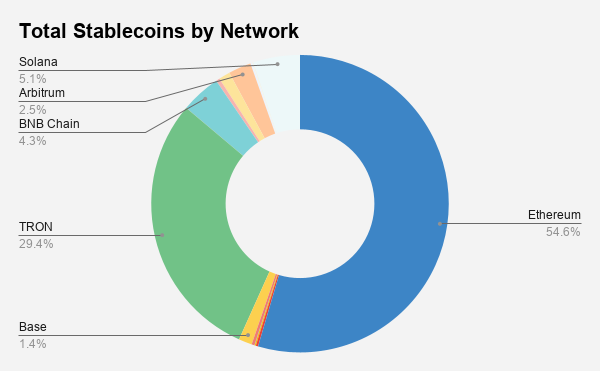
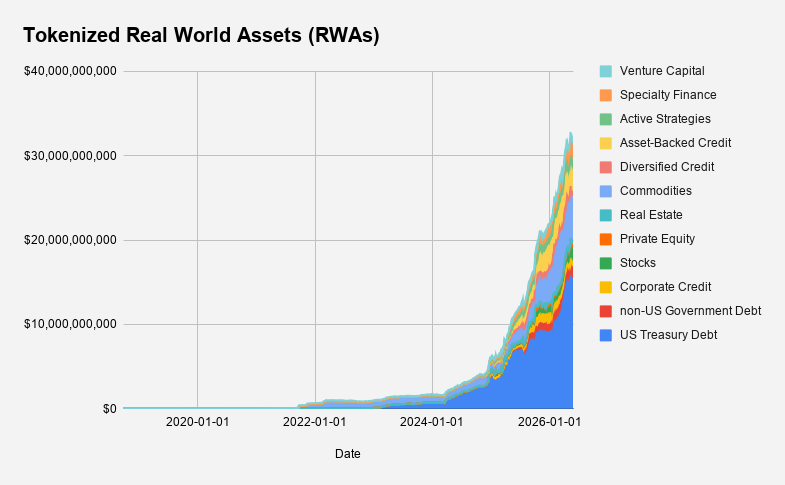
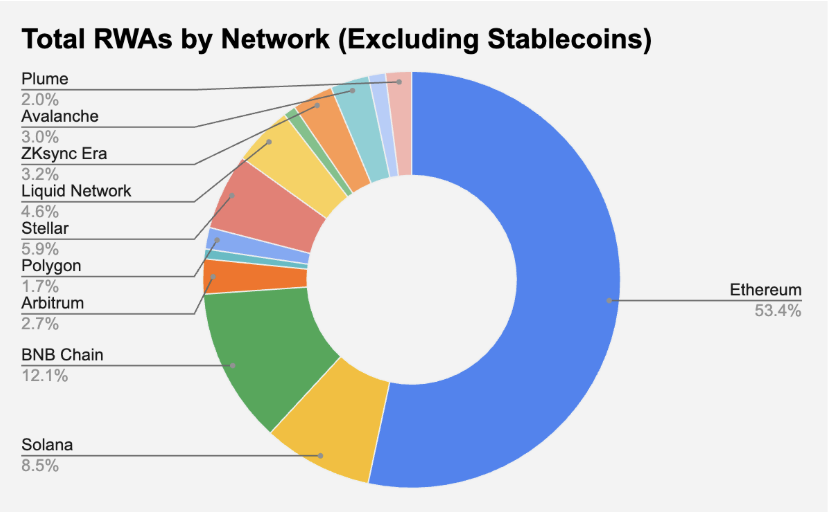
- The core logic is that "all assets will eventually be tokenized, with Ethereum becoming the unified settlement layer": the circulating market cap of stablecoins exceeds $300 billion, with Ethereum accounting for 54%; the total value of on-chain Real World Assets (RWA) exceeds $30 billion, with Ethereum holding over a 53% market share.
- The current scale of non-stablecoin RWA is roughly 7% of ETH’s market cap. For context, DeFi in its nascent stage (2019-2020) was about 20% of ETH’s market cap, indicating massive room for growth. Moreover, value capture mechanisms like EIP-1559 burning and Proof-of-Stake staking are already in place.
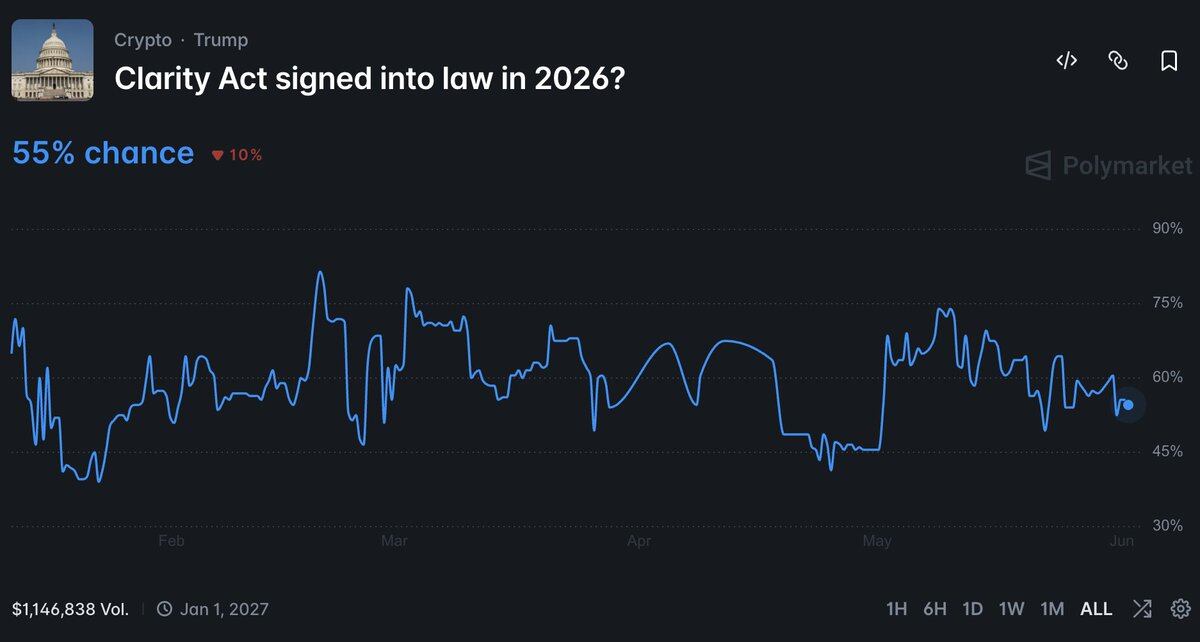
- Regulatory bills like the U.S. CLARITY Act have a relatively high probability (approx. 55%) of being enacted. If passed, they would unlock a compliant channel for traditional assets to go on-chain, serving as a super-catalyst for Ethereum.
Author: Lucas, former Bankless member
Translation: Saoirse, Foresight News
Key Takeaways:
- All assets will eventually be tokenized;
- Ethereum serves as the settlement layer for all types of tokenized assets;
- ETH secures the network through staking and captures all value generated by settlement activities;
- The global financial system is transitioning towards asset tokenization;
- Leveraging its security, stability, and long-established ecosystem moats, Ethereum will capture a significant share of the tokenization market.
The Prevailing "Ethereum is Dead" Narrative
Currently, within crypto social platforms, market sentiment towards Ethereum has hit a historic low. Many peers I've worked with for years have gradually exited the Ethereum track, with some even leaving the crypto industry entirely. The vast majority no longer hold ETH, primarily because they no longer believe in its investment value. This isn't targeting any specific individual or circle, but a common reality I've witnessed firsthand within the industry.
The large-scale exodus of capital is partly because cryptocurrency is no longer a cutting-edge technology, with AI, robotics, and longevity research becoming the new darlings of capital. However, the poor returns from ETH's weakening price action are the key driver of bearish sentiment. To put it bluntly, holding ETH over the past few years has been a terrible experience.
But I remain firmly bullish on Ethereum and ETH, more confident than ever, and I recommend readers join me in this bullish outlook. In fact, Ethereum is entering the most anticipated cycle of adoption and growth in its history.
Addressing the Dismal Price Performance
Let's first confront the most obvious issue: Over the past nearly five years, ETH's price performance has been extremely poor. Investors who entered positions in 2021 were, at best, breaking even, but most are deeply underwater. Even with the recent market correction, Bitcoin's current price still holds above its 2021 bull market peak, with its 2025 highs doubling that peak. In contrast, ETH's current price is roughly 60% below its previous all-time high. It failed to set a new record in 2025 and couldn't even breach the $5,000 mark.
During the same period, the S&P 500 index has been hitting new all-time highs almost daily, with stocks in popular Wall Street sectors like AI, semiconductors, and energy surging across the board. This contrast makes ETH's performance look even worse.
However, the good news is that over a longer timeframe, ETH's chart shows it's merely in a multi-year range-bound consolidation. Ethereum currently has a market cap exceeding $200 billion, and its price has consistently held the $2,000 level, firmly placing it among the top 100 global assets by market cap. Looking at the laws of capital market development, it's common for high-quality growth stocks to undergo years of basing and grinding before embarking on a long-term bull run.
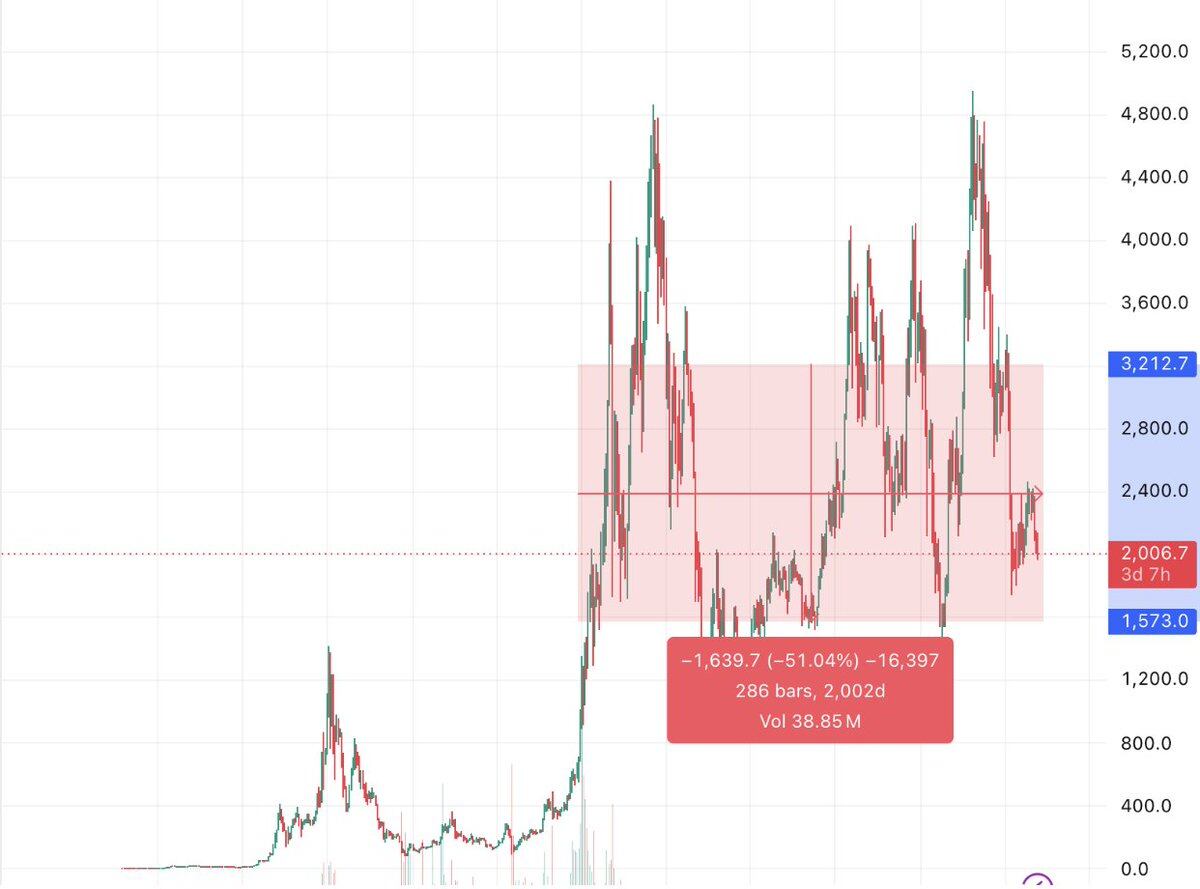
Ignore the percentage change values; focus on measuring the duration the price spends within the range.
Global giants like Amazon, Nvidia, Apple, and Microsoft have all gone through similar trajectories:
- Amazon: Under Bezos, the company traded sideways for nearly a decade in the 2000s following the dot-com bubble burst, weathering the industry winter to become a top global enterprise.
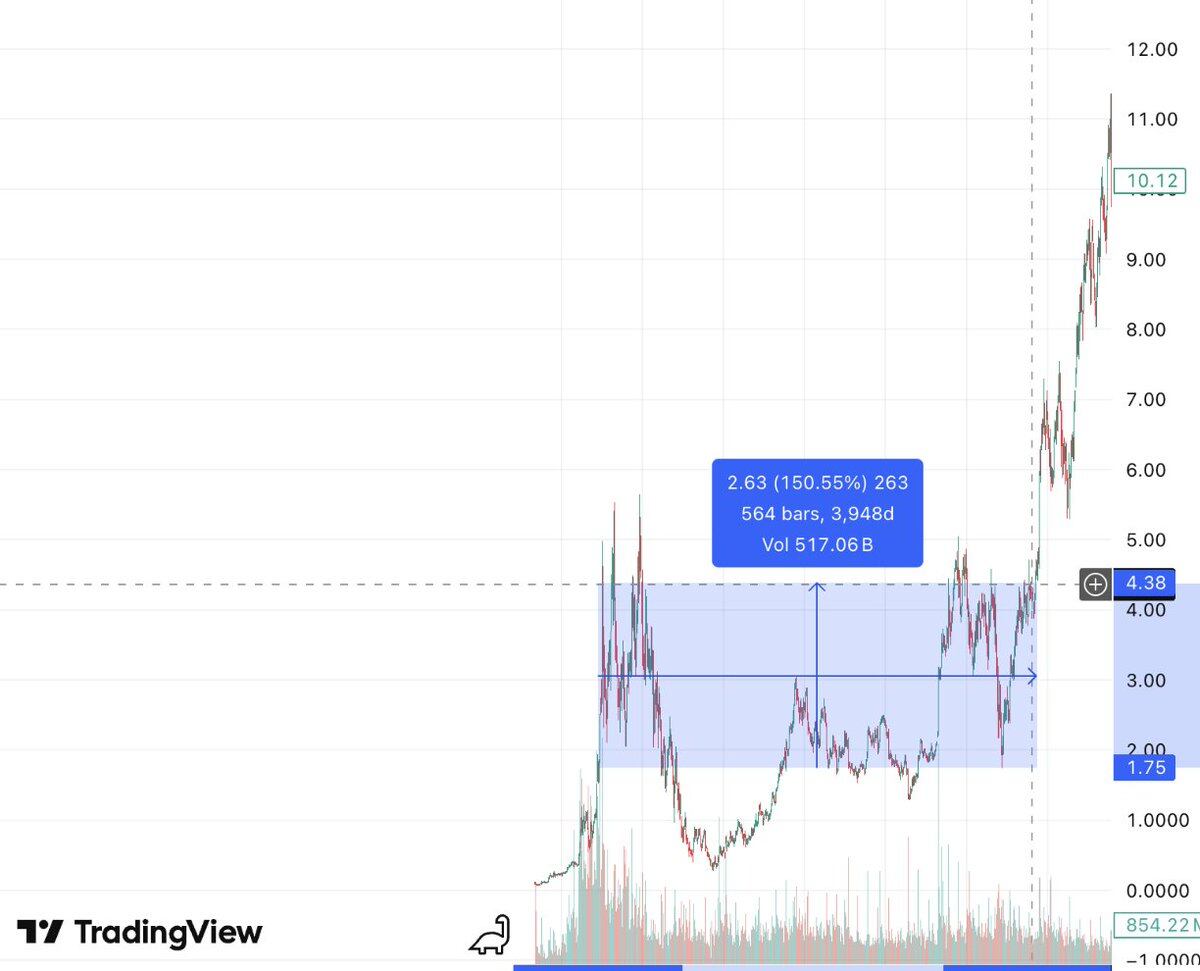
- Nvidia: Experienced a seven-year long consolidation in the 2010s before riding the AI wave to an epic stock price surge, joining the top tier of global market valuation.
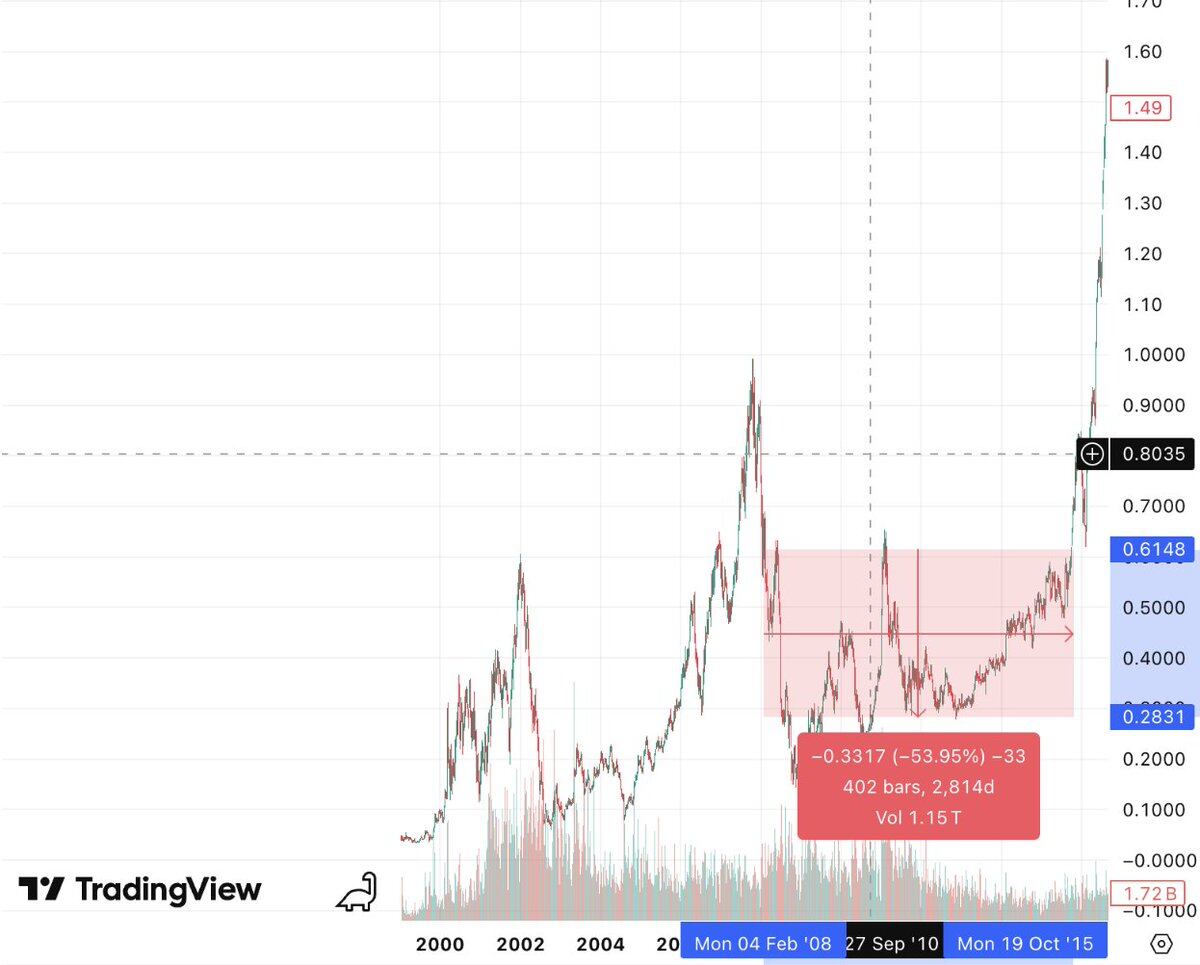
- Apple: Wandered in confusion and oscillated for a long period during the 1980s and 1990s, only taking off after Jobs returned to the company in 1997.
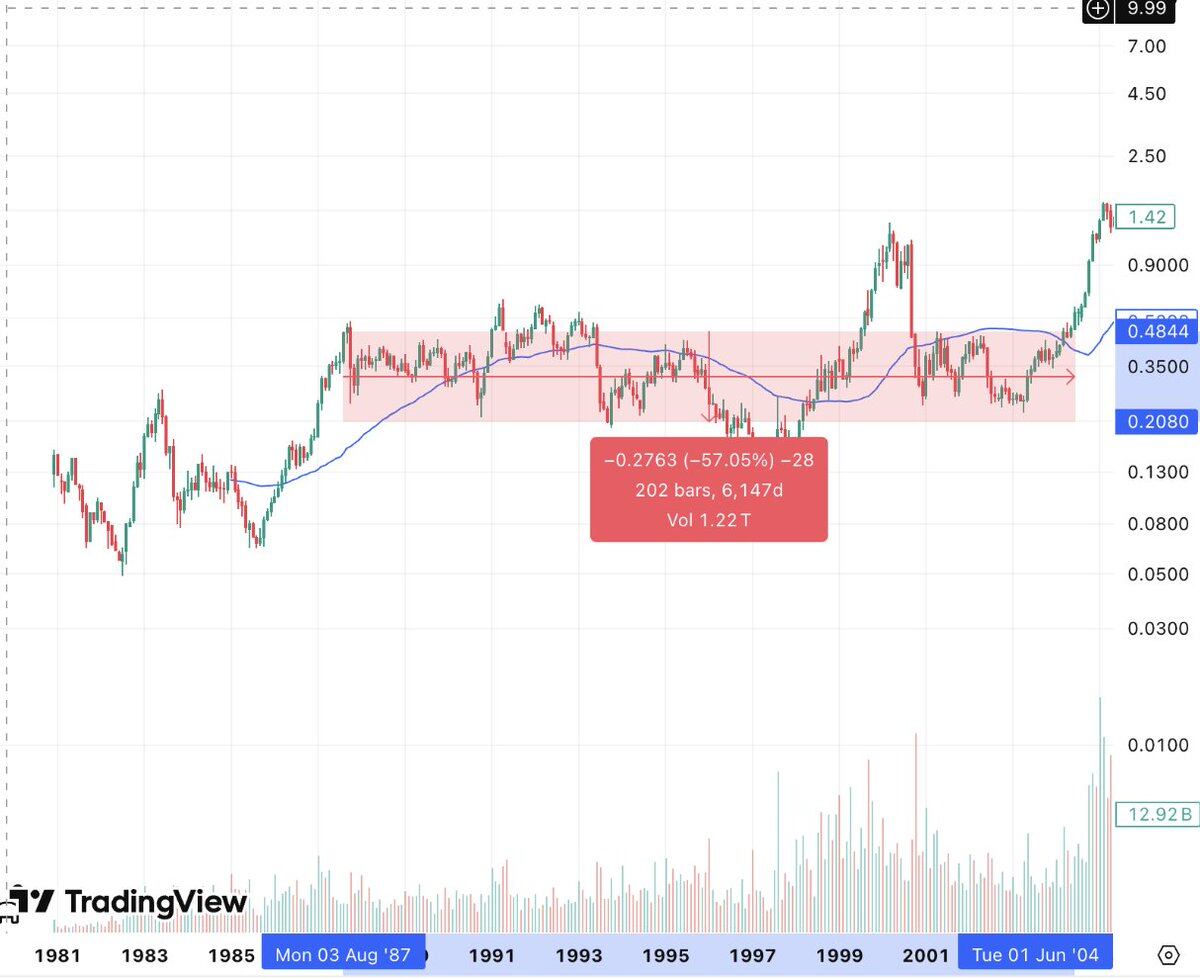
- Microsoft: Its stock price was range-bound for about 15 years after 2000. Investors who bought in 2000 didn't break even until 2015. It is now the world's second-largest company by market cap.
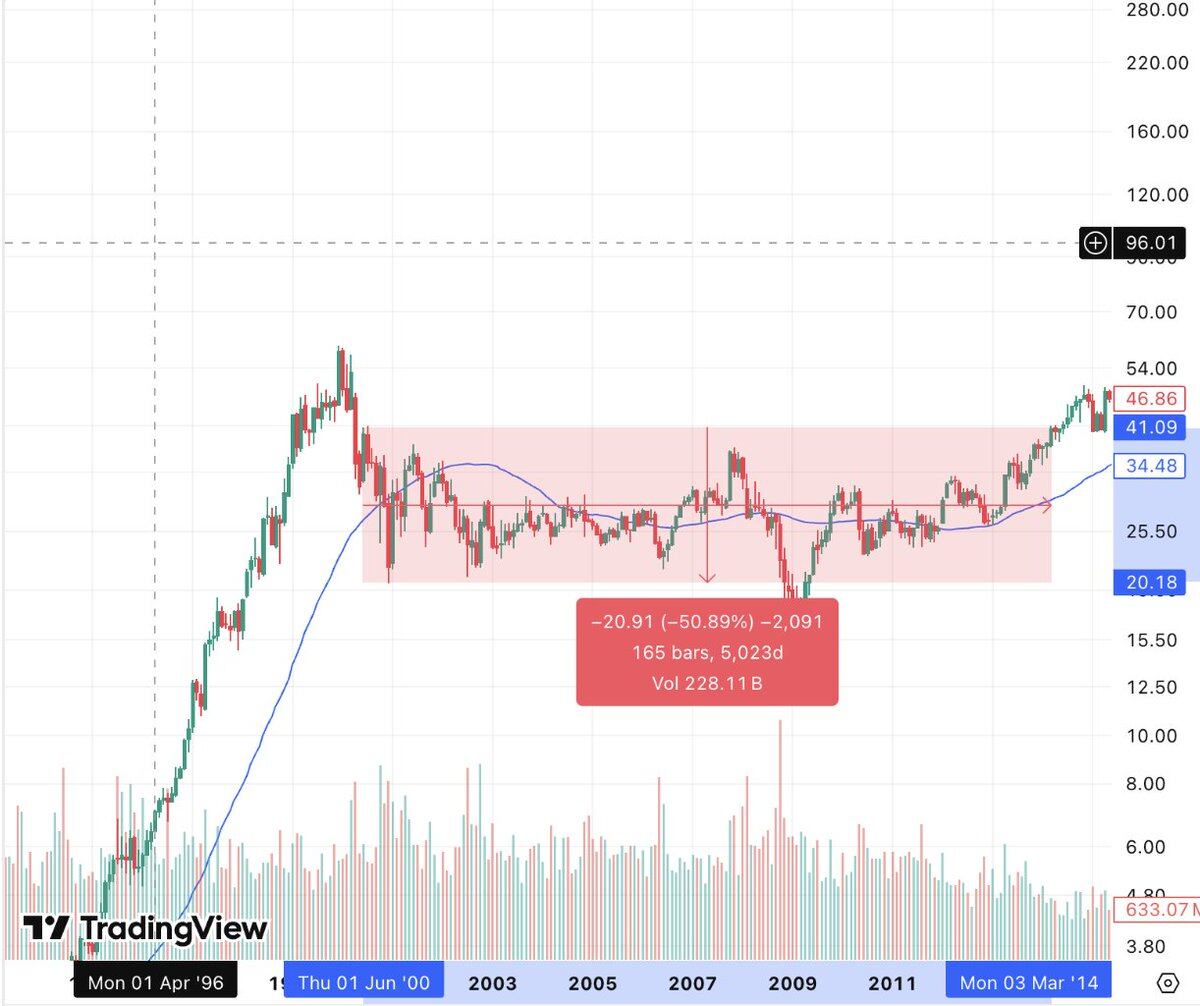
It's easy to see the pattern: Most top-tier global assets undergo long, boring periods of consolidation. Some briefly spike to new highs before falling back, waiting for the next industry catalyst to ignite a new bull run. Moreover, during these basing periods for these companies, the broader US stock market was often hitting new highs. Within this logic, ETH's weak performance over the past five years is not anomalous in financial history.
Setting aside the price, Ethereum's current fundamentals are arguably the best they've ever been.
On-Chain Ecosystem Data Continues to Improve
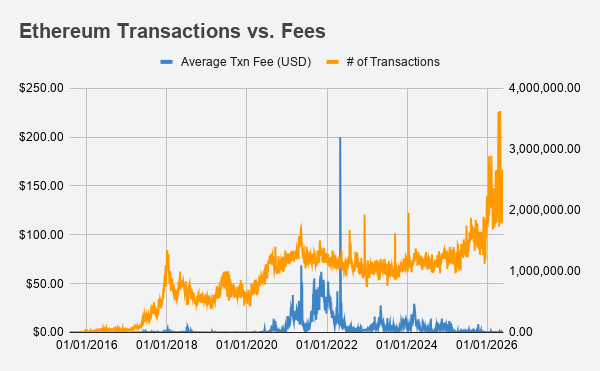
According to the bearish narrative, a weakening price should be accompanied by declining on-chain activity: lower transaction volume, high fees, and stagnant application adoption. But the actual data tells the complete opposite story. Ethereum's on-chain transaction volume is steadily climbing, fees are at cyclical lows, and the pace of asset tokenization is accelerating.
Source: Etherscan
According to Etherscan data: In May 2026, Ethereum's average daily transaction count reached 2.27 million, a new all-time high. Meanwhile, the average transaction fee was only $0.27. Compared to the exorbitant gas fees of $50-$100 during the 2021 bull run, this represents a massive cost reduction despite transaction volume doubling.
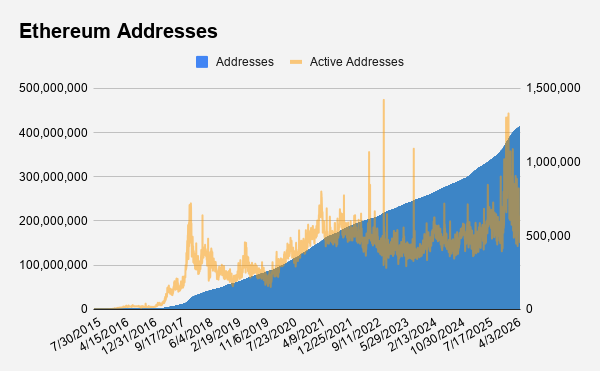
The total number of on-chain addresses has surpassed 400 million, with addresses growing at an average daily rate of roughly 0.08% in 2026. In recent months, daily active users on-chain have consistently exceeded 1 million. At the current growth rate, barring any major positive industry catalyst, Ethereum's total addresses could surpass 1 billion by mid-2029.
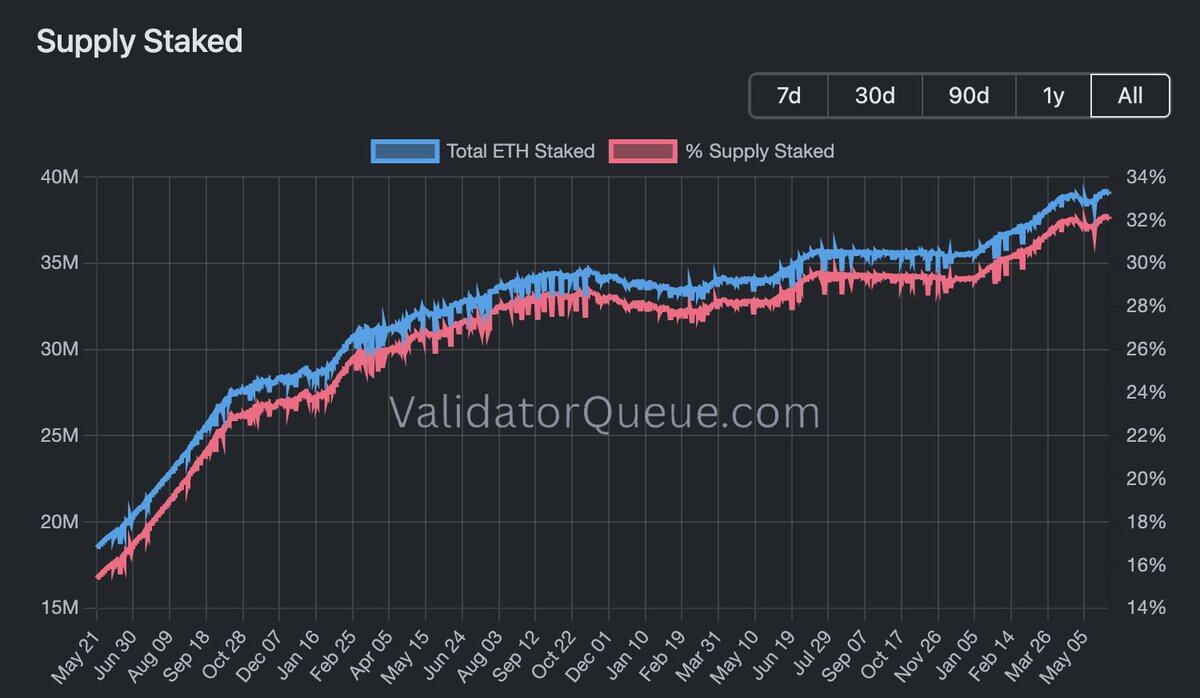
In terms of staking, records are also being broken: Over 32% of all ETH is now staked and locked, continuously providing security for the network.
Source: validatorqueue.com
In summary, Ethereum has successfully scaled while balancing decentralization and security. It has never experienced a full network outage in over a decade since its launch. By offering a maximally neutral, secure, and programmable blockchain resource, it has secured a core position to compete as the foundational infrastructure for global finance. This is a prerequisite for onboarding the massive wave of traditional asset tokenization.
Becoming the Foundational Infrastructure for the Global Financial System
Since entering the industry in 2017, my long-term thesis for Ethereum has remained unchanged:
- All valuable assets in the world will eventually be tokenized;
- Ethereum will become the unified settlement layer for all types of tokenized assets;
- ETH will capture the value increment generated by all activities on that settlement layer.
In its first decade, Ethereum primarily served as a testing ground for crypto-native assets. DeFi, NFTs, memecoins, and other sectors were born and developed here, solidifying its foundational ecosystem. In its next phase of development, Ethereum will embark on a new journey towards a trillion-dollar market cap.
For veteran crypto-native players, the onboarding of traditional finance onto the blockchain might seem somewhat mundane. However, this is an indispensable step for blockchain to go mainstream and deserves support from the entire industry. In the future, the vast majority of the global $700 trillion in traditional real-world assets will eventually be tokenized on-chain, and Ethereum will become the preferred network to host them.
Many argue that Ethereum's scalability is insufficient to handle such a massive influx of assets, or that other blockchains will capture the market. However, current data disproves this view: Traditional financial institutions are flocking to the Ethereum ecosystem in large numbers.

A series of headlines from the past two years. Notice they have something in common.
The core demand for institutions entering this space is certainty. For banks, asset managers, and clearinghouses, choosing a blockchain to custody trillions of dollars in assets is a major strategic decision. They need to capture the benefits of tokenization while avoiding career risk from poor decisions.
Of course, blockchains like Hyperliquid and Solana will also get a piece of the pie. The tokenization market is large enough to accommodate multiple blockchains developing together; no single chain can monopolize it. However, traditional institutions seeking stability will prioritize Ethereum for their RWA initiatives.
Supporting data validates this view: Stablecoins were the first tokenized real-world assets to achieve product-market fit, with a total circulating market cap exceeding $300 billion. Tom Lee calls stablecoins the "ChatGPT moment" for crypto. Ethereum hosts 54% of the total stablecoin market cap.
Source: rwa.xyz
As of June 1, 2026, the total value of tokenized real-world assets (RWA), across all categories, has surpassed $30 billion, with the sector's growth curve steeply ascending. Over 53% of all RWA assets are deployed on the Ethereum chain. Even as other blockchains start from scratch to compete for the non-stablecoin RWA market share, Ethereum firmly maintains its dominant position.
Source: rwa.xyz
The current development stage of the RWA sector is analogous to DeFi in its nascent phase during 2019-2020: a clear new track thesis with steadily rising early-stage data. Looking back at historical DefiLlama data, DeFi's Total Value Locked (TVL) experienced exponential growth in the first half of 2020, at a time when ETH's price was also consolidating in a long-term range.
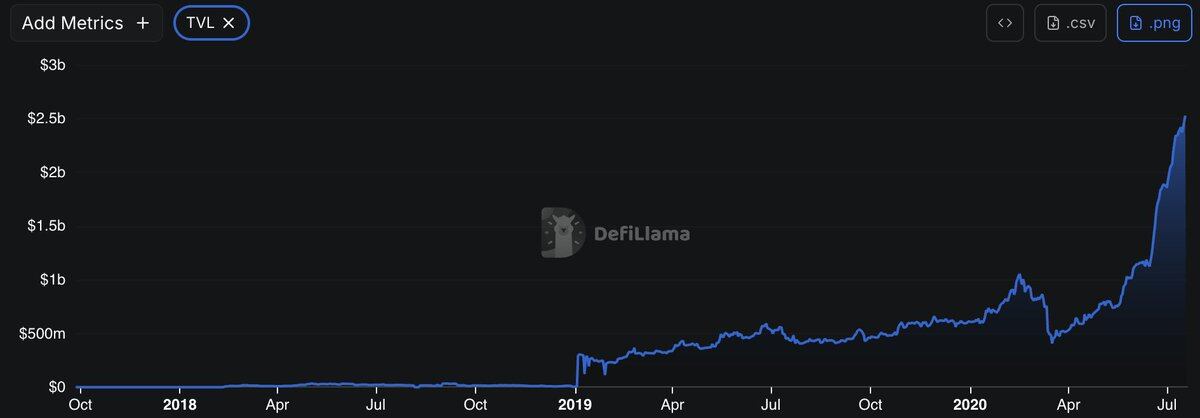
When the DeFi bull run fully erupted and liquidity mining swept the market, ETH's market cap, dragged down by the initial COVID crash, was only $20-$25 billion – roughly ten times less than its current $230 billion market cap. Around the same time, the newly launched BNB Chain briefly threatened Ethereum's position with low fees. It wasn't until DeFi asset value reached about 20% of Ethereum's total market cap that ETH took off from $300, soaring to $4,000 by year-end and embarking on a super bull run.
Compare this to the present: Excluding stablecoins, the total value of non-stablecoin RWA on Ethereum is roughly $16 billion, accounting for only 7% of ETH's total market cap. This position is analogous to the early DeFi stage. The overall scale is ten times larger than back then: DeFi started with $3 billion, RWA starts with $30 billion; ETH's bottom was $200 back then, now it's $2,000; the competitor back then was BNB Chain, now it's Hyperliquid.
Additional note: In the early days, DeFi generated significant ETH buying pressure through collateral requirements, and NFTs further reinforced the "ETH as digital gold" narrative. However, Ethereum hadn't yet implemented PoS staking and the EIP-1559 burn mechanism. Now, both mechanisms are in place, meaning every on-chain transaction directly contributes to ETH's deflation and value support.
Following a ten-fold space projection, the total scale of RWA (excluding stablecoins) in this cycle could potentially exceed $1 trillion. The US CLARITY Act could be a key catalyst. According to Polymarket data, the probability of the bill being signed into law in 2026 is around 55%. Its passage would open the door for compliant tokenization of US financial assets, serving as a massive positive catalyst for Ethereum.
Ethereum's Vitality Remains Strong
Stocks, bonds, commodities, real estate, art, intellectual property – all valuable assets will eventually be tokenized. This is the next major innovation in global finance.
The first two decades of the crypto industry focused on the issuance and innovation of crypto-native assets. The next two decades will shift focus to the on-chain onboarding of traditional real-world assets.
Even though the current crypto commentary circles are predominantly bearish on Ethereum, I remain convinced: Ethereum will become the foundational layer for the vast majority of tokenized assets globally. Leveraging its years of accumulated security, reliability, and liquidity moats, Ethereum's advantages cannot be replicated in the short term. Once a massive volume of global assets is settled on Ethereum, the market will eventually re-price ETH, replicating the valuation surges of the past.


