






全世界都在新高,币圈成了那个「霹雳穷人」


- 核心观点:文章指出加密市场在2025-2026年遭遇“结构性踏空”,全球流动性转向美股、黄金和韩国半导体等资产,而比特币既无法避险也缺乏弹性,导致持币者沦为“霹雳穷人”——他们未做错决策,却因资产未跟上上涨潮而相对变穷。
- 关键要素:
- 韩国股市KOSPI从4000点涨至8000点,三星电子和SK海力士等AI芯片股拉动大盘,未持有这些资产的人自嘲为“霹雳穷人”。
- “结构性踏空”区别于熊市集体亏损:钱未消失但搬家至黄金、美股等创新高资产,唯独绕过加密市场;涨时不带、跌时不落,加剧持币者的焦虑。
- 币圈用户和KOL已开始将交易技能迁移至美股,如盯盘英伟达财报、编写监控工具;交易所也推出链上美股产品以挽留用户。
- 2026年5月人民币兑美元升破6.8,创三年新高,导致持有USDT的加密投资者即便未动资产也因汇率变动而亏损。
- 文章警告追涨风险:当前全球流动性普遍抬升资产,但普通人不擅止盈,可能重蹈NFT和高潮山寨币的“追高归零”覆辙。
Original author: David, TechFlow
There is a kind of poverty where you did nothing wrong, yet you wake up one day to find yourself poorer than everyone around you.
South Koreans have coined a term for this: 벼락거지. Literally translated, it means "lightning pauper" – struck by a bolt from the blue, instantly turning an ordinary person into a poor one.
The term first gained traction back in 2020 during Korea's housing price surge, referring to those who hadn't bought property. Their income hadn't decreased a single cent, but compared to the skyrocketing home prices, they had effectively become poorer out of nowhere.
Recently, the term has made a comeback. Because South Korea's stock market is now mass-producing these lightning paupers.
Over the past six months, the benchmark KOSPI index has surged from around 4,000 points to over 8,000 points. Today, the Korean stock market even triggered a circuit breaker after a sharp rally. Stocks like Samsung Electronics and SK Hynix, driven by the AI memory chip narrative, have propelled the entire nation's stock market to new heights.
Consequently, online forums in Seoul are filled with people self-deprecating: "Same company, the guy sitting across from me just made ten years' worth of salary from semiconductors, while I did nothing and became a lightning pauper."

This sentiment stings the most for those in the crypto space.
The feeling of "everything around me is rising, while I'm standing still" is something crypto holders understand more deeply, earlier on, and are less willing to admit. BTC, once repeatedly hailed as the best asset years ago, has been languishing since the major crash in October of last year.
Now, remaining in the crypto space waiting for an opportunity feels more like a consolation for those not adept at stock trading, adding another layer of torment for the lightning paupers.
Structural Missing Out, The Lightning Pauper
Missing out on gains actually comes in two forms, with vastly different levels of pain.
The first type is collective missing out during a bear market. Everyone loses together; your portfolio is red, your friend's is even redder, and no one in the entire market is making money. This type isn't too painful because there's no benchmark for comparison.
If you didn't get in, missing out almost feels like dodging a bullet. This is how the crypto community has endured the bear markets of recent years – they've gotten used to it.
What we're seeing this year is different. The entire crypto market is stuck in an awkward state of structural missing out.
The money hasn't disappeared; it has simply moved house. It flowed into gold, into US stocks, and even into South Korean pension funds investing in semiconductors. Global liquidity acts like a pump running at full throttle, sucking money from all directions and injecting it into one all-time-high asset after another.
It simply bypassed crypto.
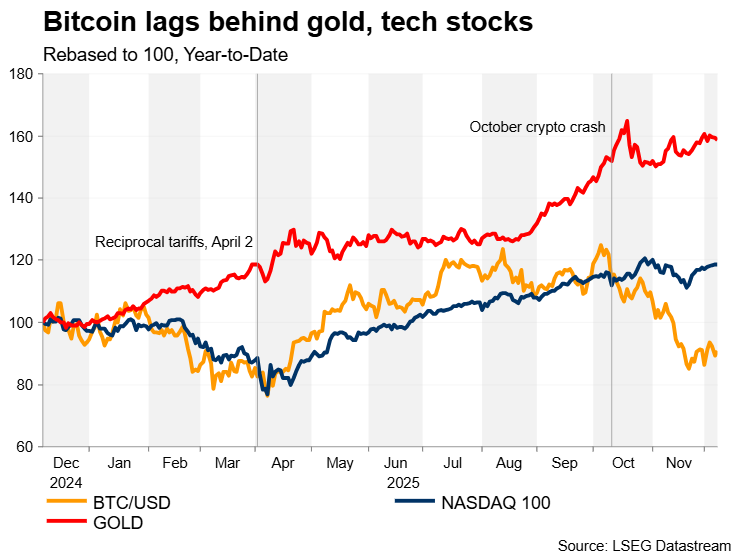
This is a completely different scenario from "everyone being broke together." Everyone else has found a path, while you stand there, watching the money flow past your door without a single cent coming in. This kind of missing out is far more psychologically devastating than a bear market.
BTC doesn't have the luck of gold as a safe haven, and it failed to ride the wave of tech stocks hitting new highs. When the market panics, it is the first to be dumped alongside risk assets. It doesn't participate in the rallies, but it doesn't escape the sell-offs either. It loses on both ends.
Holders wanted a safe haven from BTC, but it doesn't provide that. They wanted to capture upside volatility, but it shows none. Neither of the two things they originally bought BTC for has materialized this year.
Losing money, at least, gives you a clear target for your resentment – you bet on the wrong direction. But missing out is different. You did nothing wrong; the money just deliberately avoids you, and you can't even find a specific entity to blame.
And so, the entire crypto space has become the popular Korean term: the lightning pauper.
However, crypto natives inherently possess a keen sense of smell and a restless drive. The real reaction for most lightning paupers isn't to lie down and accept it, but to migrate with the trend.
In communities and on social media, discussions have shifted from which altcoin might 10x to KOLs who still have crypto tickers in their bios now debating NVIDIA's earnings and Tesla's support levels.
Everyone has directly applied the skills they honed from crypto trading – reading charts, chasing narrative hotspots, enduring volatility – only the target has changed from altcoins to US stock tickers. Some have even adapted the scripts they wrote for trading crypto, using vibe coding to create mini-tools to monitor the US stock market, handling chart watching, alerts, and automated orders in one go.
The skills weren't wasted, just deployed elsewhere.
Meanwhile, crypto exchanges are also actively saving themselves and adapting, launching various on-chain US stock trading products by following the trend. After all, Hyperliquid has already set an example for the entire crypto market.
So, exchanges selling stocks are a form of silent retention. Users want assets hitting new highs, so exchanges bring in those assets to keep users engaged. From the retail trader watching charts to the exchange listing new products, the entire industry is doing the same thing:
Finding ways to latch onto the rally they missed. Ultimately, it's all FOMO driven by trend-chasing.
Whether willingly or not, everyone is clear on one fact: If they don't adjust their strategy, the assets that are truly rising will never be the ones they hold.
Don't Let FOMO Push You Onto the Last Train
For those who don't want to leave, they might still have ammunition left, whether it's dollar-cost averaging into BTC or searching for niche narratives. "My coins didn't rise, but my U (USDT) didn't decrease either. Stay put during the bear market and wait for the next wave."
Is missing out a non-event if your principal is intact?
At the start of 2025, the RMB was trading around 7.2 to 7.3 against the USD. Entering 2026, it has been strengthening consistently. In May, both onshore and offshore rates broke above 6.8, entering the 6.7 range, hitting a three-year high.
What does this imply? Let's say you stayed put, adhered strictly to your plan, didn't chase highs, and didn't sell at a loss. The result: holding U (USDT) also constitutes a loss. Missing out was one thing – others made money while you didn't, you stood still. Now, you're standing still, but the ground is sinking beneath your feet.
Waiting isn't a cost-free activity; waiting itself is burning capital.
So a natural thought emerges: Since crypto isn't working, why not liquidate my positions and FOMO into the assets that are rising? This thought might be more dangerous than the initial feeling of missing out.
The feeling of missing out needs to be resolved, but perhaps not by chasing the rally.
Let's be honest first: This crypto cycle has indeed underperformed, and telling yourself "it will come back later" is just self-comfort. The past logic was a four-year cycle: halving, bull run, new highs. If you missed out, you waited for the next one.
The game has changed now. ETFs have turned Bitcoin into a line item on institutional balance sheets. On-chain capital is busy buying US stocks. Even exchanges have pivoted to selling stocks... This cycle's crypto is a different beast from the one in your memory that could 10x overnight.
Expecting it to follow the old script and gift you another chance is like trying to find a sword by marking the boat. But admitting crypto is on a downward slope doesn't automatically make the stock market a safe haven.
When you rush in to chase gold, US stocks, or Korean chips, you're not profiting from your own insight, but from the rising tide of liquidity. It's global liquidity lifting all boats together. When the water level is high, everyone looks like a competent swimmer. The problem is, the tide always goes out.
The real test isn't whether you got on board initially. It's whether you have the skill to convert your chips back to cash before the water recedes.
And that is precisely what ordinary people struggle with most. As proven time and again in the worlds of NFTs and altcoins, we can catch the uptrends, but successful profit-takers are few and far between. We always think it can go higher, until it goes to zero.
Switching markets won't automatically erase these weaknesses. If you transplant your crypto trading habits to US stock trading, you'll likely also transplant the "unwillingness to sell" habit along with it.
So, the concept of missing out might be a false premise. The ultimate principle is taking profits and leaving the table.
South Koreans coined the term "lightning pauper" as a self-deprecating jibe for those who missed the boat. The English term FOMO means something similar. But if you measure yourself against someone else's balance sheet, forcing yourself to jump into a pool you're equally unfamiliar with at the highest water level, it's actually quite perilous.
The real lightning strike was never the boat you missed.
It's the one you barely managed to board, only to forget, once again, which stop to get off at.


