นาคาโมโตะ โซชิ กำลังถูกฟ้องร้องหรือ? BTC มูลค่า 83,700 ล้านดอลลาร์กำลังถูก "อ้างสิทธิ์โดยชอบด้วยกฎหมาย"


- ประเด็นหลัก: โจทก์ซึ่งใช้นามแฝงว่า Noah Doe ได้ยื่นฟ้องต่อศาลมลรัฐนิวยอร์ก โดยอาศัยกฎหมายว่าด้วยทรัพย์สินที่สูญหายของมลรัฐนิวยอร์ก พยายามอ้างสิทธิ์ในความเป็นเจ้าของบิตคอยน์ประมาณ 3.7 ล้านเหรียญจากที่อยู่ที่ไม่ได้ใช้งานจำนวน 39,069 แห่ง (รวมถึงที่อยู่ที่คาดว่าเป็นของนาคาโมโตะ) แก่นแท้ของคดีคือการแสวงหา "ข้อบกพร่องทางกรรมสิทธิ์" ในรูปแบบคำชี้ขาดทางกฎหมาย เพื่อใช้ต่อสู้กับสถาบันผู้รับฝากทรัพย์สินในตลาดที่มีการกำกับดูแล มิใช่เพื่อให้ได้มาซึ่งคีย์ส่วนตัวหรือการโอนย้ายบิตคอยน์โดยตรง
- องค์ประกอบสำคัญ:
- โจทก์ใช้มาตรา 7-B แห่งกฎหมายทรัพย์สินส่วนบุคคลของมลรัฐนิวยอร์ก โดยนำแฟลชไดรฟ์ที่มีที่อยู่สาธารณะส่งมอบให้กับสถานีตำรวจในฐานะการเก็บทรัพย์สินที่สูญหาย และจ้างผู้เชี่ยวชาญมาประเมินค่าที่อยู่แต่ละแห่งให้ต่ำกว่า 10 ดอลลาร์สหรัฐ เพื่อให้มีสิทธิ์ใช้กระบวนการ "ความเป็นเจ้าของตกเป็นของผู้เก็บหลังจากหนึ่งปี" ที่สั้นที่สุด
- ที่อยู่ของจำเลยประกอบด้วยที่อยู่ของนาคาโมโตะ โซชิ (Patoshi) ที่คาดว่ามีบิตคอยน์ประมาณ 1.096 ล้านเหรียญ ที่อยู่ของแฮกเกอร์ Mt. Gox จำนวน 79,000 เหรียญ และที่อยู่ที่ไม่ได้ใช้งานอื่นๆ อีกประมาณ 2.62 ล้านเหรียญ รวมมูลค่าประมาณ 2.935 แสนล้านดอลลาร์สหรัฐ
- ความเสี่ยงของการดำเนินคดีอยู่ที่ว่า แม้โจทก์จะไม่สามารถได้รับคีย์ส่วนตัวได้ คำชี้ขาดของศาลที่โจทก์ชนะคดีก็สามารถใช้เป็น "ข้อบกพร่องทางกรรมสิทธิ์" ได้ เมื่อบิตคอยน์ที่เกี่ยวข้องถูกโอนไปยังกระดานเทรดแบบรวมศูนย์หรือสถาบันผู้รับฝากทรัพย์สิน โจทก์สามารถใช้คำชี้ขาดนี้ต่อสู้กับสถาบันเหล่านั้น ส่งผลให้ทรัพย์สินถูกอายัดหรือเกิดข้อพิพาทเรื่องความเป็นเจ้าของ
- การวิเคราะห์ข้อมูลแสดงให้เห็นว่าที่อยู่ของโจทก์มีความทับซ้อนสูงถึง 99.7% กับที่อยู่ 16,404 แห่งที่ Craig Wright อ้างว่าเป็นเจ้าของในคดี Kleiman ฎีกา Wright ซึ่งบ่งชี้ว่าโจทก์อาจมีส่วนเกี่ยวข้อง
- คดีนี้เต็มไปด้วยข้อสงสัย: กฎหมายว่าด้วยทรัพย์สินที่สูญหายไม่สามารถใช้บังคับกับที่อยู่บนบล็อกเชนสาธารณะที่ไม่มีการครอบครองคีย์ส่วนตัวทางกายภาพ การประเมินมูลค่าเห็นได้ชัดว่าไม่เป็นความจริง (โดยเฉลี่ยแต่ละที่อยู่ถือครองเหรียญมูลค่าประมาณ 7.5 ล้านดอลลาร์สหรัฐ) การไม่เปิดเผยตัวตนของโจทก์ขัดแย้งกับการกระทำของเขาที่พยายามบังคับให้จำเลยเปิดเผยตัวตน
Original article fromGalaxy
Translation / Odaily Golem (@web3_golem)
Who would have thought that Satoshi Nakamoto, the creator of Bitcoin, would one day be dragged into a lawsuit, with the "ownership" of wallet addresses potentially being seized by someone else. And if you're reading this, you might also be a "defendant," as long as you have dormant Bitcoin addresses.
In March of this year, the New York State Supreme Court accepted a lawsuit: the plaintiff is seeking to establish ownership of over 3.7 million Bitcoin (approximately $274 billion) associated with 39,069 Bitcoin addresses. The plaintiffs are pseudonymous as Noah Doe and two unnamed Wyoming limited liability companies (pseudonymously "ABC Company" and "XYZ Company").
The plaintiffs are asking the New York State Supreme Court to confirm their ownership of these dormant addresses through a declaratory judgment action under New York's lost property law. More importantly, these 39,069 addresses include those suspected to belong to Bitcoin creator Satoshi Nakamoto (a total of 21,744 addresses holding approximately 1.09 million Bitcoin, valued at roughly $83.7 billion at current prices).
In simple terms, an anonymous individual and their Wyoming-registered company are trying to get a New York court to rule that Bitcoin creator Satoshi Nakamoto's Bitcoin (and many other cryptocurrencies) constitute lost property, and that they are legally entitled to ownership for having "found" these Bitcoin. Galaxy has analyzed the plaintiffs' potential motives and identities, the impact on Bitcoin, and the likelihood of the plaintiffs succeeding.
Below is Odaily's condensed translation of the full article, enjoy~
Case Overview and Analysis of Plaintiff's Strategy
The plaintiffs have filed a petition with the New York State Supreme Court, requesting a declaration that they own 39,069 dormant Bitcoin addresses and all assets within them. The legal basis is a declaratory judgment confirming ownership under Section 3001 of the New York Civil Practice Law and Rules, fundamentally grounded in New York's lost property law, Article 7-B of the Personal Property Law. This statute stipulates that a finder who turns over lost property to the police and is not disputed by the owner within a specified waiting period may ultimately acquire ownership. The plaintiffs are attempting to apply this old framework to Bitcoin.
The specific strategy is: Noah Doe, acting as the finder, delivered a USB drive containing the addresses (not private keys or proof of holding the addresses, but merely the public addresses) to the 17th Precinct of the New York City Police Department as a substitute for turning over the lost item to the police; subsequently initiated an OP_RETURN notification on the Bitcoin blockchain and issued a press release as a substitute for contacting the owner; finally, had an expert appraise the value of each address at under $10 to move the entire case through the fastest procedure under the statute.
It is important to note that even if the plaintiffs win entirely, they would only receive a piece of paper, a court declaration, and nothing else. They would not receive any private keys and would not be able to transfer any Bitcoin.
The real value of a New York judgment lies elsewhere. It would serve as a "title defect": if any of these Bitcoin ever appear on any regulated platform, the plaintiffs could present this document to challenge the exchange or custodian. This is the potential risk this case poses to Bitcoin holders, and why this seemingly absurd lawsuit deserves careful scrutiny.
Case Timeline
The timeline below comprises two parts: one is the factual narrative presented by the plaintiffs regarding the discovery of the addresses, and the other is the procedural history of the case within the court.
- October 2024: Noah Doe claims to have discovered a "security issue" with certain addresses and developed an "algorithm" to flag abandoned addresses (in reality, these addresses had no "security issue").
- December 26, 2024: Noah Doe first "finds" approximately 1,625 addresses. A USB drive containing the addresses is delivered to the 17th Precinct of the NYPD on January 1, 2025.
- February 2025: Noah Doe hires Salomon Brothers Strategic Advisory as a consultant.
- March 31 and April 14, 2025: Noah Doe "finds" another 546 addresses and 39,911 addresses respectively, delivering USB drives containing the addresses to the police precinct after each "find."
- June 30 to July 10, 2025: Noah Doe sends "abandonment notices" to each address via OP_RETURN.
- August 7, 2025: A press release is issued to global media, covered by CoinDesk, Bitcoinist, Yahoo Finance, Investing.com, and Galaxy Digital's research report.
- August 2025 to February 2026: Salomon Brothers receives threatening emails, including over 50 emails containing only "4 8 15 16 23 42," demanding $1.5 million and 50 Bitcoin.
- October 10, 2025: The 90-day waiting period for owner claims expires.
- December 2025: Noah Doe transfers these addresses to ABC Company and places a 98% interest in an irrevocable trust; ABC Company transfers a 17.7% interest to XYZ Company.
- March 11, 2026: The initial summons and complaint are filed. Judge Arlene P. Bruce annotates the original order to appear.
- March 23, 2026: Judge Emily Morales-Minerva recuses herself from the case.
- March 25 to April 17, 2026: Judge Carlos J. Voltron signs an order allowing appearance (permitting pseudonyms) and an order authorizing alternative service via OP_RETURN (without notifying the opposing party).
- May 1, 2026: The first amended complaint expands the defendants to Doe Defendants 1 through 39,069, including a complete list of addresses.
- May 21-22, 2026: On-chain execution service: 98 batch transactions in Bitcoin blocks 950,446 to 950,576.
- May 22, 2026: Judge Carlos J. Voltron files an affidavit of service, including verification reports for each batch transaction and verification details for 39,069 lines (Documents 27-29).
Plaintiffs' Legal Arguments and Strategy
Article 7-B of the New York Personal Property Law (Sections 251-258) establishes a simplified lost property regime. It provides two distinct paths for a finder to acquire ownership, and the plaintiffs in this case invoke both paths simultaneously.
- Path A: Custody (Sections 252, 253/254, 257(1)): Section 252 requires a person who finds a lost item valued at $20 or more to return it to the owner or turn it over to the police within 10 days. Sections 253(7) and 254 specify the police custody period based on the item's value: 3 months for items under $100, 6 months for $100-$500, 1 year for $500-$5,000, and 3 years for items valued at $5,000 or more.
- Path B: Under $10 Fast Track (Section 257(2)): For lost items valued at less than $10, if the finder has "made reasonable efforts to find the owner and return it, but was unsuccessful," ownership vests in the finder after one year from the finding, without the need for police delivery.
The (unnamed) "independent expert" in the complaint valued the "as-is" value of each address at under $10, based on the improbability of recovering the items. This valuation determines the procedural timeline of the entire case, placing each address under the uniform one-year vesting period of Section 257(2). It also makes Path A applicable with a shorter duration, as items under $100 are only held by police for three months under Section 254.
Plaintiffs' Arguments
The complaint lists several arguments by the plaintiffs, each of which must be established for the next to hold, creating an interconnected chain.
- These addresses are lost property: Addresses are treated as property, similar to bank accounts. Under this view, losing a private key does not destroy the property; its contents are merely "lost" and can be retrieved by a finder.
- Noah Doe is the finder, and the NYPD's custody meets statutory requirements: Section 252 of Article 7-B requires the finder to turn over lost property to the police. The plaintiffs argue that delivering a USB drive containing the address information to the 17th Precinct satisfies this requirement.
- Ownership has vested in the finder: For property under $10 in value, Section 257(2) states that if the finder has made reasonable efforts to find the owner but failed, ownership vests after one year. The OP_RETURN notifications, press release, and 90-day claim period are considered reasonable efforts.
- These addresses have been abandoned: Noah Doe's "algorithm" flags addresses he personally manages that have been inactive for at least five years and untouched during significant price surges. Approximately 424 owners who responded by moving tokens were removed from the list; the remaining 39,069 non-responding owners became defendants.
- Service via OP_RETURN is lawful: As the alleged owners are unidentified and unlocatable, the court authorized alternative service under CPLR Section 308(5), involving on-chain notifications sent to each address linking to the complaint.
- The plaintiffs can sue anonymously: Given the known risk of kidnapping faced by large Bitcoin holders, the plaintiffs were permitted to proceed under pseudonyms.
Who are the Owners?
Galaxy utilized their Bitcoin full node and internal research database to analyze the addresses that plaintiff Noah Doe claims to have "found."
As of May 25, 2026, the 39,069 "Noah Doe Addresses" held 3,799,629 Bitcoin, valued at approximately $293.5 billion at a price of $77,245 each. This value is not evenly distributed but is concentrated in several distinct sets, each telling a different story.
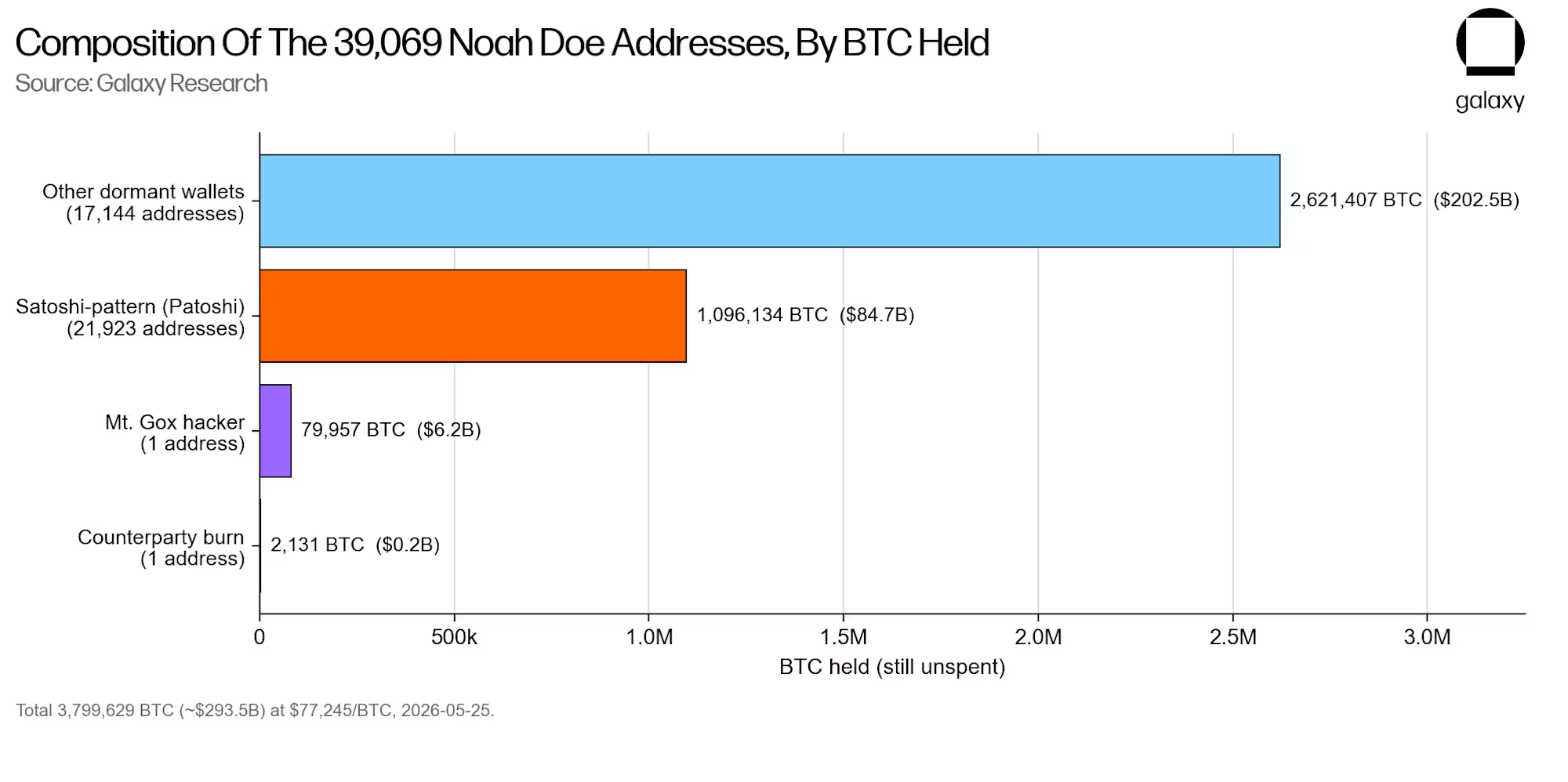
Composition of Noah Doe Addresses
Patoshi Addresses
Includes 21,923 addresses, containing approximately 1,096,134 Bitcoin (about $84.7 billion). These are early mined Bitcoin, linked to Bitcoin's creator through the "Patoshi" nonce pattern, and they have never been moved.
Mt. Gox Hacker Address
A single address, containing approximately 79,957 Bitcoin (about $6.2 billion). This is John Doe #1; these Bitcoin were stolen from the early Bitcoin exchange Mt. Gox and have remained untouched since 2011. They are disputed property that investigators have tracked for years.
Counterparty Burn Address
A single address, containing approximately 2,131 Bitcoin (about $160 million). This is John Doe #104, a provably unspendable "burn" address. No one ever held its key because, by design, no such key exists.
Other Dormant Addresses
7,144 addresses, containing approximately 2,621,407 Bitcoin (about $202.5 billion). These addresses include Bitcoin from early adopters and the exchange era that have not been transferred for years.
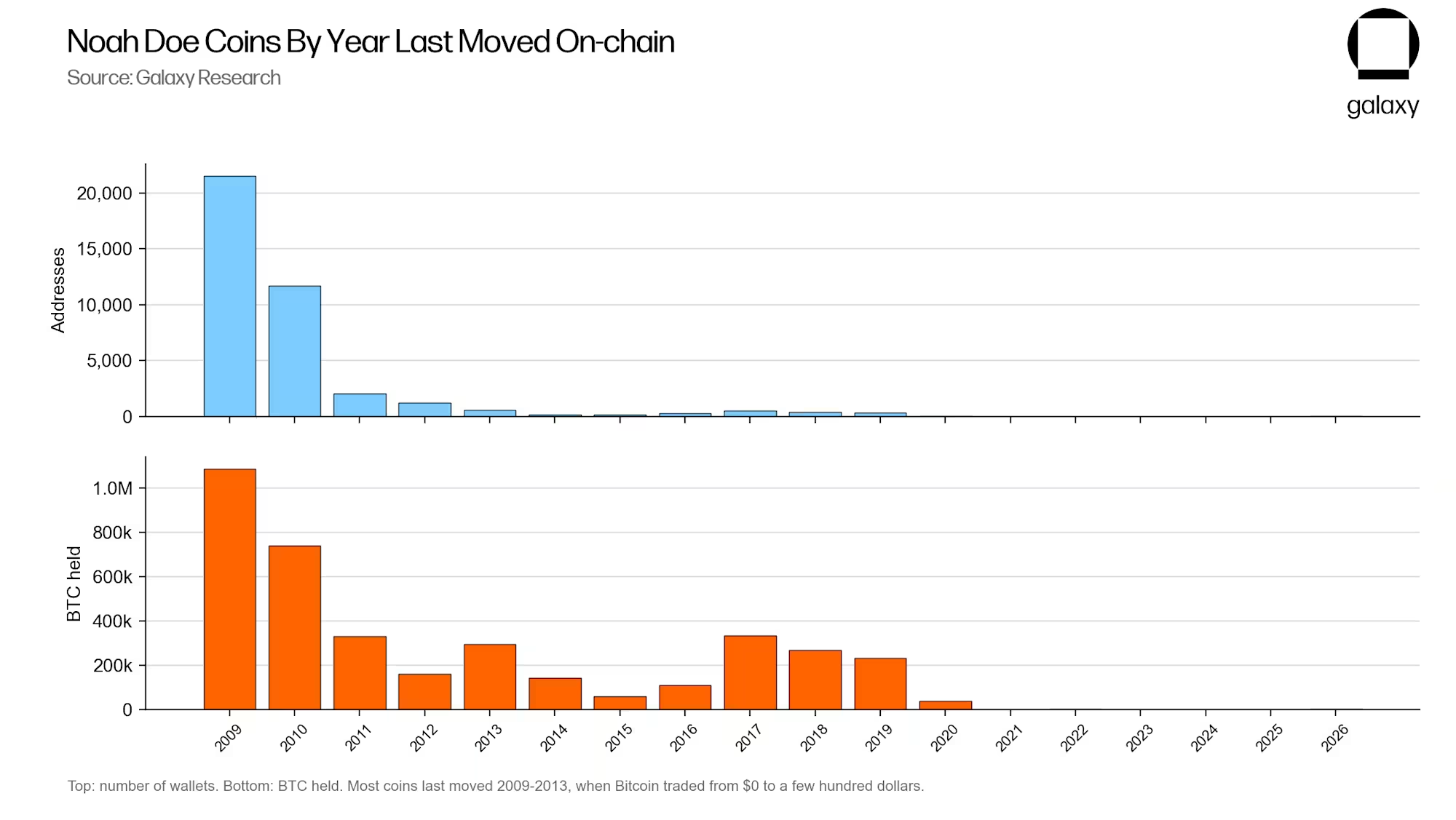
This dormancy is longstanding. If we sort each address by the year of its last on-chain Bitcoin transaction, most of the Bitcoin dates back to Bitcoin's early years. The vast majority of these Bitcoin last transacted between 2009 and 2013, a period when Bitcoin's price surged from near zero to several hundred dollars.
But many of these addresses have been claimed before. In the Kleiman v. Wright case (S.D. Fla., 2018), Australian businessman Craig Wright submitted a list of 16,404 early block addresses he claimed belonged to him as part of his subsequently dismissed attempt to establish himself as "Satoshi Nakamoto."
We compared the Bitcoin addresses Wright claimed ownership of in the Kleiman lawsuit with Noah Doe's addresses to see the overlap.
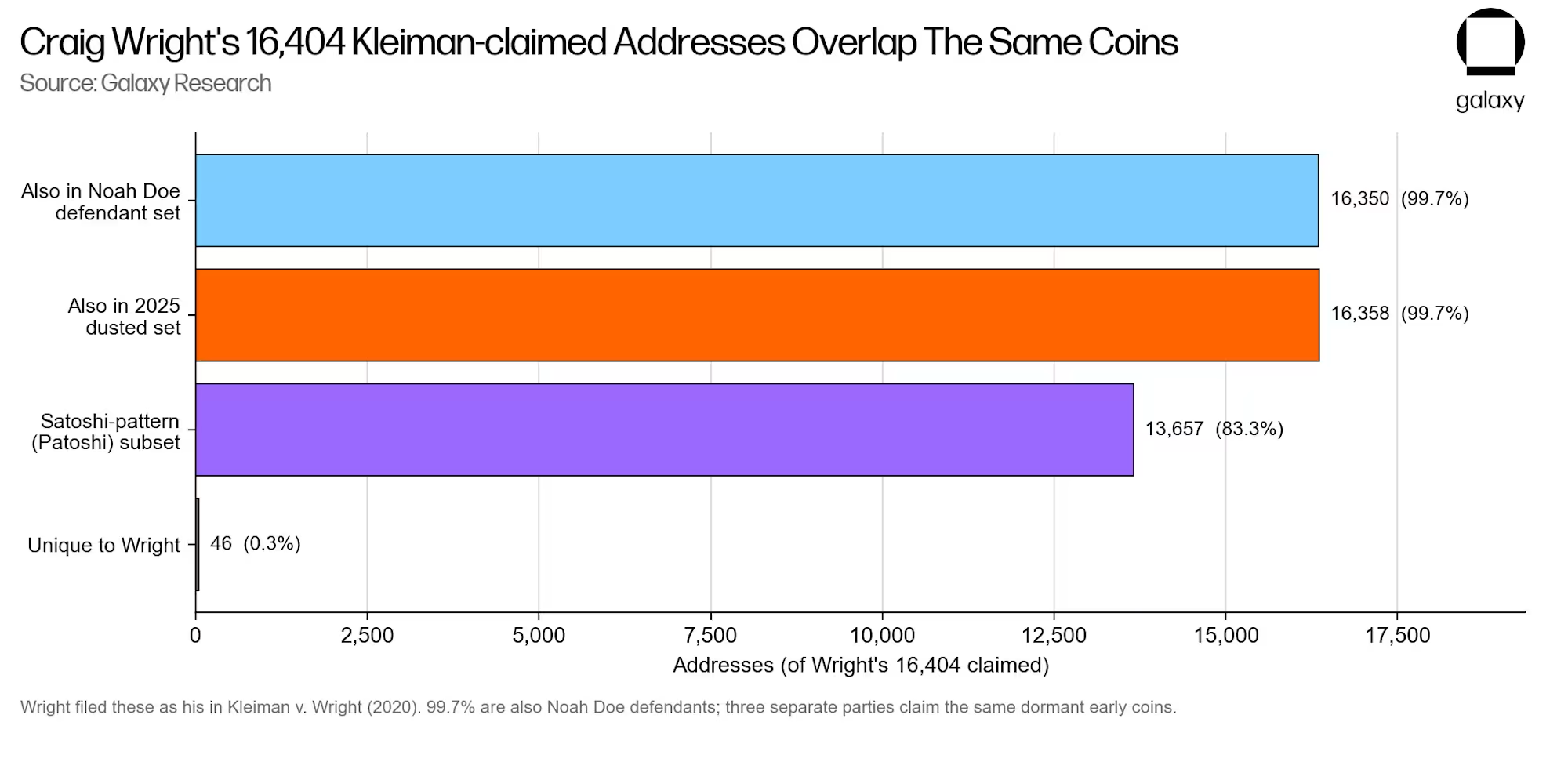
Overlap between Noah Doe and Craig Wright addresses
The overlap is nearly complete. Of the 16,404 addresses claimed by Wright, 16,350 (99.7%) are also claimed by Noah Doe's defendants. These addresses hold approximately 817,513 Bitcoin. We cannot confirm if Craig Wright has any connection to the Noah Doe case, but the overlap remains noteworthy. Craig Wright spent years trying to claim these Bitcoin through litigation but was found in contempt of court by a UK court in 2024.
Aspects of the Case Raise Suspicion
While we are not lawyers, based solely on the docket and relevant statutes, this case presents several suspicious points.
Does Lost Property Law Apply?
Before any valuation or service issues, there is a more fundamental question. Lost property laws are designed for physical items found, held, and turned over to the police by a finder. Noah Doe never held these coins or keys. He merely looked at public addresses on a public ledger, which anyone can read. Viewing public addresses is far from possessing lost property. Handing a police precinct a USB drive with a list of addresses is not the same as physically turning over the lost property.
The statute envisions a finder who can return the item when the owner comes forward. But here, the finder never held the coins and could not possibly hand them over to anyone—neither to the police allegedly holding them nor to an owner coming to claim them.The core issue goes far beyond ownership; losing a private key does not deprive the true owner of any rights. The Bitcoin remains on the blockchain. The holder of the true keys can transfer them at any time, and hundreds of Bitcoin owners who lost their keys have done exactly that.
It is obvious that ownership cannot be effectively transferred to a finder who can never access the asset.
The Valuation is Unconvincing
The average holding in a Noah Doe address is 97.25 Bitcoin, worth approximately $7.5 million; the median is 50.00 Bitcoin, worth approximately $3.86 million. Compared to these numbers, the claim that each address is worth less than $10 is clearly a tactic to push these assets through the legal process as quickly as possible.
Two additional details further undermine this valuation. The expert who provided the "under $10" figure is unnamed in the filing. Therefore, this single number dominating the entire timeline cannot be scrutinized or challenged. If the logic of "as-is recoverable value" is applied universally, almost all self-custodied Bitcoin would have near-zero value, which is completely at odds with how any user, especially those filing a lawsuit, treats their Bitcoin.
Anonymity of the Parties
Noah Doe's use of anonymity in this case is also highly suspicious. They seek anonymity to avoid being targeted as large holders, yet the relief they seek would force the actual address holders to reveal their identities to defend their cryptocurrency. The plaintiffs want the very protection they are trying to strip away from all defendants.
Even if an individual can present a genuine personal safety theory, such theories exist to protect natural persons. ABC Company and XYZ Company are shell LLCs. A company has no physical entity that can be threatened and no privacy to expose. Therefore, the logic of fearing extortion does not apply to them. Allowing two companies to claim hundreds of billions of dollars in property under shell-company names is simply bizarre.
Furthermore, New York is not favorable to anonymous entities. New York courts rarely permit pseudonyms. Although New York historically allowed anonymous LLC ownership, the state's LLC Transparency Act now mandates beneficial ownership disclosure, even though federal regulations have narrowed its