






Solana and Hyperliquid's most loyal defenders are now bickering with each other


- Core Thesis: A heated debate has erupted between Kyle Samani, Arthur Hayes, and other community members over "HYPE vs SOL." The core dispute revolves around whether crypto projects should prioritize decentralization or product growth. Hyperliquid's rise is challenging Solana's narrative as the "Internet's capital markets."
- Key Points:
- Samani criticizes Hyperliquid for being highly centralized and facing regulatory risks, labeling it as a "Binance 2.0 without a marketing team," and alleging it could face charges similar to those brought by the U.S. Department of Justice.
- Hayes and other community members strongly pushed back. Hayes directly bet that HYPE will outperform all other top 10 cryptocurrencies in the remaining seven months, proposing a creative competition targeting Samani with a 100 HYPE prize.
- Solana's core logic is to build efficient on-chain financial infrastructure, attracting liquidity to naturally aggregate. In contrast, Hyperliquid cuts directly to core demand, creating a positive flywheel through perpetual contracts (more traders → more fees → HYPE buybacks → price increase → more capital).
- Hyperliquid's cash flow capability has already surpassed public chain ecosystems including Solana. It is expanding from perpetual contracts to spot trading, prediction markets, and more, fitting the "Internet's capital markets" narrative more closely and encroaching on Solana's market narrative space.
- Samani's attack rhetoric (questioning decentralization and regulatory risks) closely mirrors the methods used by the Ethereum camp to criticize Solana in the past, revealing a "double standard" in his stance: emphasizing efficiency first when Solana was rising, but now questioning Hyperliquid over decentralization.
Original | Odaily Planet Daily (@OdailyChina)
Author | Azuma (@azuma_eth)

As HYPE continues to hit new highs, a heated debate has erupted on X around "HYPE vs SOL."
At the center of this war of words is Kyle Samani, former co-founder and managing partner of Multicoin Capital and a flagship figure in the Solana community (see The Man Who Best Talked Up SOL Leaves the Crypto World), while surrounding him on the outside are the devout "followers" of Hyperliquid, led by BitMEX co-founder Arthur Hayes.
The War of Words Between SOL Supporters and HYPE Supporters
Over the past weekend, Samani himself posted a flurry of updates on X, launching an intense attack on Hyperliquid, criticizing the project for being still highly centralized in nature and facing serious regulatory issues.
At 6:30 on May 30, Samani wrote: "Hyperliquid is essentially just a Binance 2.0 without a marketing team (Binance gets caught in the crossfire...). It has made thousands of technical decisions in its architecture that are only suitable for centralized environments, but completely unsuitable for a permissionless, decentralized environment. Now, they are already many steps behind on this path. Moreover, no real US company will ever cooperate with them in the future."
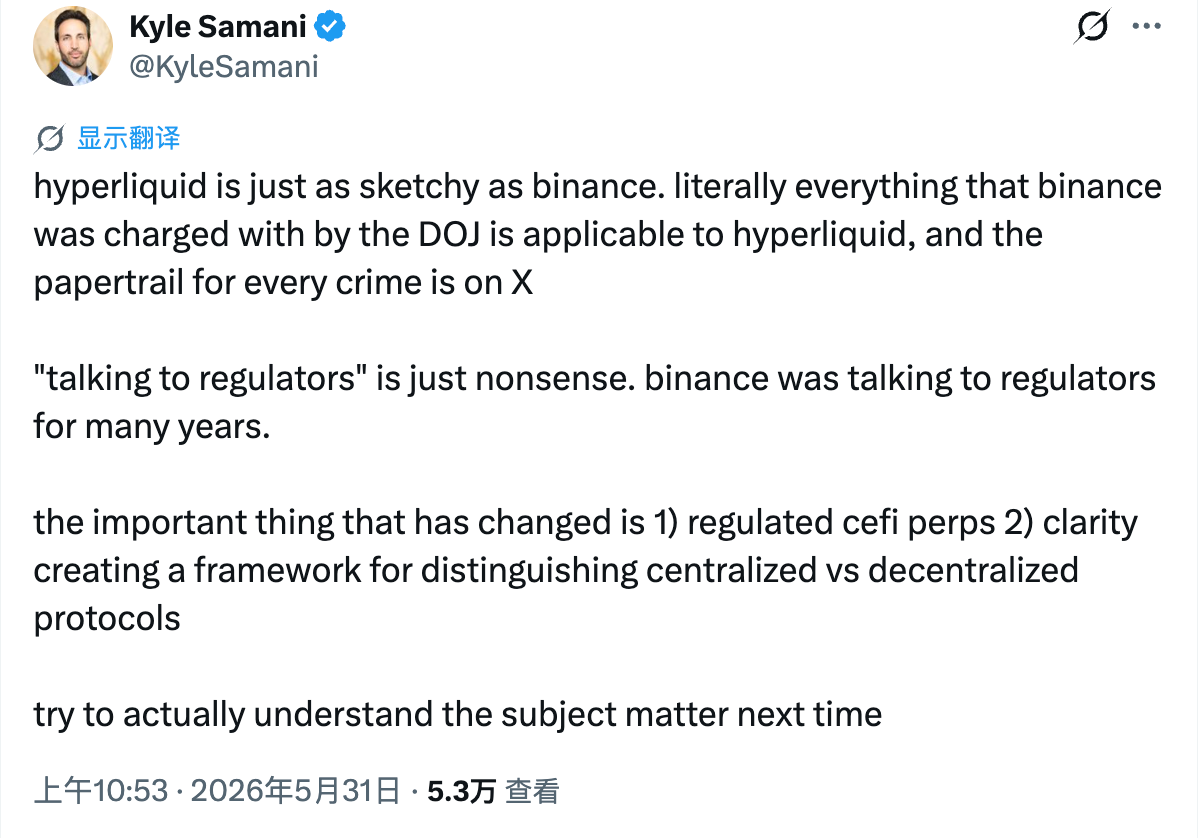
At 10:53 on May 31, Samani added: "Hyperliquid is just as questionable as Binance (caught in the crossfire again...). All the charges the U.S. Department of Justice once leveled against Binance apply to Hyperliquid, and the evidence for each crime is documented. The so-called 'communication with regulators' is pure nonsense; Binance has also been communicating with regulators for years..."
While attacking Hyperliquid, Samani also took the opportunity to take another jab at his old rival ETH, calling it "reputationally neutral but technically flawed," in other words, "completely useless"...
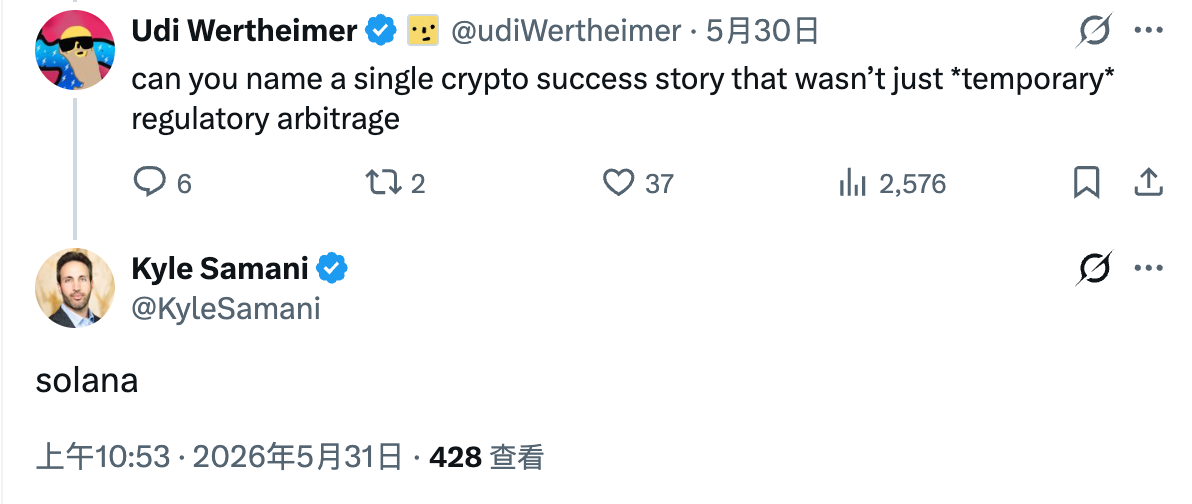
Finally, when asked by well-known Bitcoin developer Udi Wertheimer which token he considered a success story, Samani gave the predictable answer — Solana.
Unsurprisingly, Samani's comments drew fierce backlash from the community, especially at a time when HYPE is so strong. Investors like Hayes, developers like Wertheimer, and traders like Ansem all countered Samani's views with varying degrees of force.
Among them, Hayes' response was the most direct. On May 31, Hayes posted a sarcastic message to Samani, saying: "Before this cycle is over, HYPE should at least surpass SOL."
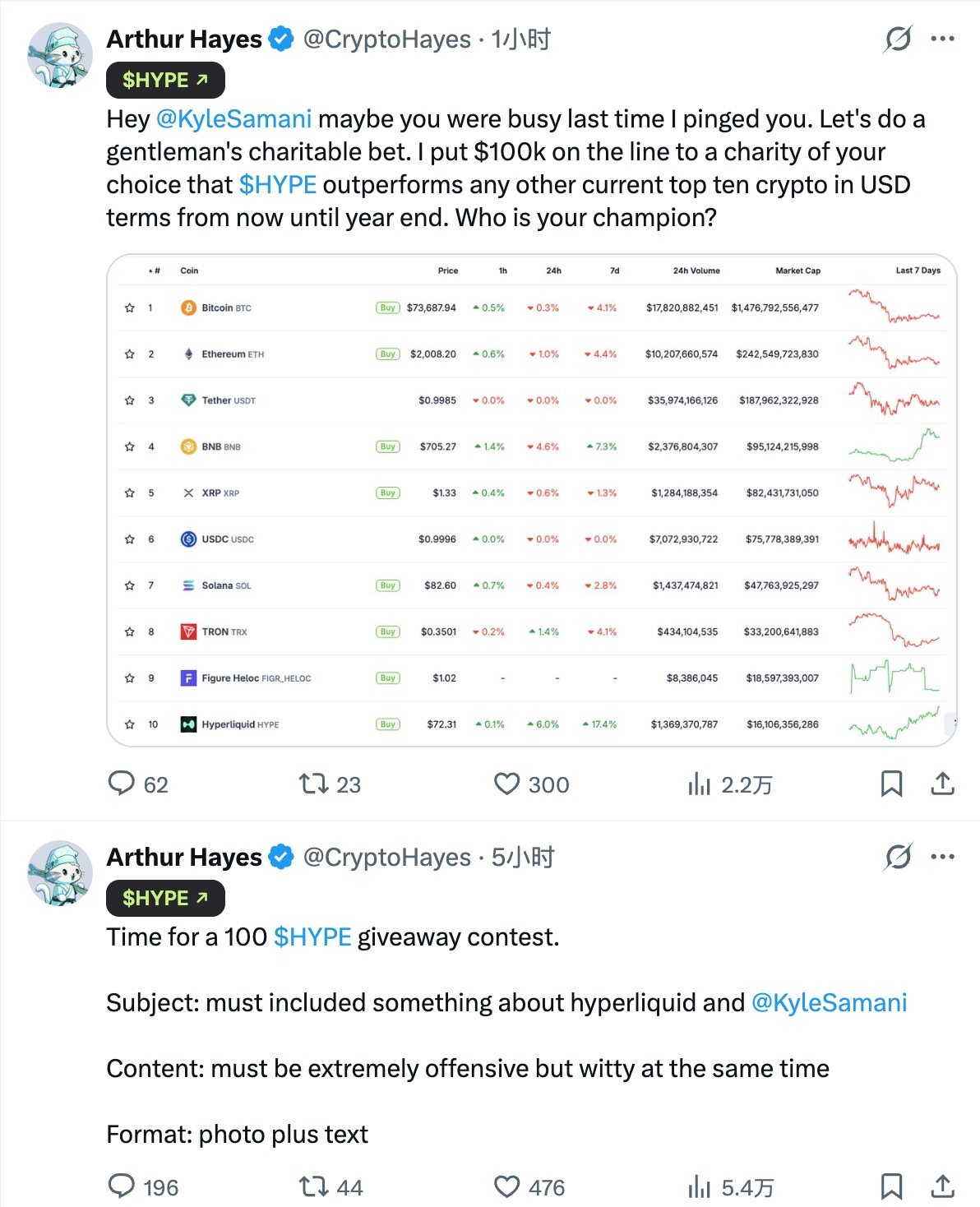
Earlier this morning, Hayes posted again, stating he wanted to organize a content competition with a prize pool of 100 HYPE, requiring contestants to respond humorously and offensively to Samani... At the same time, Hayes directly challenged Samani, offering a $100,000 bet that HYPE would outperform the other tokens in the crypto top ten over the remaining seven months of the year.
The Narrative Conflict Between Solana and Hyperliquid
Over the past few years, Solana's greatest success has been building a high-speed, low-cost on-chain financial infrastructure. From Memes, DeFi to AI Agents, various assets and applications have chosen to issue and trade on Solana, with the core logic being—liquidity will gather towards the most efficient markets.
However, Hyperliquid takes this logic a step further.
Unlike Solana, which provides infrastructure and waits for applications and liquidity to grow organically, Hyperliquid cuts straight to the most core demand of the crypto industry—trading. It accumulates users, fee revenue, and liquidity through its perpetual contract market, then gradually expands to spot, stock tokens, prediction markets, and more financial products.
From the results, Hyperliquid has formed an extremely rare positive flywheel — more traders bring more fee revenue; more revenue feeds back into HYPE buybacks and ecosystem incentives; HYPE price increases attract more capital; and more capital further enhances the platform's liquidity and trading depth. The cash flow generated by this flywheel has even surpassed that of public chain ecosystems like Solana.
In recent years, Solana's core narrative slogan has been "Internet Capital Markets," but as users, assets, liquidity, and pricing power continuously shift towards Hyperliquid, the latter now seems much more aligned with this narrative than Solana. In other words, Hyperliquid seems to have become what Solana aspired to be.
As Solana's most loyal flag-bearer, Samani is naturally unwilling to see this situation.
Samani's Tactic: Using the Same Arguments Used Against Solana to Attack Hyperliquid
A closer look at Samani's current attack on Hyperliquid reveals a rather dramatic phenomenon.
In the past few years, during the arguments between Ethereum and Solana, the most common attack from the Ethereum camp was questioning Solana's degree of decentralization. High validator node thresholds, excessive hardware requirements, frequent network outages, and ecosystems overly reliant on a few core institutions... In the eyes of many Ethereum supporters, while Solana runs fast, it essentially sacrifices decentralization for performance.
The Solana camp's response to this was quite simple—users don't care about that. For the vast majority of users, what they need is faster confirmation speeds, lower fees, and a better product experience, not a research report on node distribution.
In a way, Solana's rise itself was a massive victory for the "efficiency-first" path. But now, when Hyperliquid starts to capture market attention, Samani picks up the very banner that the Ethereum camp once loved to wave.
Centralization, regulatory risk, censorship resistance... these accusations even sound familiar, except the former "defendant" was Solana, and now it's Hyperliquid.
This may seem somewhat "double-standard," but perhaps in Samani's eyes, Solana represents the optimal balance point—Ethereum is decentralized enough but too cumbersome; Hyperliquid is extremely smooth but essentially resembles a CEX; while Solana, from every angle, just looks so "upright and reliable"...
In a sense, the essence of this debate is not a competition between HYPE and SOL, but the decade-long old question within the crypto industry—should we prioritize decentralization, or should we prioritize product and growth?
Years ago, Ethereum and Solana argued endlessly over this question. Today, Solana and Hyperliquid stand in the same position.
Only this time, facing a more aggressive opponent, the believers in Solana have become the ones holding high the banner of "decentralization."


