






两岸监管部门联手封堵港股开户,你的钱还能去哪?


- 核心观点:中国内地与香港监管机构于2026年5月22日联合出击,彻底封堵了内地投资者通过香港券商投资港美股的大量灰色通道,要求新开户及部分存量客户签署资金合法来源声明,并设2年过渡期清退存量,导致开户难度骤增、合规路径大幅收窄。
- 关键要素:
- 5月22日,香港证监会(SFC)发布严厉通函,指出券商开户存在重大合规缺陷,要求新开户必须提交书面声明,确认资金来自中国内地以外合法来源,且出入金仅可通过本人名义的香港银行账户。
- 同一日,中国证监会联合八部委印发《综合整治非法跨境证券期货基金经营活动实施方案》,设置2年整治期,期内存量账户只许卖出,禁止新增,并对富途、老虎、长桥等券商进行行政处罚。
- 新规下,“书面声明”签署并非开户保证,多起实地开户案例显示,即使提交声明,内地投资者仍面临审核失败,券商借此转移合规责任并筛选客户。
- 开户困境波及所有券商,部分银行(如中资银行)要求2026年5月23日前已开户的内地投资者补签新版《跨境披露声明》,无过渡缓冲期。
- 富途、老虎、长桥、华盛证券已全面停止接受内地新客户;盈立、复星财富、致富证券等仍保留有限通道,但审核极严,需满足“资金来自境外”等条件。
- 资金入金路径被明确封堵:此前通过钱庄换汇、USDT入金等绕过外汇管制的做法已不可行,必须通过本人名义的香港实名银行卡(如ZA Bank、天星银行)进行。
- 现有合规路径包括:拥有海外身份及境外资金来源的投资者;港股通、QDII、跨境理财通等政策渠道;以及面向海外用户的链上平台(如Hyperliquid),但后两者存在品种限制或合规边界。
Original: Odaily Planet Daily (@OdailyChina)
Author: jk
On May 24, on Haiphong Road in Tsim Sha Tsui, Hong Kong, the streets were unusually quiet.
A week earlier, this street was known as the "account opening street" for mainland Chinese investors. Temporary booths and mobile vans of brokerages were lined up, bustling with crowds. With zero commission for Hong Kong stock accounts, free stocks, support for IPO subscriptions, and relaxed address proof requirements... brokerages had virtually lowered the barriers to the ground to attract mainland clients.
Yet just seven days later, the doors slammed shut. Now, for a mainland client to open a Hong Kong stock account, they not only have to sign a written declaration confirming that funds come from overseas and that no documents have ever been forged, but after signing, they may still be met with a "rejected."
The turning point came on May 22. A coordinated regulatory crackdown by authorities on both sides of the border was implemented simultaneously, directly impacting millions of mainland Chinese investors who invest in overseas markets through Hong Kong brokerages.
How severe is this regulatory storm? What is the real experience for mainland residents trying to open an account in Hong Kong now? What compliant channels still exist for investing in overseas assets? Odaily Planet Daily breaks it down for readers.
I. Joint Action from Both Sides, The "Gray Channel" for Hong Kong Stock Investment Blocked Overnight
On May 22, regulatory bodies in Hong Kong and Mainland China acted almost in unison, launching a pincer attack from north and south.
After inspecting the account opening procedures of 12 securities brokerages, the Hong Kong Securities and Futures Commission (SFC) issued a circular with unusually strict language. The document pointed out several major deficiencies: inadequate due diligence on account opening documents, acceptance of suspicious or forged documents during the account opening process, and clear weaknesses in managing cross-border agency relationships with overseas intermediaries. The SFC explicitly stated that these accounts might be used for illegal transactions, and the risk of money laundering cannot be ignored.
Targeting mainland investors, the SFC's annex to the circular listed additional "three-piece set" requirements: new accounts must submit a written declaration, and deposits, withdrawals, and settlements can only be conducted through qualified bank accounts opened in the client's own name. The core content of the written declaration includes: confirming that all investment funds come from legitimate sources outside Mainland China, that the account has never been closed due to the use of suspicious documents, that the broker must be notified within 7 business days if circumstances change, and agreeing to disclose relevant information to law enforcement and regulatory agencies.
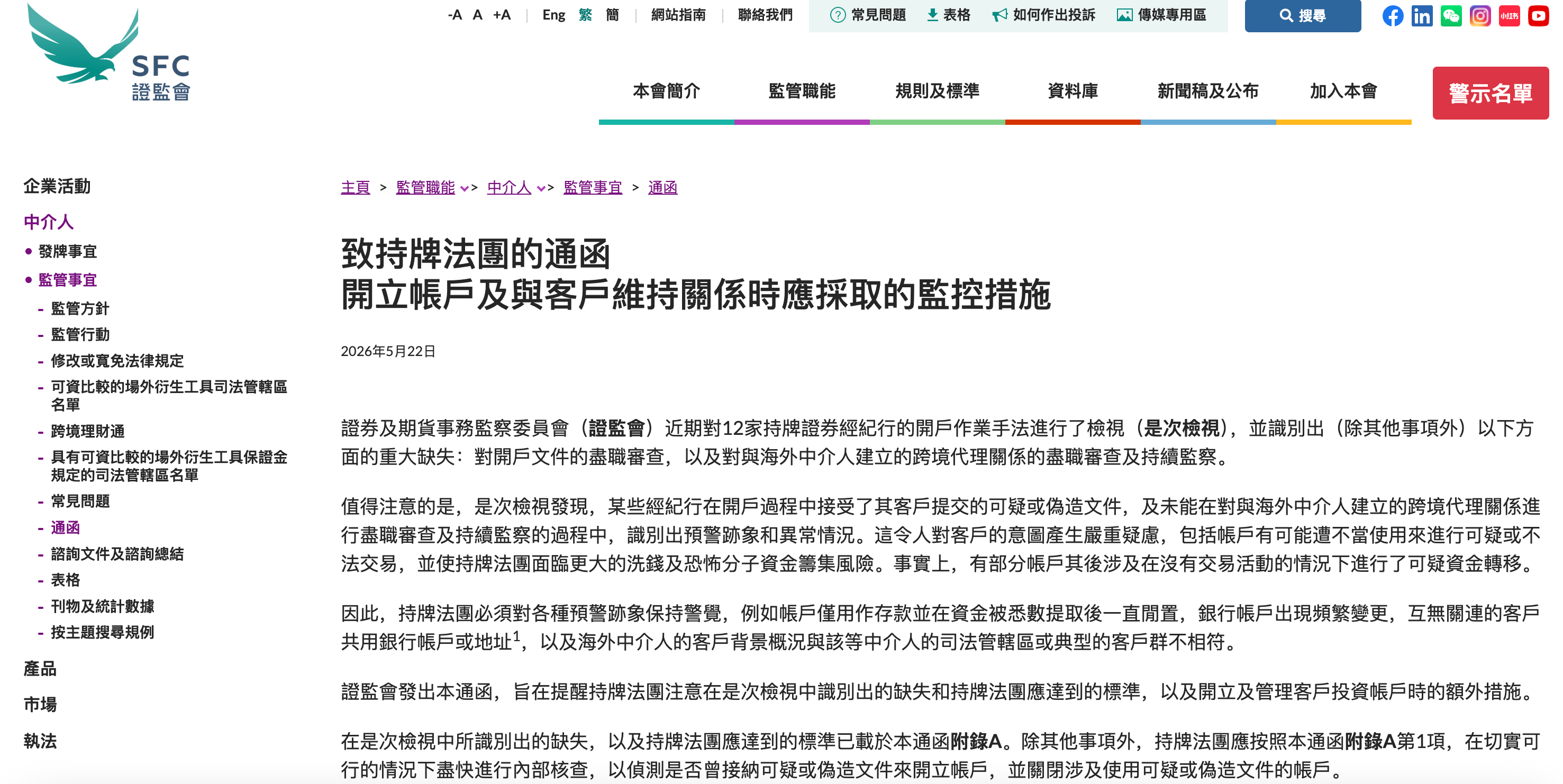
The SFC requires all licensed institutions to conduct immediate self-inspections, close accounts opened with suspicious or forged documents, as well as "dormant accounts" with zero balance and no transactions for 12 months. Senior management has been explicitly named, and those responsible for serious compliance failures may face regulatory and enforcement actions.
Almost simultaneously, the China Securities Regulatory Commission (CSRC), together with eight other ministries (MIIT, MPS, PBoC, SAMR, NFRA, CAC, SAFE), formally issued the "Comprehensive Action Plan to Rectify Illegal Cross-Border Securities, Futures, and Fund Business Activities." The plan includes a 2-year intensive rectification period, during which existing accounts are only allowed to sell and transfer funds out, with no new additions permitted. It also includes administrative penalty notices for illegal securities business activities conducted by entities related to Tiger Brokers, Futu Securities, and Longbridge Securities. The scope, intensity, and determination of this coordinated action are rare in recent financial regulatory history.
Two documents from different regulatory systems, but pointing to the same issue: The model where a large number of mainland investors previously invested in Hong Kong and US stocks through Hong Kong brokerages, which long operated in a legal gray area, has officially come to an end. Regulation this time is serious.
To understand why this action was so decisive, we need to look back at how "wide" this channel had become over the past two to three years.
From 2023 to early 2025, the Hong Kong and US stock markets saw alternating rallies, and a wave of IPO opportunities in Hong Kong emerged, driving a sharp increase in the demand for account openings among mainland investors. At that time, internet brokerages represented by Futu, Tiger, and Longbridge aggressively penetrated the mainland user base, leveraging advantages such as smooth Chinese-language App experiences, low or zero commissions, and support for direct RMB deposits. Some Hong Kong brokerages did not require address proof or did not perform substantive address verification, and even allowed deposits in stablecoins (USDT). Opening an account was almost just a click away.
As early as July 2016, the CSRC issued a risk warning, naming Tiger Brokers and Futu Securities for providing services for trading Hong Kong and US stocks. At the end of 2022, the CSRC launched a special rectification campaign targeting overseas brokerages like Tiger and Futu. However, the effect of the rectification was limited; existing accounts continued to be used normally, and some platforms continued to accept new mainland clients through various workarounds even after the rectification.
This time, the official action left no room for mercy. The policy focus shifted from limiting new business to rectifying existing business; all previous loopholes have been explicitly closed by the regulation.
II. Even with the "Written Declaration" in Hand, Account Opening Still Fails
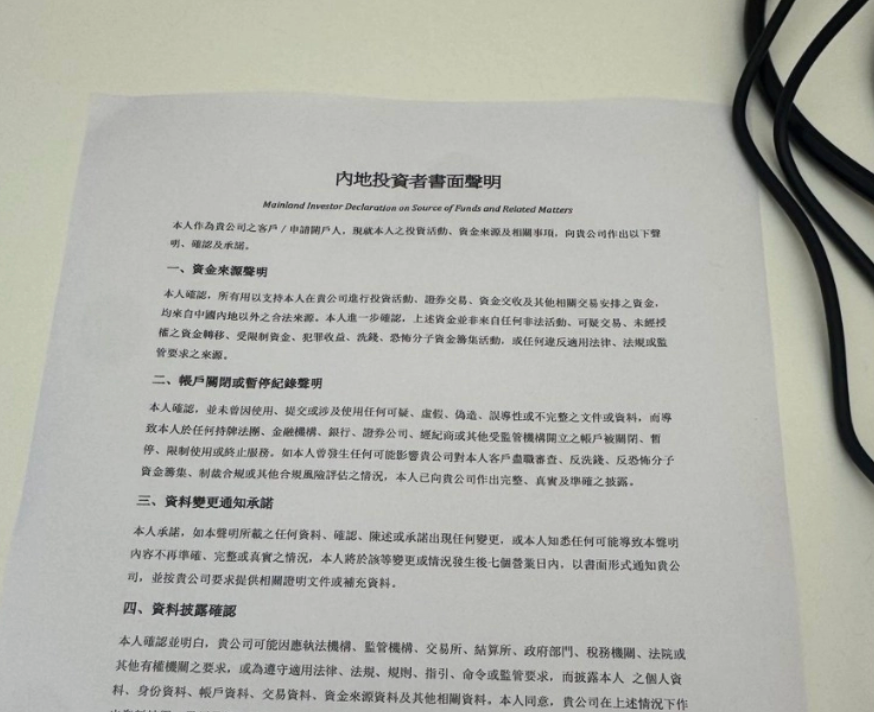
As soon as the new regulations were announced, the quickest movers had already bought tickets and flown to Hong Kong, but account opening did not go smoothly. Over the past week, multiple photos of a document titled "Written Declaration for Mainland Investors" have been circulated on social media, all from mainlanders who personally visited physical branches of Hong Kong brokerages to try to open accounts.
Blogger AB Kuai.Dong described a friend's firsthand experience: The friend made a special trip to Hong Kong to visit the retail branch of UBS Securities (Yingli Securities) to apply for a US and Hong Kong stock account. He was asked to sign the "Written Declaration for Mainland Investors," and after filling out all the materials and waiting for over an hour, he was still told "account opening application failed." Blogger Simon also recorded a similar experience: a friend walked in to open an account, signed the declaration, waited for more than an hour, and ultimately did not pass.
Judging from the declaration texts shared by multiple accounts, the content closely matches the requirements in the annex of the SFC circular, indicating that brokerages have quickly implemented the new rules.
Notably, signing the declaration does not guarantee account opening, but refusing to sign certainly prevents it. Blogger Li Zhi offered a straightforward interpretation: By having clients sign this declaration, brokerages are essentially doing two things: first, shifting compliance responsibility – if something goes wrong, they can say "the client declared the funds were legal"; second, screening clients – since most mainlanders trading Hong Kong and US stocks through Hong Kong brokerages are already in a legal gray area, this declaration requires them to confirm in black and white that their funds come from overseas, creating a barrier in itself.
A report from Caixin on May 27 also confirmed this phenomenon across almost all Hong Kong brokerage account openings: Starting May 26, opening an investment account through bank channels in Hong Kong offline has new requirements for client-provided documents, including signing a declaration on the legal source of funds. A person from a foreign bank in Hong Kong also confirmed to a Caixin reporter that the situation of signing a related new declaration indeed exists.
It is reported that the newly signed document is called the "Cross-border Disclosure Statement (Applicable for Applying for Investment Account Business)." According to documents shown by clients, the core content of the declaration is: The person opening the investment account must confirm that "all funds used to support investment activities and related settlements come from legitimate sources outside Mainland China"; it also requires mainland residents to note that investment account services are only applicable to investors physically present in Hong Kong (e.g., those living or working in Hong Kong), and they should ensure their funding sources are legal and compliant.
The document also clearly states that, to comply with relevant regulatory requirements of the Hong Kong region, the bank may require clients to provide relevant supporting documents. If they fail to do so, the bank may refuse to provide relevant services, and existing services may also be terminated. Notably, this is not limited to new accounts. Customer service from a Chinese-funded bank confirmed to a Caixin reporter that mainland investors who opened investment accounts between May 23 and May 25, 2026, also need to retroactively sign the new cross-border declaration. The policy provided no transition or buffer period.
III. Who Can Still Open Accounts? Review of Existing Compliant Channels
This tightening has directly closed the mainland entry point for major internet brokerages, but not all channels are shut.
Brokerages that have completely stopped accepting new clients from Mainland China: Futu Securities, Tiger Brokers, Longbridge Securities, and Huasheng Securities. These four have all closed their new account opening channels. Some existing accounts can still trade normally for now, but according to regulations, they can only sell, awaiting full divestment after the 2-year transition period ends.
Hong Kong licensed brokerages currently retaining limited channels for mainland residents (as of the article's publication date, the situation is still dynamically changing):
UBS Securities (Yingli Securities) is currently one of the few Hong Kong brokerages still supporting direct account opening for mainland users. It holds Type 1, 4, and 9 licenses from the SFC, and its US subsidiary is registered with the SEC and regulated by FINRA, indicating a relatively sound compliance system. However, based on the latest feedback from social media, since the implementation of the new rules, Yingli Securities has significantly tightened its account opening review for mainland residents. Cases of failed walk-in account opening have increased significantly. Success largely depends on whether the applicant can genuinely meet the condition that "funds come from outside Mainland China."
Fosun Wealth and Chee On Securities are two other options still retaining channels for mainland users.
Some bloggers claimed that, according to the latest news from Fosun, the adjusted account opening policy is: Address proof is no longer required, but applicants must use a VPN or personally go to Hong Kong to apply; users of Hong Kong virtual bank cards like ZA Bank, Tianxing Bank, or HSBC must show their location as Hong Kong during the application. Odaily has verified with Fosun officially, and this account opening policy is a rumor; account opening still requires compliance with the aforementioned rules.
For users with overseas status (students, work visa holders, overseas permanent residents, etc.), the conditions are relatively lenient, but they must also be able to provide proof that funds come from overseas.
Opening an account is only the first step; how to deposit funds is also a core constraint of the new regulations.
The SFC circular explicitly requires that deposits, withdrawals, and settlements for mainland investor accounts can only be conducted through an account opened in the client's own name with a licensed bank in Hong Kong or a qualified jurisdiction. The practice of depositing funds through money changers, friend transfers, or USDT has been explicitly blocked from a compliance perspective.
In practical terms, the prerequisite for successfully depositing funds is holding a Hong Kong local bank account in the client's own name. Hong Kong virtual banks like ZA Bank and Tianxing Bank support FPS (Faster Payment System), allowing normal deposits to brokerage accounts; some brokerages' eDDA fast deposit functions also support linking ZA Bank. Therefore, for users without a Hong Kong bank account, obtaining a Hong Kong bank card before opening a securities account has become an indispensable step in the complete process.
Overall, after May 2026, the compliant paths for ordinary mainland investors to invest in Hong Kong and US stocks have significantly narrowed, but not completely closed. Based on the current situation, a few routes are still viable.
The Safest Path: Compliant Identity, Compliant Fund Channel, and Hong Kong Bank Account. Students, overseas work visa holders, and Hong Kong/Macau residents with overseas supporting documents can still open accounts at licensed brokerages like Yingli, Chee On, and Fosun, provided they meet the "funds from outside Mainland China" condition. Tourists have a higher chance of failure, needing to pay special attention to the source of funds.
Policy-Compliant Channels: Stock Connect, QDII, Cross-boundary Wealth Management Connect. These are the directions regulators clearly aim to guide capital flows towards. Although product ranges are limited and quotas apply, they are fully compliant. Capital from affected mainland investors is expected to gradually shift to these channels.
On-Chain Path: Platforms like Hyperliquid, xStocks offer technical alternatives. For users who meet these platforms' requirements, this is also an option. However, it should be noted that such on-chain products have clear compliance boundaries. Recently, many projects offering Hong Kong stock crypto products have issued clear announcements stating that, in response to Hong Kong's recent new regulations, they will no longer offer such products. Furthermore, most products in this category do not accept registration from Mainland China users, making them more suitable for users living overseas.
Conclusion: Significantly Tightened, but Opportunities Still Exist
This tightening represents a concentrated release of long-accumulated contradictions. The disorderly expansion of Hong Kong brokerages targeting mainland clients over the past few years undoubtedly brought substantial user growth but also created numerous compliance risks, including forged documents, unidentified funding sources, and the abuse of dormant accounts. The synchronized regulatory action from both sides sends a clear signal to the market: The dividend period of this gray channel is over.
For mainland investors who still need to allocate assets to Hong Kong and US stocks, the road ahead will not be easier, but compliant options still exist. Which path to take depends on the individual's identity status, risk tolerance, and personal judgment of compliance boundaries. Regardless, before signing any written declaration, one should be clear: once signed, the legal responsibility falls on oneself.
(Odaily's Note: This article is compiled from the official circular of the Hong Kong Securities and Futures Commission, announcements from the China Securities Regulatory Commission, reports from Caixin, Yicai, and other media, as well as firsthand information from social media. It is for informational purposes only and does not constitute investment advice.)


