






OKX Exchange OS Lets Trading Markets Return from "Centralized Power" to "Everyone's Marketplace"


- Core Viewpoint: Exchange OS, launched by OKX, is a set of open protocol infrastructure designed to delegate the right to "create markets" from centralized platforms to everyone. It allows anyone to freely deploy spot, perpetual, and prediction markets based on on-chain protocols without approval, thereby reshaping the access and power structure of financial markets.
- Key Elements:
- Exchange OS is built on OKX's X Layer, opening up core exchange capabilities such as matching, margin, and settlement as callable protocol layer services - analogous to the "HTTP protocol" for the financial sector.
- The barrier to market creation is significantly lowered: Users only need to stake the core assets of X Layer to deploy spot, perpetual, or prediction markets, without relying on platform approval or building a complete system themselves.
- Unified Account and Capital Reuse: Users can participate in spot, perpetual, and prediction markets simultaneously using a single account and one margin. Funds are managed uniformly at the protocol layer, significantly improving capital efficiency.
- Expanded Market Boundaries: Any verifiable event (e.g., whether a certain L1 can surpass Ethereum) can theoretically become a trading target. The types of markets are determined by real demand, not platform will.
- Funds Secured by Code: User funds are locked in the protocol contract. Deployers (including OKX itself) cannot unilaterally access them, and deployers must stake economic bonds to deter malicious behavior.
Thousands of years ago, markets were inherently peer-to-peer. Two people would meet in a marketplace—one with grain, the other with cloth—and trade after reaching an agreement, without needing anyone's approval. Markets formed spontaneously, with pricing power held by both parties to the transaction.
Later, intermediaries emerged in the markets, and power shifted from every individual stallholder to a few large trading venues. Stock exchanges, commodity exchanges, regulatory bodies, and clearinghouses decided what could be traded and what couldn't, who was qualified to open a market and who wasn't.
After the advent of blockchain, users can trade peer-to-peer, and assets can flow freely on-chain without the need for centralized institutions to provide endorsement. However, the reality is that even on-chain, the question of "who can create a market" is still decided by a handful of platforms and protocols. Want to open a perpetual contract market? You either have to build a matching engine, margin system, and clearing logic from scratch, or submit your market for a platform's approval and listing, thereby ceding pricing power and users.
What OKX announced today with Exchange OS aims to fundamentally change this: give back the right to open a market to everyone.
How Exchange OS Restores Markets
Exchange OS is an open protocol infrastructure built by OKX on X Layer. Matching, margin, clearing, settlement, and unified accounts—these core exchange capabilities that Exchange OS has transformed from closed platform products into protocol-layer services that anyone can invoke. In other words, it's not an exchange itself, but an infrastructure for building any type of exchange.
Let's use a more intuitive analogy to understand this: The role Exchange OS plays in the financial market is akin to the role HTTP plays in the internet world. HTTP opened up communication protocols, allowing anyone to build websites and services without needing to create their own protocols, servers, or routers; Exchange OS provides the same open foundation, allowing anyone to open a market on top of it.
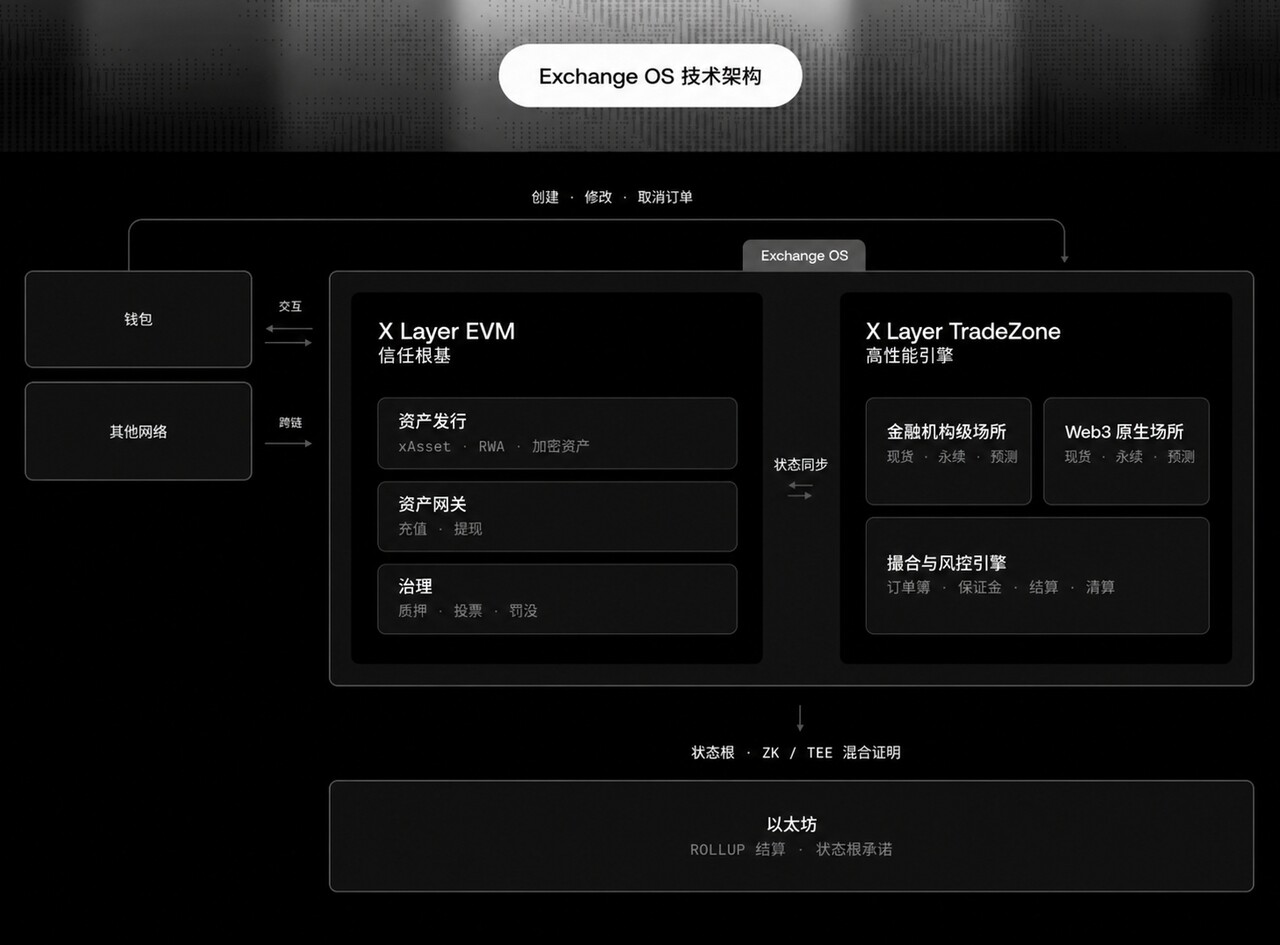
If you want to create a market, you just need to stake X Layer core assets to deploy your own market on Exchange OS, including spot, perpetual contract, and prediction markets. This requires no application to anyone, and no waiting for any platform's approval. All core exchange capabilities, such as the matching engine, margin system, and clearing mechanism, are already built at the protocol layer and are ready for you to use directly. The time and effort saved can be focused on building the market itself.
Those who open markets can be quant teams, RWA institutions, new public chain projects, or any individual user who identifies a trading need and wants to turn it into a real market.
Different deployers can set up different types of markets based on Exchange OS. Some might choose to embed their market within a CEX App, allowing users to access it with one click, offering an experience similar to traditional exchanges. Others might allow users to connect directly with self-custodial wallets, preserving full on-chain sovereignty. Both forms share the same underlying protocol foundation, with consistent rules and infrastructure. Deployers can choose their deployment method based on their judgment of user needs and compliance requirements. OKX only provides the infrastructure and does not preset or endorse any specific compliance model.
One Account for All Markets
For regular users, the most immediate change brought by Exchange OS is a significant improvement in the account experience.
Today, an active on-chain trader often needs to operate across multiple places simultaneously: participating in prediction markets on Polymarket, opening perp contract trades on a DEX, and buying spot assets on an exchange. Accounts are separated, funds are isolated, margins cannot be used across platforms, and whenever a new market launches, they have to redistribute funds into new accounts on the new market.
This experience is somewhat like social platforms without interoperability: you have one set of followers on Weibo, another on X (Twitter), and you have to start all over again on Xiaohongshu (Little Red Book)—every time you switch platforms, you need to re-register, re-set up your profile, and rebuild your network of connections. You're doing the same thing, but putting in several times the effort. This is exactly the problem Web3 social aimed to solve: using on-chain Social Graphs to settle identities and relationships, so one identity and one set of connections work across all platforms. You maintain it once, and it applies everywhere.
Just like Web3 social, Exchange OS is doing the work of "unifying identity and funds" in the trading world. One account and one pool of funds can operate across spot, perpetual contract, and prediction markets, with funds managed uniformly at the protocol layer. You can participate in multiple markets simultaneously without needing to transfer funds back and forth, manage multiple account sets, or re-deposit funds every time a new market launches. You cover all markets with the effort it takes to maintain just one account.
For professional traders, this means a fundamental improvement in capital efficiency. The same pool of funds is no longer fragmented and locked in accounts across different platforms but can serve multiple markets and strategies at the same time. Participating in a prediction market while simultaneously using the same margin to hedge with contracts on the same underlying asset—this level of capital reuse was nearly impossible to achieve before today, but it is natively supported on Exchange OS.
Any Verifiable Event Can Become a Market
For those who want to open markets, Exchange OS offers another possibility.
Imagine a few scenarios: a user focused on crypto-tech who thinks the question "Will a certain L1 surpass Ethereum this year?" deserves a price; an RWA institution wanting to make shares of a private equity fund into tradable on-chain assets; a quant team identifying an arbitrage opportunity in a small altcoin's perpetual contract and wanting to open their own market.
How can they achieve this? Either build an entire system from scratch, a massive undertaking usually affordable only by top-tier institutions, or cooperate with a platform, but platforms have their own review logic, listing cycles, revenue-sharing requirements, and may not be willing to cater to niche markets. The demand exists, but the market cannot materialize.
Exchange OS directly removes this barrier: users can turn trending events into prediction markets, communities can turn topics into tradable judgments, and institutions can turn assets into on-chain markets. Everyone just focuses on what they do best, letting Exchange OS handle the infrastructure.
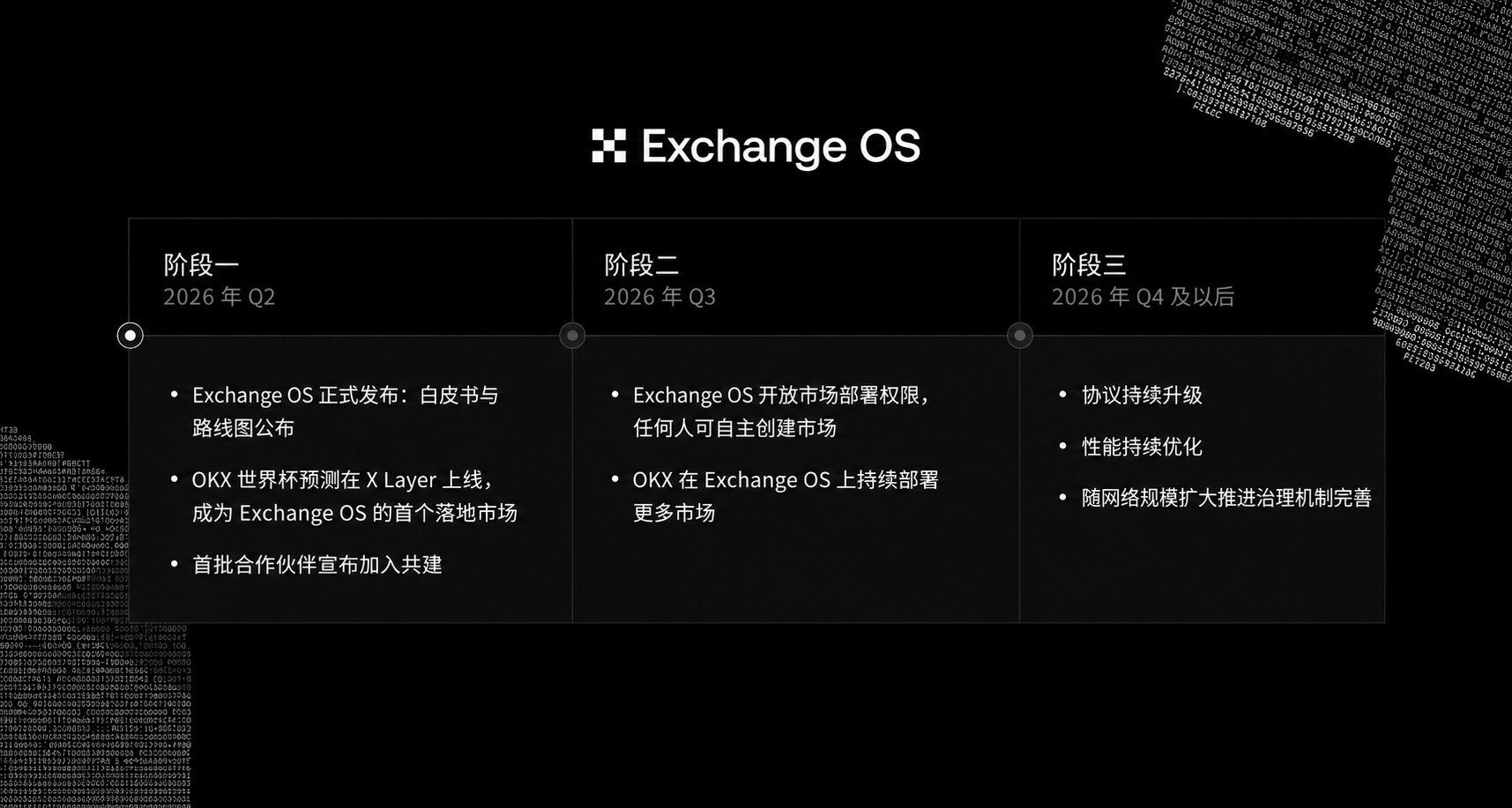 In the past, what could be traded was determined by the platforms. Mainly those few hundred coins, occasionally adding some derivatives, with niche demands often never getting a chance to be listed. Now, as long as an event is verifiable, it can theoretically become a market on Exchange OS. For the first time, the boundaries of markets are not defined by platforms, but by the boundaries of verifiable events in the real world.
The significance for the entire ecosystem is: the number and variety of markets will no longer be constrained by any single platform's operational capacity or willingness, but driven by genuine market demand. Wherever there are people who want to trade, a market can exist there.
Entrusting Fund Security to Code
Any article discussing open markets inevitably addresses the question: "Is it safe?" This question is especially pertinent in the crypto market. Over the past few years, too many platforms have attracted users to deposit assets under the guise of "decentralization," only to abscond with the funds in various ways. Users have come to realize that a platform claiming to be secure and actually being secure are two entirely different things.
Exchange OS's answer to this question is: User funds are locked in protocol smart contracts, and no one can unilaterally move them—this includes the deployers who open the market, as well as OKX itself. This assurance comes not from trusting any institution, but from code and protocol rules. The protocol is open and transparent; anyone can audit every line of logic.
The worst-case scenario is a deployer creating a market of poor quality, not the platform exit-scamming and taking your money. These two risks are fundamentally different in nature: the former is market risk, the latter is trust risk. Exchange OS eliminates the latter.
At the same time, the markets that OKX itself opens on Exchange OS operate under the exact same protocol rules as those opened by any external deployer. OKX has no protocol-level backdoors, no platform privileges, and cannot bypass the rules to give its own markets a green light.
Of course, "anyone can open a market" also necessitates a mechanism to deter malicious behavior. Exchange OS's approach is: to open a market, deployers must stake X Layer core assets. This stake serves as the deployer's economic bond. If a deployer's actions harm user interests, the governance committee can impose penalties on this staked asset, with the severity linked to the level of malicious intent. Opening a market requires cost, and acting maliciously requires cost—this is the economic foundation that allows the entire mechanism to function.
Exchange OS in Historical Context
To understand the significance of Exchange OS, we need to view it along a longer timeline.
Over the past decade-plus in blockchain, there have been several pivotal points that fundamentally altered the power structure. Bitcoin enabled peer-to-peer value transfer, allowing people to transact without banks for the first time. Ethereum allowed anyone to issue assets, turning the ability to "create tokens" from something only institutions could do into something open to everyone. The advent of AMMs allowed anyone to create liquidity pools, bypassing the need for professional market makers. Prediction markets made "events" themselves tradable for the first time, extending market boundaries from asset prices to all verifiable judgments within human society. Each step opened up a power previously held by a few to a larger group.
What Exchange OS aims to do is the next step on this path: allow anyone to create a complete financial market. What was once only possible for top-tier exchanges to build and operate is now a protocol-layer service that anyone can invoke. This is the liberation of the right to create markets. Analogous to the evolution of the internet: In the Web1 era, content was produced by a few websites and institutions; ordinary people could only browse. By Web2, anyone could write articles or start channels; content creation power spread to everyone with technological adoption. Web3 extends this openness to the asset layer—anyone can issue tokens and create liquidity pools, dramatically lowering the barrier to financial participation.
What Exchange OS aims to do is the next step on this evolutionary path: making "opening a market" something anyone can do. If Web3 solved the problem of "who can issue assets," Exchange OS aims to solve the problem of "who can create markets"—which is the form the next generation of financial infrastructure should take.
Thousands of years ago, anyone could set up a market in the town square. Exchange OS is bringing that reality back onto the chain.
Read the Exchange OS Whitepaper and help us build the future of trading markets.


