






Conversation with Arthur Hayes & NEAR Co-founder: HYPE Target Price at $150, NEAR Has 20x Potential?


- Core Viewpoint: Arthur Hayes and Illia Polosukhin believe the crypto market is shifting from speculation to fundamental screening. Macro liquidity (driven by war and the AI arms race) will flow into Bitcoin and a few assets with genuine narratives and revenue, with privacy (e.g., Zcash) and chain abstraction (e.g., NEAR) being the next major themes.
- Key Elements:
- Arthur Hayes believes the war event on February 28 (Iran opening fire) is a catalyst. The US, China, and Europe are printing money for wartime economies and AI capital expenditure, with liquidity eventually flowing into Bitcoin, driving its price higher.
- Arthur Hayes emphasizes that Zcash and Monero represent the demand for private internet money. When big tech and governments can track everything, cryptographic money privacy will become extremely necessary.
- Illia Polosukhin points out that privacy is a prerequisite for mass crypto adoption. For example, daily payments, salaries, and invoices need to remain confidential on-chain. Privacy intents allow anonymous transactions on Zcash and NEAR, generating positive cash flow.
- Illia Polosukhin believes that in the future, AI will become the computing interface, and blockchain will be the execution layer. NEAR has already achieved full dilution, aiming for deflation next year through revenue growth and inflation reduction.
- Arthur Hayes analyzes that Hyperliquid has fixed its tokenomics model (no VC sales, revenue returned to token holders), making it the only price discovery venue on weekends. It could capture more trading volume from centralized exchanges.
Compiled & Translated by: Shenchao TechFlow
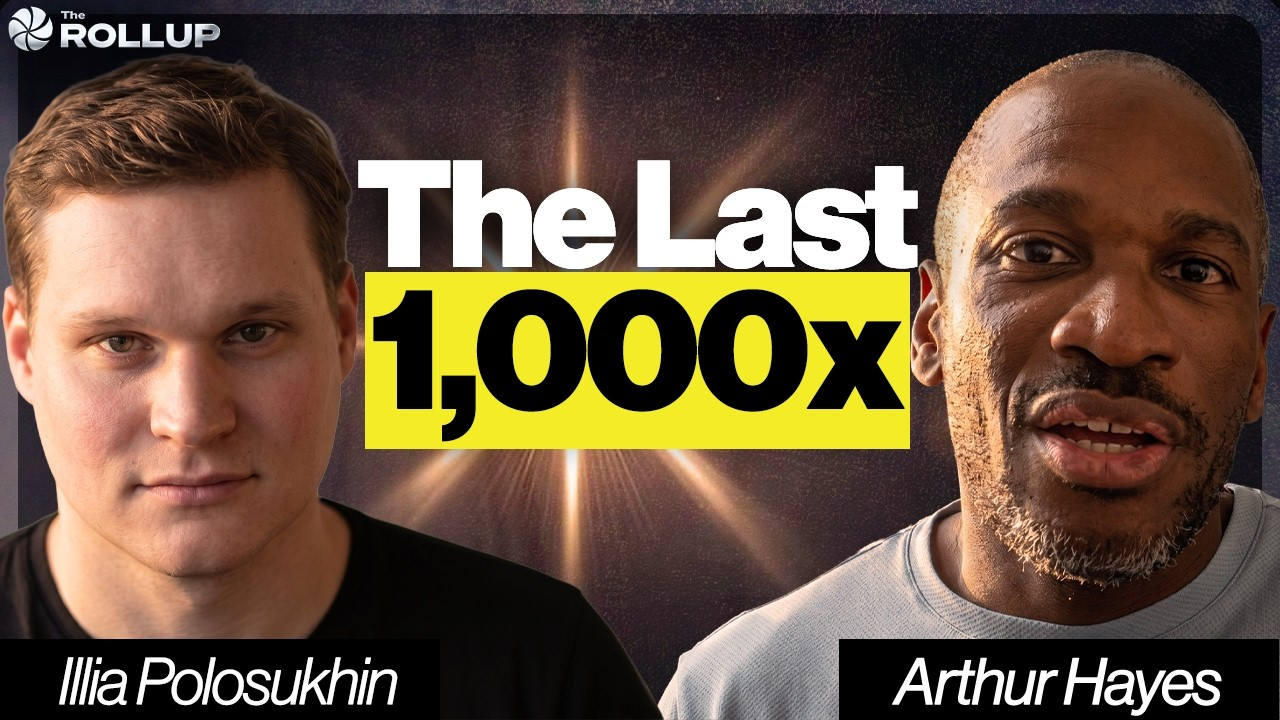
Guests: Arthur Hayes, CIO of Maelstrom; Illia Polosukhin, Co-founder of NEAR
Hosts: Andy; Rob
Podcast Source: The Rollup
Original Title: Arthur Hayes & Illia Polosukhin: Privacy Is The Last 1000x (NEAR & ZEC)
Air Date: May 25, 2026
Key Takeaways
In this episode of The Rollup, Arthur Hayes and Illia Polosukhin discuss macro liquidity, privacy assets, NEAR Intents, AI and on-chain execution layers, and the investment theses behind HYPE, NEAR, and ZEC. Arthur argues that war, the AI arms race, and supply chain restructuring are forcing the US, China, and Europe to continue supporting their economies through debt and monetary expansion, with liquidity eventually spilling over into Bitcoin and select crypto assets possessing genuine narratives and revenue. Illia emphasizes that for blockchain to enter everyday use cases like payments, payroll, invoices, and the AI agent economy, privacy is not optional but a prerequisite for mass adoption. Both agree that the crypto market is transitioning from indiscriminate speculation to a phase of fundamental screening, where privacy, sovereignty, real revenue, and token value capture will become the most important themes moving forward.
Key Insights Summary
Macro Liquidity and the AI Arms Race
- "AI has become part of national defense. Drones, AI intelligence, and battlefield decisions are being integrated into warfare systems, and governments will print money to win wars."
- "Countries previously built their food and energy supply chains on many assumptions, but when critical sea lanes like the Strait of Hormuz become unstable, holding US Treasuries won't help them feed their populations."
- "These savings held in the form of US Treasuries will ultimately need to be sold to purchase real goods, build redundant supply chains, and create energy corridors."
- "The beauty of Bitcoin is that if there are more fiat units tomorrow than today, its price will mathematically go up. It's pure math, but everything else is highly dependent on narrative."
L1 Public Chain Consolidation and the Return to Fundamentals in Crypto Markets
- "Block space has become a very common commodity, with supply far exceeding demand. The only issue was that this commodity was highly non-fungible. NEAR's bet on chain abstraction and Intents is to make it fungible. This means every chain, every asset, and every user can be truly connected without having to think about which block space they are using."
- "The old logic is fading: we buy an asset because a bunch of retail investors will come in and buy it later. Retail risk appetite has decreased significantly. People are more concerned about whether they can afford oil and food next year than whether to speculate on a particular asset."
- "The market is shifting focus to which assets truly generate revenue, have products, and have users."
- "For a Layer 1 blockchain, fully diluted valuation is very important. Many projects have massive institutional unlocks overhanging them, while NEAR already has a relatively clear path ahead."
Zcash and Privacy Assets are Undervalued
- "There is nothing more normal than having private money on the internet. Zcash and Monero represent exactly this need."
- "As Big Tech, governments, and AI become increasingly able to track everything in our lives, cryptographically proven financial privacy will become extremely important."
- "If you hold Zcash but don't hold it in a shielded form, why are you even holding it?"
- "Zcash and NEAR form the core of my privacy investment thesis: in a world coexisting with AI, Big Tech, and Big Government, privacy will be rediscovered by the market, and Maelstrom will profit from it."
- "I think NEAR has 20x potential over the next year, while Zcash might be around 5x."
NEAR Intents, Privacy Transactions, and Mass Adoption
- "If we want blockchain to truly enter everyday life, it can't happen without privacy. Privacy is actually a prerequisite for mass adoption of crypto."
- "If I pay at a coffee shop, I don't want the shop to know how much money I have, nor do I want the whole world to know I just spent money there."
- "Privacy Intents aim to solve not just holding a private asset, but enabling transfers, trades, payments, yields, and more operations to be done confidentially across all assets."
- "Payroll, invoices, and many use cases once thought suitable for crypto are actually very difficult to occur in a fully transparent on-chain environment."
AI Agents and the On-Chain Execution Layer
- "In the future, we will use computing through AI, and blockchain will become the way everything gets executed."
- "AI also needs privacy. You don't want a lab to harvest your data to train a better model and then sell the service back to you via a subscription fee."
- "AI is the new computing interface, and Intents are the business layer behind it."
- "When we started in 2017, our core thesis was that AI would become the way we build software and interact with computing."
Hyperliquid and the Dream of Decentralized Finance
- "What is one of the killer applications of the crypto industry? Exchanges. Who are the richest people in the crypto industry? Exchange owners."
- "The most important thing about Hyperliquid isn't that perpetual swaps or decentralized exchanges are new, but that it got the tokenomics model right."
- "No VC sales, only a team allocation, and nearly all revenue flows back to token holders. This is very rare in a project of this scale."
AI Labor Displacement and Political Risk
- "The impact of AI on labor highly depends on where you live. High-income white-collar workers on the US coasts will be protected, while back-office processing workers overseas will be instantly unemployed, with little concern for their fate."
- "I think the displacement has already begun, but it is also unevenly distributed. The only chance is to stay on the cutting edge. We always say you need to leverage these technologies to improve your own capabilities, learn faster, and apply faster."
- "What might really stop the music is not necessarily a giant IPO, but politics. People will ask: AI companies are getting extremely rich using all of humanity's knowledge and interactions, what do we get?"
- "If a massive progressive tax is imposed on AI profits, it's not that these companies can't make money, but would you still be willing to pay 100x revenue for a company that might be taxed at 50% for AI? Of course not."
Arthur's Macro Investment Thesis
Host Rob: Arthur, you were cautious for a while, warning people about risks, and then you turned fully bullish. What happened in between? What changed?
Arthur Hayes:
Earlier this year, I wrote an article arguing that Bitcoin was preemptively pricing in a credit event triggered by AI deflation. My thesis was that monetary authorities wouldn't print enough money until they saw a financial crisis. My entire argument at the time was that the Nasdaq had been flat since Bitcoin made its all-time high, but Bitcoin was falling along with the US investment-grade bond ETF IGB, from $126k to just over $60k, which I interpreted as a credit event.
Then on February 28th, the US engaged in fire with Iran. The war situation was fully ignited, making the market realize this would become a liquidity-positive event. First, AI is already part of national defense. Drones, AI-powered drones, and AI intelligence systems are already involved in warfare operations for all sides. Governments print money to win wars, and AI is part of war, so both the US and Chinese governments will backstop AI capital expenditures.
We've already started seeing bank loans and equity investments flowing to chip manufacturers. At least in the US, companies like Intel have received support, and similar announcements have been made in quantum computing, like $1 billion towards IBM-related projects. These are all part of the same theme.
On the other side, many countries made many assumptions about their food and energy supplies, assuming they could get them through contested waters like the Strait of Hormuz. But now things are becoming difficult, so they start thinking: why am I holding these US Treasuries? If I need to feed my population, or if I'm on an isolated island without jet fuel, holding US Treasuries doesn't help, especially if my ships can't even get through the strait.
So they need to build redundant supplies of all critical goods, especially food and energy; they need to invest in new trade relationships; they need to build new pipelines to get oil out of the Persian Gulf bypassing it, from places like the UAE. All of this means savings held in the form of US Treasuries need to be sold and exchanged for real goods.
And the US won't allow this selling to cause a market crash. It will print money to fill the hole, ensuring the market doesn't get out of control. So I think February 28th was the catalytic event for the market. The US, China, and Europe will all print money to fund the wartime economy and AI capital expenditures, and that money will ultimately flow into Bitcoin, which is why Bitcoin is performing so well.
Heavy Bets on NEAR, ZEC, and HYPE
Arthur Hayes:
Now we are also seeing a small group of coins starting to rise. Among them are some I hold, like NEAR, HYPE, and Zcash, all of which have performed very well since February 28th. That's my general logic.
In the first quarter, I didn't do much trading. After the war started, I did some more, but essentially, we had already acquired these assets at very good prices much earlier. The market is now beginning to validate why we bought them 6 to 12 months ago.
Host Andy: The whole crypto Twitter is discussing whether this trade has become consensus, but we actually placed heavy bets on it long ago. We've been following the macro and watching your shows and articles on CoinDesk. The market was wavering initially, but then NEAR, HYPE, ZEC suddenly started rising, so everything is coming together in this consolidation phase.
L1 Public Chain Consolidation Has Begun
Host Andy: Illia, I want to hear your thoughts on market consolidation. This isn't your first so-called bear market; we've seen phases like this before, but this time feels more real because the market itself is evolving.
Institutional allocators have entered the fray, the macro environment is highly volatile, forcing people to view this industry with a mindset of "adapt to the institutional era or be left behind." Beyond that, the industry itself is becoming more mature and complex. You need products, revenue, real users, and a truly sustainable, strong tokenomic pathway.
From a founder's perspective, what actually happened in the market over the past 6 to 8 months? Why did it change so fast? And how did NEAR navigate through this phase?
Illia Polosukhin:
I think several threads are converging. Let's start with the Layer 1 and Layer 2 logic. I remember giving a talk in 2019, saying that we would first experience a massive explosion, then enter a consolidation phase, and eventually only a few projects would survive. We are now approaching that phase.
Block space has become a very common commodity, with supply far exceeding demand. The only issue was that this commodity was highly non-fungible. NEAR's bet on chain abstraction and Intents is to make it fungible. This means every chain, every asset, and every user can be truly connected without having to think about which block space they are using.
The second thread is the return to fundamentals. You've been talking about this direction for over a year, maybe even a few years. Now it's actually happening. Both the market and the institutional investors who really analyze it – I'm not talking about BlackRock and Fidelity here, but funds and professional investors – are changing.
The old logic is fading: we buy an asset because a bunch of retail investors will come in and buy it later. Retail risk appetite has decreased significantly. Like Arthur said, people are more concerned about whether they can afford oil and food next year than whether to speculate on a particular asset.
So the market starts asking: which assets truly generate revenue? Which assets provide the products we are using? If I stake it, can I gain new capabilities? For example, staking HYPE gets you lower fees and access to more markets. ZEC has a different logic but provides privacy capabilities. NEAR is similar; it provides capabilities related to cross-chain, intents, and computation.
These are the new capabilities market participants want. So these assets become the focus, unlike tokens that you can hold but struggle to articulate what value they represent before a fee switch is turned on. I believe these two threads are converging and shaping the broader environment of the current crypto market.
Why Arthur Likes Zcash
Host Rob: The industry seems to be entering a state of reorganization. It seems like the folks over at Bankless have parted ways too. David Hoffman sold all his ETH, Merch stopped supporting Solana and went all-in on Zcash. Arthur, why is Zcash and privacy so important to you? Is this the core spirit of the crypto industry? What role do NEAR Intents play here?
Arthur Hayes:
The current hype around Zcash is new, but I remember back in 2016, before the Zcash mainnet launch, it was the hottest thing in the market. I was at BitMEX then, and we listed the first Zcash price derivative. That market was insane back then; the price on Poloniex shot up to around $3,000. If you remember that exchange, there was even a time when 1


