






火币成长学院|加密市场宏观研报:美联储权力交接,债券收益率飙升,流动性拐点或将至


- 核心观点:2026年5月,美联储换帅与全球债市收益率飙涨构成双重宏观压力,叠加ETF资金外流、现货/合约主动抛售及期权对冲需求激增三重抛压,导致比特币从82,000美元暴跌至76,800美元,市场进入宏观压力与机构化进程并存的转折期。
- 关键要素:
- 新任美联储主席沃什主张加速缩表、重新定义通胀目标及弱化前瞻指引,短期抗通胀任务对加密市场构成流动性压力,其上任首月PPI数据爆冷加剧紧缩预期。
- 全球债市同步抛售:美国30年期国债收益率突破5.12%(2007年高点),市场降息概率骤降,加息预期升温,“更高更久”利率叙事打击风险资产。
- 三重抛压共振:ETF连续净流出超15亿美元;现货与永续合约双市场同步主动卖出;期权25-Delta偏度升至14.4%,对冲需求陡增。
- 滞胀风险升温:美国4月CPI升至3.8%、PPI同比暴涨6%,市场预计滞胀概率一个月内从11%跳升至40%,美联储陷入政策两难。
- 机构化进程未中断:Galaxy Digital推进AI算力转型;部分长期持有者趁低积累,交易所比特币净流入达16.8亿美元/周至冷钱包。
- 市场走势推演:区间震荡整固($75,000-$77,000,概率55%)、看涨反弹(宽松信号+地缘缓和,概率25%)、看跌深调(美债收益率超5.2%,概率20%)。
1. Warsh Takes Over: The Fed's Power Transition and Restructuring of Policy Logic
On May 15, 2026, Jerome Powell officially stepped down as Chairman of the Federal Reserve, handing over the reins on his term's end to Kevin Warsh, a Hoover Institution fellow at Stanford University and former Fed governor. Warsh's nomination was confirmed by a Senate vote of 54 in favor to 45 against. This relatively close tally itself signaled that his policy stance would face sustained pressure from various sides. On his first day in office, Wall Street put on a superficial show of "decency" with the Nasdaq Composite rising over 1%, but deep-seated undercurrents of change were already stirring in market pricing.
Warsh's policy agenda revolves around three main directions. First, accelerating the reduction of the Federal Reserve's balance sheet. Currently, the Fed's balance sheet stands at approximately $6.7 trillion. Warsh has been critical of this and advocates for a more aggressive reduction. An accelerated balance sheet runoff would effectively drain liquidity directly from the financial system, pushing up long-term interest rates and tightening the overall monetary environment, putting systemic pressure on risk assets, including crypto assets. Second, redefining the inflation target system. Warsh questions the authority of the 2% numerical target, leaning towards a vaguer description of "price stability." This could mean a higher actual tolerance for inflation, but it also increases policy arbitrariness and makes it harder for the market to predict. Third, downplaying forward guidance and the dot plot. Warsh advocates reducing or eliminating forecasting tools like "forward guidance" and the "dot plot." The goal is to increase the Fed's policy flexibility, but this would also amplify information friction between the market and the central bank, exacerbating short-term volatility.
For the crypto market, Warsh's stance carries a subtle duality. Before being nominated as Fed Chair in January 2026, Warsh publicly stated that Bitcoin is an "important asset" and a "good police officer of policy," showing an overall open attitude towards cryptocurrencies. However, this moderate stance creates a structural conflict with his current urgent tasks: facing a PPI soaring 6% year-over-year in his first month in office, Warsh must prioritize proving his anti-inflation credibility over advancing crypto-friendly policies. Therefore, in the short term, Warsh's anti-inflation task exerts liquidity pressure on the crypto market; in the long term, his attitude towards digital assets could create a more favorable regulatory environment for institutional entry into the crypto market. Balancing the two, the market's short-term focus remains on when the liquidity tightening will finally land, rather than distant regulatory dividends.
2. Bond Market Anomaly: The Alarm of a Global Liquidity Inflection Point
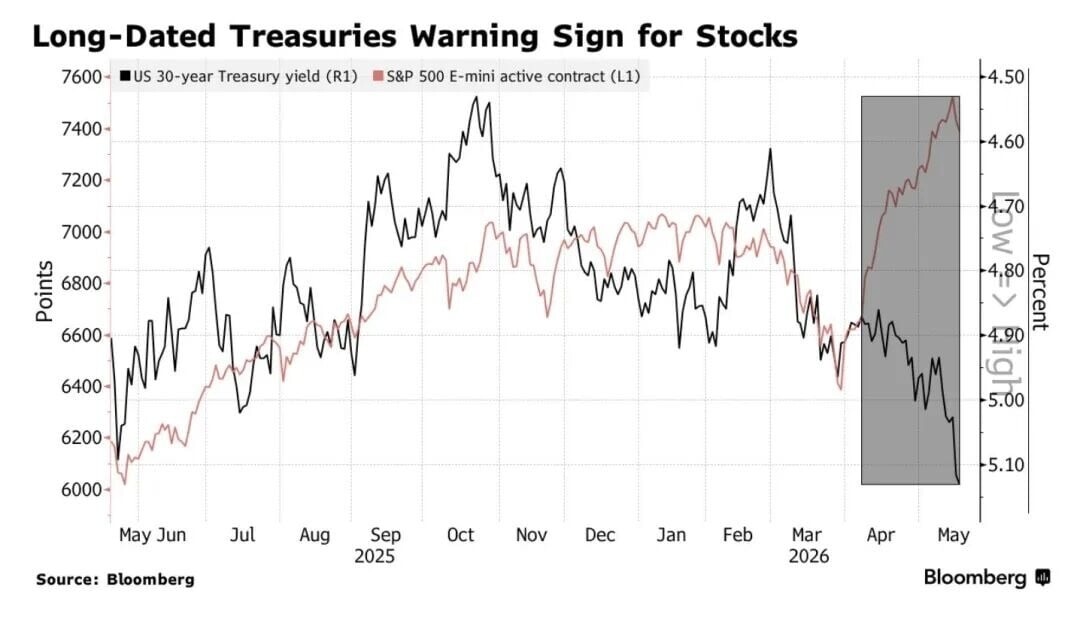
If the change in Fed leadership was merely a matter of expectations, the concurrent anomaly in the bond market represents a more direct and tangible shock to risk assets. In May 2026, the global bond market experienced a rare wave of selling, with government bond yields in multiple countries surging to multi-year or even multi-decade highs. The US 30-year Treasury yield breached the key psychological level of 5% in mid-May, hitting 5.12%, its highest level since 2007; the 10-year US Treasury yield climbed in tandem to 4.63%, a rare high in recent years. Japan's 10-year government bond yield hit a 30-year high of 2.797%, the UK's 30-year yield rose to 5.86%, France's 30-year yield reached 4.675%, and even Germany's 30-year yield, long near negative territory, climbed to 3.704%.
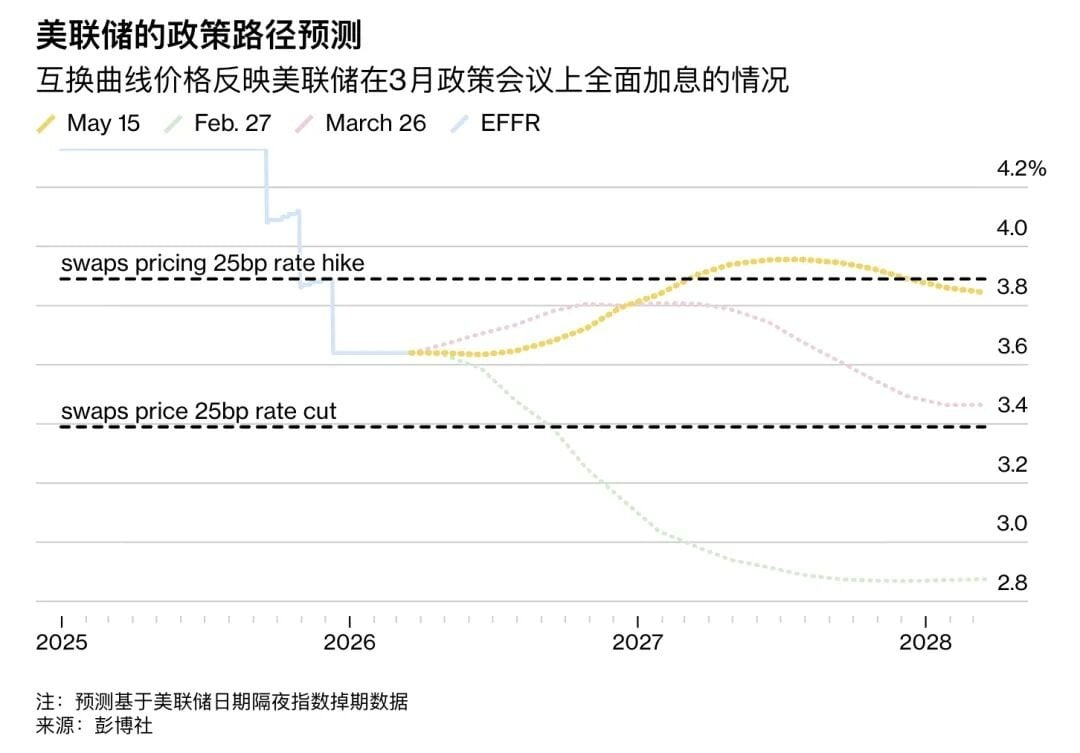
The direct trigger for this global bond sell-off was the shocking US April PPI data. The PPI rose 1.4% month-over-month, far exceeding the market expectation of 0.3%, marking the largest single-month increase since 2022. The year-over-year PPI reached 6%, almost wiping out the Fed's three years of anti-inflation efforts. As a leading indicator for CPI, the spike in PPI made the market realize inflation wasn't falling back to the 2% target as expected, forcing an immediate global repricing of assets. More critically, the market's expected path for rate cuts was completely shattered—before the sell-off, the market generally anticipated two rate cuts in 2026, with the first almost certain in June. After the sell-off, the probability of a June rate cut plummeted to 15%, and expectations for a slight rate hike even emerged, with the probability of a 25 basis point hike by July 2027 rising to 60%. The "Higher for Longer" narrative made a comeback.
The surge in bond yields transmits to the crypto market through several channels. First, rising opportunity cost: higher risk-free rates make non-yielding assets like Bitcoin less attractive compared to cash and short-term Treasuries. Second, declining risk appetite: under the expectation of tightening liquidity, assets with high beta are systematically sold off. Third, a stronger US dollar: rising real interest rates typically coincide with a stronger dollar index, placing additional downward pressure on USD-denominated risk assets. Fourth, the deleveraging accelerator effect: the market had accumulated a large number of leveraged long positions in early May 2026, and margin calls triggered forced selling, creating a cascading waterfall of deleveraging. Data shows that on the day Bitcoin hit a low of $78,704 alone, over $304 million worth of leveraged long positions were liquidated market-wide, including approximately $94 million in Bitcoin longs. This chain of transmission collectively formed the macro foundation for this round of Bitcoin's sharp decline.
3. Bitcoin's Plunge: The Battle to Defend the $76K Key Support Amid a Triple Sell-Off Resonance
In mid-May 2026, Bitcoin experienced a new round of sharp decline since 2026 under the resonance of multiple macro pressures. It fell from around $82,000 to as low as $76,800, a decline of about 6% over the period, wiping out over $304 million in leveraged long positions market-wide. Notably, the uniqueness of this decline lies in the simultaneous appearance of three sell-off signals, making it difficult for market participants to simply attribute it to a technical correction.
The first wave of selling pressure came from the continued withdrawal of institutional funds from ETFs. Since May 7, 2026, US spot Bitcoin ETFs recorded consecutive net outflows, with a single-day outflow of $648 million, the highest since January 29. Cumulative net outflows since May 7 have exceeded $1.5 billion. This scale of institutional capital outflow indicates a fundamental shift in institutional investors' macro pricing logic for Bitcoin—they are no longer viewing it as an asset benefiting from easy monetary policy but are beginning to incorporate it into the pricing framework of traditional risk assets for hedging. ETF outflows are both a result and a cause of the decline: falling prices trigger programmed stop-losses, which in turn exacerbate selling pressure, creating a negative feedback loop.
The second wave of selling pressure originated from simultaneous active selling in the spot and perpetual contract markets. Glassnode data shows the Cumulative Volume Delta (CVD) in the spot market plummeted from +$16.9 million to -$126.2 million, while the CVD in the perpetual contract market recorded a significantly negative value of -$368.5 million. Both turning negative simultaneously means sellers are actively selling in both the spot and futures markets at the same time, rather than being passively liquidated. Historically, this pattern of simultaneous active selling in both markets often corresponds to a more persistent selling cycle because passive liquidation is a one-off event, whereas active selling represents the seller's sustained bearish outlook.
The third wave of selling pressure came from a sharp increase in hedging demand in the options market. The options 25-delta skew quickly rose from 10.9% to 14.4%, reflecting a significant increase in market participants' demand for downside protection. A higher skew indicates stronger relative demand for put options, an instinctive reaction from institutional investors when exposed to systemic risk. Vikram Subburaj, CEO of India's Giottus exchange, pointed out that Bitcoin's first support level is near $76,000, with a secondary support zone between $74,000 and $75,000. A break below this area could trigger a deeper correction. On-chain data shows that the $76,000 to $75,000 range corresponds to the price level before the ETF-driven rally in 2024 and is also a high-volume node for leveraged positions. If this support is lost, technical stop-loss selling could trigger a larger-scale chain reaction.
4. Stagflation Risk Re-emerges: The Dual Dilemma of Sticky Inflation and Slowing Growth
The US April CPI rose 3.8% year-over-year, its highest level since June 2023; PPI surged 6% year-over-year, with a month-over-month increase of 1.4%, the largest since 2022. The probability of stagflation (a stagflationary shock before year-end) jumped from 11% to 40% within a month, and the market's pricing of "stagflation" is rapidly heating up. The terrifying aspect of this data isn't just the numbers themselves, but their deadly compression of the Fed's policy space: traditionally, combating an economic slowdown requires rate cuts, but high inflation prevents the Fed from cutting rates. Combating inflation requires rate hikes, but signs of an economic slowdown limit the room for hikes. The Fed is caught in a "policy dilemma," and the persistence of this dilemma is itself the biggest source of market uncertainty.
The impact of rising stagflation risk on the crypto market is particularly complex. From the perspective of nominal interest rates, high inflation pushes nominal rates up, raising the risk-free return benchmark and increasing the opportunity cost of holding zero-yield assets like Bitcoin. From the perspective of real interest rates, if nominal rates rise less than inflation, real rates could still fall, theoretically providing some support for Bitcoin. However, the unique aspect of this cycle is that the Fed's policy response is significantly lagging—the market has begun repricing for rate hikes, while the Fed is still in the transition period of a new chair. This "policy vacuum" prevents the market from relying on the "Fed put" (the implicit promise of central bank intervention during market crashes), amplifying the magnitude of downside volatility.
Meanwhile, global risk assets are experiencing a synchronous decline. South Korea's KOSPI index fell 6.12% in a single day, triggering a circuit breaker; Japan's Nikkei 225 fell 6.22%; the Nasdaq fell 1.54%; and the Shanghai Composite Index fell 2.5% over two days. This pattern of synchronized cross-market declines indicates that this adjustment is not an isolated event for the crypto market, but a systematic reflection of global liquidity tightening across all risk assets. The bond market "sounded the alarm" for both the AI bull market and the crypto market—when the "safety cushion" of risk-free rates disappears, all high-valuation assets reliant on discounting future cash flows face repricing pressure.
5. Market Structure Observation: Institutionalization Progress and Internal Divergence
Despite the sharp short-term price decline, the institutionalization process of the crypto market has not been interrupted by this adjustment. Galaxy Digital successfully completed the first delivery of its first Bitcoin mining power-related investment product aimed at institutional clients, delivering the first Phase 1 data hall to CoreWeave (CRWV) on time and on budget. This marks a substantive commercial step in the transition of Bitcoin mining infrastructure towards AI/HPC computing power leasing. The continuation of this structural trend suggests that institutional capital is still systematically increasing its allocation to core crypto assets over a longer-term horizon, rather than abandoning its strategy due to short-term volatility.
At the same time, the divergence within the crypto mining camp is also intensifying. Keel Infrastructure (formerly Bitfarms) reported a net loss of $145.4 million in its Q1 2026 earnings, with revenue down 23% year-over-year to $37 million. However, its stock price rose over 8% on the day of the earnings release. The market's focus was not on the losses themselves, but on whether its 2.2 GW AI/HPC data center development pipeline can be converted into formal leases between 2027 and 2028. This narrative of "swapping Bitcoin mining tail assets for long-term AI infrastructure leases" is becoming the most recognized logical theme in the mining transition camp.
On-chain data also shows a divergence of "accumulation amid panic." Despite significant ETF outflows, the net inflow of Bitcoin to exchanges is accelerating, with approximately $1.68 billion per week moving to cold wallets, indicating some long-term holders are accumulating coins at lower prices. Long-term holder supply is stabilizing, and the sell-off of high-cost coins acquired in the $100,000 to $126,000 range is largely complete, suggesting that potential selling pressure has been significantly released. Historically, when the derivatives market is at a bearish extreme (the 30-day funding rate is at the 6th percentile, the lowest since early 2023), it often precedes a sharp rebound rather than a continued decline—because when everyone is already short, the source of additional selling pressure is limited, but any rebound catalyst can trigger massive short covering, providing fuel for a "V-shaped reversal".
6. Conclusion: Three Scenario Projections and an Investment Framework
Looking ahead to the crypto market trends in late May and June 2026, the probabilities and trigger conditions for three scenarios warrant close attention. The most likely scenario is "range-bound consolidation." Bitcoin finds technical support in the $75,000 to $77,000 range, and the market waits for new catalysts while digesting macro headwinds. If bond yields stabilize and the $76,000 support holds, the market could enter a 2-4 week consolidation phase, awaiting the next directional signal. In this scenario, the overall crypto market shows a pattern of "unable to fall further, unable to rally strongly," and alpha opportunities will come more from individual token selection rather than systematic long positioning.
The bullish scenario requires the resonance of two or more positive catalysts: first, the Fed or Warsh sends a clear easing signal (e.g., a dovish stance from the June FOMC meeting); second, a substantial de-escalation in Middle East geopolitical tensions (the Strait of Hormuz issue returns to the negotiating table); third, April inflation data confirms a decline. If all three conditions are met, renewed rate cut expectations could drive Bitcoin to quickly reclaim the $80,000 integer level and potentially challenge the $85,000 to $87,000 range. The probability of the bullish scenario is currently estimated at around 25%, with the main obstacle being that Warsh is unlikely to pivot quickly towards easing in his early tenure.
The bearish scenario is the direction requiring the most caution currently. If the 30-year US Treasury yield continues to climb and effectively breaks through the 5.2% to 5.3% range, rapidly rising risk-free rates could open the door to a decline towards the $74,000 to $75,000 range. A more extreme tail risk involves opening the $54,000 to $38,000 channel (corresponding to Stifel's trendline analysis target), which would mean a complete retracement of the 2025 bull market gains and a significantly prolonged bear market. The bearish scenario currently has a probability of about 20%, but the risk-reward is asymmetrical—once the $74,000 support is lost, programmed stop-losses could trigger a stampede, pushing losses beyond fundamentally justified levels.
In summary, the market is currently in a structural inflection point where "macro stress testing" coexists with "deepening institutionalization." The alarm from the bond market has not been silenced, and the $76,000 to $75,000 support zone faces a severe test. However, against the backdrop of extreme pessimism, continued accumulation by long-term holders, and the evolving narrative of mining transition, market bottom signals are also gradually accumulating. Investors at this stage should maintain portfolio flexibility, avoid aggressive chasing or heavy bottom-fishing, and patiently wait for the macro turning point. When the "Fed put" becomes effective again and bond yields turn lower, a new round of rally in the crypto market will have a more solid macro foundation.


